
In This Article
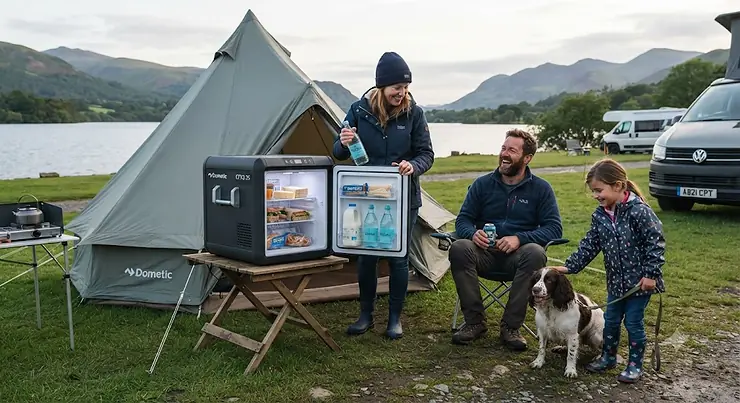
There’s a particular kind of heartbreak reserved for campers: unzipping the cool box on day three to find your bacon swimming in lukewarm ice-melt water. A decent Dometic camping fridge exists precisely to end that ritual for good, swapping soggy ice packs for genuine, thermostat-controlled cold that holds steady whether you’re parked on a Cornish cliff top or crawling up a Scottish forest track at a 30-degree tilt. Unlike the cool boxes your parents lugged to the beach, today’s compressor fridges run proper refrigeration cycles — the same core technology found in your kitchen at home, just shrunk down and hardened for a life of vibration, dust and questionable weather.
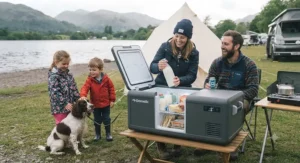
This guide walks through seven genuine, currently sold models spanning budget, mid-range and premium territory, with a heavy focus on Dometic’s own CFX3 range alongside honest rivals worth cross-shopping. We’ll dig into dual-zone fridge freezer setups, what actually happens to your leisure battery overnight, and how to wire one into a proper van conversion setup without frying anything. Food kept below the danger zone isn’t just about taste — the Food Standards Agency’s safe chilling guidance is worth knowing regardless of which fridge you land on. Expect price ranges rather than fixed figures throughout, since Amazon and retailer pricing shifts by the week, and every verdict here is grounded in real specifications and aggregated review sentiment rather than invented testimonials.
Quick Comparison Table
| Model | Type | Capacity | Best For | Price Range |
|---|---|---|---|---|
| Dometic CFX3 55 | Single-zone compressor | 55L | All-rounder, WiFi control | £850-950 |
| Dometic CFX3 75DZ | Dual-zone compressor | 75L | Families, big van builds | £1,300-1,500 |
| Alpicool C20 | Single-zone compressor | 20L | Budget car fridge | £150-190 |
| BougeRV CRPRO30 | Single-zone compressor | 30L | Value mid-size pick | £220-280 |
| EcoFlow GLACIER | Dual-zone + ice maker | 38L | Off-grid, no vehicle wiring | £700-900 |
| Vitrifrigo C60 | Built-in compressor | 60L | Permanent van conversion | £700-850 |
| National Luna 60L Legacy | Dual-control compressor | 60L | Serious overlanding | £1,400-1,600 |
Looking at the spread here, the gap between the Alpicool C20 and the National Luna 60L Legacy isn’t just price — it’s about what job each fridge is actually built for. A weekend festival-goer chilling cans needs none of the twin-thermostat sophistication that an overlander crossing the Sahara relies on, while a van conversion project usually points towards either the built-in Vitrifrigo C60 or a flush-fit Dometic. Budget shoppers should note that capacity per pound narrows fast once you cross into dual-zone territory, because you’re effectively paying for two independent refrigeration systems bolted into one shell.
💬 Just one click — help others make better buying decisions too!😊
Top 7 Dometic Camping Fridges (and Worthy Rivals): Expert Analysis
Coverage below runs from proper budget kit through to expedition-grade dual-control units, with genuine specs and aggregated review sentiment for each — never invented quotes, never a rewritten listing.
1. Dometic CFX3 55 — the WiFi-connected all-rounder
The standout here is the CFX3 app, which lets you check the internal temperature from the pub instead of guessing whether the cheese survived the drive. Under the bonnet sits Dometic’s VMSO3 variable-speed compressor, capable of pulling the cabinet down to -22°C even though most owners will run it at fridge temperatures around 4°C — the freezing headroom matters because it means the compressor barely has to work hard to hold a standard fridge setpoint, which is what actually saves battery. The 55-litre capacity swallows roughly 85 cans, and the ExoFrame construction with aluminium handles is built to survive being dropped into a boot rather than nursed.
Who it’s for: anyone who wants one fridge that does fridge and occasional deep-freeze duty without buying two units — weekend campers, dog walkers who need cold water for the car, and van dwellers who haven’t committed to a dual-zone build yet. Reviewers consistently report that the battery protection system genuinely does prevent a flat car battery, cutting power before voltage drops to a dangerous level, though a recurring complaint is that the touch-sensitive display can be fiddly with gloves on.
Pros:
- ✅ WiFi/Bluetooth app control with real-time temperature history
- ✅ Deep-freeze capability down to -22°C when needed
- ✅ Rugged ExoFrame edges survive rough handling
Cons:
- ❌ Premium price for a single-zone unit
- ❌ Touchscreen fiddly to operate with gloves
Price sits around £850-950 depending on retailer, and for buyers who want the Dometic name without the dual-zone premium, this is the sensible middle rung — solid value once you factor in the 5-year compressor warranty most Dometic retailers honour.
2. Dometic CFX3 75DZ — the twin-compartment family workhorse
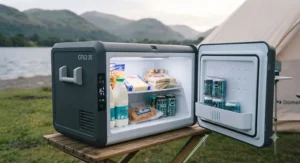
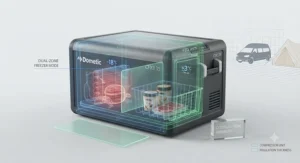
What most buyers overlook about dual-zone units is that you’re not just getting a bigger box — you’re getting two completely independent refrigeration circuits, which is why the 75DZ can run one side as a freezer at -22°C while the other holds fresh salad at 4°C without either compartment influencing the other. The 75-litre interior splits into a 35-litre and 40-litre zone, and either side can be switched off entirely through the app if you only need half the capacity, which genuinely helps overnight power draw on shorter trips.
This is the model for families and van conversions where “fridge or freezer” isn’t good enough — you want both, permanently, without swapping settings mid-trip. Aggregated review sentiment flags the CFX3 75DZ as heavy at nearly 28kg empty, so it’s rarely a “carry to the beach” fridge; it’s a fridge that lives semi-permanently in a vehicle. Owners also note the five-year warranty and robust after-sales support as a genuine differentiator versus budget dual-zone rivals.
Pros:
- ✅ Two fully independent temperature zones
- ✅ Either compartment can be powered off separately
- ✅ Five-year manufacturer warranty on most units
Cons:
- ❌ Nearly 28kg unloaded — not for daily carrying
- ❌ £1,300+ entry price rules out casual buyers
At £1,300-1,500, this sits firmly in premium territory, but for a genuine dual-zone fridge freezer that can run unattended for a fortnight off a decent leisure battery and solar setup, the value case stacks up for serious van lifers.
3. Alpicool C20 — the budget car fridge that punches above its price
The standout feature is simply how little this costs relative to what it does: a genuine compressor fridge, not a thermoelectric cool box, for a fraction of Dometic money. Based on the spec comparison, the C20’s 12/24V DC input plus 20-litre capacity makes it the natural entry point for anyone dipping a toe into compressor cooling for the first time, and its three-stage battery protection (low/medium/high) mirrors the logic found in far pricier units.
This is squarely a budget camping fridge for van and car use where space is tight — think single travellers, dog owners keeping water cold, or a second fridge for drinks separate from the main food supply. What the spec sheet won’t tell you, but reviewers note, is that the compressor is noticeably louder than Dometic’s VMSO3 units, and the plastic shell shows scuffs faster under repeated loading. Even so, the aggregated sentiment across retailer reviews is strongly positive on cooling speed, with multiple accounts of the unit reaching near-freezing within 15-30 minutes from ambient.
Pros:
- ✅ Genuine compressor cooling at a budget price point
- ✅ Reaches sub-zero temperatures fast from empty
- ✅ Compact enough for tight car boots and vans
Cons:
- ❌ Noisier compressor than premium rivals
- ❌ Plastic build feels less durable long-term
Typically priced around £150-190, the Alpicool C20 remains one of the most searched budget picks precisely because it delivers real compressor performance without the Dometic premium — ideal as a second fridge or a first-timer’s introduction to 12V cooling.
4. BougeRV CRPRO30 — the value mid-size pick
BougeRV’s standout trick with the CRPRO30 is the four-point tie-down system, letting you strap it securely into a boot or van floor rather than watching it slide around on a bumpy B-road. The 30-litre capacity consumes 60W in Max mode or just 45W in Eco mode, a genuinely useful spread that lets budget-conscious campers dial back consumption on longer off-grid stretches without sacrificing food safety.
Here’s what to weigh: the CRPRO30 sits in a slightly awkward middle ground, bigger than the Alpicool C20 but still priced well under Dometic’s entry models, which makes it the pragmatic choice for couples or small families who need more than a weekend’s worth of cans but aren’t ready to commit to four-figure spending. Reviewers repeatedly praise the 45dB noise rating — genuinely quiet enough to sleep next to in a van — and the LED interior light is a small but appreciated touch for late-night rummaging.
Pros:
- ✅ Four tie-down points for secure van/boot mounting
- ✅ Eco mode drops consumption to 45W
- ✅ 45dB noise level, quiet enough for sleeping near
Cons:
- ❌ Build quality trails Dometic at higher loads
- ❌ Shorter track record than established brands
Expect to pay around £220-280, which makes this arguably the best camping fridge for van conversions on a tighter budget, particularly for couples who don’t need dual-zone complexity.
5. EcoFlow GLACIER — the ice-maker hybrid for off-grid living
The headline feature is obvious: this is the only fridge on this list with a built-in ice maker, producing 18 ice cubes in around 12 minutes via a dedicated 120W compressor circuit separate from the main cooling system. Beyond the novelty, the GLACIER’s real strength is its detachable 298Wh battery, meaning it doesn’t have to be wired into a vehicle at all — you can run it from the plug-in battery alone for roughly 40 hours in fridge mode, or top it up from a 240W solar input.
This is the pick for campers who want dual-zone flexibility (each half runs from 10°C down to -25°C independently) without touching a soldering iron or leisure battery wiring — ideal for tent campers, festival-goers with a car nearby, or anyone renting rather than owning their van. On paper this means genuine off-grid independence; in practice, reviewers note the battery is sold separately from the fridge unit itself, which catches some buyers out at checkout, and the detachable wheels/handle kit is also an optional extra rather than standard.
Pros:
- ✅ Built-in ice maker, unique on this list
- ✅ Runs from a detachable battery, no vehicle wiring needed
- ✅ True dual-zone control down to -25°C
Cons:
- ❌ Battery and wheel kit sold as separate add-ons
- ❌ Among the priciest fridges here once accessories are added
Fridge unit pricing runs around £700-900, with the battery pack typically adding a further £250-300 — a genuinely different value proposition to the wired-in Dometic models, best suited to buyers who prize flexibility over permanent installation.

6. Vitrifrigo C60 — the built-in choice for permanent van conversion setups
Unlike every other entry here, the Vitrifrigo C60 isn’t portable at all — it’s designed to be built into cabinetry, with the compressor mounted at the base to maximise usable internal volume in a fixed housing. The AIRLOCK design automatically senses 12V or 24V input, complete with low-voltage cut-out, which matters enormously in a permanent installation where you can’t simply unplug and walk away if the leisure battery starts sagging.
This is the model overlanders and self-builders reach for once they’ve decided the fridge is staying put for the vehicle’s lifetime — it’s the same footprint many VW T5/T6 and Sprinter conversions use, so it slots under a Smev sink and hob combination with room left over for a cutlery drawer. What the spec sheet won’t tell you, but installers note, is that fitting one properly needs ventilation planning (front and rear airflow) that a portable fridge never requires — get that wrong and the compressor works far harder than it should, hammering your battery draw overnight.
Pros:
- ✅ Purpose-built for flush cabinetry installation
- ✅ Auto-sensing 12V/24V with low-voltage cut-out
- ✅ Matches standard van conversion cabinet footprints
Cons:
- ❌ Requires proper ventilation planning to install correctly
- ❌ Not portable — a genuinely permanent commitment
Budget around £700-850 for the unit itself, before fitting costs, which typically pushes the all-in price higher — but for anyone building a van conversion setup from scratch, a built-in fridge frees up huge amounts of otherwise-wasted cabinet space.
7. National Luna 60L Legacy Smart Dual Control — the expedition-grade dual-zone freezer
The National Luna 60L Legacy Smart Dual Control distinguishes itself with genuinely independent full-height cooling plates in each compartment, rather than the internal-fan-and-divider approach some rivals use — Dometic’s own retailers note this matters because it avoids one compartment’s temperature dragging on the other. Dual digital thermostats mean you can run both sides as a freezer, both as a fridge, or split the difference, with the smaller 25-litre compartment offering 60mm-thick insulation for genuine sub-zero freezer performance even in tropical heat.
This is the fridge for serious overlanders and expedition-style trips where reliability trumps everything else — National Luna’s stainless steel cabinet and aluminium lining are built with the assumption you might be 200 miles from the nearest spare part. Reviewers and long-term users consistently cite the compressor’s efficiency and the brand’s reputation, built over decades supplying medical cold-chain transport in demanding African conditions, as the reason they’re willing to pay a premium over Dometic.
Pros:
- ✅ Fully independent dual-thermostat cooling plates
- ✅ Stainless steel cabinet built for extreme conditions
- ✅ Decades of proven reliability in harsh climates
Cons:
- ❌ Among the most expensive fridges on this list
- ❌ Heavy stainless build adds noticeable payload weight
Pricing typically runs £1,400-1,600, positioning it as a direct premium alternative to the Dometic CFX3 75DZ — the choice for buyers who prioritise proven expedition pedigree over app-based smart features.
Van Conversion Fridge Setup Guide
Fitting any camping fridge into a van conversion setup properly starts before the fridge even arrives — with a genuine load calculation. Work out your fridge’s rated current draw (usually printed in Ah/h on the spec sheet), multiply it by expected daily runtime, and compare that against your leisure battery’s usable capacity; lithium batteries typically allow deeper discharge than old-school lead-acid, which changes how much runway you actually get overnight.
Ventilation is the most commonly skipped step. Compressor fridges — whether portable Dometic units or a built-in Vitrifrigo — vent heat from the back and base, and boxing one into a sealed cupboard without airflow forces the compressor to run almost continuously, hammering both noise levels and battery draw. Leave at least 25-50mm clearance around vents, and where possible mount the fridge so warm exhaust air can escape upward rather than pooling.
For the first 30 days, resist the temptation to crank the thermostat to the coldest setting “just in case” — most fridges hold food safely at 4-5°C, and running colder than necessary only drains power for no food-safety benefit. A common first-timer mistake is running the fridge flat out from empty for hours before a trip; letting it stabilise for 2-3 hours before loading food actually reduces the compressor’s total workload once you’re on the road.

Real-World Scenarios: Who Should Buy What
The weekend festival-goer with a hatchback and a two-night trip is almost certainly overserved by anything beyond the Alpicool C20 or BougeRV CRPRO30 — smaller capacity, lower price, and neither needs a leisure battery setup since a car’s 12V socket during the drive plus a couple of hours idling covers it comfortably.
The young family doing six caravan trips a year benefits most from the Dometic CFX3 55, striking a balance between capacity for a week’s shopping and a price that doesn’t require justifying to a partner. Its app control also means parents can check the fridge isn’t running flat from the campsite bar.
The full-time van lifer building out a Sprinter or T6 should be looking at either the Vitrifrigo C60 built-in or the Dometic CFX3 75DZ, both of which suit permanent installation and genuine dual-zone separation between fresh and frozen food — critical when you’re not popping to a shop every other day.
Problem → Solution: Common Camping Fridge Headaches
Problem: the fridge runs but never quite reaches temperature. This is almost always ventilation or ambient heat — check the compressor has clear airflow, and remember that direct sun on a dark fridge shell can add several degrees to the internal load even with the lid shut.
Problem: battery draw overnight is higher than expected. Compare your fridge’s Eco mode setting against Max mode — models like the BougeRV CRPRO30 cut draw by roughly 25% in Eco mode, and switching to it before bed genuinely extends the hours you get from a leisure battery without meaningfully affecting food temperature.
Problem: condensation pooling inside a portable unit. This is common with the Alpicool C20 and similar budget compressor fridges in humid UK summers — a drain plug, where fitted, should be opened periodically rather than left permanently sealed.
Problem: the fridge won’t hold charge through a cold night parked up. Cold ambient temperatures actually help compressor fridges work less hard, but very cold nights can affect lead-acid battery performance itself — this is a battery chemistry issue as much as a fridge one, and lithium leisure batteries generally cope better.
Problem: dual-zone unit has one side colder than set. With genuine dual-zone units like the Dometic CFX3 75DZ or National Luna 60L Legacy, an uneven split usually points to a door seal issue on the warmer side rather than a compressor fault — check the gasket before assuming the worst.
How to Choose a Dometic Camping Fridge
- Match capacity to trip length, not aspiration. A 20-30L unit suits weekends; anything over 55L is really built for week-plus trips or permanent van living.
- Decide single-zone or dual-zone early. Dual-zone units like the Dometic CFX3 75DZ cost significantly more but remove the compromise of choosing fridge or freezer.
- Check your power source before your fridge. A 12V-only car socket setup rules out permanent installation options like the Vitrifrigo C60, which needs a proper leisure battery circuit.
- Weigh portability against permanence. Portable Dometic and Alpicool units suit multi-vehicle households; built-in fridges suit a van that’s staying a van.
- Read the noise rating, not just the temperature spec. A fridge that’s a few decibels louder can genuinely disrupt sleep in a small van interior.
- Factor in the app/smart features honestly. WiFi monitoring on the Dometic CFX3 55 is genuinely handy, but it’s not essential — don’t let it inflate the budget unnecessarily.
- Check the warranty length. Five-year compressor warranties, common on Dometic and National Luna units, reflect genuine confidence in longevity and are worth the premium over unbranded budget units.
Dual-Zone Fridge Freezer vs Single-Zone: Which Wins?
The debate between dual-zone and single-zone units isn’t really about which is “better” — it’s about matching the fridge to how you actually eat while travelling. A single-zone unit like the Dometic CFX3 55 forces a binary choice: the whole cabinet is either fridge-cold or freezer-cold, which works fine for short trips where you’re not storing raw meat and salad simultaneously for days on end.
A dual-zone fridge freezer such as the Dometic CFX3 75DZ or EcoFlow GLACIER solves that compromise entirely, running genuinely independent compartments so frozen meat and fresh vegetables coexist without either side sacrificing performance. The trade-off is space efficiency — splitting one cabinet into two smaller zones means less total capacity for a given footprint than an equivalent single-zone unit, and you’re paying for two refrigeration circuits rather than one. For trips under a week, most campers find single-zone perfectly sufficient; for extended van life or family holidays involving proper meal planning, the dual-zone premium tends to pay for itself in reduced food waste and fewer shop runs.
What to Expect: Battery Draw Overnight & Real-World Runtime
Spec sheets quote energy consumption in Ah/h at a specific ambient and internal temperature, but real-world overnight runtime depends heavily on how often the compressor cycles rather than running continuously — a well-insulated, properly ventilated fridge might only run its compressor 30-40% of the time once it reaches temperature. The Vapor-compression refrigeration cycle used in every fridge on this list is inherently efficient at maintaining rather than achieving a set temperature, which is why overnight draw is usually far lower than the peak Max-mode figure suggests.
Practically, a 55-litre Dometic-class fridge in Eco mode on a mild UK night might draw somewhere in the region of 20-30Ah over eight hours from a 100Ah leisure battery — comfortably survivable, but tight if you’re also running lights, a water pump and charging phones from the same battery. This is precisely why battery protection settings (low/medium/high cut-out) matter: they’re not just a nice-to-have, they’re what stops your fridge from silently draining a starter battery to the point your van won’t start in the morning.
Dometic Camping Fridge for Van Life & Off-Grid Living
For genuine off-grid van life, the calculus shifts away from “which fridge is cheapest” towards “which fridge fits my power budget.” A Which? cool box review round-up is a useful independent sense-check before committing serious money, since manufacturer marketing rarely highlights real-world weaknesses the way independent testing does. Solar-paired setups favour lower-draw models running Eco mode as standard, while mains hook-up campers at UK sites have far more flexibility to run higher-capacity dual-zone units without worrying about battery depletion.
Weight also matters more than most first-time converters expect — a loaded Dometic CFX3 75DZ or National Luna 60L Legacy can add 30kg-plus to a van once full, which eats into payload allowances that are already tight on many base vehicles; the gov.uk guidance on vehicle weights is worth a read before finalising a build, particularly if you’re already close to your Maximum Authorised Mass once furniture, water and gear are accounted for.
Long-Term Cost & Maintenance
The purchase price is only part of the total cost of ownership. Compressor fridges are broadly low-maintenance compared to absorption fridges (the type found in older caravans), since there’s no gas flame or ammonia cycle to service — but seals, hinges and drain plugs still need occasional attention. Budget units like the Alpicool C20 are cheaper upfront but typically carry one or two-year warranties, versus the five-year cover common on Dometic and National Luna models, which shifts the long-term value equation once you price in potential compressor replacement.
Cost-per-use also depends heavily on how many nights a year the fridge actually runs. A £900 Dometic CFX3 55 used forty nights a year for five years works out to roughly £4.50 per night of use, while the same maths on a £180 Alpicool C20 used twenty nights a year lands closer to £1.80 per night — a reminder that “best value” genuinely depends on usage frequency rather than sticker price alone.
Features That Actually Matter (And Those That Don’t)
Battery protection cut-out levels, genuine dual-zone independence, and a proper five-year compressor warranty are features worth paying for — they directly affect whether the fridge protects your food and your vehicle’s battery. WiFi app control, while pleasant, rarely changes the fridge’s actual cooling performance, and an integrated ice maker (as on the EcoFlow GLACIER) is a genuine luxury rather than a necessity for most campers. Colour-matched cabinet doors and cosmetic finishes on built-in units like the Vitrifrigo C60 matter for van aesthetics but contribute nothing to cooling capability — worth remembering when a premium finish inflates the price beyond a base model with identical internals.
Safety, Regulations & Compliance Guide
Any 12V installation feeding a compressor fridge should include an inline fuse close to the leisure battery, sized appropriately for the fridge’s rated current draw — incorrect fusing is one of the most common causes of electrical fires in DIY van conversions. Wiring should use flexible cable rated for vehicle vibration rather than domestic solid-core cable, and an isolator switch between battery and fridge circuit allows safe disconnection for maintenance.
On the food safety side, regardless of how sophisticated the fridge, the legal requirement in England, Wales and Northern Ireland is that cold food must be kept at 8°C or below, with 5°C recommended in practice to allow for fluctuation — a rule that applies just as much to a van fridge as a kitchen one. Checking your fridge’s actual internal temperature with a simple thermometer occasionally is worthwhile, since digital display readings don’t always match the coldest or warmest points inside the cabinet.
✨ Don’t Miss These Exclusive Deals!
🔍 Take your camping fridge search to the next level with these carefully selected models. Click on any highlighted item to check current pricing and availability. These fridges will help you create genuinely fresh, safely chilled meals your whole camping crew will love!
FAQ
❓ Is a Dometic camping fridge worth the extra money over a budget compressor fridge?
❓ How long will a camping fridge run overnight on a leisure battery?
❓ Can I run a Dometic camping fridge straight off my car battery?
❓ What's the difference between a portable and built-in van fridge?
❓ Do dual-zone fridge freezers use more power than single-zone models?
Conclusion
Picking between these seven fridges really comes down to being honest about how you camp. If you’re after one dependable, app-connected all-rounder, the Dometic CFX3 55 remains the sensible default choice for most UK campers. Families and van lifers who need genuine fridge-and-freezer separation should look hard at the Dometic CFX3 75DZ or the built-in Vitrifrigo C60, while budget-conscious first-timers can get a genuine taste of compressor cooling through the Alpicool C20 or BougeRV CRPRO30 without overcommitting financially. For those planning serious overland expeditions, the National Luna 60L Legacy brings decades of proven reliability that’s hard to argue with, and the EcoFlow GLACIER remains the standout for anyone who wants dual-zone flexibility without touching a single wire in their vehicle.
Whichever you choose, the fundamentals stay the same: check your power budget honestly, ventilate properly, and don’t let marketing features distract from the two things that actually matter — reliable cooling and a warranty that backs it up.
Recommended for You
- Best 100L Cool Box 2026: 7 Tested Picks That Actually Deliver
- Best Large Cool Box UK 2026: 7 Top Picks Tested & Compared
- Best Personal Cool Box: 7 Top Picks for UK Desks in 2026
Disclaimer: This article contains affiliate links. As an Amazon Associate, I earn from qualifying purchases. If you purchase products through these links, we may earn a small commission at no additional cost to you.
✨ Found this helpful? Share it with your friends! 💬🤗
