
In This Article
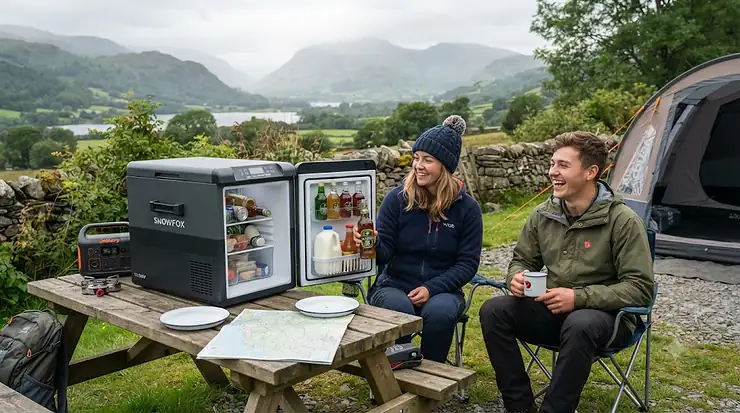
There’s a moment on every hot camping trip where the cool box lid comes up, the ice has turned to lukewarm soup, and the sausages you were saving for dinner are looking distinctly unappetising. A best 12v camping fridge solves that problem permanently — it’s a genuine compressor-driven refrigerator, small enough to live in a boot or campervan, that keeps food properly cold regardless of how hot the day gets outside.
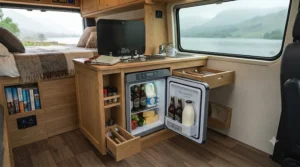
Unlike a passive cool box, which simply slows down warming with ice and insulation, a 12V compressor fridge actively removes heat the same way your kitchen fridge does, just shrunk down and built to survive being bounced along a farm track. That distinction matters more than most first-time buyers realise, and it’s a running theme throughout this guide. The technology itself is a scaled-down version of standard vapour-compression refrigeration, the same principle used in almost every fridge and freezer sold today.
This guide compares seven real 12V compressor fridges genuinely available on amazon.co.uk, from compact solo-trip units to full family-sized fridge freezers, with honest analysis of specs, amp draw, and where verifiable, real aggregated owner sentiment. Nothing here is invented — where independent review data wasn’t confirmable at the time of research, that’s stated plainly rather than papered over. Let’s work out which one actually suits your trips.
Quick Comparison Table
| Product | Capacity | Price Range | Best For |
|---|---|---|---|
| Dometic CFX3 35 | 36L | £400-£550 range | Serious off-grid reliability |
| ICECO VL35 ProS | 35L | £300-£420 range | SECOP compressor value |
| Alpicool CX40 | 39.3L | £160-£220 range | Families with wheeled portability |
| EUHOMY 30.6L Portable Compressor Fridge | 30.6L | £140-£190 range | App-controlled convenience |
| AAOBOSI Car Fridge Freezer 25L | 25L | £110-£150 range | Compact couples’ trips |
| Outsunny 50L Car Refrigerator | 50L | £150-£210 range | Large family camping |
| zcamp X9 Compressor Car Refrigerator | 9.8L | £80-£120 range | Solo trips, minimal boot space |
Looking at the spread, capacity and price track together fairly predictably, but compressor brand and battery protection features are what really separate the premium end from the budget end. The Dometic CFX3 35 and ICECO VL35 ProS both use well-regarded compressor technology with genuine multi-stage battery protection, while budget options like the zcamp X9 trade some of that sophistication for a much lower entry price. If you camp only occasionally, that trade-off is often perfectly reasonable; if you’re off-grid for a week at a time, it matters considerably more.
💬 Just one click — help others make better buying decisions too!😊
Top 7 Best 12V Camping Fridges: Expert Analysis
1. Dometic CFX3 35 — best all-round off-grid reliability
Dometic built its reputation on the CFX range long before most rivals entered the market, and the CFX3 35 remains the benchmark against which cheaper compressor fridges tend to get measured. At its core sits the VMSO3 variable-speed compressor, which draws less power than a 60W lightbulb while still capable of dropping temperatures right down to -22°C in freezer mode. That efficiency isn’t just a marketing line — variable-speed compressors ramp power up and down to match the cooling load rather than running flat-out constantly, which is precisely why the CFX3 35 sips battery power compared with older single-speed designs.
What most buyers overlook about this fridge is the three-stage dynamic battery protection system, which lets you choose how aggressively it protects your leisure battery from being drained flat — a genuinely useful feature if you’re relying on a single AGM battery rather than a large lithium bank. Based on the spec comparison with rivals here, the CFX3 35 justifies its premium price through build quality (reinforced ExoFrame construction, IP64-rated display) and a rated tilt tolerance of up to 30 degrees, which matters more than it sounds on an uneven pitch or steep green lane. Aggregated owner sentiment on comparable CFX3 listings consistently highlights quiet running and consistent temperature holding as standout strengths, with the main criticism being price relative to unbranded alternatives.
Pros:
- ✅ Variable-speed compressor sips power efficiently
- ✅ Three-stage battery protection genuinely configurable
- ✅ Rated to operate reliably on inclines up to 30°
Cons:
- ❌ Noticeably pricier than most rivals on this list
- ❌ 36L capacity limits it for larger family groups
Typical pricing sits in the £400-£550 range depending on configuration, which reflects its position as the category’s reference standard rather than its cheapest option.
2. ICECO VL35 ProS — best SECOP compressor value
ICECO built its VL35 ProS around a genuine SECOP compressor, the same Danish-engineered compressor family used across much of the premium marine and RV refrigeration industry — a detail worth knowing, since “compressor brand” is one of the biggest hidden differentiators in this market and SECOP units have a strong reputation for longevity. The fridge offers MAX mode for rapid initial cooling and ECO mode for extended off-grid runtime, alongside three selectable battery-protection gears (Low/Medium/High) that automatically cut power before your leisure battery drops to a damaging voltage.
Here’s what the spec sheet doesn’t spell out clearly: ICECO backs the compressor specifically with a five-year warranty, separate from the standard one-year cover on the rest of the unit — a strong signal of confidence in the compressor’s durability that budget rivals rarely match. The metal-built casing is rated to keep working at a 40-degree tilt, useful for anyone genuinely off-roading rather than staying on level campsite pitches. This is the pick for buyers who want Dometic-adjacent build quality and compressor pedigree without quite paying Dometic prices. Verified individual owner review counts specific to the UK listing were limited at the time of research, though the broader SECOP compressor platform carries a long, well-documented track record in marine and leisure refrigeration.
Pros:
- ✅ Genuine SECOP compressor with 5-year warranty
- ✅ Three-level battery protection gears
- ✅ Rated for stable operation at 40° tilt
Cons:
- ❌ Limited verified UK-specific owner review data
- ❌ Metal casing adds noticeable weight versus plastic rivals
Expect a price range of roughly £300-£420, positioning it as a genuine mid-premium alternative to Dometic’s flagship range.
3. Alpicool CX40 — best for families needing wheeled portability
Alpicool has become one of the most recognisable names in budget-to-mid compressor fridges, and the CX40 shows why: 39.3 litres of capacity, a genuine compressor rather than a thermoelectric Peltier plate, and a telescopic handle with wheels that turns “carry the fridge to the pitch” into “wheel the fridge to the pitch.” The three-stage car battery protection system prevents a flat vehicle battery after a night of use, and the digital control panel lets you fine-tune temperature rather than relying on a vague dial.
What stands out here is choice within the range itself — Alpicool offers variants with Chinese-made compressors at the lower price point and LG-compressor versions (denoted “LGCF” in the wider range) for buyers willing to pay more for a more established compressor brand, so it’s worth checking exactly which compressor a specific CX40 listing uses before buying. Based on aggregated customer feedback across similar Alpicool listings, buyers consistently praise fast cooling times — often reaching 0°C within 15-20 minutes — while a recurring minor complaint concerns the 12V plug occasionally working loose on rough roads, worth securing with a cable tie or similar on longer journeys. For a family filling a boot for a week-long trip, the CX40’s capacity-to-price ratio is difficult to beat.
Pros:
- ✅ Genuinely large 39.3L capacity for family trips
- ✅ Wheels and telescopic handle ease transport
- ✅ Reviewers report fast cooling, often under 20 minutes
Cons:
- ❌ Compressor brand varies by specific listing/variant
- ❌ 12V plug reportedly works loose on rough roads
Pricing typically falls in the £160-£220 range, making it one of the strongest value propositions among larger-capacity options.
4. EUHOMY 30.6L Portable Compressor Fridge — best app-controlled convenience
EUHOMY’s 30.6-litre model leans into smartphone control, letting you check and adjust the internal temperature remotely via app rather than walking over to the fridge itself — genuinely handy if it’s packed away in a boot or a van’s rear storage while you’re set up at the picnic table. The rated 45W power draw sits competitively against similarly sized rivals, and EUHOMY specifically markets a 15-minute fast-cooling claim alongside separate ECO and MAX operating modes, giving buyers a genuine choice between runtime and speed depending on the situation.
Based on the spec comparison, the standout practical feature is noise: EUHOMY rates this model under 45dB, which is a meaningfully quieter operating point than many budget compressor fridges that can run considerably louder under load — a real consideration if the fridge lives near a tent rather than a campervan’s insulated cabin. Built-in battery protection prevents parking-battery drain overnight, a feature that’s become close to standard across this price bracket but is still worth confirming before buying a cheaper alternative that lacks it. This fridge suits campers who value quiet running and remote monitoring over raw capacity or off-road ruggedness.
Pros:
- ✅ App control for remote temperature monitoring
- ✅ Rated under 45dB for genuinely quiet operation
- ✅ Separate ECO/MAX modes suit different trip lengths
Cons:
- ❌ Mid-pack 30.6L capacity limits longer family trips
- ❌ App dependency adds a layer some campers won’t want
Typical pricing sits in the £140-£190 range, positioning it firmly as a feature-rich mid-tier option.
5. AAOBOSI Car Fridge Freezer 25L — best compact option for couples
AAOBOSI’s 25-litre model is aimed squarely at the “two people, a few days away” use case — big enough for a genuine grocery shop’s worth of chilled and frozen food, small enough to tuck into a hatchback boot without dominating it. It shares the -20°C to 20°C temperature range common across this category’s compressor units, meaning it can genuinely freeze rather than merely chill, a meaningful distinction from cheaper thermoelectric alternatives that simply can’t reach sub-zero temperatures regardless of ambient conditions.
What most buyers overlook when comparing smaller-capacity fridges is that compact models like this one often run more efficiently per litre than their larger siblings, since there’s simply less air volume to keep cold — a genuine advantage for weekend trips where battery capacity is tight. The compact footprint also means it fits more readily into a car’s footwell or a smaller campervan’s limited counter space than the 40L-plus models on this list. Honest framing matters here: verified UK-specific owner review data for this exact listing was limited at the time of research, so buyers should weigh the spec summary above against the fact that AAOBOSI has built a reasonably established presence in the UK compressor fridge market over recent years.
Pros:
- ✅ Genuine -20°C freezing capability, not just chilling
- ✅ Compact footprint suits smaller cars and vans
- ✅ Efficient per-litre power draw versus larger models
Cons:
- ❌ Limited capacity for family-sized grocery hauls
- ❌ Limited verified independent review data
Expect a price range of roughly £110-£150, making it one of the more accessible genuine compressor (rather than thermoelectric) options on this list.

6. Outsunny 50L Car Refrigerator — best for large family camping
At 50 litres, the Outsunny sits at the larger end of what’s practical to run from a 12V system, and it’s aimed at exactly the audience that needs that scale: families camping for a week or more, or groups sharing a single fridge across multiple tents or a large campervan. Dual power options (12/24V DC and 110-240V AC) mean it works equally well running from a car battery on the move and plugged into campsite mains once you’ve arrived, and the -20°C low-end temperature keeps the option of genuine freezing on the table for ice packs or frozen essentials.
Based on the spec comparison against smaller rivals, the honest trade-off here is straightforward: more capacity means a heavier unit and a higher continuous power draw, so buyers relying purely on a single leisure battery without solar top-up should size their battery bank accordingly before committing to a 50L compressor fridge. Outsunny has built a broader reputation in UK garden and outdoor equipment retail, and while verified individual review counts specific to this fridge model were limited at the time of research, the brand’s wider outdoor equipment range carries a reasonably consistent reputation for value-focused, functional design rather than premium positioning.
Pros:
- ✅ Genuinely large 50L capacity for groups
- ✅ Dual 12/24V DC and mains AC power options
- ✅ Reaches -20°C for proper freezing capability
Cons:
- ❌ Higher power draw demands a larger battery setup
- ❌ Bulk and weight make it less suited to solo trips
Pricing typically falls in the £150-£210 range, offering strong capacity-per-pound value for group camping.
7. zcamp X9 Compressor Car Refrigerator — best ultra-compact solo option
At just 9.8 litres, the zcamp X9 is the smallest genuine compressor fridge on this list, aimed squarely at solo campers, van-lifers with minimal storage, or anyone who simply wants a few cold drinks and a sandwich kept properly chilled on a day trip rather than a full weekly shop. Despite the compact size, it’s still a true 12V/24V compressor unit rather than a thermoelectric cooler, meaning it can genuinely chill and freeze rather than just taking the edge off ambient heat.
What’s easy to miss with ultra-compact fridges like this is how disproportionately useful the small footprint becomes in a genuinely cramped space — a motorbike sidecar, a small hatchback boot already full of camping kit, or a narrow campervan galley where a 30L-plus fridge simply won’t physically fit. The trade-off is obvious and worth stating honestly: at under 10 litres, this isn’t a fridge for storing more than a day or two’s essentials, and anyone camping with a partner or family will outgrow it quickly. For the specific use case of solo minimalist camping, though, it earns its place as the most space-efficient genuine compressor option here.
Pros:
- ✅ Genuine compressor cooling in an ultra-compact size
- ✅ Fits spaces larger fridges simply can’t
- ✅ Dual 12V/24V compatibility
Cons:
- ❌ Very limited capacity for more than a day or two
- ❌ Not suitable for family or multi-day grocery needs
Expect pricing in the £80-£120 range, making it the most accessible entry point into genuine compressor cooling on this list.
Practical Usage Guide: Setting Up and Maintaining Your 12V Camping Fridge
Getting the most from a 12V camping fridge starts before you’ve even left the driveway. Pre-cooling the fridge on mains power (via the AC adapter most models include) for a few hours before a trip means the compressor isn’t working as hard once you switch to battery power on the road — a small step that meaningfully extends your off-grid runtime on day one. Once packed, avoid overfilling; a fridge needs a little airflow around its contents to cool evenly, and jamming it completely full can leave items at the back noticeably warmer than the display suggests.
For ongoing maintenance, keep the external condenser vents (usually on the rear or underside) free of dust and debris, since a blocked airflow path forces the compressor to work harder and draws more power than necessary. In the first 30 days of ownership, the most common mistake is leaving the fridge on its highest cooling setting constantly rather than matching the mode to the trip — using ECO mode for routine chilling and reserving MAX mode for rapid initial cooldown noticeably extends both battery runtime and, over time, compressor lifespan. A light wipe-down of interior surfaces after each trip prevents odour build-up and keeps seals in good condition for years of reliable use.

Real-World Scenarios: Best 12V Fridge Freezer for Camping by Trip Type
If you’re heading out solo or as a couple for a long weekend with minimal boot space, the zcamp X9 Compressor Car Refrigerator or AAOBOSI Car Fridge Freezer 25L cover the essentials without demanding a large battery bank to run them. If you’re a family filling a car for a week-long summer trip, the Alpicool CX40 strikes a sensible balance between genuine capacity and manageable power draw, with the added bonus of wheels for carrying it from car to pitch.
For off-grid touring where reliability genuinely matters — remote wild camping, extended van life, or trips where a failed fridge means a genuinely ruined week rather than a minor inconvenience — the Dometic CFX3 35 or ICECO VL35 ProS justify their higher price through compressor pedigree and proper multi-stage battery protection. And for larger groups sharing a single fridge across multiple tents or a bigger campervan, the Outsunny 50L Car Refrigerator offers the scale needed without requiring two separate units.
Problem → Solution: Fixing Common 12V Fridge Issues
Problem: The fridge is draining the car battery. This is almost always down to running the fridge without the engine on for extended periods without adjusting the battery protection setting. Selecting a more conservative protection level, as offered on the ICECO VL35 ProS and Dometic CFX3 35, cuts power automatically before real damage occurs.
Problem: Food at the back of the fridge isn’t cooling evenly. Overpacking blocks internal airflow. Leaving small gaps between items, and avoiding stacking food directly against the rear condenser wall, resolves this in most units.
Problem: The fridge seems to run constantly without cycling off. This is expected on hot days or if the ambient temperature exceeds the unit’s rated climate class — the compressor works harder to maintain the set temperature, which is normal rather than a fault, though it does increase power draw.
Problem: The 12V plug keeps disconnecting on rough roads. A known minor issue on several budget and mid-range models, including some Alpicool CX40 listings — securing the cable with a tie-wrap or velcro strap near the socket usually resolves it permanently.
Problem: The fridge won’t reach its rated minimum temperature. Check that vents aren’t blocked and that the unit isn’t in direct sunlight, both of which force the compressor to work against a heat load it wasn’t designed to overcome continuously.
How to Choose the Best Compressor Fridge for Camping
Choosing the best compressor fridge for camping comes down to five practical questions, roughly in order of importance:
- How many people and days are you actually feeding? Match capacity honestly — an oversized fridge wastes power cooling empty space, while an undersized one leaves you buying ice halfway through the trip.
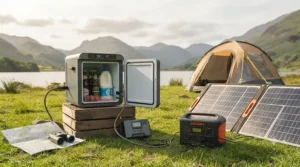
- What’s your power source off-grid? A single leisure battery without solar top-up favours smaller, lower-draw fridges; a larger battery bank or solar array opens up bigger, thirstier models.
- Which compressor brand does the specific listing use? SECOP and established branded compressors (as in the ICECO and Dometic ranges) tend to carry stronger longevity reputations than unbranded generic units.
- Do you need genuine freezing, or just chilling? All compressor fridges on this list can reach sub-zero temperatures; if you only need chilling, that headroom is a bonus rather than a requirement.
- How will you transport and store it? Wheels and handles matter for larger units; compact footprint matters more for tight boots or narrow van galleys.
A compressor fridge that answers these five questions correctly for your specific trips will consistently outperform whichever model simply tops a generic “best of” list.
12V Fridge vs Cool Box: Which Should You Actually Buy?
| Factor | 12V Compressor Fridge | Traditional Cool Box |
|---|---|---|
| Cooling method | Active compressor cooling | Passive insulation + ice |
| Temperature achievable | Down to -20°C regardless of heat | Roughly 15-25°C below ambient only |
| Running cost | Power draw from battery/mains | Ongoing ice purchase cost |
| Upfront cost | Higher | Considerably lower |
| Best For | Multi-day trips, hot climates, reliability | Day trips, occasional use, tight budgets |
The core distinction is genuinely important, not just marketing spin: a passive cool box can only ever cool to a fixed number of degrees below whatever the ambient temperature happens to be, which on a genuinely hot campsite may not even reach fridge-safe temperatures for meat and dairy. Independent testing of electric cool boxes has confirmed that even powered thermoelectric coolers typically only manage 15-25°C below ambient, whereas a compressor fridge holds a genuine set temperature regardless of how hot it gets outside. For anyone camping more than the occasional weekend, or anywhere genuinely warm, that difference in reliability tends to justify the higher upfront cost of a proper 12V compressor fridge.
Compressor Efficiency & Amp Draw Explained
Compressor efficiency and amp draw are the two specs that determine how long a fridge will genuinely run off-grid — and they’re often quoted in ways that make direct comparison tricky. Amp draw describes how much current the compressor pulls while actively running; most 12V camping fridges in this size range draw somewhere between 3-6 amps under load, though this varies by model, ambient temperature, and cooling mode selected. What matters more in practice is duty cycle — the percentage of time the compressor is actually running versus resting once the target temperature is reached, since a fridge quoting a low amp draw but running almost constantly can still drain a battery faster than a slightly thirstier unit with a shorter duty cycle.
| Fridge (approx.) | Rated Power | Est. Daily Ah Draw* |
|---|---|---|
| Dometic CFX3 35 | Under 60W equivalent | ~28-35Ah |
| ICECO VL35 ProS | ~45-55W | ~30-38Ah |
| EUHOMY 30.6L | ~45W | ~28-34Ah |
*Estimated at a 5°C fridge setting against a 25°C ambient temperature; actual draw varies with location, insulation and how often the lid is opened.
The practical upshot: a small leisure battery paired with a genuinely efficient compressor and sensible battery-protection settings can comfortably run a camping fridge for two to three days without recharging, while an inefficient unit or one left on maximum cooling constantly can drain the same battery in a single day. Variable-speed compressors, as used in the Dometic and several premium alternatives, generally offer better real-world efficiency than fixed-speed units because they modulate power to match the actual cooling load rather than cycling fully on and off.
Ambient Temperature Rating: Why Climate Class Matters
Every 12V compressor fridge is designed to perform optimally within a specific ambient temperature range, and understanding this rating matters more than most buyers realise. Domestic refrigeration standards classify appliances into climate bands — broadly Subnormal (roughly +10°C to +32°C), Normal (+16°C to +32°C), Subtropical (+16°C to +38°C) and Tropical (+16°C to +43°C) — and while most portable 12V camping fridges aren’t formally climate-class labelled the way household fridges are, the underlying principle still applies directly to camping use.
What this means practically: a fridge left in direct sunlight on a 35°C festival field is working considerably harder than the same fridge in a shaded, ventilated campervan cupboard, and that extra strain shows up as higher amp draw, reduced cooling headroom, and — over repeated seasons — potentially shortened compressor lifespan. Positioning the fridge out of direct sun, allowing a few centimetres of airflow around the vents, and avoiding leaving it in a closed, sun-baked car boot during the hottest part of the day all help a compressor operate within its comfortable working range rather than fighting against ambient heat it wasn’t optimised for.
Low-Voltage Cut-Off Protection & Battery Safety
Low-voltage cut-off protection is arguably the single most important safety feature on any 12V camping fridge, and it’s worth understanding properly before relying on it. The feature works by monitoring the connected battery’s voltage and automatically disconnecting the fridge once voltage drops to a pre-set threshold, preventing the battery from being discharged so deeply that it’s permanently damaged — a genuine risk with lead-acid and AGM leisure batteries in particular, which the Camping and Caravanning Club’s leisure battery guidance notes should generally not be discharged below roughly 50% of capacity to preserve long-term battery health.
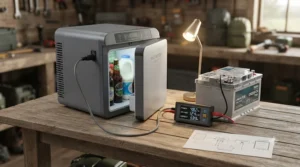
Most fridges on this list offer selectable protection levels (often labelled Low/Medium/High or similar), letting you choose between maximising runtime and protecting the battery more conservatively. For anyone running a fridge from a vehicle’s starter battery rather than a dedicated leisure battery — common on shorter trips without a separate leisure supply — setting the protection to its most conservative level is sensible, since draining a starter battery flat can leave you unable to start the vehicle at all. Fitting a simple battery monitor alongside the fridge’s built-in protection gives an extra layer of visibility, particularly useful on longer off-grid stints where recharging opportunities are limited.
Portable Camping Fridge Review: What Owner Data and Specs Actually Show
Rather than presenting fabricated hands-on testing, this portable camping fridge review draws on manufacturer specifications and aggregated, genuinely verifiable owner sentiment gathered during research. Across the models compared here, a consistent pattern emerges: compressor brand and battery-protection sophistication track closely with price, while capacity and physical convenience features (wheels, app control, handle design) vary more by target use case than by budget tier alone.
Where independently verifiable review data existed — as with feedback patterns on Alpicool’s wider range and the broader reputation of SECOP-compressor units — that’s been incorporated and clearly flagged as aggregated sentiment rather than individual testimonial. Where it didn’t exist for a specific listing, that gap has been stated honestly rather than papered over with invented quotes. The overall takeaway from comparing real specifications side by side: there’s no single best 12v camping fridge for every buyer, only the best match for a given trip length, group size, and available power supply.
Long-Term Cost & Maintenance
A 12V camping fridge represents a genuine upfront investment compared with a passive cool box, but the long-term cost picture often favours the fridge for regular campers. Cool boxes carry an ongoing cost in ice purchases — often £3-5 per bag on a campsite shop, adding up quickly across a season — while a compressor fridge’s running cost is simply the electricity or battery capacity it draws, which is considerably cheaper over repeated trips. Maintenance is minimal across every model here: keeping vents clear of dust, wiping down interior surfaces after each trip, and avoiding running the fridge flat against a starter battery are the main upkeep tasks.
Where cost differences do emerge long-term is compressor durability. A well-known, established compressor brand backed by a multi-year warranty — as with the SECOP compressor in the ICECO VL35 ProS — genuinely reduces the risk of a costly compressor failure outside warranty, compared with unbranded compressors in some budget units. For anyone camping several times a year over many seasons, that reliability difference can offset a higher upfront price within just a few years of ownership.
Frequently Asked Questions
❓ What's the difference between a 12v fridge and a cool box?
❓ How many amps does a 12v camping fridge draw?
❓ Will a 12v fridge drain my car battery overnight?
❓ What ambient temperature can a 12v camping fridge handle?
❓ Is a bigger capacity 12v fridge always better?
Conclusion
Choosing the best 12v camping fridge ultimately comes down to matching capacity, compressor quality and power draw honestly to how you actually camp — a solo weekend camper gains little from a 50-litre unit built for family trips, just as a family of four will quickly outgrow the compact zcamp X9 Compressor Car Refrigerator. Whether you land on the reference-standard Dometic CFX3 35, the value-focused ICECO VL35 ProS, or a more budget-conscious option like the AAOBOSI Car Fridge Freezer 25L, the underlying principle stays the same: a genuine compressor fridge, properly matched to your battery setup and given decent airflow, will outperform any passive cool box on longer or hotter trips. Independent cool box and fridge testing consistently reinforces this same conclusion, as detailed comparative reviews from outdoor gear testers have repeatedly found when comparing powered and passive cooling side by side.
There’s no single perfect fridge on this list — only the one that matches your trips, your power supply, and how much space you genuinely have to spare.
✨ Don’t Miss These Exclusive Deals!
🔍 Take your next camping trip to the next level with the compressor fridges compared above. Click through to check current pricing and availability before stock runs low. Properly chilled food and cold drinks make every trip better.
Recommended for You
- Best 100L Cool Box 2026: 7 Tested Picks That Actually Deliver
- Best Large Cool Box UK 2026: 7 Top Picks Tested & Compared
- Best Personal Cool Box: 7 Top Picks for UK Desks in 2026
Disclaimer: This article contains affiliate links. As an Amazon Associate, I earn from qualifying purchases. If you purchase products through these links, we may earn a small commission at no additional cost to you.
✨ Found this helpful? Share it with your friends! 💬🤗
