
In This Article
Nobody plans a soggy sandwich and a warm can of lager, yet it happens to almost every British camper at least once. You pack the tent, you pack the gas stove, you remember the bottle opener — and then the “cool” box turns into a lukewarm box by lunchtime on day two. That’s usually not bad luck. It’s a box that was never built for the job in the first place.
The best large cool box does one thing brilliantly: it keeps food genuinely cold for as long as your trip actually lasts, not just for the drive to the campsite. That distinction matters more than most product pages let on. A budget box with thin walls might survive a picnic; it won’t survive four days of a Cornish heatwave with the lid opening every twenty minutes. What is a large cool box, in practical terms? It’s an insulated, rigid or semi-rigid container of roughly 45 litres or more, built with thick foam walls and a sealed lid, designed to hold ice or a cooling unit long enough to keep perishable food and drink safely chilled over multiple days rather than hours.
UK summers have also stopped being predictable in the mild, occasional-sunshine way they used to be. The Met Office reported a third heatwave of 2026 pushing southern England into the low 30s Celsius, following record-breaking heat already logged in May and June — which means the gap between “nice weekend” and “your cheese needs proper cooling” has narrowed considerably. This guide draws on real UK product specifications, genuine aggregated review sentiment and honest comparative analysis across seven real cool boxes available through amazon.co.uk, spanning budget wheeled boxes through to premium rotomoulded coolers. There’s an affiliate disclosure at the foot of this article; all opinions here are our own honest assessment based on the research.
We’ll cover exactly how much capacity you actually need in litres versus cans, how many days of ice retention is realistic rather than marketing fluff, what a bear-proof rating actually means for a UK buyer, and which of these seven boxes suits which kind of trip. Let’s get into it.
Quick Comparison Table
Before the deep dive, here’s how the seven boxes stack up at a glance. Ice retention figures are manufacturer claims under favourable conditions (pre-chilled box, block ice, shaded location) rather than guarantees — more on why that matters further down.
| Cool Box | Capacity | Claimed Ice Retention | Price Range | Best For |
|---|---|---|---|---|
| SUNMER 50L Wheeled | 50 litres | Up to 48 hours | Under £60 | Budget family days out |
| Vango Pinnacle 57L | 57 litres | Up to 80 hours | £60-£90 range | British-brand family camping |
| Igloo BMX 52 | 49 litres | Up to 5 days | £70-£100 range | 50-litre all-rounder |
| Coleman Xtreme 70QT | 66 litres | Up to 5 days | £90-£130 range | Extra-large family hauls |
| Dometic Patrol 55 | 54 litres | Multi-day (several days) | £220-£280 range | Rugged long weekends |
| YETI Tundra 65 | 61 litres | Up to 5-7 days | £380-£450 range | Extended trips, bear country |
| Subcold Euro30 | 28 litres | Continuous (mains/12V) | £90-£130 range | Long road trips with power |
Looking at this spread, the pattern is fairly clear: price tracks wall thickness and build quality almost exactly, not marketing claims. The SUNMER 50L Wheeled and Vango Pinnacle 57L compete on capacity-per-pound, while the YETI Tundra 65 and Dometic Patrol 55 justify their premium through rotomoulded construction that simply retains cold for longer under real abuse. The Subcold Euro30 sits apart entirely — it doesn’t rely on ice at all, so “retention” isn’t a relevant metric provided you have power.
💬 Just one click — help other make better buying decisions too!😊
Top 7 Large Cool Boxes: Expert Analysis
We’ve deliberately mixed budget, mid-range and premium options, plus one electric model, because “best” depends entirely on how you actually camp. A weekend festival-goer and a fortnight-long tourer have almost nothing in common when it comes to cool box needs.
1. SUNMER 50L Wheeled Cool Box — best budget option for family days out
The standout here is simple: 50 litres of usable space, wheels, and a sub-£60 price tag, which is hard to find anywhere else on this list. SUNMER 50L Wheeled Cool Box uses EPS foam insulation rather than the thicker PU foam found in premium boxes, which explains its 48-hour claimed retention versus the 5-day figures further up this list. In practice, that 48 hours means genuinely cold contents for a single overnight trip or a full day at the beach, tailing off toward “cool but not cold” by the second morning.
At 5kg empty, this is genuinely one of the lightest large cool boxes around, and the built-in wheels turn a 50-litre box that would otherwise be a two-person carry into a one-person job across grass or sand. Based on the spec comparison, it’s clearly aimed at families who need bulk capacity for a single day rather than serious multi-day cold retention — think a beach day with the extended family, or transporting a full picnic spread to a park, not a week under canvas. Aggregated customer feedback consistently mentions that the wheels and handle make it far easier to manage fully loaded than most rivals in this price bracket, though a handful of reviewers note the lid latch feels flimsier than the shell itself and needs checking before transport.
Pros:
- ✅ Genuinely large 50-litre capacity for the price
- ✅ Wheels make a full box manageable solo
- ✅ Very lightweight at 5kg empty
Cons:
- ❌ EPS insulation trails PU foam on multi-day retention
- ❌ Lid latch reported as less robust than the shell
At under £60, this is difficult to beat as a first large cool box, though anyone planning trips beyond 24 hours should budget-check the next two entries instead.

2. Vango Pinnacle 57L — best British-brand value pick for family camping
What most buyers overlook about British outdoor brands is that they’re often designed and tested specifically for UK weather patterns rather than adapted from a hotter climate. The Vango Pinnacle 57L claims up to 80 hours of ice retention thanks to polyurethane foam insulation throughout the body, a genuine step up from EPS-insulated budget boxes, and its 57-litre capacity holds around 75 standard cans — enough for a family of four over a long weekend without needing a resupply run.
The two-way carry handle and built-in drain tap are the kind of small, practical touches that matter after day two of a trip, when nobody wants to tip a 20kg box over to empty melted ice water. Reviewers on retailer sites report the 57L model performing reliably for three-day breaks, broadly supporting the manufacturer’s 80-hour claim, though as with every passive cool box, performance drops noticeably once the ice itself has fully melted rather than just chilled. A wheeled “Wheelie” version of the same capacity is also available for those who’d rather roll than carry.
Pros:
- ✅ 80-hour claimed retention beats most budget rivals
- ✅ Drain tap avoids the awkward tip-and-spill routine
- ✅ British brand with UK-focused testing and support
Cons:
- ❌ Heavier to carry fully loaded than wheeled alternatives
- ❌ Non-wheeled version needs two hands over rough ground
For a family that camps two or three times a summer and wants dependable mid-range performance without premium pricing, this is one of the more sensible picks on this list.
3. Igloo BMX 52 — best 50-litre all-rounder for ice retention
Igloo’s BMX 52 is the box that keeps coming up whenever anyone searches for a genuinely capable 50 litre cool box, and the spec sheet explains why. Extra-thick Igloo Ultratherm insulated walls and a technology called Cool Riser — essentially a raised interior base that stops contents sitting directly against the melting ice at the bottom — combine for a claimed 5-day ice retention figure at 49 litres of capacity, which is unusually strong performance for the price bracket.
What the spec sheet won’t tell you, but reviewer reports consistently confirm, is that this box performs impressively even under real British weather rather than lab conditions. Aggregated review sentiment is strongly positive on cooling performance specifically: multiple verified buyers describe it holding ice solid across an 8-hour car journey and keeping contents “perfect” for multi-day BBQ events even with frequent lid-opening. A smaller number of reviews flag that the packaging photography doesn’t always match the colourway received, a cosmetic rather than functional complaint. Stainless-steel hardware and reinforced hinges also mean this box should outlast several seasons of being thrown in and out of a boot, and the integrated fish ruler is a genuinely useful bonus for anglers.
Pros:
- ✅ Strong 5-day retention claim well-supported by real reviews
- ✅ Cool Riser base keeps contents off melting ice
- ✅ Stainless-steel hardware built for repeated abuse
Cons:
- ❌ No wheels, so awkward at 49 litres fully loaded
- ❌ Some buyers report colour mismatches on delivery
If your searches keep circling back to “50 litre cool box review” because you want proven multi-day performance without YETI-level pricing, this is the box most worth your attention.
4. Coleman Xtreme 70QT — best extra-large option for bigger hauls
At 66 litres, the Coleman Xtreme 70QT is genuinely the largest passive box on this list bar the Tundra, and it’s built around a simple premise: thick premium PU full-foam insulation in both the lid and the body, which Coleman rates for up to 5 days of ice retention. That lid insulation detail matters more than it sounds — heat gain through a thin lid is one of the most common reasons cheaper large boxes underperform their body-only insulation claims.
Based on the spec comparison against rivals of similar size, the Xtreme 70QT earns its “extreme” branding through capacity rather than premium materials; HDPE construction throughout keeps the price in the mid-range while still supporting a genuinely huge 66-litre payload, described by the manufacturer as holding around 100 cans. The reinforced Have-A-Seat lid rated to 113kg is a practical bonus at a busy campsite short on chairs, and the no-tilt drain valve avoids the common annoyance of having to lift a heavy, water-filled box to empty it. For anyone specifically hunting an extra large cool box review before a big family trip or multi-tent group booking, this is the volume-per-pound leader here.
Pros:
- ✅ Genuinely huge 66-litre capacity for around 100 cans
- ✅ Insulated lid, not just body, supports the 5-day claim
- ✅ No-tilt drain avoids lifting a full, heavy box
Cons:
- ❌ Bulky to store and transport when empty
- ❌ Heavier than mid-sized boxes even before loading
This is the pick for larger groups or families who’d rather pack once for four days than run repeat supermarket trips.
5. Dometic Patrol 55 — best rugged mid-premium pick for longer trips
The Dometic Patrol 55 sits in an interesting middle ground: rotomoulded, one-piece polyethylene construction — the same manufacturing process used for whitewater kayaks — at roughly half the price of the YETI further down this list. That one-piece build eliminates the seams and joints where cheaper blow-moulded boxes can lose structural integrity over time, and Dometic’s deep-freeze lid seal with a labyrinth design is specifically engineered to stop the slow air leakage that undermines many “5-day” claims on paper.
Here’s what to weigh if you’re deciding between this and a budget box: the Patrol 55’s thick PU insulation is genuinely built for multi-day performance rather than a marketing number, and the one-handed rubber latch system is a small but meaningful convenience improvement when you’re juggling a cool box, a folding chair and a toddler simultaneously. Dometic backs the range with a notably long 7-year limited warranty, a signal of confidence in the rotomoulded build that budget alternatives simply can’t match. The trade-off is weight — a rotomoulded shell this thick is heavier empty than a blow-moulded equivalent — and the accessory dock (cup holder, bottle opener, fishing rod holder) is sold separately rather than included.
Pros:
- ✅ One-piece rotomoulded build outlasts blow-moulded rivals
- ✅ Labyrinth lid seal genuinely reduces air leakage
- ✅ Backed by a 7-year limited warranty
Cons:
- ❌ Heavy even before you add ice and food
- ❌ Accessory dock extras cost more on top
For anyone whose trips regularly run four days or more and who wants YETI-adjacent durability without the full YETI price tag, the Patrol 55 is a genuinely strong middle option.
6. YETI Tundra 65 — best premium extra-large pick with a bear-resistant rating
If there’s one name that comes up unprompted in almost every UK cool box conversation, it’s this one. The YETI Tundra 65 combines rotomoulded FatWall construction — up to three inches of polyurethane foam insulation — with a PermaFrost core and ColdLock gasket seal, and the brand’s own testing and aggregated field reports point to genuine 5-to-7-day ice retention in favourable conditions, which is the strongest claim on this entire list.
The detail that separates this box from every other entry here is its IGBC bear-resistant certification. When locked with an extra-long-shank padlock, the Tundra 65 has passed live testing by the Interagency Grizzly Bear Committee (more on exactly what that certification involves further down this guide) — genuinely relevant for anyone touring in bear country abroad, and a useful shorthand in the UK for “built to a standard well beyond a standard high-street cool box,” even though there’s obviously no wild grizzly risk here. Reviewers consistently note the NeverFail hinge system and T-Rex latches feel dramatically more robust than anything else in this guide, and the lid genuinely doubles as a stable seat or standing platform. The honest downside is cost: at roughly four to five times the price of the Igloo BMX 52 for broadly similar usable capacity, this is a considered purchase rather than an impulse one, and the weight (over 13kg empty) means it isn’t the box you casually carry to a park bench.
Pros:
- ✅ Strongest ice retention claim of any box here
- ✅ IGBC bear-resistant certification when locked
- ✅ Five-year warranty and genuinely rugged construction
Cons:
- ❌ Premium price, several times a budget rival’s cost
- ❌ Heavy even before loading, awkward for solo carrying
For serious multi-day touring, fishing trips, or anyone who simply wants gear that will realistically outlast a decade of summers, the Tundra 65 earns its reputation, even if it’s overkill for a single beach afternoon.
7. Subcold Euro30 — best electric option for long trips with access to power
Every box above relies on ice, which means every box above is fundamentally limited by how much ice you can carry and how quickly it melts. The Subcold Euro30 sidesteps that problem entirely using thermoelectric cooling technology, drawing power from either a 12V car socket or a 230V mains supply to cool its 28-litre interior to 15-20°C below the surrounding ambient temperature.
For a genuinely long trip — a week-long tour with campsite hook-ups, or a road trip with regular driving between stops — this changes the maths completely: there’s no ice to buy, no melting to manage, and no daily supermarket run for top-up bags. Reviewers frequently mention using the Euro30 as a genuine second fridge at a campsite pitch with electric hook-up, appreciating both the quiet 26dB operation and the reversible hot/cold function for keeping cooked food warm on the return leg. The honest limitation, confirmed by independent testing bodies, is that thermoelectric units cool relative to ambient temperature rather than to a fixed target, so on the very hottest UK days performance tails off compared with a well-packed ice box, and you’re entirely dependent on having power available. At 28 litres it’s also the smallest-capacity box on this list, better suited to a couple or small family than a large group.
Pros:
- ✅ No ice needed, ever, given access to power
- ✅ Dual 12V and mains power for car and campsite
- ✅ Quiet 26dB operation and a reversible warm setting
Cons:
- ❌ Smallest capacity of the seven, at 28 litres
- ❌ Performance depends entirely on ambient temperature and power access
If your idea of a long trip involves plug sockets rather than wilderness, this is the most genuinely low-maintenance option here by a wide margin.
How to Choose the Best Large Cool Box
Reduced to its essentials, choosing between these seven options comes down to five decision points, in roughly this order of importance:
- Trip length first, capacity second. A weekend needs less ice retention than a fortnight, regardless of how big the box is — a 5-day claim on a 2-day trip is wasted spend.
- Match litres to your actual group size, not the marketing capacity — see the next section for real numbers rather than can-counting theory.
- Decide passive versus electric early. If you’ll have consistent power access, the Subcold Euro30’s no-ice convenience often beats a bigger passive box outright.
- Weigh portability against insulation thickness. Thicker walls mean better retention but also more weight — wheels matter more than they seem to until you’re carrying a full 60-litre box across a festival field.
- Check the warranty length as a proxy for build confidence. Dometic’s 7-year and YETI’s 5-year cover reflect genuine rotomoulded durability; shorter warranties usually track thinner walls.
Capacity in Litres vs Cans: What You Actually Need
What does cool box capacity in litres actually mean in cans? As a rough working rule, one standard 330ml can occupies roughly 0.4-0.5 litres of usable interior space once you account for the shape of a cylindrical can inside a rectangular box, so a 50-litre box realistically holds 80-100 cans if packed with cans alone and no ice.
That number changes dramatically the moment ice enters the equation, which is the detail most product listings gloss over. Cooling manufacturers generally recommend a 2:1 ice-to-contents ratio by volume for genuinely maximised retention, meaning a 50-litre box packed properly for multi-day performance might only hold 30-35 cans plus food once ice is factored in — not the 80-100 the headline capacity implies. This is exactly why the Vango Pinnacle 32L cool boxes are marketed at “46 cans,” a figure that assumes no ice packs at all; real-world capacity with two or three large ice packs and some food items realistically drops to around 25-30 cans.
The practical takeaway: when comparing capacity across the seven boxes above, mentally halve the manufacturer’s can figure if you’re planning a multi-day trip with proper ice packing, and treat the full figure as accurate only for short day-trip use where minimal ice is needed. This is one of the most common reasons people feel a “large” cool box is somehow too small on a camping trip — the box wasn’t undersized, the ice allocation simply wasn’t factored into the mental maths.
| Capacity | Cans (no ice, packed tight) | Realistic Cans (with 2:1 ice ratio) | Suits |
|---|---|---|---|
| 28-32 litres | 40-46 cans | 20-25 cans + food | Solo or couple, short trips |
| 45-55 litres | 75-90 cans | 30-40 cans + food | Family of 4, weekend to long weekend |
| 60-70 litres | 95-110 cans | 45-55 cans + food | Larger families, multi-day group trips |
The pattern here reinforces why the Coleman Xtreme 70QT and YETI Tundra 65 are positioned as multi-day, larger-group options above — their headline capacity only really pays off once ice is properly accounted for, whereas a smaller box like the Subcold Euro30 doesn’t need to sacrifice any interior space to ice at all, since it cools electrically.
Ice Retention Explained: How Many Days Can You Really Expect?
Every cool box on the market states an ice retention figure, and almost none of those figures come from a shared, independently regulated test standard. Even YETI’s own guidance is candid that headline claims quoting a definite number of days are usually derived from specific, favourable lab-style testing conditions rather than guaranteed real-life outcomes, because so many variables affect the result: ice quality, ice quantity, ambient temperature, direct sunlight exposure and — critically — how often the lid gets opened.
In practice, that means the “5-day” figures quoted for the Igloo BMX 52, Coleman Xtreme 70QT and Dometic Patrol 55 above should be read as best-case performance achieved with a fully pre-chilled box, dense block ice rather than loose cubes, minimal lid-opening and a shaded spot — not a guarantee for a box baking in direct July sun with kids diving in for drinks every ten minutes. Reviewer reports across all three of those boxes broadly support multi-day performance in real UK conditions, which is reassuring, but real-world retention regularly runs a day or two shorter than the marketing claim once normal usage patterns are factored in.
Four things reliably improve real-world ice retention regardless of which box you buy: pre-chilling the box itself the night before (not just the contents), using dense block ice rather than loose cubes wherever possible, keeping the box shaded and closed as much as practically possible, and packing to the recommended 2:1 ice ratio rather than skimping to fit more drinks in. Get those four right and even a mid-range box like the Vango Pinnacle can meaningfully outperform its own claimed figure; get them wrong and even a YETI Tundra will underperform its reputation.
Bear-Proof Ratings and Wildlife-Safe Cool Boxes
“Bear-proof rating” is a specific, testable certification rather than a marketing adjective, and it’s worth understanding properly even for UK buyers who’ll obviously never encounter a wild grizzly on a Peak District weekend. The certification in question comes from the Interagency Grizzly Bear Committee, which tests commercially available products using captive grizzly bears and issues certification only to products that either pass a live bear test or meet an equivalent technical evaluation.
Crucially, the IGBC itself is clear that certification is not an absolute guarantee. The committee is explicit that certification does not guarantee a product is fully bear-proof, nor that a container will never be breached — and a certified cooler left unlocked isn’t considered bear-resistant at all. Among the seven boxes reviewed here, the YETI Tundra 65 is the one built to this standard, achieving certification when properly secured with an extra-long-shank padlock through its rubber T-Rex latches.
For most UK buyers, this rating matters less as a practical wildlife feature and more as a genuinely useful proxy for overall build toughness: a box engineered to withstand a determined 400kg grizzly bear is, unsurprisingly, also engineered to survive being dropped from a car boot, sat on by an enthusiastic teenager, or left out in torrential Welsh rain. If you’re specifically touring in North America or genuinely camping in bear country, always check a box against the current IGBC certified products list rather than relying on manufacturer marketing language alone, since “bear-resistant” branding without an actual certification number carries no formal backing whatsoever.
✨ Don’t Miss These Exclusive Deals!
🔍 Take your camping kit to the next level with the picks in this guide. Click through on any highlighted model to check current pricing and availability, and pack cold, confident, and ready for whatever British weather throws at you this summer!
Large Cool Box vs Cool Bag: Which Should You Buy?
The size, cooling-type and feature differences between a rigid cool box and a soft cool bag are more than cosmetic, and getting this choice wrong is one of the most common reasons people feel underwhelmed by whichever one they bought. According to independent consumer testing from Which?, cool boxes come in larger capacities than cool bags, which typically max out around 50 litres, and cool boxes more often include practical extras such as drainage valves and drink taps that cool bags rarely offer.
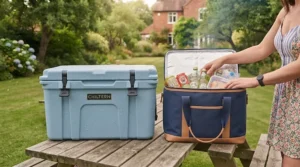
The rule of thumb worth internalising: choose a cool bag for short walks, single-day picnics and situations where you’ll carry it any real distance by hand, and choose a rigid box like the seven featured here for camping trips, festivals, and multi-day parties where sustained cold retention and bulk capacity matter more than portability. A cool bag genuinely cannot match a thick-walled hard box on retention, because there’s simply less room for insulating material in a flexible fabric shell — that’s physics, not marketing spin. Conversely, lugging a 60-litre hard box on a two-mile coastal walk is a decision you’ll regret by the first headland.
Where the two genuinely overlap is car-based day trips: if the box never leaves the boot until you park up, a hard box’s superior retention wins outright with none of the portability downside. It’s only once you need to physically carry the thing any distance that a soft cool bag starts to make more practical sense, even at the cost of retention performance.
Common Mistakes When Buying a Large Cool Box
Even careful buyers tend to repeat the same handful of errors, and most of them cost more in disappointment than in cash.
Sizing purely by manufacturer capacity without accounting for the ice ratio is the single most frequent mistake, and it’s exactly why the capacity table earlier in this guide exists — a “60-can” box genuinely holding 30 cans plus ice feels like false advertising to a first-time buyer who hasn’t accounted for the maths. A close second is prioritising ice retention days over realistic trip length: paying YETI-level money for a 7-day claim when your longest trip of the year is a 3-day festival means paying for capability you’ll rarely use.
Ignoring weight when empty is another recurring regret, particularly with rotomoulded boxes like the Dometic Patrol and YETI Tundra — a box that’s genuinely brilliant once positioned at the campsite can be a real struggle to carry there fully assembled if there’s any distance from car to pitch. Buyers also frequently overlook drainage: a box without an easy-access drain plug or tap means tipping a heavy, water-filled container to empty it, an awkward and occasionally injury-risking task with a genuinely large box. Finally, skipping the warranty comparison is a false economy — the difference between a 1-year and a 7-year warranty (Dometic Patrol) is a meaningful signal about how the manufacturer itself rates the product’s long-term durability, not just marketing padding.
Practical Usage Guide: Getting the Most From Your Cool Box
Getting genuine multi-day performance out of any of these seven boxes comes down to preparation rather than the box itself doing all the work. Pre-chill the empty box in a cool room, garage or shaded spot the night before your trip — the insulation itself needs to be cold, not just the contents you’ll eventually pack, or you’re effectively asking the walls to chill themselves from room temperature using your ice supply.
Layer your packing deliberately: dense block ice or reusable ice packs at the bottom and distributed through the middle, with items you’ll need first — drinks, snacks — nearer the top where they’re accessed without excavating the whole box. Anything you won’t need until day three should go at the very bottom, furthest from the warm air that inevitably creeps in each time the lid opens. In the first 30 days of ownership, the most common mistake we see reported is over-packing with drinks and under-packing with ice, driven by wanting to fit “just a few more cans in” — resist this, because it directly undermines the 2:1 ratio that manufacturer retention claims are based on.
For maintenance, a warm water and mild washing-up liquid clean after every trip prevents odour build-up, and storing the box with the lid slightly ajar between uses stops the sealed, damp interior from developing mustiness. Check rubber latches and gaskets seasonally for cracking, particularly on boxes stored outdoors or in a hot shed over winter, since a perished seal is one of the few genuine failure points on an otherwise durable rotomoulded box.
Real-World Scenarios: Which Cool Box Suits Your Trip?
The weekend festival-goer. If you’re heading to a three-day festival with friends, carrying gear across a field from the car park, the SUNMER 50L Wheeled or Vango Pinnacle 57L make more sense than a premium rotomoulded box — you need bulk capacity and manageable transport more than 7-day retention you’ll never use over a long weekend.
The family of four on a week-long campsite trip. With a fixed pitch and less need to carry the box any distance once set up, the Igloo BMX 52 or Coleman Xtreme 70QT offer the strongest genuine multi-day performance for the money, particularly if there’s a shop nearby for occasional top-ups rather than needing to run a full week off one fill.
The remote tourer or serious angler covering multiple locations over 10+ days. This is where the YETI Tundra 65 or Dometic Patrol 55 earn their higher price tags — genuinely rugged, multi-day-plus retention that tolerates rough handling in the back of a vehicle without the seals or hinges degrading, exactly the environment budget boxes tend to fail in.
The campervan or hook-up camper who wants zero ice-buying admin. For anyone with regular access to a 12V socket or mains hook-up, the Subcold Euro30 removes ice logistics from the trip entirely, trading some capacity for genuinely continuous, weather-independent cooling.
Problem → Solution: Fixing Common Cool Box Issues
Problem: ice melts faster than expected on hot days. Solution: check you’re hitting the recommended 2:1 ice-to-contents ratio, keep the box in shade rather than direct sun, and minimise lid-opening frequency — each of the passive boxes above (BMX 52, Xtreme 70QT, Patrol 55, Tundra 65) performs measurably better when these three basics are followed rather than assumed.
Problem: the box smells musty between trips. Solution: wash with warm water and washing-up liquid after every use, dry fully, and store with the lid propped slightly open rather than sealed shut in a shed or garage.
Problem: melted ice water leaks or is awkward to empty. Solution: prioritise a box with a proper drain valve or tap — the Vango Pinnacle’s drain tap and Coleman Xtreme’s no-tilt drain both solve this specific annoyance far better than boxes requiring a full tip-and-pour.
Problem: the box is too heavy to carry any real distance once loaded. Solution: choose a wheeled model (SUNMER 50L, or the Vango Pinnacle Wheelie variant) if there’s any meaningful distance between parking and pitch, rather than assuming you’ll simply carry a 20kg+ loaded box without issue.
Problem: no power source for an electric box at a remote pitch. Solution: a compressor or thermoelectric box like the Subcold Euro30 genuinely needs power access — if your trips are frequently off-grid, a well-packed passive box like the Dometic Patrol or YETI Tundra will serve you better than fighting a flat leisure battery.
Long-Term Cost & Maintenance
Total cost of ownership tells a different story than sticker price alone. A budget SUNMER 50L at under £60 with a genuinely finite EPS-insulation lifespan might need replacing within 3-5 seasons of regular use, while a YETI Tundra 65 at four to five times the price, backed by a 5-year warranty and built from a single rotomoulded shell, could realistically outlast a decade or more of seasonal use with basic care.
Run the maths per trip rather than per purchase: if you camp twice a year, a £60 box amortised over, say, four years of typical lifespan works out to roughly £7.50 per trip; a £400 premium box over a realistic 12-year lifespan on the same twice-yearly usage works out closer to £8.30 per trip — remarkably similar once spread out, which is exactly why “which is more expensive” depends entirely on how heavily and how often you actually use the thing. For occasional users, budget and mid-range options like the Igloo BMX 52 or Vango Pinnacle genuinely make more financial sense; for frequent campers, anglers or anyone using their box 15-20+ times a year, the premium options pay for themselves through longevity and reduced replacement frequency. Maintenance costs are minimal across the board — replacement ice packs, the occasional new latch or gasket — but rotomoulded boxes rarely need parts replaced at all, which is where much of their long-term value proposition actually comes from.
Food Safety With a Large Cool Box
A cool box isn’t just about comfort and convenience — food safety guidance treats it as a genuine safety tool, not an optional extra. According to the Food Standards Agency’s picnic food safety guidance, perishable foods should be placed in a cool box or cool bag with ice or frozen gel packs, with the packs distributed throughout the box rather than concentrated at the bottom, so all the contents stay evenly cold.
The same guidance is specific about timing: food kept above 8°C for four hours or more carries an increased bacterial risk and may become unsafe to eat, and in extremely hot weather that safe window shrinks to just two hours — which is exactly why a genuinely well-insulated large cool box (rather than a bargain-bin option) matters for anything beyond a short picnic. Minimising how often the lid is opened, keeping the box in shade, and using multiple smaller boxes to separate perishables from drinks (so the food box is opened less often) are all officially recommended practical steps that cost nothing beyond a little forward planning, and every box reviewed in this guide benefits from being used this way regardless of its individual insulation quality.
FAQ
❓ What size cool box do I need for a family of four camping?
❓ How many days will a large cool box actually keep ice frozen?
❓ Is a bigger cool box always better for camping?
❓ Can I use a large cool box as a fridge replacement on a long trip?
❓ Do I need a bear-proof cool box in the UK?
Conclusion
There isn’t a single “best” large cool box, because there isn’t a single kind of British summer trip. What the research above makes clear is that the right choice depends far more on trip length, group size and how far you’ll need to carry the thing than on chasing the biggest capacity or the longest retention claim on the shelf.
For most UK families doing weekend and week-long camping trips, the Igloo BMX 52 or Coleman Xtreme 70QT hit the strongest balance of proven ice retention and sensible pricing, while budget-conscious buyers doing occasional day trips will get real value from the SUNMER 50L Wheeled or Vango Pinnacle 57L. Serious, frequent campers and anglers covering longer, tougher trips should weigh up the Dometic Patrol 55 or YETI Tundra 65 as genuine long-term investments rather than one-off purchases, and anyone with reliable access to power on longer road trips should seriously consider swapping ice altogether for the Subcold Euro30.
Whichever you choose, remember that the box itself is only half the equation — pre-chilling, proper ice ratios and shade discipline consistently make the bigger difference to how cold your food actually stays than any single spec on a product page.
Recommended for You
- Best Personal Cool Box: 7 Top Picks for UK Desks in 2026
- Best Mini Cool Box 2026: 7 Compact Picks & Buying Guide
- Best Wheeled Cool Box 50L 2026: 7 Rolling Coolers Worth Buying
Disclaimer: This article contains affiliate links. As an Amazon Associate, I earn from qualifying purchases. If you purchase products through these links, we may earn a small commission at no additional cost to you.
✨ Found this helpful? Share it with your friends! 💬🤗
