

In This Article
A battery lantern for festivals is a self-contained, portable LED light that runs on a built-in rechargeable cell or swappable AA/D batteries, designed to light a tent, camping pitch or small group area without mains power. The best ones are dimmable, splash-resistant and light enough to carry across a muddy field.

Here is the problem they solve. It is 2am, it is drizzling, your phone is on 6%, and 4,000 near-identical dome tents are glowing back at you like a field of sleeping jellyfish. Glastonbury’s own pre-festival packing guidance lists a torch with spare batteries for exactly this reason. But a torch lights one thing at a time, usually the thing you are not looking for. A decent battery lantern for festivals lights the whole tent, hangs hands-free and doubles as the beacon that gets you home.
So I compared seven real options, from budget picks to premium builds, using published specifications and aggregated reviewer feedback rather than hype. Each is judged on what matters in a field: runtime across a long weekend, weather resistance, weight in your rucksack and how kind the light is at 3am. Along the way you will find advice on setting up a festival tent light, finding your tent at night, muddy-field durability and the disposable vs reusable kit question.
Quick Comparison: 7 Festival Lanterns at a Glance
| Lantern | Max output | Runtime (high / low) | Power | Weather rating | Best For |
|---|---|---|---|---|---|
| Vango Star 300 Recharge | 300 lm | ~5h / ~70h | Built-in 2,600mAh | IPX4 | First-timers wanting warm light |
| Vango Nova 200 Recharge USB | 200 lm | ~5h / ~20h | Built-in 2,000mAh | None listed | Tight budgets, solo or couples |
| LE 1000LM Rechargeable Lantern | ~1,000 lm | Up to ~13h (lower modes) | Built-in, power-bank function | IPX4 (listings vary) | Brightness per pound |
| Etekcity 4-Pack Camping Lanterns | 154 lm each | Up to ~50h | 3 AA per lantern | Water-resistant | Groups and tent clusters |
| LuminAID PackLite Max 2-in-1 | 150 lm | ~3–5h / ~44–50h | Built-in + solar | IP67 | Wet weekends, light packers |
| BioLite AlpenGlow 500 | 500 lm | ~5h / ~200h | Built-in 6,400mAh | IPX4 | Ambience and phone top-ups |
| Ledlenser ML6 | 750 lm boost | ~4h / ~70h | Built-in Li-ion | IP54–IP66 (listings vary) | Long-term, premium kit |
Looking at the table, BioLite AlpenGlow 500 and Ledlenser ML6 deliver the longest low-mode runtimes and phone-charging ability, but you pay noticeably more for them. Vango Nova 200 Recharge USB is the cheapest route to a rechargeable festival tent light, though its spec sheets list no weather rating. If rain is your main worry, LuminAID PackLite Max 2-in-1 is the only one here with a full IP67 rating.
💬 Just one click — help others make better buying decisions too!😊
Top 7 Options for a Battery Lantern for Festivals: Expert Analysis
1. Vango Star 300 Recharge — warm glow that lasts 70 hours
The Vango Star 300 Recharge is one of the few lanterns pitched squarely at festival-goers, and its soft, warm light is the reason it earns that badge.
It offers 300, 50 and 10 lumens, with manufacturer runtimes of roughly 5, 15 and 70 hours (some retailers round the low mode up to 80, so plan around 70). The built-in 2,600mAh cell recharges in about five hours over USB, and the IPX4 rating means splashes are fine but submersion is not. In practice, the 10-lumen mode is a whole-weekend night light on one charge, while 50 lumens suits card games in the porch.
Based on the spec comparison, this suits first-timers and groups who want atmosphere rather than interrogation-room glare. Warm LEDs bounce more gently off dome-tent walls than the blue-white beams common at this price, and at around 380g it will not wreck your back. It stands on a table or hangs from its hook.
Review sentiment is encouraging but thin. A small retailer sample of about twenty ratings is very positive, with one buyer calling it versatile. Treat that as a hint rather than proof.
Pros:
- ✅ Warm, tent-friendly light quality
- ✅ 70-hour low mode covers a whole weekend
- ✅ Stands on a table or hangs up
Cons:
- ❌ High mode lasts only about five hours
- ❌ No phone-charging output listed
Expect roughly £22–£40 depending on retailer; check current price. For a festival-specific design, that is strong value.

2. Vango Nova 200 Recharge USB — cheapest route to a rechargeable tent light
The Vango Nova 200 Recharge USB is the lantern for people who would rather spend their money on cider than lighting.
It produces up to 200 lumens with a dimmer, runs from a 2,000mAh lithium cell and charges in about four hours over USB. Listed runtime is roughly 5 hours on high and around 20 on low, and it weighs about 300–330g. Retailers say the charging cable stores in the base, which is exactly the sort of detail that stops cables vanishing into the mud.
What the spec sheet means: review guides commonly suggest 25–150 lumens is plenty inside a tent, so 200 is more than enough for two people and their chaos. The 20-hour low mode, though, is modest. Expect to recharge mid-festival, so pair it with a small power bank.
One important caveat: none of the spec sheets I found list an IP rating. Treat it as a keep-it-under-the-flysheet light, not a leave-it-in-the-rain light. I could not find verified customer reviews either, so I cannot characterise reviewer sentiment honestly.
Pros:
- ✅ Dimmer gives genuinely useful brightness control
- ✅ Carry handle makes hanging easy
- ✅ Very low cost of entry
Cons:
- ❌ No weather rating listed
- ❌ Only about 20 hours on low
Roughly £15–£22 at the time of research; prices may vary. Excellent value if you keep it dry.
3. LE 1000LM Rechargeable Lantern — maximum brightness, minimal spend
The LE 1000LM Rechargeable Lantern (Lighting EVER’s own-brand range) is the one to buy if your motto is “more lumens, fewer pounds”.
Listings cite up to 1,000 lumens across four or five dimmable modes, a built-in power-bank function (around 4,400mAh on the version I found), IPX4 splash resistance and runtime of up to roughly 13 hours on lower settings. Specifications differ slightly between listings and generations, so check the exact model before buying. One older listing even quoted IP44.
Here is the honest analysis: 1,000 lumens is overkill in a tent and will make you very unpopular in a quiet campsite. The real value is the dimmable range, the group-area punch for cooking or checking guy ropes, and the ability to top up a phone. At this price, the LE 1000LM Rechargeable Lantern gives you headroom you will rarely use but occasionally love.
Reviewer-reported quirks include micro-USB charging rather than USB-C, the power bank being limited to 5V devices, and manufacturer advice not to charge the lantern while using it as a power bank.
Pros:
- ✅ Huge brightness range for the money
- ✅ Doubles as an emergency phone charger
- ✅ Multiple dimmable modes
Cons:
- ❌ Micro-USB charging only
- ❌ Specs vary between listings
Roughly £15–£25; check current price. Great value for cluster campsites.
4. Etekcity 4-Pack Camping Lanterns — four lights for tent, porch and beacon
The Etekcity 4-Pack Camping Lanterns solve a problem single lanterns cannot: lighting several places at once for the price of one premium unit.
Each collapsible lantern throws 154 lumens from 30 LEDs, runs on three AA batteries (twelve AAs come in the pack) and is rated for up to about 50 hours. They are water-resistant ABS, with no IP rating I could find. That means one for the tent, one for the porch, one on the table and one hung outside as a landmark, all for a modest outlay.
My read of the specs: the cool-white light is practical rather than romantic, but the collapsible, stackable design is brilliant for rucksacks. The cleverest move is fitting rechargeable NiMH AAs, since one reviewer reports nearly 50 hours on rechargeables.
Reviewers consistently praise the brightness for the size, the compact footprint and the battery life, though some stress they are water-resistant rather than waterproof.
Pros:
- ✅ Four lights cover a whole pitch
- ✅ Very long runtime per set of batteries
- ✅ Collapse flat for packing
Cons:
- ❌ Disposable AAs create waste unless you use NiMH
- ❌ No formal IP rating found
Roughly £20–£35 for the four-pack; prices may vary. Superb value split between friends.
5. LuminAID PackLite Max 2-in-1 — inflatable, solar and fully waterproof
The LuminAID PackLite Max 2-in-1 looks like a glowing pillow, which is exactly why it is clever.
It inflates to a 6-inch cube, packs down to about an inch thick and weighs around 245g. Output is 150 lumens on turbo (3–5 hours), down to roughly 15 lumens on low for 44–50 hours. The 2,000mAh battery recharges by USB in 1–2 hours or by solar in 12–14 hours of direct sun, and a 5V output can top up a phone. The IP67 rating means it floats and survives brief submersion.
For muddy-field durability, that IP67 rating is the standout: dropping it in a puddle at midnight is not a disaster. In UK weather, treat the solar panel as a bonus top-up, not a primary charger.
A Trailspace reviewer praised the low weight and bright light on long hikes. Its light is a cooler white (roughly 5900–6500K), and UK availability and delivery vary, so check stock.
Pros:
- ✅ Full IP67 waterproofing
- ✅ Packs almost flat
- ✅ USB output charges phones
Cons:
- ❌ Cool white light feels harsh to some
- ❌ Only 3–5 hours on turbo
Roughly £35–£50; check current price. A fair premium for the weatherproofing.
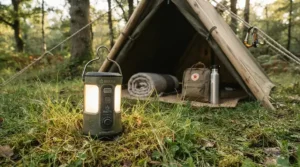
6. BioLite AlpenGlow 500 — 200-hour low mode and shake controls
The BioLite AlpenGlow 500 is the party lantern that grew up and learned to be practical.
It delivers 500 lumens on high for about 5 hours and 5 lumens on low for up to 200 hours, from a 6,400mAh battery that recharges in about 3 hours via micro-USB. It weighs around 380g, carries an IPX4 rating, and a USB-A output charges phones. Its multicolour modes (including a candle flicker) switch by button or by shaking.
On paper this means a single charge could light several nights at low settings and still revive a flat phone. That makes it a sound glamping lantern for events as well as everyday tent use. Gear reviewers note the shake control does not always register and that the hook could be more secure, and one tester found it pricey.
GearJunkie rated it its best overall camping lantern, which I read as strong, though not festival-specific, endorsement.
Pros:
- ✅ 200-hour low mode
- ✅ 500 lumens plus phone charging
- ✅ Sealed port covers aid weather resistance
Cons:
- ❌ Pricey versus rivals
- ❌ Micro-USB charging, not USB-C
Roughly £70–£90 in the UK; verify current price. Worth it if you glamp often.
7. Ledlenser ML6 — glare-free premium build
The Ledlenser ML6 is the lantern for people who buy once and cry once.
Live for the Outdoors describes a 750-lumen boost that drops back to around 550, which is bright enough to fill a family tent, and Ledlenser claims about 70 hours at 20 lumens. The Li-ion cell is around 3,000mAh, the body weighs about 280g, and the kit includes a magnetic charging cable, stand and a red-light mode. Listings disagree on its water rating (IP54 on some, IP66 on others), so verify before relying on it in a downpour.
My analysis: that boost is a party trick, but the glare-free micro-prism lens and dimming range are the real merit. Reviewers also flag a proprietary charging cable and a premium price. A multi-year warranty (five years in the listings I found) supports the “buy once” case.
Pros:
- ✅ Glare-free, even light
- ✅ Strong build and long warranty
- ✅ Magnetic charging and red-light mode
Cons:
- ❌ Expensive for a tent light
- ❌ Proprietary charging cable
Roughly £85–£115 depending on version; check current price. Best long-term value.
Festival Tent Light Setup: A Practical Guide
Buying the right festival tent light is half the job. Setting it up properly is the other half.
Before you leave:
- Charge to full at home, then test it overnight on low to confirm real runtime.
- Pack a short cable and a small power bank.
- Clip it to a carabiner so it never sits on the wet ground.
On site:
- Hang the lantern from your tent’s ceiling loop or a pole clip, away from the flysheet.
- Run it on the lowest comfortable setting. A 10–50 lumen glow is plenty for a sleeping bag, and low modes stretch runtimes enormously (for example, Vango Star 300 Recharge goes from 5 hours to 70).
- Keep it zipped in a bag when you are out.
Common mistakes in the first 30 days:
- Running everything on maximum “just to see”.
- Charging only an hour before departure.
- Leaving mud caked around charging ports.
- Storing a fully drained lantern for months.
Maintenance after the festival: wipe off the mud, let it dry fully, then recharge. Store lithium-powered lanterns somewhere cool and dry, partly charged. That is common battery-care advice, so check your lantern’s manual.

Finding Your Tent at Night: A Problem-and-Solution Guide
Finding your tent at night is the festival skill nobody trains for. Here are the four problems that come up most.
Problem 1: every tent looks identical. A guide from the Guardian recommends a flag and pole as a campsite marker. Combine that with a small light for after dark.
Problem 2: your phone is dead. One veteran festival blogger suggests battery-powered fairy lights outside the tent to identify it in the early hours. Hang a lantern at the porch instead and you cover both lighting and navigation.
Problem 3: rain and mud. Choose a weatherproof lantern for the outside beacon. LuminAID PackLite Max 2-in-1 at IP67 is the safest option here, while the Etekcity 4-Pack Camping Lanterns are cheap enough to hang outside and not worry about.
Problem 4: annoying your neighbours. A blazing white beacon is rude in a quiet camping area. Use a low, warm setting; the 10-lumen mode on Vango Star 300 Recharge can run for around 70 hours.
Finally, check your festival’s rules. Some campsites have quiet or lighting policies, and a tent beacon should never blind passers-by.
Real-World Scenarios: Which Lantern Fits Which Festival-Goer?
These are illustrative scenarios built from specs and aggregated reviews, not personal tests.
The Budget Student (3 nights, shared two-person tent, one festival a year)
You want light, not luxury. The Vango Nova 200 Recharge USB or the LE 1000LM Rechargeable Lantern covers a weekend for less than a round of drinks. Bring a power bank, because both need a mid-festival top-up.
The Friend Group (four people, three tents, a shared cooking area)
Four cheap lights beat one great one. The Etekcity 4-Pack Camping Lanterns cover each tent plus the cooking area. Pack rechargeable AAs to avoid waste, as covered in the disposable vs reusable kit section below.
The Comfort Seeker (pre-pitched tent, a few festivals a year)
Ambience matters here. BioLite AlpenGlow 500 (or Vango Star 300 Recharge for less) delivers warm, adjustable light. Frequent use justifies the premium over time.
✨ Don’t Miss These Exclusive Deals!
🔍 Take your festival camping to the next level with these carefully selected lanterns. Click on any highlighted item to check current pricing and availability. These lights will help you create a cosy, easy-to-find home base your whole crew will love!
How to Choose a Battery Lantern for Festivals
- Decide your lumens. Rules of thumb: 25–150 lumens for tent use, 200–600 for a whole pitch, 1,000+ only for big groups or bad weather.
- Prioritise low-mode runtime. The headline lumens matter less than hours at 10–50 lumens. That is what carries you through three nights.
- Check the weather rating. The IP code system defines protection levels, and IPX4 means splashes from any direction are fine. That suits rain but not submersion.
- Match the power source. Rechargeable lanterns need a power bank. AA lanterns can be refuelled from any festival shop.
- Weigh the weight. If you are carrying everything from a car park, every 100g counts.
- Look for phone-charging output if you are a heavy phone user, but treat it as a bonus.
- Pick the light colour. Warm light suits tents, while cool white suits tasks.
Battery Lantern for Festivals vs Other Light Sources
| Light source | Strength | Weakness | Best For |
|---|---|---|---|
| Battery lantern | Lights the whole space hands-free | Needs charging or batteries | Tent and pitch lighting |
| Head torch | Directional, hands-free | Hard on the eyes in group chat | Night walks, toilet trips |
| Phone torch | Always with you | Drains your phone | Emergencies only |
| Gas or candle lantern | Atmospheric | Fire and fumes risk in tents | Outdoor use only, never in a tent |
A head torch and a lantern do different jobs, and the smartest packers bring both. Never use fuel-burning lanterns inside a tent, which is the key reason a battery lantern for festivals wins for sleeping areas. The phone torch is the false economy that costs you your map, camera and ride-home.
Muddy-Field Durability: What Actually Survives a Wet Weekend
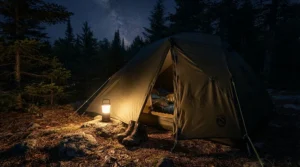
Muddy-field durability comes down to three things: seals, drop protection and your own habits.
- Seals: IPX4 resists splashes, not puddles. BioLite AlpenGlow 500 uses tight rubber port covers, and LuminAID PackLite Max 2-in-1 at IP67 is the most waterproof here. Vango Nova 200 Recharge USB lists no rating at all.
- Drops: Lanterns get knocked off hooks at 2am. Collapsible ABS bodies like those on the Etekcity 4-Pack Camping Lanterns are forgiving, while metal-bodied units like the Ledlenser ML6 are tougher still.
- Habits: Hang lanterns up rather than standing them in standing water, close port covers firmly and wipe off mud before charging.
Muddy-field durability also depends on how you store things after the event. Dry everything thoroughly before packing, because damp plus a charging port is a recipe for corrosion.
Disposable vs Reusable Kit: Which Costs Less and Wastes Less?
The disposable vs reusable kit debate comes down to where the cost and waste fall.
AA lanterns such as the Etekcity 4-Pack Camping Lanterns are cheap to buy and easy to refuel mid-festival. But twelve disposable AAs a trip adds up, and the batteries become waste. Rechargeable NiMH AAs fix this, and one reviewer reports nearly 50 hours from them.
Built-in rechargeables such as Vango Star 300 Recharge or BioLite AlpenGlow 500 cost more up front but remove disposable batteries entirely. Lithium cells do degrade after hundreds of cycles, so the right choice depends on how often you go.
Never bin batteries. The UK government’s consumer guidance explains that batteries and electricals should carry the crossed-out wheelie bin symbol and be taken to proper collection points. Check lanterns and chargers carry UKCA or CE marking too.
| Price band | Lanterns | Approx. cost per festival (5 trips) |
|---|---|---|
| Under £25 | Vango Nova 200 Recharge USB, LE 1000LM Rechargeable Lantern | ~£3–£5 |
| £20–£50 | Etekcity 4-Pack Camping Lanterns, Vango Star 300 Recharge, LuminAID PackLite Max 2-in-1 | ~£4–£10 |
| £70+ | BioLite AlpenGlow 500, Ledlenser ML6 | ~£14–£23 |
Over five festivals, the budget lanterns cost pennies per night, while the premium units only make sense if you will use them for a decade. The 4-pack looks pricey until you divide it per lantern.
Glamping Lantern for Events: When Ambience Beats Brightness
A glamping lantern for events has a different brief: it needs to look good, glow warmly and survive being passed around.
BioLite AlpenGlow 500 is the obvious candidate, with its colour modes, candle flicker and 200-hour low mode. Vango Star 300 Recharge is the budget alternative, with a warm 300-lumen top end and a hook for hanging above a table.
When choosing a glamping lantern for events, think about the glow rather than the lumens. A 5–50 lumen warm light looks far more inviting than a 500-lumen floodlight. Check the weather rating too, because outdoor events mean unpredictable weather, and think about chargeability, as a lantern with a USB output can rescue a guest’s phone.
If you are styling a bell tent or pop-up lounge, mix one hero lantern with several small ones. That is where the Etekcity 4-Pack Camping Lanterns earn a spot too.
Compact Lantern for Festival Camping: Packing Light Without Going Dark
A compact lantern for festival camping has to earn its place in a rucksack.
LuminAID PackLite Max 2-in-1 packs to roughly an inch thick, which makes it a standout for light packers. The Etekcity 4-Pack Camping Lanterns collapse flat too, and Vango Star 300 Recharge at around 380g is compact enough for most bags.
When choosing a compact lantern for festival camping, count grams and volume. Every item you carry from the car park to the campsite feels heavier by the hour. Glastonbury’s own guidance asks you to bring only what you can take home, so a compact lantern for festival camping that does two jobs (light plus phone charger) wins on both counts.
One caution: the smallest lanterns often have the smallest batteries. Pair a compact lantern for festival camping with a power bank, and run it on low.

Frequently Asked Questions
❓ Is a battery lantern for festivals better than a head torch?
❓ Where can I charge a rechargeable lantern at a festival?
❓ What is the best festival tent light for a family tent?
❓ Can I leave a lantern on to help with finding your tent at night?
❓ How long should a battery lantern for festivals last on one charge?
Conclusion
Choosing a battery lantern for festivals is really about matching light to your weekend. Budget campers will find a lot to like in Vango Nova 200 Recharge USB and LE 1000LM Rechargeable Lantern. Groups should look at the Etekcity 4-Pack Camping Lanterns, while Vango Star 300 Recharge is the festival-specific all-rounder with its warm light and 70-hour low mode. If rain and mud are your main worries, LuminAID PackLite Max 2-in-1 brings IP67 protection, and BioLite AlpenGlow 500 and Ledlenser ML6 reward frequent festival-goers with long-term quality.
Whatever you choose, run it on low, hang it up out of the mud, bring a power bank and mark your tent so you can find it at 3am. Check current prices and availability before you buy, as stock and prices change.
✨ Ready to light up your festival?
🔍 Click on any highlighted lantern above to check current pricing and availability. Pick the one that suits your tent, your budget and your muddy-field durability needs, and enjoy a weekend where you can actually find your way home! 🌙
Recommended for You
- Battery Lantern For Kids: 7 Best Safe, Tough Picks (2026)
- Battery Lantern Multipack: 7 Best Buys For UK Camps (2026)
- Battery Camping Lantern: 7 Proven Picks For UK Campers (2026)
Disclaimer: This article contains affiliate links. As an Amazon Associate, I earn from qualifying purchases. If you purchase products through these links, we may earn a small commission at no additional cost to you.
✨ Found this helpful? Share it with your friends! 💬🤗
