

In This Article
What is a battery lantern multipack? It is a bundle of two or more identical battery-powered LED lanterns sold together, usually as a lantern twin pack, a four-pack or a bulk set. Most are collapsible, run on AA or AAA cells, and cost far less per lantern than buying singles. Think of it as lighting by the handful.
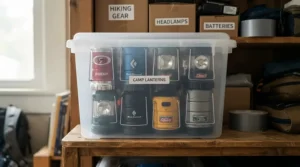
Here’s the thing about camping in Britain. Darkness arrives early, the drizzle arrives earlier, and one lonely lantern in the middle of the tent turns everyone else’s corner into a cave. A battery lantern multipack fixes that without fuss. One goes in the porch, one over the stove, one on the ridge pole, and one in your pocket for the trudge to the toilet block. There are no cables, no plug sockets and no hunting for the USB brick somebody left in the kitchen.
This guide is built around that idea. I’ve researched seven real four-pack sets and compared their claimed brightness, battery appetite and build. I’ve then translated the spec sheets into what actually happens in a damp field at 11pm. Along the way we’ll cover price per lantern maths, when a lantern twin pack beats bulk camping lanterns, how to fit a set of LED lanterns into a scout camp kit, and why stackable storage matters more than you’d expect.
A quick note on brightness. Manufacturers love shouting about lumens, the SI unit of luminous flux, which measures the total visible light a source gives off. It says nothing about how that light is spread or how long it lasts, so treat every big number with a raised eyebrow.
One honest caveat: specs and review figures below come from public listings and aggregated reviews gathered at the time of research. Amazon UK listings change, so check current price and availability before you buy.
Battery Lantern Multipack Quick Comparison Table (2026)
Here’s the whole field at a glance. Light and runtime figures are manufacturer claims taken from listings, not lab results. Where I couldn’t verify something, the table says so.
| Product | Claimed light / runtime | Power per lantern | Price range (check current) | Rating snapshot | Best For |
|---|---|---|---|---|---|
| Etekcity CL10 4-Pack | 154 lm / up to 50 hrs | 3 × AA (included) | around £15-£25 | c.4.7★ from c.50,000 ratings (US listing) | Families wanting a proven all-rounder |
| Lichamp 4 Pack COB Lanterns | 150-350 lm (listings vary) / up to 30 hrs | 3 × AA (check if included) | around £15-£25 | c.4.8★ from c.1,500 ratings (2024 snapshot) | Brightness chasers who read the small print |
| Vont LED Camping Lantern 4-Pack | 140 lm / 15-30 hrs | 3 × AA | around £15-£25 | Not verified | Wet pitches and rougher handling |
| Eveready LED Camping Lantern 360 PRO 4-Pack | Listings differ; 100-hr runtime claimed | 3 × AA (included) | around £15-£25 | Not verified for UK | Long power cuts and long weekends |
| Lepro LED Camping Lantern 4-Pack | 140 lm / 5-10 hrs | 3 × AAA | around £15-£25 | Not verified | Warm-light evenings and household backup |
| Milestone Camping 4 Pack Ultra Bright LED Waterproof Lantern | Specs thinly published | Check listing | mid-£10s to around £20 | Not verified | Budget buyers who like a UK camping retailer |
| MalloMe Camping Lantern 4-Pack (Multicolour) | c.146 lm | 3 × AA (batteries likely extra) | around £15-£25 | c.4.1★ from c.70 ratings | Kids, patrols and colour-coded kit |
Looking at the table, Etekcity and Lichamp have the biggest review pools, which counts for something when you’re buying blind. Lepro trades runtime for AAA convenience and a warm-light option, while MalloMe and Milestone are the ones to double-check before you click. If you only skim one thing, skim the power column. A set of LED lanterns that arrives without batteries isn’t really the bargain it looked like.
💬 Just one click — help others make better buying decisions too!😊
Top 7 Battery Lantern Multipack Picks: Expert Analysis
Each pick below is a genuine four-pack, ordered roughly from safest all-rounder to most specialised. Review commentary is aggregated from public listings, and where I couldn’t verify reviews I say so rather than guess.
1. Etekcity CL10 4-Pack — best all-round value for families
The Etekcity CL10 4-Pack has one big virtue: consistency. Each lantern claims 154 lumens from 30 LEDs on three AA cells, with up to 50 hours of runtime. The collapsible ABS body shrinks to roughly soup-can size. In practice, 154 lumens is a gentle, even glow, ideal for a four-person tent or a picnic table but no substitute for a floodlight. At around 259 g each, four lanterns add up to about a kilo, which is nothing in a car boot but worth rationing on a backpacking trip.
Based on the spec comparison, this is the sensible default for families who want twelve AA cells in the box and no drama. One compliance point: the listing data I found cites FCC and RoHS, so look for UKCA or CE marking on the UK product page.
Reviewers consistently rate it highly. The US listing shows roughly 4.7 out of 5 across nearly 50,000 ratings, with buyers praising easy battery fitting and value. Recurring complaints include a cool, blue-white tint and the occasional dud. One reviewer noted that partly closing the top only masks LEDs, so the battery drain doesn’t drop. UK review pools may differ.
Pros:
- ✅ Batteries included in the box
- ✅ Even 360-degree light for family tents
- ✅ Huge review pool and long track record
Cons:
- ❌ Cool blue-white light divides opinion
- ❌ Dimming by closing the top saves no power
Expect a price in the £15-£25 range. For four working lanterns plus cells, that’s very good value.

2. Lichamp 4 Pack COB Lanterns — boldest brightness claims, so check the listing
The Lichamp 4 Pack COB Lanterns use COB LED strips for a smooth, shadow-free wash of light. The first thing to spot is that listings disagree on brightness. Some say 150 lumens, others 250, others 350. Runtime is quoted at up to 30 hours on three AA cells. On paper this means you should treat it as a solid mid-brightness lantern rather than the fire-breather the headline implies.
The sensible reading is that Lichamp suits buyers who want soft light and a tidy collapsible design, and who will confirm the exact variant they’re ordering. Battery inclusion also varies by listing, with one retailer page stating that cells are not included. That changes your price per lantern, so check before you buy.
Aggregated sentiment is positive. A 2024 snapshot showed about 4.8 out of 5 from roughly 1,470 ratings, and reviewers mention a smooth opening and closing mechanism, light weight, and the usefulness of one lantern per room during power cuts. I couldn’t verify a large UK-specific review set.
Pros:
- ✅ Soft COB light with no harsh hotspots
- ✅ Very high average rating in snapshot
- ✅ Light enough to move room to room
Cons:
- ❌ Lumen claims vary wildly between listings
- ❌ Batteries not included on some listings
Expect a price in the £15-£25 range. It’s good value once you’ve confirmed the variant and the battery situation.
3. Vont LED Camping Lantern 4-Pack — most transparent spec sheet in the group
The Vont LED Camping Lantern 4-Pack lists its numbers refreshingly plainly: 140 lumens per lantern, 15-30 hours of runtime, alkaline cells, waterproof construction and a patented collapsible design. Each lantern weighs about 296 g with batteries and measures roughly 4.9 by 3.5 inches. A pack needs twelve AA cells, and one retailer listing says they’re included.
What does that mean outdoors? The 15-30 hour range is honest about brightness trade-offs, which most rivals bury. At roughly 1.2 kg for four, this is the heaviest set here, so it’s a car-camping pack rather than a lightweight one. The waterproof claim is the main reason to consider it for wet pitches, though I’d still look for a formal IP rating before trusting it in a downpour.
I couldn’t find verified review data for Vont that I’d be comfortable summarising, so I won’t invent any. If review volume matters to you, the Etekcity pack has far more public feedback behind it.
Pros:
- ✅ Clear, specific specifications
- ✅ Waterproof build claimed for wet pitches
- ✅ Compact when collapsed
Cons:
- ❌ Heaviest per lantern in this group
- ❌ Independent review data hard to verify
Expect a price in the £15-£25 range. It’s fair value if you prize transparency and wet-weather confidence.
4. Eveready LED Camping Lantern 360 PRO 4-Pack — longest runtime claim on paper
The Eveready LED Camping Lantern 360 PRO 4-Pack headlines with a 100-hour runtime claim, three AA cells per lantern, and batteries in the box. A related listing for the same product family quotes 280 lumens, 16 hours and four light modes. Those numbers don’t match, which suggests different generations or different test conditions, so verify the exact listing you’re buying.
Here’s what to weigh. A 100-hour figure almost certainly refers to the lowest setting, so expect a lot less at full tilt. Even so, the combination of long low-mode life and included cells suits a household that wants a drawer-ready emergency kit more than a weekend bag.
Reviewers on retail listings commonly mention that you really do get four working lanterns with batteries for a modest outlay. I couldn’t verify UK-specific review volumes, and one listing showed no warranty, so check seller and returns details on amazon.co.uk.
Pros:
- ✅ Batteries included with all four lanterns
- ✅ Long low-mode runtime claimed
- ✅ Rugged, water-resistant design claimed
Cons:
- ❌ Conflicting specs between listings
- ❌ Warranty details unclear on some pages
Expect a price in the £15-£25 range. Good value if the spec on your listing checks out.
5. Lepro LED Camping Lantern 4-Pack — warm or cool light at the press of a button
The Lepro LED Camping Lantern 4-Pack swaps AA for AAA cells, three per lantern, and claims 140 lumens. The button cycles through brightness levels and lets you choose warm or cool light. The frosted shade is described as glare-free and cool to the touch, and the claimed runtime is about 5 hours on high and 10 on low.
That runtime is the catch. A warm, tent-friendly glow is lovely, but a 10-hour ceiling on low means a long weekend will need a battery refresh. AAA cells also make each lantern lighter, so this pack suits indoor and household use as much as camping. Based on the spec comparison, it’s the pick for people who dislike harsh blue-white light.
I couldn’t verify a meaningful pool of reviews for this exact pack, so treat the claims as manufacturer data. The listing says batteries are included.
Pros:
- ✅ Warm and cool light options
- ✅ Glare-free frosted shade
- ✅ Batteries included per listing
Cons:
- ❌ Short claimed runtime versus AA rivals
- ❌ AAA refills cost more per hour of light
Expect a price in the £15-£25 range. Good value as a cosy-light household and tent pack.

6. Milestone Camping 4 Pack Ultra Bright LED Waterproof Lantern — budget set from a UK camping retailer
The Milestone Camping 4 Pack Ultra Bright LED Waterproof Lantern is described as a robust, lightweight, durable set built for the outdoors. It has appeared at a budget price through a UK camping retailer, in the mid-£10s on a past deal. Public specs are thin, though. I couldn’t confirm lumens, runtime or battery type from the sources I found.
What does that mean for you? Milestone is a sensible shortlist candidate if you like buying from a British outdoor retailer, but it asks for homework. Check the lumen figure, the cell type and whether batteries are included before comparing its price per lantern with the others. A cheap set that needs twelve extra cells is no longer cheap.
I found no verified review data, so I’m not going to characterise customer sentiment. If you’re buying for a group, order one set first and test it before committing to bulk camping lanterns.
Pros:
- ✅ Four lanterns at a low entry price
- ✅ Sold through a UK camping retailer
- ✅ Waterproof design claimed
Cons:
- ❌ Detailed specs hard to verify
- ❌ Little independent review data found
Expect a price in the mid-£10s to around £20. It’s decent value only once you’ve confirmed the details.
7. MalloMe Camping Lantern 4-Pack (Multicolour) — colour-coded lanterns for kids and patrols
The MalloMe Camping Lantern 4-Pack (Multicolour) has four different colours, a claimed 146 lumens and a featherweight 5.3 oz per lantern. The twist is the colour-coding. Hand each child, tent or patrol a colour and “who took my lantern?” disappears. The listing also notes that you expand the lantern to adjust the brightness.
It needs twelve AA cells and the listing indicates batteries aren’t supplied, so factor that into the price per lantern. Colour-coding is genuinely useful in a scout camp kit, because it makes counting equipment at pack-up trivial.
Aggregated review data is limited: roughly 4.1 out of 5 from about 70 ratings in the snapshot I found. That’s a small, lower-scoring pool compared with Etekcity or Lichamp, so treat it as a promising niche pick rather than a proven winner.
Pros:
- ✅ Four colours for easy ownership
- ✅ Lightest lantern in this group
- ✅ Handy for kids and patrol tents
Cons:
- ❌ Batteries likely to be an extra cost
- ❌ Small review pool and lower rating
Expect a price in the £15-£25 range. Worth it if the colour-coding solves a real problem for you.
How to Set Up and Maintain Your Battery Lantern Multipack
Buying is the easy bit. Keeping a battery lantern multipack happy for years is where the real value lives, and it’s the sort of know-how listings never mention.
Before the first trip
- Test every lantern at home. A dud discovered in the dark is a very British kind of misery.
- Mark each one with tape or a permanent pen (1, 2, 3, 4). It makes spotting a weak unit easy.
- Fit fresh cells of the same brand and age in all four. Mixing old and new cells is the classic cause of flickering and early failure.
On site
- Spread the light. One lantern at head height in the tent, one low by the door, one over the cooking area, one spare.
- Hang rather than stand where possible. Light thrown downwards covers more floor.
- Use the lowest brightness you’re comfortable with. If a lantern claims, say, 30 hours, that figure almost certainly belongs to a dim setting.
First 30 days: common mistakes
- Leaving lanterns switched on in a rucksack. Pressing a button in transit is the number one battery killer.
- Storing them wet. Wipe them dry and let them air before closing the lid.
- Forgetting to remove cells from lanterns you won’t use for months.
End of life
Old cells contain hazardous substances and should never go in the general waste or recycling bin, as NI Direct explains. Pop them in a shop or supermarket battery bin, or take them to your household recycling centre.

Real-World Scenarios: Which Set of LED Lanterns for Which Camp?
Specs only mean something when you attach them to a real trip. Here are three typical buyers and how I’d match them to a pick, based on the spec comparison.
The Lake District family (two adults, two children, three nights in September, £20 budget).
The Etekcity pack covers it neatly. Put one in each sleeping area, one in the kitchen shelter and one spare. Four hours a night over three nights is about 12 hours per lantern, comfortably inside the claimed battery life, so one set of cells should see you through, with spares for safety.
The scout leader prepping a troop camp (eight patrol tents, tight club budget).
This is bulk camping lanterns territory. Two MalloMe sets give you eight colour-coded lanterns, one per tent. Colour-coding keeps count easy at pack-up, and a stackable storage box keeps the whole set of LED lanterns together between camps. Buy batteries in bulk, and check your group’s own kit list and policies first.
The power-cut household (£20, used maybe twice a year).
Here I’d lean towards Lepro for the warm light in living areas, or the Eveready 360 PRO if you want a long low-mode runtime. Park them in a hallway cupboard with cells fitted and tested every few months. The value here is a reliable backup, not a fashionable one.
✨ Don’t Miss These Exclusive Deals!
🔍 Take your camp lighting to the next level with these carefully selected multipacks. Click on any highlighted product name to check current pricing and availability. A good battery lantern multipack will help you create a cosy, safe campsite your whole group will love!
How to Choose a Battery Lantern Multipack (7 Steps)
A good choice comes down to seven decisions. Make them in order and the right pack usually reveals itself.
- Decide your pack size. A lantern twin pack suits couples and car glove boxes, a four-pack suits families, and bulk camping lanterns suit groups and events.
- Match brightness to space. For a tent, 100-150 lumens per lantern is plenty. More lanterns beat more lumens, because several soft pools of light beat one glaring hotspot.
- Check the battery type and whether it’s included. AA is easiest to find, AAA is lighter, and D cells are brighter but bulky. Unsupplied cells quietly raise your price per lantern.
- Read runtime claims sceptically. Ask at which brightness the hours were measured. Long figures usually describe the dimmest setting.
- Look for a real water rating. Phrases like “military-grade” are marketing. An actual IP code, or at least clear “water-resistant” wording, is more useful.
- Check the compliance marks and the seller. Look for UKCA or CE marking and clear UK returns information.
- Plan for storage. Collapsed size and stackable storage determine whether a set of LED lanterns stays organised or ends up in a drawer of tangled regret.
Features that actually matter, and those that don’t: a warm-light mode, an even diffuser, easy battery access and a sturdy hook matter every night. Rainbow flashing modes, SOS strobes and “survival” branding mostly don’t. On a camp pitch, I’d take a plain, reliable lantern over a gimmicky one every time.
Price Per Lantern: What a Battery Lantern Multipack Really Costs
The simplest comparison tool is price per lantern. Divide the pack price by the number of lanterns, then add the cost of any batteries that aren’t included, divided by the same number. The figures below are illustrative planning ranges, not quotes.
| Set size | Illustrative pack price | Price per lantern | Best For |
|---|---|---|---|
| Lantern twin pack | £8-£14 | £4-£7 | Couples, spare lantern, glove-box kit |
| Four-pack | £14-£24 | £3.50-£6 | Families: Etekcity, Lepro |
| Bulk camping lanterns (two four-packs) | £28-£48 | £3.50-£6 | Scout groups: MalloMe colour-coded set |
The pattern is clear: stepping up from a lantern twin pack to a four-pack usually trims the price per lantern, but stepping up again to bulk camping lanterns rarely cuts it further. The real saving is spending on batteries wisely, because a “cheap” pack with no cells can end up costing the same as a dearer one with them. Choose by use, not by the bargain headline.
Total cost of ownership: if you camp six weekends a year at about 12 hours of light per lantern each time, that’s roughly 72 hours. At a claimed 30 hours per set of cells, expect two or three battery refreshes per lantern. Real-world runtime is usually shorter than claimed, so budget a little extra. Rechargeable AA cells cost more upfront but pay back quickly for frequent campers.
Battery Lantern Multipack vs Single and Rechargeable Lanterns
Is a battery lantern multipack always the answer? Not quite. Here’s how it stacks up.
| Option | Light spread | Running costs | If one fails | Best For |
|---|---|---|---|---|
| Battery lantern multipack | Several soft pools of light | Ongoing AA or AAA cells | The others carry on | Families, groups: Etekcity, Lepro |
| Single premium lantern | One strong source | Low if rechargeable | The whole tent goes dark | Solo backpackers |
| Rechargeable USB lantern | Strong and adjustable | Cheap per use, needs charging | Needs a power bank | Pitches with power or power banks |
The big advantage of a multipack is redundancy. One failure is an annoyance rather than a crisis, and you can light several spaces at once. A single rechargeable lantern wins on brightness and running costs, but it puts all your eggs in one basket, as any caravanner with a flat battery will tell you.
On safety, Practical Caravan’s group test of ten lanterns points out there’s no carbon monoxide risk from electric camping lanterns, unlike gas ones, which is a real plus inside tents and awnings. For most British campers, my take is simple: take a multipack as your everyday lighting and add one rechargeable lantern if you want a brighter communal light.

Lantern Twin Pack or Bulk Camping Lanterns? Choosing Your Pack Size
Pack size is the decision most buyers rush. Let’s slow it down.
When a lantern twin pack wins. Two lanterns cover a couple’s tent, a campervan or a boot kit. You get redundancy without paying for lights you’ll never switch on, and a lantern twin pack slips into small stackable storage boxes with room to spare. It also makes a tidy gift.
When a four-pack wins. Families, small groups and anyone who likes a lantern per zone should land here. It’s the sweet spot of price per lantern, and every pick in this guide comes in four-pack form for that reason.
When bulk camping lanterns win. Troops, school trips, festival stalls and event teams benefit from buying in volume. The real gains aren’t just cash. Identical lanterns mean identical batteries, one spares box and one routine, which saves time. Colour-coding, as with MalloMe, helps stop lanterns drifting between tents.
My rule of thumb: buy one lantern for every sleeping space, one for the kitchen, and one spare. If that number is two, buy a lantern twin pack. If it’s four to six, buy a four-pack. If it’s seven or more, treat bulk camping lanterns as an organised system, not just a bigger bag of kit.
Scout Camp Kit and Stackable Storage: Packing Lanterns Properly
A set of LED lanterns that arrives in a tangle of boxes and loose cells is a recipe for frustration. A little organisation pays off, especially for a scout camp kit.
Use stackable storage. Collapsible lanterns are designed to squash flat, so they pair beautifully with a lidded stackable storage crate. One crate per patrol or tent group keeps lanterns, spare batteries and a spare bulb-free routine in one place. Clear lids make it obvious at a glance whether everything is present.
Bag the batteries. Keep spare cells in a labelled zip bag inside the crate. Never loose, and never mixed old with new.
Colour-code and number. The MalloMe colours do the work for you. With other brands, a strip of coloured tape and a number achieves the same result.
Run a pack-up check. Count lanterns, switch each one on to confirm it works, wipe it dry and close it. Take half a minute now and save yourself an evening later.
Build it into the scout camp kit list. Every group has its own kit list and policies, so check yours first. Where lighting is allowed, a battery lantern multipack in a stackable storage box is easy for young campers to understand, easy for leaders to count, and cheap to replace if a lantern goes astray.
Safety, Regulations and Battery Disposal Guide
Battery lanterns are among the safer ways to light a tent, but a few sensible checks apply.
Compliance marks. Look for UKCA or CE marking on UK listings. Some listing data I found cites FCC and RoHS, which is common on US-focused pages, so ask the seller or check the product images for UK-appropriate marks.
No carbon monoxide worries. Electric lanterns don’t burn fuel, so there’s no carbon monoxide risk in a tent, unlike gas lanterns. You still shouldn’t leave any light switched on and unattended near flammable fabrics, though LED lanterns generally run cool.
Battery safety. Don’t mix cell brands or ages, don’t try to recharge standard alkaline cells, and remove cells before long-term storage to avoid leaks.
Disposal. Used batteries shouldn’t go into household bins, because they can start fires in collection vehicles and recycling plants. You can find a drop-off point through the Recycle Now locator, and most large supermarkets have battery bins at the entrance. Carry a small zip bag for spent cells and drop them off on your way home.
If you run a group, make battery recycling part of pack-up. It takes thirty seconds and turns a chore into a good habit for young campers.

FAQ
❓ How many lumens do I need from a battery lantern multipack for a family tent?
❓ Are AA or AAA batteries better in a set of LED lanterns?
❓ Are bulk camping lanterns worth it for a scout group?
❓ How long will batteries last in a battery lantern multipack?
❓ What is the best stackable storage for camping lanterns?
Conclusion
A battery lantern multipack is one of those rare camping purchases that quietly improves every single evening. You get light where you need it, a built-in spare if one lantern fails, and a price per lantern that makes buying one premium lamp look a bit lavish. Whether you pick a lantern twin pack for a couple’s tent, a four-pack for the family or bulk camping lanterns for a troop, the recipe is the same: match the number of lanterns to the number of spaces, check the batteries, and look past the headline lumens.
If I had to narrow the seven down, the Etekcity CL10 4-Pack is the safest all-rounder, the Lepro four-pack is the cosy household pick, and the MalloMe set is the clever choice for kids and patrols. The Lichamp, Vont, Eveready 360 PRO and Milestone sets all have their moments, provided you verify the details on the live listing. Add some stackable storage, label everything, recycle your old cells properly, and your set of LED lanterns will light a lot of damp, happy nights.
Recommended for You
- Battery Camping Lantern: 7 Proven Picks For UK Campers (2026)
- Solar Rechargeable Lantern: 7 Brilliant Picks For UK Camping (2026)
- Rechargeable Lantern With Power Bank Function: 7 Smart Picks (2026)
Disclaimer: This article contains affiliate links. As an Amazon Associate, I earn from qualifying purchases. If you purchase products through these links, we may earn a small commission at no additional cost to you.
✨ Found this helpful? Share it with your friends! 💬🤗
