
In This Article
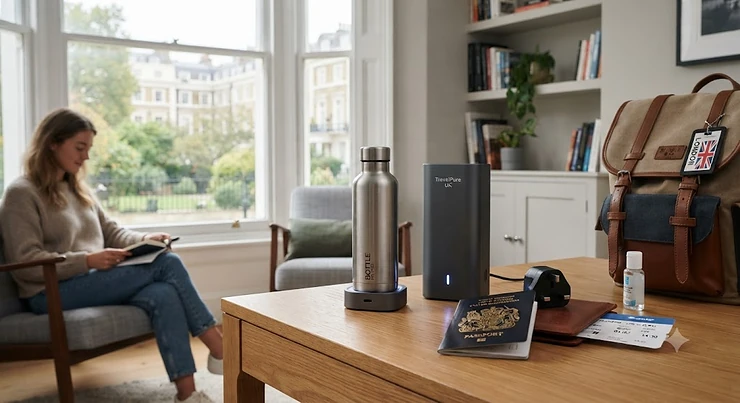
Here’s a fact that tends to ruin a good holiday mood: the thing most likely to derail your trip abroad isn’t a missed flight or a lost passport. It’s a glass of tap water you didn’t think twice about. A UV purifier for international travel exists precisely for that unglamorous, unavoidable moment — the hotel bathroom tap, the street stall’s ice cubes, the questionable jug at a homestay in the hills — when you have to decide, in about two seconds, whether to drink or wait.
We’ve spent a good chunk of time digging through real specs, real owner reviews, and the genuinely dry but important world of UV-C dosing to work out which devices actually earn their place in a carry-on. Not which ones have the flashiest marketing copy — which ones hold up when you’re three days into a trip through somewhere the tap water isn’t your friend.
This guide covers seven real, currently available devices spanning roughly under £40 to a bit over £200, from pocket-sized UV pens to hybrid press-filter bottles that do double duty against sediment and chemicals too. We’ll also get into how UV purification actually stacks up against traditional filters, what UK airlines will and won’t let you carry through security, and where a UV purifier fits (and doesn’t) into an emergency kit. If you’ve ever squinted suspiciously at a carafe of water in a foreign hotel room, this one’s for you.
Quick Comparison Table
| Purifier | Type | Best For | Price Range |
|---|---|---|---|
| Katadyn SteriPEN Ultra | UV-C pen | All-round travel & clear water sources | £80-£100 range |
| SteriPEN Adventurer Opti | UV-C pen | Ultralight packing, backups | £65-£85 range |
| GRAYL GeoPress | Press-purifier (UV-equivalent filtration + carbon) | Murky water, families, group trips | £85-£105 range |
| GRAYL UltraPress | Press-purifier | Solo travellers wanting filter + purifier in one | £75-£90 range |
| LARQ Bottle PureVis | Self-cleaning UV-C LED bottle | Daily hydration, city breaks | £80-£90 range |
| LARQ Bottle Movement PureVis | Lightweight UV-C LED bottle | Gym, commuting, light packing | £75-£90 range |
| Iconique UV Filtered Water Bottle | Budget UV-C LED bottle | First-time buyers, tight budgets | £35-£45 range |
Looking at the spread above, there’s a genuine fork in the road between true UV-C devices (the SteriPENs, the LARQ bottles, the Iconique) and press-purifiers like the GRAYL GeoPress and GRAYL UltraPress, which use ion-exchange and activated carbon rather than light to do the killing. Budget buyers gravitate toward the Iconique, but anyone heading somewhere with visibly cloudy tap water should lean toward the GRAYL pair, since UV alone can’t see through sediment. For most mixed-itinerary travellers, the Katadyn SteriPEN Ultra sits in the sweet spot of speed, proven track record, and manageable cost.
💬 Just one click — help others make better buying decisions too!😊
Top 7 UV Purifiers for International Travel: Expert Analysis
1. Katadyn SteriPEN Ultra — fastest all-rounder for clear water sources
The standout here is speed: treat a full litre in roughly 90 seconds, no waiting around, no pumping. The SteriPEN Ultra runs on a rechargeable battery (charged via USB) and its UV-C lamp is rated for around 8,000 activations before it needs replacing, which works out to thousands of litres over its lifetime — genuinely one of the better cost-per-litre figures in this category. Its OLED display shows treatment progress and battery status, useful when you’re stood in a dim hotel bathroom at 11pm trying to work out if it’s actually working.
Based on the spec comparison, this is the purifier for travellers who want speed and reliability without carrying a separate filter cartridge, and who are mostly dealing with clear tap or bottled-refill water rather than murky village pumps. It’s not the cheapest device here, and it won’t do anything for water with visible sediment floating in it — the UV light needs relative clarity to penetrate properly. Reviewers consistently report that the Ultra performs impressively well when used as intended, though a recurring theme across multiple review sources is occasional unit failure after a year or two of use, so it’s worth registering the warranty and keeping receipts.
Pros:
- ✅ Treats a full litre in about 90 seconds
- ✅ USB-rechargeable, no disposable batteries needed
- ✅ OLED display shows real-time treatment status
Cons:
- ❌ Struggles with cloudy or sediment-heavy water
- ❌ Some owners report reliability issues after extended use
Sitting around £80-£100, the Katadyn SteriPEN Ultra earns its price through sheer convenience — if your trips mostly involve clear water sources that just need pathogen treatment, this is hard to beat.
2. SteriPEN Adventurer Opti — lightest UV pen for minimalist packers
What most buyers overlook about this model is how much it shaves off both weight and bulk compared with the Ultra, without giving up the core UV-C treatment technology. It runs on standard CR123 batteries rather than USB charging, which sounds like a downgrade until you realise it means no cables, no waiting for a charge in an airport lounge, and the ability to buy spares almost anywhere.
The trade-off, and it’s a real one, is running cost: CR123 batteries aren’t cheap and you’ll want spares in your bag, particularly since cold weather drains them faster. Here’s what to weigh: if you’re travelling somewhere with unreliable electricity — think rural guesthouses, long train journeys, multi-stop backpacking routes — battery-swap convenience can beat rechargeability. Aggregated review sentiment across outdoor gear sites consistently frames the Adventurer Opti as the go-to backup unit that serious travellers throw in alongside a primary purifier, precisely because it doesn’t rely on finding a plug socket.
Pros:
- ✅ Runs on widely available CR123 batteries
- ✅ Noticeably lighter and more compact than the Ultra
- ✅ No charging cable to lose or forget
Cons:
- ❌ Battery costs add up on longer trips
- ❌ Still ineffective in cloudy or particulate-heavy water
At around £65-£85, the SteriPEN Adventurer Opti is the pragmatic backup pick — the one you buy as insurance alongside a primary device, or as your only purifier if you genuinely just need lightweight, no-fuss coverage.
3. GRAYL GeoPress — best for murky water and multi-person trips
This is where things shift meaningfully away from pure UV. The GeoPress works by pressing water through an ion-exchange and activated-carbon cartridge rather than shining light through it, which means it tackles sediment, some heavy metals, chemicals, and unpleasant tastes at the same time as viruses, bacteria, and protozoan cysts. The claimed flow rate is roughly 8 seconds for a full 710ml press — genuinely fast for a device doing this much filtration work.
The practical upshot: where a UV pen would leave you holding a glass of clean-but-still-cloudy water, the GeoPress hands you something that actually looks and tastes like tap water from home. Reviewers consistently flag the trade-off of arm effort — you’re physically pressing the inner cup down through resistance, which is a workout compared with a UV pen’s push-a-button simplicity. The 710ml capacity also makes it the largest single-fill option here, useful for families splitting one device or anyone who hates refilling constantly.
Pros:
- ✅ Handles sediment, chemicals, and pathogens together
- ✅ Fastest flow rate of any purifier in this list
- ✅ Largest single capacity at 710ml
Cons:
- ❌ Requires physical pressing effort each use
- ❌ Bulkier and heavier than pen-style UV devices
Priced roughly £85-£105, the GRAYL GeoPress is the pick for destinations where water quality genuinely varies — think rural Southeast Asia, parts of Central America, or any trip where you can’t guarantee the source is even relatively clear.
4. GRAYL UltraPress — compact hybrid purifier for solo travellers
Think of this as the GeoPress’s smaller sibling: same press-filter mechanism, same broad-spectrum protection against viruses, bacteria, protozoa, chemicals, and particulates, but in a 500ml body that’s noticeably easier to slot into a daypack side pocket. What most buyers overlook about the UltraPress is that it uses the same filtration chemistry as its pricier sibling — you’re not sacrificing purification quality for the smaller size, just capacity.
Based on the spec comparison, this is the better choice for solo travellers and city-hopping itineraries where you’re refilling more often from smaller taps and don’t need the GeoPress’s bulk. A titanium version also exists for travellers who prioritise long-term durability over a lower upfront price, though it comes at a significant premium. Aggregated review sentiment notes the pressing mechanism feels smoother than some competitors’, with less resistance for a comparable filtration job.
Pros:
- ✅ Same broad-spectrum filtration as the larger GeoPress
- ✅ Slimmer profile fits daypack side pockets easily
- ✅ Replacement cartridges are widely stocked
Cons:
- ❌ Smaller 500ml capacity means more frequent refills
- ❌ Still needs manual pressing, unlike UV-only devices
At roughly £75-£90, the GRAYL UltraPress suits travellers who want hybrid protection in a genuinely portable size, without stepping up to GeoPress bulk or titanium pricing.
5. LARQ Bottle PureVis — self-cleaning UV-C bottle for daily hydration
The LARQ Bottle PureVis flips the usual purifier logic: instead of treating water once on the way in, its UV-C LED activates automatically every two hours to keep the bottle itself sanitised, tackling the bacteria that build up on the inside of any reusable bottle over a few days of travel. A double-tap triggers a longer three-minute “Adventure Mode” cycle for water you’re less confident about, delivering a higher UV-C dose.
What the spec sheet won’t tell you, but reviewers note, is how genuinely low-maintenance the self-cleaning cycle feels day to day — you stop thinking about bottle hygiene entirely, which matters more than it sounds like on a two-week trip where laundry facilities for water bottles simply don’t exist. The double-wall stainless steel construction keeps drinks cold for 24 hours or hot for 12, useful in climates at either extreme. It’s worth being honest about a limitation: like all UV-only devices, it needs visually clear water to work properly, and LARQ itself advises against using it for coffee, tea, or sugary drinks, which can stain the internal UV-C sensor.
Pros:
- ✅ Automatic self-cleaning cycle every 2 hours
- ✅ Insulation keeps drinks cold 24 hours or hot 12
- ✅ USB-rechargeable battery lasts up to a month
Cons:
- ❌ No good for cloudy water or drinks other than plain water
- ❌ Premium price for what is essentially a bottle
Around £80-£90, the LARQ Bottle PureVis earns its keep less as an emergency water-safety device and more as a daily-carry travel bottle that happens to solve the “why does my water bottle smell weird” problem permanently.
6. LARQ Bottle Movement PureVis — lightweight non-insulated variant
Here’s what most comparisons miss: the Movement isn’t a downgrade so much as a different trade-off. Dropping the double-wall insulation shaves meaningful weight and bulk, which matters when you’re already carrying a laptop, adapters, and a week of clothes through an airport. It uses the same PureVis UV-C LED technology as its insulated sibling, running the same automatic and Adventure Mode cycles.
Based on the spec comparison, this is the version for travellers who prioritise pack weight over temperature retention — city breakers, conference attendees, anyone doing more walking-between-meetings than hiking-between-campsites. The single-wall stainless steel body is genuinely lighter in hand than the insulated PureVis, though naturally your water won’t stay cold as long on a hot afternoon. Reviewers consistently frame it as the pick for gym bags and daily commuting as much as travel, which says something about how far it’s drifted from being a pure “emergency water safety” device toward everyday self-cleaning hydration.
Pros:
- ✅ Noticeably lighter than the insulated PureVis
- ✅ Same UV-C self-cleaning technology, lower price
- ✅ Good for daily carry, not just travel days
Cons:
- ❌ No insulation, so drinks warm up faster
- ❌ Same clear-water-only limitation as all UV bottles
Priced around £75-£90 depending on size and colour, the LARQ Bottle Movement PureVis is the value-conscious LARQ pick for anyone who’d rather save the pack weight than the drink temperature.
7. Iconique UV Filtered Water Bottle — best budget entry point
Every product mention on this list so far assumes you’re ready to spend £75 or more, so it’s worth flagging the option that doesn’t. The Iconique is a stainless steel, self-cleaning UV bottle with an LED display on the lid that shows temperature and issues drink reminders — a genuinely useful nudge on long-haul flights when dehydration creeps up unnoticed.
Here’s what to weigh: at well under half the price of the premium bottles above, you are working with a newer entrant to the market and a smaller, less established review base than SteriPEN or LARQ, both of which have years of aggregated field use behind them. That doesn’t make it a bad purchase — plenty of reviewers report it does exactly what’s promised for casual use — but if you’re heading somewhere with genuinely questionable water and no backup plan, the lack of a long track record is a real consideration, not just a nitpick. It’s best understood as a confidence-building first purchase rather than a device you’d stake a serious expedition on.
Pros:
- ✅ Roughly half the price of premium alternatives
- ✅ LED display adds temperature and hydration reminders
- ✅ Self-cleaning function reduces bottle odour buildup
Cons:
- ❌ Shorter track record than established UV brands
- ❌ Smaller battery and treatment capacity than premium models
At £35-£45, the Iconique UV Filtered Water Bottle is the sensible starting point for travellers testing whether a UV purifier fits their routine before committing to a pricier device.
Top 7 Products: Detailed Comparison
| Purifier | Technology | Treats Sediment? | Charging | Best For |
|---|---|---|---|---|
| Katadyn SteriPEN Ultra | UV-C pen | ❌ | USB rechargeable | All-round clear-water travel |
| SteriPEN Adventurer Opti | UV-C pen | ❌ | CR123 batteries | Lightweight backup |
| GRAYL GeoPress | Press-filter | ✅ | None needed | Murky water, groups |
| GRAYL UltraPress | Press-filter | ✅ | None needed | Solo hybrid protection |
| LARQ Bottle PureVis | UV-C LED bottle | ❌ | USB rechargeable | Daily hydration |
| LARQ Bottle Movement PureVis | UV-C LED bottle | ❌ | USB rechargeable | Lightweight daily carry |
| Iconique UV Filtered Water Bottle | UV-C LED bottle | ❌ | USB rechargeable | Budget entry point |
The table makes the real dividing line obvious: it’s not really “which brand” so much as “UV-only versus press-filter.” If your itinerary involves any water source you can’t visually confirm is clear — rivers, questionable taps, rural pumps — the GRAYL pair is the only pairing here built to cope with that. Everyone else on this list is betting that you’ll only ever point the device at water that already looks clean, which, for the vast majority of international travel involving hotel taps and bottled refills, is a safe enough bet.
What Is a UV Purifier for International Travel?
A UV purifier for international travel is a portable device that uses ultraviolet-C light to disable the DNA of bacteria, viruses, and protozoa in drinking water, rendering them unable to reproduce and cause illness, without adding chemicals or filtering out physical particles. It’s designed to be carried in luggage and used on the move, typically treating water in 60-180 seconds per use.
The technology itself isn’t new or exotic — UV-C disinfection has been used by municipal water treatment plants for decades, as noted in the World Health Organization’s own guidance on safe drinking-water standards. What’s changed is miniaturisation: the same basic physics now fits in something the size of a chunky pen or a bottle cap, battery-powered and light enough to live permanently in a wash bag.
UV Purifier vs Water Filter: Which Do You Actually Need?
This is probably the single most useful question to answer before you buy anything, because the two technologies solve genuinely different problems.
A UV purifier deactivates biological pathogens — viruses, bacteria, protozoa — by scrambling their DNA with light. What it does not do is remove anything physical from the water: no sediment, no heavy metals, no chemical taste, no microplastics. Point a SteriPEN at a glass of muddy river water and you’ll get sterilised muddy water. A traditional filter, by contrast, physically strains water through a membrane or activated carbon, catching particulates and often improving taste, but many basic filters have pore sizes too large to reliably catch viruses, which are smaller than bacteria or protozoan cysts.
| Factor | UV Purifier | Water Filter |
|---|---|---|
| Kills viruses | ✅ Yes, effectively | ⚠️ Depends on pore size |
| Removes sediment | ❌ No | ✅ Yes |
| Removes chemicals/taste | ❌ No | ✅ With activated carbon |
| Speed | Fast (60-180 seconds) | Varies, often slower |
| Best For | Clear water, viral risk areas | Cloudy or chemically tainted water |
The analysis paragraph writes itself once you see it laid out: neither technology is strictly “better,” they cover different gaps. This is exactly why hybrid devices like the GRAYL GeoPress and GRAYL UltraPress exist — they bolt filtration and purification-grade treatment together into one press cycle, sidestepping the need to carry both. For destinations where you genuinely can’t predict water clarity, a hybrid device or a pairing of a cheap pre-filter with a UV pen like the Katadyn SteriPEN Ultra covers more bases than either technology alone. Independent testing bodies such as Which? consistently find that filter performance varies significantly between models even within the same category, which is worth remembering before assuming any filter automatically means safe water.
✨ Don’t Miss These Exclusive Deals!
🔍 Take your travel water safety to the next level with a purifier that actually matches your itinerary. Click on any highlighted pick above to check current pricing and availability.
How to Choose a UV Purifier for International Travel
- Match the technology to your destination’s water clarity. If you’re mostly refilling from taps, hotel filtered water, or bottled sources, a UV-only pen or bottle like the SteriPEN Ultra or LARQ Bottle PureVis covers you. If you’re anywhere near untreated rural sources, lean toward a GRAYL hybrid.
- Check the charging method against your itinerary. USB-rechargeable devices need power access every few days; battery-powered pens like the SteriPEN Adventurer Opti need spare batteries but no plug sockets.
- Work out your realistic daily water volume. A 500ml bottle means more refills; a 710ml device like the GeoPress means fewer trips to the tap but more bulk in your bag.
- Factor in the lamp or cartridge lifespan and replacement cost. UV lamps typically last thousands of activations; filter cartridges in press-purifiers need periodic replacement, adding a recurring cost most buyers don’t budget for upfront.
- Consider your airline’s battery rules before you pack. Any rechargeable UV device relies on a lithium battery, which has specific carry-on requirements covered in detail below.
- Weigh speed against effort. UV pens and self-cleaning bottles are push-a-button simple; press-purifiers require physical pressing but handle a wider range of water conditions.
- Read aggregated reviews for reliability, not just performance. Several devices in this category — SteriPEN’s Ultra included — show a recurring minority of reports about units failing after extended use, which is worth weighing against warranty terms.
Airline Carry-On Battery Rules for UV Purifiers
Nearly every UV purifier on this list runs on a rechargeable lithium-ion or lithium-metal battery, which means airline battery rules apply the moment you pack one for a flight. According to the UK Civil Aviation Authority, portable electronic devices powered by lithium-ion batteries up to 100Wh are generally permitted in carry-on baggage without prior airline approval, but devices with batteries between 100Wh and 160Wh require the operator’s written approval in advance.
In practice, every UV purifier and self-cleaning bottle in this guide sits comfortably under that 100Wh threshold — we’re talking about small lithium-polymer cells designed to charge a pen-sized device, not power banks or laptops. Still, three points matter for actual packing: first, these devices should travel in your cabin bag rather than checked luggage, since CAA guidance treats lithium battery fire risk as a cabin-crew-response issue best avoided in the hold. Second, if a device uses CR123 batteries (like the SteriPEN Adventurer Opti), those are lithium primary cells and follow the same “carry-on only” logic as any spare battery. Third, keep terminals protected — a battery rattling loose in a wash bag risking a short circuit is exactly the scenario airline security screening is watching for.
None of this should put you off travelling with one; it simply means packing it in your hand luggage rather than burying it in a checked case, which most travellers do anyway to avoid losing an expensive device to baggage handling.
UV Purifier for Emergency Preparedness
There’s a version of this purchase decision that has nothing to do with holidays: stocking a UV purifier as part of a home or travel emergency kit, for situations where mains water becomes unreliable — flooding, infrastructure failure, extended power outages affecting local treatment plants.
The problem-to-solution logic here is straightforward. Problem one: bottled water reserves run out faster than most households expect, and restocking during a genuine emergency isn’t guaranteed. Solution: a rechargeable UV device paired with a small solar charger or power bank extends your safe-water capability well beyond what bottled reserves alone provide. Problem two: emergency water sources are frequently cloudy or sediment-heavy, which UV-only devices can’t handle. Solution: this is precisely the scenario where a hybrid press-purifier like the GRAYL GeoPress earns its higher price tag, since it strips sediment and chemicals as well as pathogens without needing any external power source at all — arguably the more resilient choice for a grab-bag kit than anything battery-dependent.
Problem three: batteries degrade in storage, and a UV pen left untouched in a drawer for two years may not hold charge when you actually need it. Solution: rotate rechargeable devices into occasional real-world use (a camping trip, a long train journey) rather than letting them sit indefinitely, and choose at least one non-electronic backup, since manual press-purifiers and basic filters have no battery to fail. A sensible emergency kit arguably pairs a SteriPEN Ultra for speed in normal conditions with a GRAYL UltraPress as the no-power-needed fallback.
Waterborne Pathogens Abroad: What You’re Actually Protecting Against
It’s worth being specific about what a UV purifier is defending against, because “dodgy water” undersells the actual risk. Contaminated water can transmit a genuinely unpleasant list of illnesses — cholera, typhoid, dysentery, hepatitis A, and various strains of E. coli among them — and the World Health Organization estimates unsafe drinking water contributes to hundreds of thousands of diarrhoeal deaths globally each year, concentrated overwhelmingly in regions with limited water treatment infrastructure.
For UK travellers specifically, the more common (and less headline-grabbing) reality is travellers’ diarrhoea rather than anything more severe, but it’s still capable of wrecking a trip. The UK’s official travel health resource, TravelHealthPro, advises drinking only bottled or boiled water where a clean supply isn’t guaranteed, avoiding ice in drinks, and being cautious even at higher-end resorts, since water hygiene standards don’t automatically scale with hotel star ratings. A properly used UV purifier fits directly into that advice as a practical alternative to relying entirely on bottled water, which isn’t always available, isn’t environmentally ideal at scale, and occasionally turns out to be refilled tap water sold in resealed bottles in some regions — a genuine, documented problem in a handful of destinations.
The honest caveat worth repeating: UV purification handles the biological threat brilliantly but does nothing for chemical contamination or heavy metals, which is why destinations with industrial runoff concerns are better served by a filtration-inclusive device like the GRAYL pair rather than a UV-only pen.
Practical Usage Guide: Getting the Most From Your UV Purifier Abroad
Getting a UV purifier working properly on day one of a trip is mostly about avoiding a handful of predictable first-use mistakes. Charge the device fully before you fly, ideally the night before, since airport chaos rarely leaves room for last-minute top-ups, and confirm the charging cable and any adaptor plugs are actually packed — an oddly common oversight.
On first use, run a “clean” cycle with tap water at home if the manufacturer recommends it, both to confirm the device works and to familiarise yourself with the button sequence before you’re stood in an unfamiliar bathroom trying to remember how many taps triggers which mode. For UV pens specifically, agitate the water gently during treatment rather than holding the device still — the light needs to reach all of the liquid, not just what’s directly adjacent to the bulb. If your device has a pre-filter attachment (SteriPEN offers one separately), use it on any water with visible particles, since UV alone simply passes through sediment without neutralising anything hiding inside it.
For maintenance, rinse UV-C contact points with clean water after each use rather than letting residue build up, and store devices with the battery at a partial charge rather than fully depleted if you won’t use them for weeks, since lithium batteries degrade faster when stored empty. A common thirty-day mistake worth flagging: assuming the device is “topped up enough” after a quick top-up charge rather than a full one, only to find it dies mid-treatment on day four of a trip.
Real-World Scenarios: Matching the Purifier to the Trip
The gap-year backpacker on a six-month route through Southeast Asia and South America, budget tight, itinerary unpredictable, occasionally staying somewhere with genuinely questionable tap water. This traveller is well served by the GRAYL UltraPress: no batteries to charge in places with unreliable electricity, broad-spectrum protection covering both pathogens and sediment, and a filter cartridge system that’s straightforward to replace along common backpacker routes where GRAYL has decent international stockist coverage.
The business traveller doing a tight week of European city hops, back-to-back meetings, minimal luggage, mostly staying in mid-to-upper-range hotels where the tap water is probably fine but the traveller would rather not gamble on “probably.” Here the LARQ Bottle Movement PureVis makes more sense than anything bulkier — light enough to sit in a laptop bag alongside a charger cable, self-cleaning enough to survive a week without a proper wash, and quick enough to use between calls.
The family heading to a rural homestay in a region with a documented history of waterborne illness, several children to keep hydrated safely, and no patience for a device that needs perfect technique to work. The GRAYL GeoPress‘s larger capacity and simple press-mechanism suits this group well — one adult fills it once for several children’s water bottles, and its handling of murky or sediment-heavy village water sources removes the guesswork that a UV-only pen would leave in place.
Business Travel Essentials: Packing a UV Purifier for Work Trips
Business travel essentials tend to prioritise compactness, speed, and low failure risk over raw purification power, since the trips are shorter and usually to destinations with more developed infrastructure than backpacking routes. A UV purifier for international travel earns its spot in a laptop bag precisely because it solves a specific, recurring annoyance: airport water fountains of dubious cleanliness, hotel minibars charging absurd amounts for bottled water, and the mild anxiety of not knowing whether a client dinner’s ice cubes came from filtered or tap water.
For this use case, weight and charging convenience matter more than maximum filtration capability. A self-cleaning bottle like the LARQ Bottle PureVis or its lighter Movement sibling slots into carry-on luggage without adding meaningful bulk, and both charge via the same USB cable most business travellers already carry for phones and laptops — one less adaptor to remember. The three-minute Adventure Mode cycle is fast enough to use during a hotel room’s ten-minute gap between a shower and a client call, which matters more than it sounds on a genuinely packed itinerary. For business travellers heading somewhere with less predictable infrastructure — certain manufacturing hubs, resource-sector site visits — stepping up to a SteriPEN Ultra or even a compact GRAYL UltraPress adds a meaningful safety margin without significantly increasing luggage weight.
Common Mistakes When Buying a UV Purifier for Travel
The most frequent mistake is buying based on brand recognition alone rather than matching the technology to the actual destination — a UV-only pen bought for a trip through regions with genuinely cloudy or sediment-heavy water sources will leave the traveller with sterilised-but-still-unpleasant water, or worse, a false sense of security about water that still contains chemical contaminants UV can’t touch.
A second common error is underestimating charging logistics: purchasing a USB-rechargeable device without checking voltage compatibility or packing the right plug adaptor, then discovering on day one that the charging cable simply doesn’t fit local sockets. A third mistake, less obvious but genuinely costly, is ignoring lamp or cartridge lifespan entirely — buying the cheapest device without checking how many treatments it delivers before requiring an expensive replacement part, which can flip an apparent bargain into the priciest option over a year of regular use. Finally, plenty of buyers skip reading aggregated review sentiment around reliability specifically, focusing only on initial performance claims rather than what happens to the device after eighteen months of actual travel wear.
Long-Term Cost & Maintenance
| Purifier | Replacement Cost | Estimated Lifespan | Value Verdict |
|---|---|---|---|
| Katadyn SteriPEN Ultra | Lamp: ~£25-£35 | ~8,000 activations | Strong long-term value |
| GRAYL GeoPress | Cartridge: ~£25-£35 | ~250 litres per cartridge | Higher running cost, broader protection |
| LARQ Bottle PureVis | No consumables (LED lasts years) | Multi-year LED lifespan | Low ongoing cost |
| Iconique UV Filtered Water Bottle | No consumables | Shorter track record | Cheapest upfront, unproven longevity |
Running the numbers here tells a slightly different story than sticker price alone. The GRAYL GeoPress‘s cartridge replacement cost, at roughly £25-£35 every 250 litres, adds a genuine recurring expense that UV-only devices like the LARQ bottles largely avoid, since their LED emitters are rated to last years rather than needing periodic swaps. Over a year of frequent travel, a SteriPEN Ultra with its long-lived lamp often works out cheaper per litre than it first appears, while the Iconique‘s low upfront cost needs weighing against a shorter public track record for long-term reliability.
Features That Actually Matter (And Those That Don’t)
What actually matters: treatment speed under two minutes, battery or lamp lifespan measured in thousands of uses rather than dozens, and genuine third-party or aggregated review consensus on reliability after extended use. These directly affect whether the device works when you actually need it, three weeks into a trip, in a hotel bathroom with patchy wifi and no returns department nearby.
What matters considerably less, despite marketing emphasis: app connectivity and hydration tracking, which sound useful but add another point of failure (a phone battery, a Bluetooth connection, an app update) to a device whose only real job is treating water. Similarly, an extensive colour range or “limited edition” finishes have zero bearing on purification performance, and premium materials like titanium mainly buy long-term durability against drops rather than any improvement in water safety — worth paying for if you’re rough on gear, skippable if you’re not.
Frequently Asked Questions
❓ Do UV purifiers work on all types of water?
❓ Can I take a UV water purifier in hand luggage on a UK flight?
❓ How long does a UV purifier lamp or battery last?
❓ Is a UV purifier better than bottled water for international travel?
❓ What's the difference between a UV purifier and a UV water filter?
Conclusion
If there’s one takeaway worth carrying past this article, it’s that “UV purifier” isn’t a single category with one right answer — it’s a spread of tools built for genuinely different water conditions. The Katadyn SteriPEN Ultra remains the sensible default for most international trips where water is likely clear but you’d rather not gamble on it. Anyone heading somewhere with murkier, less predictable sources should look hard at the GRAYL GeoPress or UltraPress, which trade a bit of speed and simplicity for genuinely broader protection. Daily-carry travellers and business commuters will likely get more day-to-day value from a self-cleaning LARQ bottle, while the Iconique offers a low-risk way to test whether this category fits your travel habits at all before committing serious money.
Whichever direction you land on, the underlying logic doesn’t change: match the device to where you’re actually going, respect the airline’s battery rules when you pack it, and don’t let a genuinely useful piece of travel kit sit forgotten in a drawer between trips — batteries and habits both need the occasional top-up.
Recommended for You
- Portable UV Water Purifier Under £80: 7 Best Picks (2026)
- 7 Best Chlorine Dioxide Water Tablets UK 2026
- Water Purification Tablets for Travel: 7 Best Picks (2026)
Disclaimer: This article contains affiliate links. As an Amazon Associate, I earn from qualifying purchases. If you purchase products through these links, we may earn a small commission at no additional cost to you.
✨ Found this helpful? Share it with your friends! 💬🤗
