
In This Article
A food storage sack under £15 is a roll-top, waterproof or water-resistant bag that keeps camping food dry, contained and easy to hang or stash away from wildlife. It’s a small, cheap piece of kit, and it leaves room in your budget for the rest of your gear. It also stops your breakfast oats turning to porridge before you’ve boiled the kettle.
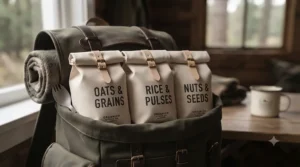
British camping is a lottery with a very reliable prize: damp. A tent porch, a rucksack lid, a picnic bench at 7am after overnight drizzle. Food that lives loose in a pack ends up squashed, soggy or scented like last night’s chorizo, which is an open invitation to every fox, crow and mouse in the postcode. A dedicated sack solves all of that for the price of a sandwich and a coffee.
This guide compares seven real, widely sold options and explains what their specs mean in practice, not just what they claim on the packet. Along the way you’ll get a clear view of what makes a value food storage sack, how a food sack for camping differs from a generic dry bag, and how basic campsite food storage works in the UK. There’s also a plain-English breakdown of waterproofing fabrics and where all this sits among budget camping essentials.
One thing to know first. Fabric waterproofing is usually quoted as hydrostatic head, a measurement in millimetres of the water column a fabric can hold back before it starts to seep. That single number explains a lot about why some bags shrug off a downpour and others merely tolerate it.
Food Storage Sack Under £15: Quick Comparison Table
Here’s the whole field at a glance. Prices are ranges at the time of research (September 2026) and will vary by size, colour and seller, so check current prices before you buy.
| Product | Fabric / build | Typical price range | Review signal | Best For |
|---|---|---|---|---|
| Lifeventure Ultralight Dry Bag | 30D siliconised ripstop, taped seams | around £8-£13 | Thin independent data; DofE-recommended kit | Lightest budget carry |
| Highlander Outdoor Lightweight Dry Bag | PU-coated polyamide, taped seams | around £11-£15 | Small pool, positive | Cheapest bigger sizes |
| Unigear Dry Bag | 500D PVC, welded seams | around £10-£15 | Rated 4/5 by one outdoor site | Rough handling |
| Osprey Ultralight Dry Sack | 40D recycled nylon, coated seams | around £11-£17 | About 4.7 stars, 550+ ratings (12L snapshot) | Neat packing |
| Sea to Summit Lightweight Dry Bag | 70D recycled nylon, taped seams | around £14-£18 | About 4.8 stars, 88 reviews (US retailer) | Durability on a budget |
| Highlander Tri-Laminate PVC Drybag | Tri-laminate PVC, welded seams | check current price | About 4.4-4.5 stars, polarised | Car camping, groups |
| LOKSAK OPSAK | Odour-barrier polymer film | around £10-£16 per pair | About 3.6-3.7 stars (REI) | Smell control |
Two things stand out. First, fabric weight drives almost everything: the nylon sacks (Lifeventure Ultralight Dry Bag, Osprey Ultralight Dry Sack, Sea to Summit Lightweight Dry Bag) are feather-light, while the PVC options (Unigear Dry Bag, Highlander Tri-Laminate PVC Drybag) trade grams for toughness. Second, the LOKSAK OPSAK isn’t a dry bag at all. It’s an odour barrier, and that changes what it’s good for.
💬 Just one click — help others make better buying decisions too!😊
Top 7 Food Storage Sack Under £15: Expert Analysis
Every pick below is judged on real specs, aggregated review themes and what the numbers mean on a wet campsite. Where I couldn’t verify solid review data, I say so rather than dress it up.
1. Lifeventure Ultralight Dry Bag — 30 g of DofE-approved lightness
The headline here is weight. The 5L size is about 30 g, and even the 25L is only around 60 g, so you can carry several without noticing. The fabric is 30D siliconised ripstop nylon with an inside PU coating, fully taped seams, a roll-top and a lightweight Kross buckle. In practice, that’s plenty for rain, wet grass and a splash, but it’s a thin skin, so don’t drag it across gravel.
The elliptical base lets the bag stand upright on a groundsheet, which matters when you’re rummaging for breakfast in a dim porch. On paper, the 10L suits a solo weekend’s dinners and breakfasts, and a 15L stretches to two people. The Duke of Edinburgh’s Award lists these on its recommended kit, which tells you youth expedition leaders trust them in damp conditions.
Review data: I couldn’t verify a large independent pool for this exact size, so treat the fabric spec and the DofE recommendation as the evidence, not star ratings.
Pros:
- ✅ Ultralight, roughly 30 g at 5L
- ✅ Taped seams and PU coating
- ✅ Colour-coded sizes make sorting easy
Cons:
- ❌ Thin 30D fabric punctures more easily
- ❌ Lightweight buckle feels less robust
Price: around £8-£13 depending on size. As a value food storage sack, it’s hard to beat for solo hikers counting grams.
2. Highlander Outdoor Lightweight Dry Bag — biggest capacity for the least cash
Highlander’s selling point is scale. The 13L listing I found was around £11-£12, and even the 25L stayed in the mid-£14 range. That makes it the sensible route when you’re feeding two or three people from one sack. The XTP LITE fabric is PU-coated polyamide taffeta with taped seams and a roll-and-clip closure.
Retailer listings for the V2 range quote a 10,000 mm water column, which is generous for a sack that lives inside a rucksack or under a tarp. In practice, big food bags fill up with heavy tins and pouches, so a coated fabric that stays supple matters more than headline numbers. My analytical take: choose this if the family or group cooks together and you’d rather buy one large sack than several small ones.
Review data: the handful of reviews I could find were small in number but positive, praising light weight and quick closing. That’s too few to draw firm conclusions, so I’d inspect the seams on arrival.
Pros:
- ✅ Large sizes still land under £15
- ✅ Taped seams on PU-coated fabric
- ✅ Simple roll-and-clip closure
Cons:
- ❌ Very limited review evidence
- ❌ Larger sizes get bulky when full
Price: around £11-£15 depending on size. Verdict: excellent budget camping essentials value for group trips, with the caveat of thin review evidence.
3. Unigear Dry Bag — welded-seam toughness for rough handling
This is the rugged option. The 500D PVC fabric is far heavier than nylon and the seams are high-frequency welded, so there are no needle holes to leak. The buckle and D-rings are made from POM, a hard plastic, and they’re specifically reinforced against snapping, which is a common failure point on cheap bags.
What that means on a campsite: the bag survives being kicked under a bench, dropped on a tent peg or wedged in a car boot. It also wipes clean, which suits greasy food residue. The bundled phone case and shoulder strap are aimed at paddlers, so they’re not much use for food duty. One outdoor testing site scored the Unigear range 4 out of 5 and gave it a “best lightweight” nod within a heavier PVC group. Note “lightweight” is relative here. It’s still heavier than any nylon sack above.
Review data: aggregated themes suggest a solid seal when rolled properly and few complaints, though I couldn’t verify a large UK sample.
Pros:
- ✅ Welded seams, no needle-hole leaks
- ✅ Tough 500D PVC resists abrasion
- ✅ Reinforced buckle and D-rings
Cons:
- ❌ Heavier and stiffer than nylon
- ❌ Strap and phone case rarely needed
Price: around £10-£15 depending on size. Verdict: the best waterproof food sack for hiking that also sees car-boot abuse.
4. Osprey Ultralight Dry Sack — rectangular shape packs like a brick
Osprey’s trick is geometry. Instead of a round tube, the sack is rectangular and stands up on its own, so it slots into a rucksack like a packed lunch box. The fabric is recycled 40D high-tenacity nylon with waterproof-coated seams, a roll-top and a hanging loop. The brand rates it IPX5, meaning it’s fine in rain and spray but not designed to be submerged.
On paper, the 6L (around £11) holds a weekend’s dinners for one, while the 12L (mid-teens) suits two. You can also squeeze the air out of a loaded sack through the roll-top before sealing, which saves rucksack space. Reviewers said the same, describing a vacuum-like compression without extra tools.
Review data: a listing snapshot for the 12L at the time of research showed about 4.7 stars from more than 550 ratings. Reviewers praise light weight, tidy packing and easy sealing. A common complaint is price relative to rivals, and one retailer review reported a tear during a river trip.
Pros:
- ✅ Rectangular shape stands and packs neatly
- ✅ Air-squeeze compression saves space
- ✅ Strong overall review sentiment
Cons:
- ❌ Thin fabric, one reported tear
- ❌ 12L can creep above £15
Price: around £11-£17 depending on size. Verdict: worth it if you value packing efficiency.
5. Sea to Summit Lightweight Dry Bag — sturdy nylon with a lifetime warranty
This is the stretch pick. The 8L usually sits around £14-£18, so you’ll want a sale price to keep it under budget. The reward is 70D recycled nylon, double-stitched and fully taped seams, a Hypalon roll-top with a field-repair buckle, and a white interior so you can spot the peanut butter at dusk. Retailer specs cite a 10,000 mm hydrostatic head, and the brand says it’s fine in rain but not for submersion.
Retailer copy even pitches the 8L as roughly three days of a solo hiker’s food. My analytical view: that’s optimistic for big eaters, but realistic for dehydrated meals and snacks. The oval base and D-ring add practical touches.
Review data: one US retailer showed about 4.8 stars from 88 reviews, with reviewers praising light weight and dryness on canoe trips. The notable complaint is buckle failure: one buyer of eleven bags reported two failing on first use.
Pros:
- ✅ Tough 70D fabric and Hypalon closure
- ✅ White interior helps in low light
- ✅ Warranty backing
Cons:
- ❌ Often above £15 unless discounted
- ❌ Some buckle failures reported
Price: around £14-£18. Verdict: the durability leader if you catch it on offer.

6. Highlander Tri-Laminate PVC Drybag — old-school armour for car camping
Think canoe-trip toughness. The tri-laminate PVC fabric, welded seams and roll-top are built to keep contents dry when the bag is being thrown into a boat or kicked around a campsite. It isn’t light: the medium (around 30L) weighs about 350 g. That’s a bad trade for a hiker, but a fine one when the boot is doing the carrying.
The size makes it a group or family food store, holding a weekend’s dry goods, breakfast bits and the kettle. The wipe-clean surface helps with sticky spills. Analytically, this is the pick for basic campsite food storage at a pitch you drive to.
Review data: listing snapshots show roughly 4.4-4.5 stars across a few dozen to about a hundred ratings, with a polarised split. Most give five stars, but around one in ten give one star. I couldn’t pin down a stable UK price, so prices vary by size and seller.
Pros:
- ✅ Rugged tri-laminate PVC construction
- ✅ Welded seams and wipe-clean surface
- ✅ Big enough for group food
Cons:
- ❌ Heavy for backpacking
- ❌ Price varies, so check first
Price: check current price. Verdict: a car-camping workhorse, not a hiker’s sack.
7. LOKSAK OPSAK — odour-barrier bags that go inside your dry sack
This is the odd one out, and the reason it earns a slot. It’s a resealable 5-mil barrier film with a double zip, designed to block food smells, and each bag weighs under an ounce. The maker says it meets food-contact standards, tolerates boiling water and can be reused until it wears out.
Wildlife tends to find food by scent, not sight. Putting your smelliest items (cheese, bacon, tuna pouches) in an OPSAK inside a dry sack gives you two layers: odour control and waterproofing. I’d rather do that than buy one super-thick bag.
Review data: one major outdoor retailer showed averages around 3.6-3.7 stars from over 100 reviews, with roughly 60% recommending. Buyers who liked it praised smell control when paired with a bear-resistant sack. Critics called it not especially sturdy and disposable after heavy use.
Pros:
- ✅ Blocks food odours effectively
- ✅ Food-grade and heat tolerant
- ✅ Featherweight and see-through
Cons:
- ❌ Mixed review scores overall
- ❌ Punctures ruin the barrier
Price: around £10-£16 per pair depending on size and seller. Verdict: a smart add-on, not a standalone sack.
Spec-by-Spec Comparison of All Seven Picks
| Product | Weight class | Seam type | Closure | Best For |
|---|---|---|---|---|
| Lifeventure Ultralight Dry Bag | Ultralight | Taped | Roll-top, Kross buckle | Solo hikers |
| Highlander Outdoor Lightweight Dry Bag | Light | Taped | Roll-and-clip | Groups on a budget |
| Unigear Dry Bag | Heavier | Welded | Roll-top, POM buckle | Rough handling |
| Osprey Ultralight Dry Sack | Ultralight | Coated | Roll-top | Tidy rucksack packing |
| Sea to Summit Lightweight Dry Bag | Light | Taped, double-stitched | Roll-top, Hypalon | Long-term durability |
| Highlander Tri-Laminate PVC Drybag | Heavy | Welded | Roll-top | Car camping |
| LOKSAK OPSAK | Ultralight | Zip seal | Double zip | Smell control |
The table shows a clear split. Backpackers should cluster around the nylon sacks, and campers who drive to a pitch can afford the heavier PVC bags. The LOKSAK OPSAK slots in with either group as a scent barrier.
✨ Don’t Miss These Exclusive Deals!
🔍 Take your camping food storage to the next level with these carefully selected products. Click on any highlighted item to check current pricing and availability. These sacks will help you keep every trip’s meals dry, organised and wildlife-proofed!
How to Use a Food Sack for Camping: Setup, Packing and Care
A food sack for camping only works if you treat it like a system. Start with a home test: fill the sack with a litre of water, roll the top down at least three times, clip it and hold it upside down over the sink. Any drip means a returnable defect, and it’s much better to find that out on the kitchen floor than in a Lakeland downpour.
Pack in a sensible order. Put heavy tins and pouches at the bottom, and keep breakfast items near the top so you can reach them without emptying the lot. Colour-code by meal if you own several sacks, such as one for dinners and one for snacks. Before sealing, squeeze out excess air. You don’t need it airtight, but a flatter sack sits better in your pack.
After a trip, turn the sack inside out, wipe crumbs, rinse with lukewarm water and a drop of washing-up liquid, then air-dry fully before storing. A damp sack turns musty quickly, and that smell defeats the point.
Common mistakes in the first 30 days: overfilling (which prevents proper rolling), rolling only once or twice, storing the sack scrunched with the buckle bent, and leaving greasy crumbs to fester. Fix those four habits and even a modest food storage sack under £15 will feel like a premium bit of gear.

Basic Campsite Food Storage: Real-World Scenarios
Here’s how basic campsite food storage plays out for three typical UK campers.
The Duke of Edinburgh group leader. You’re packing for six teenagers on a wet weekend expedition, and every pound matters. A set of Lifeventure Ultralight Dry Bag sacks in different sizes lets each participant carry a colour-coded meal sack. The DofE recommendation adds reassurance, and the taped seams cope with the classic soggy-hedge scenario.
The weekend car camper in the Peak District. You have a family tent, a pitch near woodland and a fox that’s clearly done this before. Here I’d pair a Highlander Tri-Laminate PVC Drybag with a LOKSAK OPSAK for the smelliest items. Keep the sack in the car overnight if you can. The Mountaineering Council of Scotland’s wild camping good practice guide is a helpful read on campsite behaviour, even if you’re staying south of the border.
The solo Highland backpacker. Grams matter, and you need dry food after river crossings. The Osprey Ultralight Dry Sack in 6L or 12L and a Sea to Summit Lightweight Dry Bag for spare layers gives you a lightweight, sealed system. Hang the food sack from a branch or stash it away from your tent, at least a few metres downwind.
In all three cases, the principle is the same: separate food from sleeping space, seal it, and keep it clean. That’s the heart of basic campsite food storage, and it costs very little.
Problem-to-Solution Guide: Common Food Sack Headaches
Problem: the sack leaks. Check the seams first, then the closure. Roll the top at least three times and make sure the buckle clicks fully. If the seam itself weeps, use it for dry goods inside your pack and replace it.
Problem: the sack smells. Wash after every trip and air-dry it open. For strong-smelling meals, put them in a LOKSAK OPSAK inside the sack, which keeps the odour off the fabric.
Problem: the sack is too big or too small. Use the litre guide in the choosing section below. Oversized sacks get half-filled and flop around, and undersized ones won’t roll.
Problem: litter and waste. A food sack doubles as a rubbish carrier. VisitScotland’s outdoor access code guidance is blunt that campers should take away all belongings and litter, and leave no trace. Dedicate one sack (or a spare Highlander Outdoor Lightweight Dry Bag) to rubbish so wrappers never sit next to your breakfast.
Problem: wildlife visits. No sack is animal-proof. The realistic fix is distance and odour control: store food away from your tent, sealed, and keep the smelliest items double-bagged.
How to Choose a Food Storage Sack Under £15
Choosing well comes down to six steps, in this order.
- Set a realistic capacity. Roughly 5-8L for one person’s overnight food, 10-13L for a solo weekend, 15L or more for two people. Dehydrated meals pack tighter than fresh food.
- Match weight to how you travel. Backpacking favours nylon (under 100 g). Car camping tolerates heavier PVC.
- Check the seams. Taped seams and welded seams both work. Plain stitched seams without tape will leak.
- Inspect the closure. A roll-top with a decent buckle is the standard. Field-repairable buckles are a bonus.
- Look at the waterproofing type. Fabric ratings matter less than build quality for a sack that stays inside a pack.
- Check the price, and remember the bag is rarely the only cost. If it’s over £15, ask whether a discount, a smaller size or a cheaper alternative gets you the same result.
Waterproofing Fabrics Explained: What the Numbers Really Mean
Understanding waterproofing fabrics saves you money. The two main families are coated nylon and PVC. Coated nylon (like the 30D, 40D and 70D sacks above) is light and packable, and its waterproofing comes from a polyurethane layer, often on the inside. Higher “D” numbers, such as 70D, indicate a thicker, tougher yarn. PVC (500D, tri-laminate) is heavier, stiffer and highly abrasion-resistant.
Seams are the weak point of any waterproof fabric. Taped seams use waterproof tape over needle holes, and welded seams fuse the material with heat, which is why welded PVC sacks tend to be more robust. A hydrostatic head figure such as 10,000 mm tells you how well the fabric itself resists water pressure, but it says nothing about seam quality or closure.
Also watch the wording. “Waterproof” often means “waterproof unless submerged”. The Sea to Summit Lightweight Dry Bag and the Osprey Ultralight Dry Sack are both explicit that they aren’t designed for submersion. For food inside a rucksack or under a tarp, that’s completely fine. Just don’t count on them to survive a dunking.

Long-Term Cost: Is a Value Food Storage Sack Actually Worth It?
A value food storage sack isn’t just about the sticker price. Divide the cost by the nights you’ll use it. A £12 sack used across 40 nights over a few seasons works out at about 30p a night. A cheaper one that fails after five trips costs more per night, plus the annoyance of replacing it.
| Option | Upfront cost | Lifespan | Cost per use |
|---|---|---|---|
| Lifeventure Ultralight Dry Bag | low | moderate | very low |
| Unigear Dry Bag | low-mid | long (thick PVC) | low |
| Sea to Summit Lightweight Dry Bag | mid-high | long, with warranty | low |
| LOKSAK OPSAK | low-mid | short (disposable) | higher |
The table shows the trade-off: robust PVC or warrantied nylon pays back over years, and the disposable LOKSAK OPSAK costs more per use but earns its place for smelly food. In my view, the sweet spot for most campers is one durable sack (Unigear Dry Bag or Sea to Summit Lightweight Dry Bag) plus one lighter spare, not a drawer of cheap ones.
Waterproof Food Sack for Hiking vs Zip Bags, Bear Canisters and Plastic Tubs
A waterproof food sack for hiking competes with several alternatives, and each has a job.
| Option | Weight | Waterproof | Animal-resistant | Best For |
|---|---|---|---|---|
| Waterproof food sack (e.g. Osprey Ultralight Dry Sack) | Very light | Yes (roll-top) | No | Most UK hikers |
| Freezer zip bags | Very light | Splash only | No | Short day trips |
| Bear canister | Heavy, bulky | Yes | Yes | Bear country |
| Plastic tub | Moderate | Mostly | Somewhat | Car camping |
Freezer bags are cheap but tear and pop open. Hard canisters are unnecessary in Britain, where there are no bears. A dry sack hits the balance: light, tough and, with a smell-blocking liner such as the LOKSAK OPSAK, reasonably discreet. It won’t stop a determined badger, but it protects food from rain and keeps your kit organised.
Common Mistakes When Buying a Food Storage Sack Under £15
The first mistake is buying purely on price. A £5 bag with untaped stitched seams looks identical online but leaks in real rain. Check for taped or welded seams.
The second is choosing the wrong size. A 20L sack for one person’s dinners flops around, and a 5L sack won’t fit a weekend of food. Match the size to the trip.
The third is trusting “waterproof” without reading the small print. Many bags are splash-proof, not submersible.
The fourth is skipping the odour question. Buyers focus on water and forget that smell is what attracts wildlife. Adding a LOKSAK OPSAK for strong-smelling items is a cheap fix.
The fifth is sealing food that’s still damp. Wet crumbs in a closed sack turn sour by day two, so let cookware and wrappers dry before packing.
Finally, don’t ignore the buckle. Buckle failures were a recurring complaint in reviewer feedback for sturdier brands, so test yours at home.
Budget Camping Essentials: Where a Food Sack Fits in Your Kit
If you’re building a kit on a tight budget, budget camping essentials fall into a sensible order: shelter, sleep system, stove, water, then organisation. A food sack lives in the last group, and that’s precisely why it punches above its weight. It costs little, weighs almost nothing and protects the most expensive consumable you carry: your food.
A sensible starter set might be one dry sack for food, one for clothes and one small one for electronics, all in different colours. That’s three bags for roughly the price of a single premium sack. Where I’d spend a little more is on the item you’ll open most, which is the food sack.
Safety, Regulations and Wildlife: What UK Campers Should Know
Britain has no bears, but it does have foxes, badgers, corvids, rodents and, in parts of the Highlands, pine martens and deer. A sealed sack reduces the temptation but doesn’t eliminate it. Keep food away from your tent, don’t cook or eat inside it, and never leave scraps.
If you camp in Scotland, access rights come with responsibilities. The Scottish Outdoor Access Code’s camping leaflet explains that access rights depend on responsible behaviour and includes advice on litter and waste. In England and Wales, camping rules are different and generally require landowner permission, so check before pitching.
There are no UK regulations governing dry bags themselves. Look for clear manufacturer claims and warranty terms, and store food with care to avoid food-safety problems in hot weather.

FAQ
❓ What size food storage sack do I need for a weekend camp?
❓ Are cheap dry bags really waterproof?
❓ Will a food sack keep animals out?
❓ Can I put hot food or boiling water in a dry sack?
❓ How do I clean and dry a camping food sack?
Conclusion
A good food storage sack under £15 is one of those quietly brilliant pieces of camping kit. It costs less than a takeaway, weighs less than a bar of chocolate and saves you from soggy, squashed, smelly meals. The right choice depends on how you travel: the Lifeventure Ultralight Dry Bag and Osprey Ultralight Dry Sack suit backpackers, the Highlander Outdoor Lightweight Dry Bag covers groups, and the Unigear Dry Bag and Highlander Tri-Laminate PVC Drybag suit rougher, heavier use. The Sea to Summit Lightweight Dry Bag rewards patient bargain-hunters, and the LOKSAK OPSAK is a smart add-on for smelly food.
If I had to keep it simple, I’d buy one sturdy sack for the food and a second lightweight one for spares, then add an odour liner for anything pungent. That combination covers most UK trips at a total cost that still sits comfortably within a sensible budget.
Recommended for You
- Odour-Proof Bear Bag: 7 Best Picks For UK Adventurers (2026)
- Bear Bag For Backpacking: 7 Proven Picks For UK Hikers (2026)
- Bear Bag Kit Under £30: 7 Best Picks for UK Campers (2026)
Disclaimer: This article contains affiliate links. As an Amazon Associate, I earn from qualifying purchases. If you purchase products through these links, we may earn a small commission at no additional cost to you.
✨ Found this helpful? Share it with your friends! 💬🤗
