
In This Article
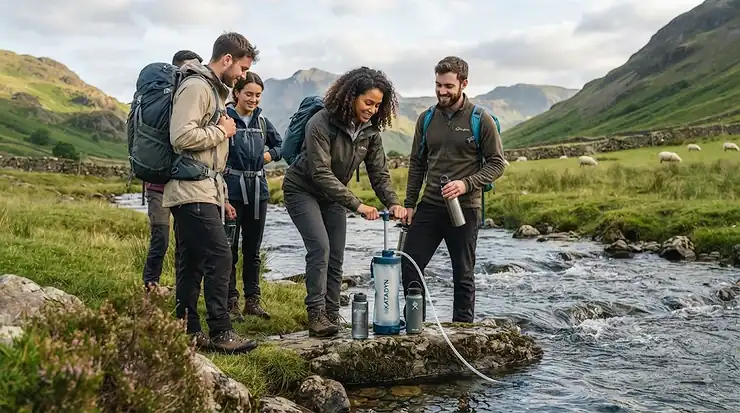
A pump water filter for group expeditions is a hand-operated filtration system built to process large volumes of water quickly enough to keep a whole team hydrated, rather than just one person sipping from a bottle. Unlike ultralight squeeze filters designed for solo backpackers, these units prioritise flow rate, cartridge lifespan and field durability, because when there are six, eight, or twelve mouths to fill twice a day, a slow filter isn’t an inconvenience — it’s the thing that eats your entire evening.
Anyone who has actually run camp logistics for a group knows the maths gets brutal fast. A single trekker needs roughly 2-3 litres a day for drinking alone, more if you’re cooking, washing up, or sweating through a Highland bog in August. Multiply that by a group of eight and you’re suddenly needing 20+ litres before breakfast is even on the stove. Try that with a filter rated at half a litre a minute and you’ll be pumping until your forearm files a formal complaint.
This guide walks through seven real, currently available pump filters — from budget field-maintainable units to expedition-grade purifiers used by relief organisations — with honest analysis of who each one actually suits. We’ll lean on genuine specs, aggregated reviewer sentiment, and practical guidance for UK-based groups heading into the hills, along the coast, or further afield. As Mountaineering Scotland’s drinking water advice notes, clear flowing water above habitation is generally the safest source, but “generally safe” still isn’t a gamble worth taking with eight people relying on the same tap. This is where a proper pump earns its keep, and it’s a genuinely useful primer if you’re new to backcountry water sourcing before we get into gear below.
Quick Comparison Table
| Product | Flow Rate | Best For | Price Range |
|---|---|---|---|
| MSR MiniWorks EX | ~1 L/min | Budget groups, field maintenance | around £90-£110 |
| Katadyn Combi | ~1 L/min | Small groups (up to 3), better taste | around £90-£110 |
| Katadyn Vario | 1-2 L/min | Mixed group sizes, adjustable flow | around £110-£140 |
| Katadyn Pocket | ~1 L/min | Long expeditions, 20-year lifespan | around £300-£340 |
| First Need XLE Elite | ~2 L/min | Groups travelling abroad, virus risk | around £180-£220 |
| MSR Guardian Purifier | ~2.5 L/min | Demanding groups, self-cleaning | around £370-£410 |
| Katadyn Expedition | ~4 L/min | Basecamps, large mobile groups | around £750-£850 |
Looking at the spread above, the gap between the Katadyn Combi and the Katadyn Expedition isn’t just price — it’s an entirely different category of use. Budget pumps ask you to trade speed for cost, while the high-flow options at the top of the table are built specifically to solve the “twelve people, one water source, thirty minutes before we need to be walking” problem. If your group tops six people or camps together for more than a weekend, flow rate should weigh more heavily in your decision than sticker price.
💬 Just one click — help others make better buying decisions too!😊
Top 7 Pump Water Filters for Group Expeditions: Expert Analysis
Coverage below spans budget, mid-range and premium options, plus a couple of lesser-known picks that punch above their price point. Every specification is followed by what it actually means when you’re the one holding the pump handle at 6am.
1. MSR MiniWorks EX — best budget entry point for field maintenance
The MiniWorks EX pairs a 0.2-micron ceramic element with an internal carbon core, and that carbon stage is the detail worth dwelling on. Most rivals at this price only filter; the MiniWorks also strips out the flat, chemical taste that ruins morale on longer trips. Flow sits around 1 litre per minute from clear sources, dropping as the ceramic clogs, though the field-cleanable design means you scrub it back to near-original speed with the included pad rather than replacing anything. Based on the spec comparison, this is the filter that rewards groups willing to trade a little pumping effort for genuine long-term economy — the cartridge is rated to roughly 2,000 litres and the ceramic shell can be cleaned dozens of times over.
Reviewers consistently report that it’s reliable to the point of boring — in a good way — with several long-term owners noting it still performs after a decade of intermittent use. The recurring complaint is maintenance frequency in silty water, where flow can drop noticeably every few litres and demand another scrub.
Pros:
- ✅ Field-cleanable ceramic keeps flow rate restorable indefinitely
- ✅ Carbon core genuinely improves taste over pure membrane filters
- ✅ Backed by a strong reliability track record among UK hillwalkers
Cons:
- ❌ Requires frequent scrubbing in turbid or peaty water
- ❌ Doesn’t remove viruses, so needs pairing with tablets abroad
Sitting around £90-£110 at the time of research, the MiniWorks EX is the sensible baseline for a group that filters from clear UK streams and wants gear that lasts years, not seasons.
2. Katadyn Combi — best dual-stage taste upgrade for groups of three
The Combi bolts a replaceable activated carbon stage onto Katadyn’s classic 0.2-micron ceramic depth filter, giving you two filtration methods in one housing. What most buyers overlook about this model is the simple switch to single-stage ceramic-only operation, which lets you skip carbon replacement entirely on short trips where taste matters less than speed. Output runs close to 1 litre per minute, and the ceramic element alone is rated to an enormous 50,000 litres, though the carbon cartridge needs swapping roughly every 400 litres or two fillings.
Katadyn positions the Combi as suited to groups of up to three, and reviewer sentiment backs that framing — long-term owners praise the sweet water it produces but flag that Katadyn has scaled back official support for the model, meaning UK stockists carrying remaining inventory are worth checking before committing.
Pros:
- ✅ Ceramic element rated for tens of thousands of litres
- ✅ Optional carbon stage noticeably improves taste and odour
- ✅ Simple switch between one-stage and two-stage filtering
Cons:
- ❌ Increasingly hard to find as Katadyn phases out support
- ❌ Piston action feels less ergonomic than lever-style pumps
At around £90-£110, the Combi is worth grabbing from UK outdoor retailers while stock remains, but it’s a poor fit for anyone planning to rely on it for a decade of trips given the uncertain spares supply.
3. Katadyn Vario — best adjustable flow rate for mixed group sizes
The Vario’s dual-piston mechanism switches between “Longer Life” mode, which pre-filters through a ceramic disc at roughly 1 litre per minute, and “Faster Flow” mode, which bypasses the ceramic for up to 2 litres per minute through the glass fibre element alone. Here’s what to weigh: that flexibility is genuinely useful for groups moving between clear alpine streams and murkier lowland water sources on the same trip, because you’re not locked into one trade-off.
Aggregated reviewer sentiment is broadly positive — one long-serving wilderness trips coordinator specifically chose the Vario for group programmes after years running a Katadyn Pocket, citing the higher rated capacity. That said, a meaningful minority of reviews describe suction failures and seal problems developing mid-trip, which is worth flagging honestly rather than glossing over.
Pros:
- ✅ Two flow modes suit both clear and turbid water sources
- ✅ 2,000-litre glass fibre cartridge offers strong value per litre
- ✅ Activated carbon stage improves taste on top of filtration
Cons:
- ❌ A notable minority report seal or suction failures on longer trips
- ❌ Bulkier and heavier than single-mode pumps in its price bracket
Priced around £110-£140, the Vario suits groups whose water sources vary trip to trip — just pack a spares kit if you’re heading somewhere remote enough that a seal failure would actually matter.
4. Katadyn Pocket — best 20-year expedition workhorse
In production in various forms since 1928, the Pocket is built around a silver-impregnated ceramic element that’s field-cleanable by hand, with Katadyn backing it with a 20-year warranty most manufacturers simply won’t match. The spec sheet won’t tell you this, but user reports suggest the roughly 1 litre per minute flow rate demands real forearm effort — filtering 20 litres for a group of four takes about 20 minutes of sustained pumping, which on a rotating-duty basis is entirely manageable but genuinely tiring done solo.
What most buyers overlook is that the Pocket’s appeal isn’t speed at all — it’s certainty. Reviewers across multiple independent test sites describe it as the filter you choose because it works with absolute reliability over decades, not because pumping it is pleasant. The aluminium housing shrugs off drops that would crack cheaper plastics.
Pros:
- ✅ 50,000-litre lifespan with a genuine 20-year warranty
- ✅ Field-cleanable ceramic restores flow without spare parts
- ✅ Aluminium housing survives drops and rough handling
Cons:
- ❌ Noticeably heavier arm workout than hollow-fibre alternatives
- ❌ One of the heaviest and bulkiest pumps in this line-up
At around £300-£340, the Pocket carries a genuine expedition price tag, but spread across its multi-decade service life, the cost-per-litre works out remarkably low for groups who’ll actually use it for years.
5. First Need XLE Elite — best virus protection for travel expeditions
The First Need XLE Elite is one of the only pump-style systems on this list that purifies rather than simply filters, using Structured Matrix technology independently tested against the EPA’s Guide Standard for microbiological purifiers covering bacteria, cysts and viruses. Reviewers consistently note that this virus-removal capability is what separates it from ceramic-only filters, making it the more sensible choice for groups travelling to regions where sewage-contaminated water is a realistic risk rather than a remote possibility.
Based on the spec comparison, the trade-off is cartridge lifespan: at roughly 180 gallons (around 680 litres), the canister needs replacing far sooner than a Katadyn ceramic element, and replacement canisters aren’t cheap. The included gravity-feed bag is a genuinely practical add-on for groups, letting you set up hands-free filtration for camp duty rather than pumping every drop manually.
Pros:
- ✅ Certified purification against bacteria, cysts and viruses
- ✅ Gravity-feed bag option reduces manual pumping for camp use
- ✅ Roughly 2 litres per minute — among the faster pumps here
Cons:
- ❌ Shorter cartridge life than ceramic-based competitors
- ❌ Replacement canisters add meaningfully to long-term cost
At around £180-£220, this sits mid-pack on price but earns its place for any group whose expedition crosses borders where viral contamination is a genuine concern rather than a UK hillside stream.
6. MSR Guardian Purifier — best premium self-cleaning purifier for demanding groups
The Guardian is the filter multiple independent reviewers describe, almost without exception, as the most refined pump on the market. It purifies down to virus level via hollow-fibre technology, meets NSF Protocol P248 — the US military’s own testing standard — and self-cleans on every single pump stroke, meaning there’s no backflushing and no scrubbing required across its 10,000-litre cartridge life. Reviewers consistently note the flow rate as the standout feature: roughly 2.5 litres per minute, with independent testing clocking a full litre in around 37 seconds.
What most buyers overlook is how that self-cleaning mechanism changes the maths for a group. A filter that maintains consistent flow across thousands of litres, rather than degrading and demanding constant maintenance, is worth far more to a team than its price tag suggests once you account for the collective time saved. The honest downside, echoed across nearly every review found in research, is weight and bulk — at around 490g and roughly the size of a large water bottle, it’s not a filter you forget you’re carrying.
Pros:
- ✅ Purifies bacteria, protozoa and viruses via self-cleaning hollow fibre
- ✅ 10,000-litre cartridge life, among the longest on this list
- ✅ Fastest tested flow rate of any pump filter covered here
Cons:
- ❌ Heaviest and bulkiest option outside the Expedition
- ❌ Premium price puts it out of reach for casual weekend groups
At around £370-£410, the Guardian is genuinely expensive, but for a group running serious mileage through variable water quality — including travel abroad — reviewers overwhelmingly agree it earns the outlay.
7. Katadyn Expedition — best high-flow system for large basecamp groups
Built for a different scale of problem entirely, the Katadyn Expedition uses the same silver-impregnated 0.2-micron ceramic technology as the Pocket, scaled up into a housing that pumps roughly 4 litres per minute — by some measures the highest flow rate of any portable filter available. The cartridge is rated for an enormous 100,000 litres, though it weighs close to 5.8kg, which immediately rules it out for anything carried on foot for long distances.
Here’s what to weigh: aggregated commentary from users running large-group and relief-style operations consistently frames the Expedition as the right call specifically when a smaller filter simply can’t keep pace with demand — one detailed comparison notes the flow rate is roughly quadruple the Pocket’s, while cartridge lifespan is only around double, meaning you’re paying a substantial premium purely for speed. For a fixed or vehicle-supported basecamp serving eight, ten, or more people, that trade is worth making. For a backpacking group carrying everything themselves, it almost never is.
Pros:
- ✅ Highest flow rate of any portable filter covered in this guide
- ✅ 100,000-litre cartridge life dramatically lowers long-term cost
- ✅ Proven in demanding mobile-group and relief-style deployments
Cons:
- ❌ At roughly 5.8kg, unsuitable for anything carried on foot
- ❌ Significant upfront cost relative to per-litre savings
Around £750-£850 at the time of research, the Expedition is a specialist purchase — brilliant for vehicle-supported basecamps, overkill for almost anyone else on this list.
Setting Up and Maintaining Your Pump Water Filter for Group Expeditions
Getting a group pump filter working well from day one comes down to habits, not luck. Before you leave, run every filter through a full priming cycle at home — pump a few litres through into a sink so you know it works and everyone in the group has actually handled it once, rather than fumbling with an unfamiliar mechanism at a riverbank in the rain.
On site, source water from moving streams above any habitation or livestock where possible, and always keep the intake hose weighted or floated so it doesn’t drag silt off the streambed. A cheap coffee filter or bandana pre-filter over the intake extends ceramic life dramatically in peaty Scottish or Welsh water, where fine sediment is often the real enemy rather than the pathogens themselves.
The single most common first-30-days mistake is letting the filter freeze. A cracked ceramic element is invisible until it fails catastrophically mid-trip, so anyone camping in shoulder-season conditions should sleep with the filter in their sleeping bag on cold nights. Equally common: forgetting to fully dry and store the unit after the trip, which invites mould in carbon stages and bacterial growth in housings. Rotate pumping duty across the group — nobody’s forearm should be doing all the work by day three.
Group Camping Checklist: Water Gear to Pack Before You Go
A pump filter is only as good as the kit supporting it. Before any group camping trip, run through this checklist so nobody’s left improvising at the water’s edge.
- Primary pump filter matched to group size, plus a documented backup plan if it fails
- Spare O-rings and a cleaning pad — the single most common field failure across every filter reviewed here is a worn seal, not the filter media itself
- Collapsible water containers (10-20L) so filtered water can be batch-processed once rather than bottle by bottle
- Water purification tablets as genuine backup, not decoration — useful if the pump fails or a virus risk is suspected
- A dedicated “dirty water” vessel to keep unfiltered water clearly separated from treated supply
- Rotating duty roster written into the trip plan, so pumping fatigue never falls on one person
Case in point: a university expedition society running a nine-person trip to the Cairngorms found their single Katadyn Vario couldn’t keep pace with breakfast demand until they added a 20-litre collapsible container and started batch-filtering the night before — a logistics fix, not a gear failure, and one that cost nothing beyond forward planning.
How to Choose a Pump Water Filter for Group Expeditions
Picking the right unit comes down to seven practical questions, each with a clear reasoning behind it.
- Count your group size honestly. Filters rated under 1.5 L/min struggle past four or five people; larger groups need the higher-flow options covered above.
- Assess your water sources. Clear UK streams need less filtration muscle than turbid, silty, or livestock-adjacent water abroad.
- Decide if virus protection matters. UK backcountry water rarely carries viral risk, but international expeditions usually need a purifier, not just a filter.
- Weigh portability against basecamp use. Anything carried on foot for days needs to stay under roughly 700g; vehicle-supported camps can go heavier.
- Check cartridge lifespan against trip frequency. A ceramic element rated to 50,000 litres is wasted money for one annual trip; it’s essential for a club running weekly outings.
- Factor in field maintainability. Ceramic elements that self-clean in the field beat sealed cartridges for remote, multi-week expeditions.
- Budget for spares, not just the unit. O-rings, replacement carbon, and a backup purification method should sit in every group’s kit list, not just the filter itself.
| Comparison Point | Budget Pump | Premium Purifier |
|---|---|---|
| Typical flow rate | 1 L/min | 2-4 L/min |
| Removes viruses | Rarely | Usually |
| Best For | Occasional weekend groups | Frequent or international expeditions |
The pattern here is straightforward: budget pumps handle the vast majority of UK group camping trips perfectly well, but the moment your group travels internationally, grows past six or seven people, or heads out weekly rather than occasionally, the maths tips decisively toward the premium end of the table.
Pump Water Filter for Family Camping
Family trips introduce a different set of priorities than an adult-only expedition, and it’s worth being honest about what changes. Weight and simplicity move up the priority list, because you’re often carrying a child’s gear alongside your own, and a filter with a fiddly multi-stage assembly is the last thing you want to manage while also watching younger campers near open water.
For most family groups of four to six, a mid-range option like the Katadyn Vario or MSR MiniWorks EX hits the right balance — capable enough to keep a family hydrated without the bulk of expedition-grade units. Reviewers consistently note that families camping regularly in the UK rarely need virus-level purification, since the risk profile of a clear Lake District beck is very different from water sourced abroad. What matters more is a filter simple enough that an older child or less experienced partner can operate it confidently, since sharing pumping duty keeps everyone invested and nobody exhausted.
One genuinely useful family-specific tip: keep the filter and its intake hose in a dedicated dry bag separate from food, since a torn hose mid-trip is a much bigger problem for a family relying on a single filter than for a larger group carrying a backup.
Top Pump Water Filters for Wild Camping
Wild camping in the UK — legally straightforward in Scotland under the Land Reform (Scotland) Act, more nuanced in England and Wales — puts specific demands on a filter that basecamp use doesn’t. You’re carrying everything, sourcing from unpredictable streams, and often camping somewhere without a clear water source right at the pitch.
For wild camping specifically, the MSR MiniWorks EX and Katadyn Pocket stand out for different reasons. The MiniWorks wins on weight-to-capability ratio for weekend trips; the Pocket wins on raw reliability for multi-week routes like the Cape Wrath Trail, where a filter failure days from resupply is a genuinely serious problem, not just an inconvenience. The Katadyn Vario‘s dual-mode flexibility also suits wild campers moving between water sources of varying clarity across a single trip.
| Method | Speed | Group Suitability | Best For |
|---|---|---|---|
| Pump filter (e.g. Katadyn Pocket) | Moderate | Excellent for 4-8 people | Multi-day wild camping routes |
| Gravity filter | Slow, hands-free | Good, but needs hanging point | Basecamp-style pitches |
| Purification tablets | Instant dosing, 30+ min wait | Poor for large volumes | Emergency backup only |
Reading across that comparison, pump filters consistently win for wild camping groups specifically because they don’t depend on a hanging point or fixed setup time the way gravity systems do — you can filter directly into a bottle from an awkward streamside pitch in minutes. Tablets remain worth carrying as backup, but as the sole method for a group of five or more, the wait time becomes genuinely impractical.
Shared Water Sourcing: Getting It Right on Group Trips
Sharing a single filtration point across a group introduces hygiene considerations that solo hikers never have to think about. The core rule, echoed by UK mountaineering bodies, is simple: draw water upstream of where anyone has washed themselves, cooking pots, or clothing, and never let the “dirty” intake hose touch a bottle mouth that’s about to hold filtered water.
Cross-contamination risk rises with group size, not falls, because more people means more hands touching the pump, more opportunities for someone to dip an unwashed bottle into the filtered supply, and more variation in how carefully each person follows the protocol. Nominating one or two people as “water officers” for the trip — responsible for sourcing, filtering and distributing — measurably reduces this risk compared to an ad hoc free-for-all.
It’s also worth understanding what you’re actually protecting against. NHS Fit for Travel’s guidance on waterborne illness outlines cryptosporidiosis as a genuinely common cause of gastrointestinal illness linked to contaminated water, with symptoms that can persist for weeks — precisely the kind of trip-ruining, hard-to-treat illness a decent pump filter is designed to prevent.
Expedition Logistics: Planning Water Provision for Larger Teams
Expedition logistics for water provision starts well before departure. Map every planned water source in advance using OS mapping, note which are running streams versus standing water, and build filtering time into the daily schedule rather than treating it as an afterthought squeezed in before breakfast.
For groups above roughly eight people, a single filter — even a fast one — usually becomes a bottleneck. Running two mid-range pumps in parallel, such as a pair of Katadyn Vario units, often outperforms one premium filter on total group throughput, since you’re not queueing the whole team behind one pump handle. This is a genuine trade-off worth costing out: two mid-range filters at around £110-£140 each can beat a single £750-£850 Katadyn Expedition on total speed for teams under about ten people, though the Expedition still wins decisively for larger, vehicle-supported camps.
If your expedition crosses into Scotland, it’s worth knowing your rights and responsibilities as a group under the Scottish Outdoor Access Code, which specifically addresses responsible group camping practices, including keeping groups small and well away from water sources when pitching, which directly supports the shared-sourcing hygiene practices covered above.
| Team Size | Recommended Setup | Est. Cost Range |
|---|---|---|
| 2-4 people | One mid-range pump (Vario or MiniWorks EX) | £90-£140 |
| 5-8 people | One premium pump (Guardian or First Need XLE Elite) | £180-£410 |
| 9+ people, basecamp | Katadyn Expedition or two parallel mid-range pumps | £220-£850 |
The table above interprets fairly simply: cost per person actually falls as group size rises, since a £750 Expedition filter split across a twelve-person basecamp works out cheaper per head than a £100 filter serving two people, once you account for how many trips that gear will see over its multi-decade lifespan.
Common Mistakes When Buying a Pump Filter for Groups
The most expensive mistake groups make is buying for solo backpacking specs and expecting group performance. A filter reviewed glowingly for a single hiker’s needs can become a genuine liability when eight people are queuing behind it every morning — check flow rate specifically for group scenarios, not just headline capacity figures.
A second common error is ignoring cartridge lifespan against actual trip frequency. Buying a 50,000-litre Katadyn Pocket for one annual camping trip ties up capital that would be better spent on a cheaper filter plus better tents. Conversely, clubs running weekly outings who buy budget filters end up replacing cartridges so often that the premium option would have paid for itself within a year or two.
Finally, groups frequently forget spares entirely. A single failed O-ring can take a filter out of action completely, and without a backup purification method — even simple tablets — that failure becomes the whole group’s problem, not a minor inconvenience.
Safety, Regulations and Long-Term Costs
UK drinking water regulations don’t typically apply to backcountry sourcing in the way they do to mains supply, which is precisely why personal responsibility for treatment matters so much for groups. The 2024 Devon cryptosporidiosis outbreak, which affected thousands of households after contamination entered the mains supply and left 17,000 properties under a boil water notice, is a useful reminder that even treated water infrastructure isn’t infallible — backcountry sources deserve at least the same caution. It happened to mains-fed households, not backcountry campers, which makes the underlying lesson sharper: if treated infrastructure can fail, an unfiltered hill stream deserves no less caution.
On long-term cost, the maths generally favours investing more upfront for groups that camp regularly. A £100 filter replaced every two seasons across a decade costs roughly the same as one £350 purifier that lasts the full ten years — but the purifier also removes viruses the budget option can’t, meaning the extra spend buys genuine risk reduction, not just convenience.
Frequently Asked Questions
❓ How many people can one pump water filter for group expeditions serve?
❓ Do pump filters remove viruses as well as bacteria?
❓ How often should a group pump filter be cleaned in the field?
❓ Is a pump filter better than a gravity filter for group camping?
❓ What's the realistic lifespan of a group expedition water filter?
Conclusion
Choosing a pump water filter for group expeditions really comes down to being honest about your group’s actual size, trip frequency, and where you’re sourcing water. A weekend group of four filtering clear Welsh streams has completely different needs from a twelve-person basecamp running for a fortnight, or a family trip prioritising simplicity over raw flow rate.
Across the seven models covered here, there’s no single “best” — the MSR MiniWorks EX and Katadyn Combi suit budget-conscious small groups perfectly well, the Katadyn Vario and Katadyn Pocket cover the reliable mid-to-premium middle ground most UK expedition groups actually need, and the MSR Guardian Purifier and Katadyn Expedition exist for genuinely demanding scenarios most casual campers will never encounter. The First Need XLE Elite carves out its own niche for international travel where viral risk is real. Match the filter to the trip, not the other way round, and pumping water stops being the chore that eats your morning and just becomes part of the routine.
Recommended for You
- 7 Best Pump Water Filter for Camping Picks 2026
- Water Filter for Duke of Edinburgh Expedition: 7 Best Picks 2026
- Best Water Filter for Emergency Preparedness UK: 7 Picks (2026)
Disclaimer: This article contains affiliate links. As an Amazon Associate, I earn from qualifying purchases. If you purchase products through these links, we may earn a small commission at no additional cost to you.
✨ Found this helpful? Share it with your friends! 💬🤗
