
In This Article
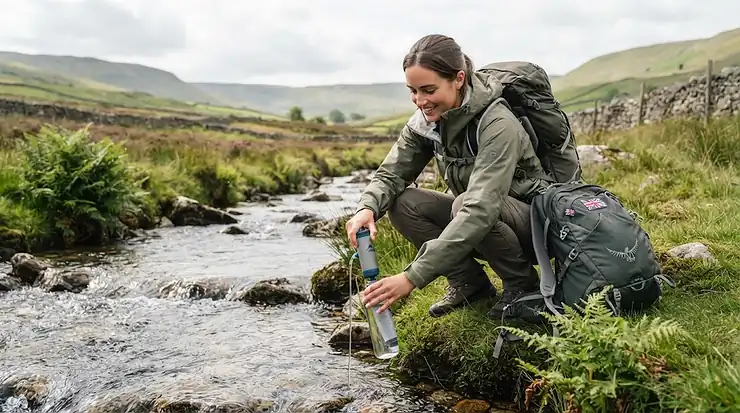
There’s a particular kind of dread that sets in when your last bottle runs dry and the only water in sight is a peaty Highland burn or a suspiciously still pond. A pump water filter for camping solves that problem the old-fashioned way — no batteries, no waiting around for chemical tablets to work their magic, just your own arm doing the work and a hollow-fibre or ceramic cartridge doing the filtering. What is a pump water filter for camping? It’s a hand-operated device that draws untreated water through an intake hose, forces it through a microfiltration cartridge under manual pressure, and delivers clean water out the other side, typically at a rate of half a litre to two litres a minute.
Pumps have fallen out of fashion a bit, elbowed aside by squeeze filters and gravity bags that ask less of your forearms. But dismissing them outright misses the point. A decent pump filter for camping still does things squeeze filters can’t: it pulls water from puddles too shallow to dunk a bottle in, it keeps working reliably when you’re filtering for four people rather than one, and the ceramic models can be scrubbed clean at the water’s edge rather than binned. According to fitfortravel.nhs.uk, filtration remains one of the most reliable non-chemical ways to make questionable water safe, provided the filter’s pore size is small enough to catch the pathogens you’re worried about.
This guide walks through seven real, currently available pump filters — from a £45 pocket-sized squeeze-pump hybrid up to a £300 purifier that also kills viruses — with honest analysis based on published specifications and aggregated reviewer experience, not fabricated first-hand testing. We’ll cover flow rate, cartridge lifespan, manual filtration methods more broadly, and exactly which type of camper each model actually suits. Whether you’re weekend car camping in the Lakes or planning a fortnight in the Scottish hills, there’s a sensible pick here.
Quick Comparison Table
| Model | Type | Flow Rate | Best For |
|---|---|---|---|
| MSR TrailShot | Squeeze-pump hybrid | ~1 L/min | Ultralight hikers, trail runners |
| Katadyn Hiker Pro | Hand pump | ~1 L/min | Best value, small groups |
| Survivor Filter PRO | Hand pump | ~0.5 L/min | Budget virus protection |
| MSR MiniWorks EX | Ceramic hand pump | ~1 L/min | Turbid water, field cleaning |
| Katadyn Vario | Dual-mode pump | Up to 2 L/min | Families, versatility |
| Katadyn Pocket | Ceramic hand pump | ~1 L/min | Expedition, decades of use |
| MSR Guardian | Purifier pump | ~2.5 L/min | International travel, viruses |
Look closely and a pattern emerges: flow rate on the spec sheet tends to sit close to 1 litre a minute across most hand pumps, but that number is measured with a fresh cartridge in clear water — real streams and lake edges are rarely that cooperative. The Katadyn Vario‘s continuous-flow piston and the MSR Guardian‘s auto-backflushing design both exist specifically to keep real-world flow rate closer to the marketing number than older single-action pumps manage. If virus protection matters for your trip, only the MSR Guardian and, with caveats discussed below, the Survivor Filter PRO are in the running.
💬 Just one click — help others make better buying decisions too!😊
Top 7 Pump Water Filters for Camping: Expert Analysis
1. MSR TrailShot — fastest deploy for ultralight hikers
Weighing a genuinely pocketable 142 grams, the MSR TrailShot trades the traditional pump handle for a squeeze-bulb action you operate one-handed, which is why some sites classify it as a hybrid rather than a pure pump. It uses a 0.2-micron hollow-fibre cartridge rated to filter one litre per minute under ideal conditions, with a cartridge lifespan of roughly 2,000 litres before replacement.
In practice, that flow rate assumes a warmed-up arm and clean-ish water — several reviewers note it’s genuinely tiring to keep squeezing through a full one-litre bottle, and the grip becomes noticeably less comfortable toward the end of a fill. Based on the spec comparison, this is the filter for people who are weighing grams for a reason: trail runners, fastpackers, and mountain bikers who want the option to top up quickly without carrying anything bulkier. It’s not the filter you want if you’re supplying water for a group at camp.
Reviewers consistently report that the TrailShot’s compactness and one-handed deploy are its strongest selling points, with mixed opinions on flow rate consistency once the filter starts to clog in murkier water. What most buyers overlook is that it removes bacteria and protozoa but not viruses — for UK hill streams that’s rarely an issue, but it’s worth knowing before you rely on it abroad.
Pros:
- ✅ Pocket-sized at 142g — genuinely disappears in a hip pocket
- ✅ One-handed operation with zero setup time
- ✅ Fills a litre bottle in about 60 seconds when fresh
Cons:
- ❌ Squeezing tires your hand over a full bottle
- ❌ Struggles with silty or heavily turbid water sources
At around £45-£60, the MSR TrailShot earns its keep as a genuine value pump water filter for hiking rather than basecamp use — buy it for weight savings, not group capacity.
2. Katadyn Hiker Pro — best value classic pump for small groups
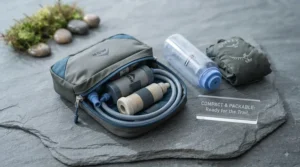
The Katadyn Hiker Pro is the filter most UK hillwalkers picture when they hear “pump water filter.” It uses a 0.2-micron pleated glass-fibre cartridge with an activated carbon core, rated for around 1,150 litres before replacement, and produces roughly a litre of clean water per minute at about 48 strokes.
The carbon core is what most spec sheets gloss over: it’s the difference between water that’s merely safe and water that actually tastes decent, stripping out the chlorine-like or earthy notes that raw ceramic and hollow-fibre filters can leave behind. Reviewers consistently note the transparent housing as a practical touch — you can see the cartridge discolouring before flow rate actually drops, which means you replace it on your schedule rather than mid-pump at the water’s edge. On the downside, aggregated reviews mention the pump handle isn’t the most ergonomic shape to grip for extended sessions, and small connector pieces have a reputation for snapping off under rough handling.
Based on the spec comparison against pricier ceramic options, the Hiker Pro’s honest trade-off is longevity: the glass-fibre cartridge can’t be scrubbed clean like ceramic, so once it clogs from silty water, you’re replacing it rather than cleaning it.
Pros:
- ✅ Around 1 litre per minute — one of the faster hand pumps tested
- ✅ Transparent housing shows cartridge condition at a glance
- ✅ Quick-connect fittings work with most bottles and reservoirs
Cons:
- ❌ Handle grip isn’t the most comfortable for long sessions
- ❌ Small parts have a reputation for breaking off
Priced in the £65-£85 range, this is arguably the strongest all-round value pump water filter on this list — reliable, quick, and cheaper than the ceramic alternatives further down.
3. Survivor Filter PRO — budget virus protection
Most pump filters at this price point stop at bacteria and protozoa. The Survivor Filter PRO uses a three-stage system — cotton pre-filter, ultrafiltration hollow-fibre membrane rated down to roughly 0.05 microns, and an activated carbon stage — that its maker claims also captures viruses, a capability normally reserved for filters costing three or four times as much.
Here’s what the spec sheet won’t tell you plainly: reported flow rates vary wildly across independent testers, from around 200ml per minute up to 1.2 litres per minute, depending on pumping technique, water clarity, and how recently the membrane was backflushed. That’s a wide spread, and it matters — if you’re planning on this for a family’s daily water supply, budget on the slower end. Reviewers do agree the unit is backflushable using its included adapter, which restores flow after silty water clogs the membrane, and that build quality holds up to repeated field use.
On virus removal specifically, honest caveats apply: a 0.05-micron rating blocks the vast majority of waterborne viruses but some sources note certain viral particles are smaller still, so travellers heading somewhere with known viral contamination risk shouldn’t treat this as a total substitute for boiling.
Pros:
- ✅ Rare virus-rated filtration at a genuinely budget price point
- ✅ Backflushable membrane restores flow without replacement
- ✅ Three-stage design improves taste as well as safety
Cons:
- ❌ Reported flow rates vary significantly between users
- ❌ Cold water can drop flow rate by 20-25%
At roughly £55-£75, this is the pick for budget-conscious travellers who specifically need virus protection abroad rather than pure UK hillwalking.
4. MSR MiniWorks EX — field-cleanable ceramic for turbid water
The MSR MiniWorks EX pairs a 0.2-micron ceramic outer element with an activated carbon core, weighs 462 grams, and is rated for around 2,000 litres before the ceramic sleeve needs replacing — though that number stretches considerably further because, unlike glass-fibre cartridges, this one can be scrubbed clean in the field.
That field-cleaning capability is the entire reason to choose this over the lighter Hiker Pro. When the ceramic clogs from silt or algae — and on any extended trip near lakes or slow-moving water, it will — you unscrew the housing, scrub the outer surface with the included pad, and you’re back to near-original flow rate within a minute, no new cartridge required. Reviewers consistently describe the MiniWorks as slower going than glass-fibre pumps, with some testers clocking closer to 80 seconds per litre against a claimed one-litre-per-minute rate, and pumping resistance that increases noticeably as the ceramic dirties up. Based on the spec comparison, the honest read here is that you’re trading pumping effort for genuine longevity — the ceramic gauge included with the unit lets you measure wear and predict when, after years rather than months, a replacement element is finally due.
It threads directly onto wide-mouth Nalgene-style bottles, which sidesteps the fiddly bag-and-adapter setups some hollow-fibre filters require.
Pros:
- ✅ Field-cleanable ceramic restores flow without buying a new cartridge
- ✅ Carbon core noticeably improves taste over pure ceramic filters
- ✅ Threads directly onto standard wide-mouth bottles
Cons:
- ❌ Pumping requires more effort than glass-fibre alternatives
- ❌ At 462g, it’s one of the heavier hand pumps here
In the £90-£120 range, the MSR MiniWorks EX suits campers who return to the same turbid lakes and rivers trip after trip and would rather scrub a filter than keep buying cartridges.
5. Katadyn Vario — dual-mode versatility for families
The Katadyn Vario takes a different engineering approach: a dual-piston design filters water on both the push and pull stroke, rather than only one direction like most simple pumps, and it can reach up to 2 litres per minute in its fastest continuous-flow setting. It combines a cleanable ceramic pre-filter with a replaceable glass-fibre disc, weighing around 425 grams.
What most buyers overlook about this model is the adjustable stroke length — you can shorten each pump for less effort when filtering small amounts, or lengthen it to maximise flow when filling several bottles at a basecamp. That flexibility is genuinely useful for a family or small group where different people are doing the pumping and arm strength varies. The ceramic pre-filter extends the working life of the glass-fibre disc significantly by catching larger particulate before it ever reaches the finer element, which in practice means fewer cartridge replacements than a filter relying on glass fibre alone.
Reviewers generally position the Vario as the versatile middle ground in Katadyn’s range — faster than the Hiker Pro when needed, more affordable and considerably lighter than the ceramic-only Pocket.
Pros:
- ✅ Dual-piston action filters on both push and pull strokes
- ✅ Adjustable stroke length suits different users and volumes
- ✅ Cleanable pre-filter extends the finer cartridge’s working life
Cons:
- ❌ More moving parts than a simple single-action pump
- ❌ Replacement glass-fibre discs add an ongoing cost
Expect to pay around £90-£110 — solid value for a group or family camping setup that needs speed without stepping up to ceramic-only pricing.
6. Katadyn Pocket — the 50,000-litre expedition legend
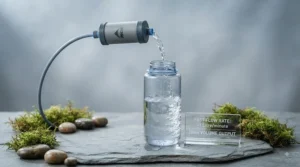
Some products earn their reputation through decades of unglamorous reliability rather than clever engineering, and the Katadyn Pocket is exactly that. In production in various forms since 1928, its silver-impregnated ceramic element is rated for up to 50,000 litres depending on water quality, backed by a 20-year manufacturer guarantee, and delivers roughly a litre of clean water per minute.
The silver impregnation isn’t a gimmick — it creates an antimicrobial zone within the ceramic that prevents bacteria colonising the pores during storage between trips, which matters enormously for a filter designed to sit unused in a cupboard for months at a time. Aggregated reviews are strikingly consistent: testers report zero maintenance issues beyond occasional lubrication of the piston seal, no complaints about water taste or clarity even after heavy rain events, and a build quality that makes cheaper plastic pumps feel flimsy by comparison. The trade-off is honest and unavoidable — at 570 grams it’s noticeably heavy for a solo hiker, and the pump requires roughly 16 pounds of force per stroke, which several reviewers describe as “a bit of a chore” for a full group’s water needs.
What the spec sheet won’t tell you is that this is genuinely a buy-once, use-for-decades purchase — expedition outfitters and humanitarian organisations still specify it precisely because field failure isn’t an acceptable risk.
Pros:
- ✅ Ceramic element rated for up to 50,000 litres
- ✅ 20-year manufacturer guarantee reflects genuine build quality
- ✅ Field-cleanable and maintainable for decades of use
Cons:
- ❌ Heavy at 570g and requires real pumping force
- ❌ Premium price relative to lighter alternatives
At roughly £220-£260, the Katadyn Pocket is overkill for a weekend at a Peak District campsite but the obvious choice for anyone filtering water regularly, for years, without wanting to think about it twice.
7. MSR Guardian — the only pump that’s also a virus purifier
The MSR Guardian sits at the top of this list for a specific reason: it’s the only hand pump here rated as a true purifier rather than just a filter, using a 0.02-micron hollow-fibre membrane fine enough to remove viruses alongside bacteria and protozoa. Reported flow rate runs around 2.5 litres per minute, among the fastest of any pump-style device on the market.
Its standout engineering trick is automatic backflushing — a portion of filtered water is diverted to clean the membrane on every single stroke, which means the Guardian largely avoids the flow-rate collapse that plagues other filters in silty or algae-heavy water. Reviewers who expected a slow, effortful pump based on its bulk have consistently reported being surprised at how smooth and fast the action actually feels. The honest downside is size and cost: this is a genuinely bulky unit, and one tester specifically noted disliking how much space it takes up, even while praising its lack of fiddly loose parts. It’s also, without question, the most expensive filter on this list.
Based on the spec comparison, if your trip stays within the UK, virus removal is largely unnecessary — waterborne viruses are rare in British upland water sources. Where the Guardian earns its price is international travel to regions with less reliable sanitation, or as a serious emergency-preparedness purchase where you genuinely can’t afford a filter to fail.
Pros:
- ✅ True purifier — removes viruses as well as bacteria and protozoa
- ✅ Self-backflushing design resists clogging far better than rivals
- ✅ Fast flow rate around 2.5 litres per minute
Cons:
- ❌ Bulky and heavy compared with every other filter here
- ❌ Significantly more expensive than filtration-only pumps
Priced around £280-£340, the MSR Guardian is the sensible splurge for international travellers and emergency-preparedness buyers, not the average UK weekend camper.
Top 7 Pump Filters: Full Specification Comparison
| Model | Weight | Filter Media | Cartridge Life | Price Range | Best For |
|---|---|---|---|---|---|
| MSR TrailShot | 142g | Hollow fibre, 0.2 micron | ~2,000L | £45-£60 | Ultralight hiking |
| Katadyn Hiker Pro | 318g | Glass fibre + carbon | ~1,150L | £65-£85 | Best overall value |
| Survivor Filter PRO | ~370g | Hollow fibre UF + carbon | Very high (varies) | £55-£75 | Budget virus protection |
| MSR MiniWorks EX | 462g | Ceramic + carbon | ~2,000L (cleanable) | £90-£120 | Turbid water, field cleaning |
| Katadyn Vario | 425g | Ceramic pre-filter + glass fibre | ~1,000L (disc) | £90-£110 | Families, versatility |
| Katadyn Pocket | 570g | Silver-impregnated ceramic | Up to 50,000L | £220-£260 | Decades of expedition use |
| MSR Guardian | Heaviest | Hollow fibre, 0.02 micron | Long-life, self-cleaning | £280-£340 | International travel, viruses |
Reading across this table, the price jump between the Vario and the Pocket is really a jump between “years of typical use” and “decades of near-indestructible use” — you’re not paying nearly triple for triple the performance, you’re paying for a completely different maintenance philosophy. The MSR TrailShot remains the clear outlier on weight, which matters enormously if you’re covering serious daily mileage rather than car camping. If cost per litre filtered is your priority, the Katadyn Pocket‘s 50,000-litre rating makes it the cheapest option here in the long run, despite the highest upfront price.
✨ Don’t Miss These Exclusive Deals!
🔍 Take your camping water setup to the next level with these carefully selected filters. Click on any highlighted model to check current pricing and availability. The right pump will keep clean, great-tasting water flowing on every trip your family takes into the hills.
Practical Usage Guide: Setting Up and Maintaining Your Pump Filter
Getting the most from any pump water filter for camping starts before you ever leave the house. Assemble the unit and run a litre or two of tap water through it at home — this confirms everything’s seated correctly and lets you learn the pump action somewhere that isn’t a cold riverbank in the rain. On the trail, always position the intake hose in moving water where possible, a few centimetres below the surface and away from silty bottom sediment; a small stone or the pre-filter’s built-in float usually keeps the hose from settling into mud.
The single most common first-30-days mistake is letting a filter freeze. Any water left inside a hollow-fibre or ceramic element expands as ice and can crack the membrane invisibly, so a filter that worked perfectly in September can fail silently in a cold October dawn. Always shake out and, where possible, blow out residual water before an overnight below freezing. Maintenance schedules differ by filter type: ceramic elements like those in the MSR MiniWorks EX and Katadyn Pocket should be scrubbed with the supplied pad as soon as pumping resistance increases noticeably, while hollow-fibre cartridges in filters like the Survivor Filter PRO rely on backflushing — pushing clean water in reverse through the membrane — roughly every 10 to 20 litres in turbid conditions.
An optimisation trick worth knowing: pre-filtering visibly cloudy water through a bandana or coffee filter before it ever reaches your pump’s intake dramatically extends the interval between cleanings, regardless of which model you own.
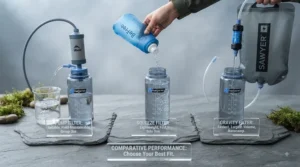
Real-World Scenarios: Which Pump Filter Matches Your Trip
Consider three fairly typical UK camping profiles. A solo Munro-bagger covering 15-20 miles a day, camping wild each night, cares about grams above almost everything else — for them, the MSR TrailShot at 142g is the rational choice, accepting the arm fatigue of squeeze-pumping in exchange for barely noticing it’s in the pack.
A family of four doing a week at a Lake District campsite with no water hookup has entirely different priorities: volume, reliability, and not fussing with cartridge replacements mid-holiday. The Katadyn Vario‘s dual-piston speed and adjustable stroke length suit multiple family members taking turns at the pump, while its cleanable pre-filter reduces the odds of a mid-trip cartridge failure.
A third scenario — someone preparing for a multi-country backpacking trip through regions with unreliable sanitation — needs virus removal as a genuine requirement rather than a nice-to-have. Here, the MSR Guardian‘s purifier-grade filtration and self-cleaning design justify the extra weight and cost, because a filter failure abroad carries real health consequences that a UK hillwalker rarely faces.
Problem → Solution: Common Pump Filter Headaches Solved
Flow rate collapsing mid-trip is the complaint that comes up most often in aggregated reviews. The fix depends on filter type: ceramic elements need scrubbing with the included pad, glass-fibre and hollow-fibre cartridges need backflushing or, eventually, replacing — trying to force a clogged pump harder generally just strains the seals.
A pump that feels stiff or won’t build pressure at all is usually a lubrication issue rather than a filter fault; the silicone lubricant included with most ceramic pumps, applied sparingly to the piston O-ring, resolves this in seconds. Water that tastes flat or metallic despite filtering correctly points to a filter lacking a carbon stage — models like the Katadyn Hiker Pro and MSR MiniWorks EX include one specifically to address this, so if taste matters to you, check for “activated carbon” on the spec sheet before buying.
Cracked housings after a cold night are almost always the frozen-residual-water problem covered above, and the solution is prevention rather than repair: dry your filter fully before any night where temperatures might dip below zero.
How to Choose a Pump Water Filter for Camping
- Match pore size to your risk. A 0.2-micron rating handles bacteria and protozoa, which covers the vast majority of UK camping water sources; only step up to a purifier-grade 0.02-micron rating like the MSR Guardian‘s if you’re travelling somewhere with known viral contamination risk.
- Weigh flow rate against real conditions. The litres-per-minute figure on a box is measured with fresh cartridges in clear water — expect it to drop as sediment builds up, and favour field-cleanable or self-backflushing designs if you’ll be filtering from lakes or slow rivers.
- Decide between cleanable and replaceable cartridges. Ceramic elements cost more upfront but can be scrubbed clean repeatedly; glass-fibre and hollow-fibre cartridges are cheaper initially but need periodic replacement.
- Consider who’s doing the pumping. A single-action pump asks more of one person’s arm; dual-piston or continuous-flow designs like the Katadyn Vario spread that effort more evenly across a group.
- Check bottle and reservoir compatibility. Some pumps thread directly onto wide-mouth bottles; others need adapters for hydration bladders, which matters if your existing gear doesn’t match.
- Factor in weight against trip type. A car-camping trip can absorb the 570g of a Katadyn Pocket; a multi-day hike genuinely can’t.
- Price per litre, not just sticker price. A £250 filter rated for 50,000 litres works out cheaper over its life than repeatedly replacing a £20 cartridge every few hundred litres.
Value Pump Water Filter: Getting Genuine Performance Without Overspending
A genuinely good value pump water filter for camping isn’t simply the cheapest one on the shelf — it’s the model that matches your actual usage pattern without paying for capability you’ll never use. On that basis, the Katadyn Hiker Pro is the strongest value argument on this list: a roughly £65-£85 outlay buys a litre-a-minute flow rate, a carbon core for decent taste, and a transparent housing that takes the guesswork out of maintenance, all in a package that’s genuinely comparable in performance to filters costing considerably more.
What most buyers overlook when hunting for value is total cost of ownership rather than sticker price alone. The MSR TrailShot is cheaper upfront, but if you’re filtering large volumes regularly, its lighter-duty cartridge and hand-fatiguing squeeze action make it a worse long-term value than a proper pump for anyone doing more than occasional top-ups. Reviewers consistently note that spending slightly more for a carbon-core filter pays off in daily usability — nobody enjoys drinking flat-tasting water for a week, and that’s a real, if unquantifiable, cost of the cheapest options. If your budget allows a modest step up, prioritise a carbon stage and field-cleanability over shaving off another £10-£15.
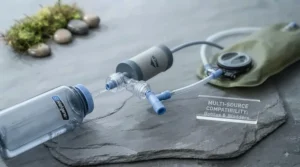
Pump Water Filter for Hiking: What Changes When You’re Carrying It All Day
The moment a filter goes into a pack rather than staying at a car-camping basecamp, weight and pack volume stop being minor considerations and start driving the whole decision. A pump water filter for hiking needs to justify every gram against the alternative of simply carrying more water, and the honest calculation favours the lightest models here — the MSR TrailShot at 142g or the Hiker Pro at 318g — over ceramic options that can weigh triple that or more.
Beyond raw weight, hiking use changes the maintenance calculus too. On a multi-day route with no resupply point, a filter that clogs and can’t be cleaned in the field is a genuine trip-ending problem, which is exactly why field-cleanable ceramic elements retain a following among longer-distance backpackers despite the weight penalty. Here’s what the spec sheet won’t tell you: pumping technique matters more on a hiking trip than a car-camping one, simply because you’re doing it while already tired from walking. Reviewers who test filters after a full day on the trail consistently report finding pump resistance more noticeable than testers filtering fresh at a desk, which is worth bearing in mind when comparing lab-measured flow rates against your own likely experience.
Understanding Flow Rate: Why Litres Per Minute Matters More Than Marketing Claims
Flow rate is the single most quoted spec on any pump filter’s box, and it’s also the most commonly misunderstood. The number printed on packaging is almost always measured under best-case conditions — a brand-new cartridge, clean water, and consistent pumping effort — and every filter’s real-world flow rate degrades from that baseline as the cartridge accumulates sediment. On paper, the MSR Guardian‘s claimed 2.5 litres per minute and the Katadyn Vario‘s 2 litres per minute look like a huge jump over the roughly 1 litre per minute common to simpler pumps, and in practice that gap generally holds up, because both designs specifically engineer around flow-rate degradation — the Guardian through automatic backflushing, the Vario through its dual-piston action.
What the spec sheet won’t tell you plainly is that flow rate and filtration fineness are in constant tension: a smaller pore size that catches more contaminants inherently restricts flow more than a coarser one, all else being equal. That’s precisely why the ultra-fine MSR Guardian needs its clever backflushing engineering to hit a genuinely fast flow rate — without it, a 0.02-micron membrane would clog and slow dramatically within minutes. When comparing filters, treat the advertised litres-per-minute figure as a ceiling rather than a promise, and weight your decision more heavily toward filters with genuine anti-clogging engineering if fast group filtering matters to your trips.
Filter Cartridge Lifespan: How Long Yours Will Actually Last
Cartridge lifespan claims range enormously across this list, from around 1,150 litres for the Katadyn Hiker Pro‘s glass-fibre element up to 50,000 litres for the Katadyn Pocket‘s ceramic core, and the honest reality is that every one of those figures assumes reasonably clear water. Reviewers consistently note that filtering silty, tannic, or algae-heavy sources shortens actual cartridge life significantly below the manufacturer’s headline number — sometimes by half or more for glass-fibre cartridges specifically, since unlike ceramic they can’t be scrubbed back to full capacity.
Based on the spec comparison, the practical distinction that matters most isn’t the raw litre figure but whether a cartridge is cleanable or purely consumable. Ceramic elements in the MSR MiniWorks EX and Katadyn Pocket can be scrubbed dozens of times over their working life, meaning their effective lifespan in genuinely turbid UK conditions often exceeds the on-paper rating for hollow-fibre and glass-fibre rivals, even when the initial number looks lower. For long-term cost, that means a slightly pricier ceramic filter can work out cheaper per litre than repeatedly buying £20-£40 replacement cartridges for a lighter pump, particularly if you’re a regular rather than occasional camper.
Manual Filtration Methods vs Alternative Treatments
Pump filters are one manual filtration method among several, and it’s worth being honest about where they win and lose against the alternatives. Squeeze filters like the well-known Sawyer and BeFree ranges are lighter and simpler than any pump here, but they need you to fill a soft bottle first, which is awkward in shallow puddles or fast-flowing water where a pump’s intake hose can simply be dropped in. Gravity filters shift the effort from your arms to time — hang a bag and walk away — which suits basecamp cooking for a group but does nothing for someone who needs a drink right now on the move.
Chemical treatment with chlorine dioxide remains a genuinely useful backup precisely because it needs no moving parts to fail, though as fitfortravel.nhs.uk, it requires a waiting period that can stretch well past 20 minutes in cold water and doesn’t reliably remove all protozoa on its own. UV purifiers are fast and chemical-free but depend on battery power and only work properly in already-clear water, making them a poor sole option for silty streams. Reviewers consistently rate pump filters ahead of these alternatives specifically for one scenario: filtering meaningful volumes for a group directly from awkward or shallow sources, which is exactly where squeeze and gravity systems struggle most.
Common Mistakes When Buying a Pump Water Filter
The most frequent mistake is buying purely on flow-rate numbers without checking whether the cartridge is cleanable, which leads to unexpectedly high running costs for anyone who filters regularly from silty UK lakes and rivers. A close second is underestimating weight — a 570g ceramic pump feels perfectly reasonable in a shop but becomes a genuine burden on day four of a multi-day hike, so match the filter to the trip type rather than buying the most capable model available.
Buyers also commonly overlook bottle compatibility, discovering only in the field that their pump’s output hose doesn’t fit their hydration bladder without an adapter they didn’t buy. Finally, plenty of people purchase purifier-grade virus protection they simply don’t need for UK camping, paying a substantial premium for capability that matters far more for international travel than for a weekend in the Peak District.
Safety, Regulations and Water Quality Guidance for UK Campers
Unlike mains tap water, which the dwi.gov.uk, water drawn from a stream, lake, or pond while camping has had no such oversight, however clean it looks. Clear-running upland water in Scotland or the Lake District carries a genuinely lower risk profile than water near farmland, since livestock run-off is a major source of the bacteria and protozoa that cause the diarrhoeal illness most hikers actually need to worry about — but “lower risk” is not the same as “risk-free,” and filtering remains sensible practice regardless of how pristine a source appears.
If you’re planning to source water on land you don’t own, it’s also worth a quick check of the gov.uk, particularly around checking local water quality conditions and access rights before you rely on a specific source. Whichever pump you choose, always position the intake away from visible farm run-off or standing water near livestock, and treat any water downstream of a settlement with particular caution — filtration handles biological contaminants well but does very little against dissolved chemical pollutants.
Frequently Asked Questions
❓ Do I need a pump water filter for camping in the UK, or is stream water safe to drink untreated?
❓ What's the difference between a pump filter and a squeeze filter for camping?
❓ How often does a pump water filter cartridge need replacing?
❓ Can a pump water filter remove viruses from water?
❓ What flow rate should I look for in a pump water filter for hiking?
Conclusion
There’s no single best pump water filter for camping — only the one that matches how, where, and how often you actually camp. The MSR TrailShot wins for anyone counting grams on a long hiking trip, the Katadyn Hiker Pro remains the sensible default for most weekend and family campers who want reliability without overspending, and filters like the Katadyn Pocket and MSR Guardian earn their higher prices through decades-long durability or genuine virus protection respectively, for the specific travellers who need those things.
What all seven share is the same basic honesty: a pump asks a little more physical effort than a squeeze or gravity filter, in exchange for reliability in awkward, shallow, or high-volume situations those alternatives handle poorly. Match your pick to your trip type using the comparisons above, check cartridge lifespan against how often you actually camp, and you’ll end up with a filter that quietly does its job trip after trip rather than one you regret carrying — or wish you’d bought — halfway up a hill.
✨ Don’t Miss These Exclusive Deals!
🔍 Ready to upgrade your camping water setup? Check current pricing on any of the models above and make sure your next trip starts with clean, great-tasting water from the very first stream.
Recommended for You
- Water Filter for Duke of Edinburgh Expedition: 7 Best Picks 2026
- Best Water Filter for Emergency Preparedness UK: 7 Picks (2026)
- Portable Water Filter: 7 Best Picks to Drink Safely in 2026
Disclaimer: This article contains affiliate links. As an Amazon Associate, I earn from qualifying purchases. If you purchase products through these links, we may earn a small commission at no additional cost to you.
✨ Found this helpful? Share it with your friends! 💬🤗
