
In This Article
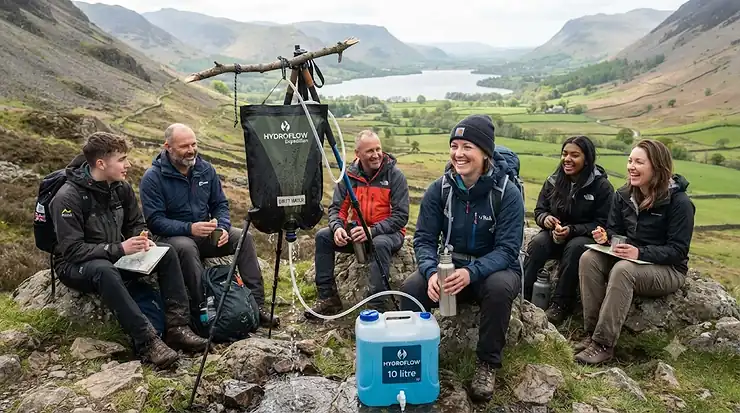
A gravity water filter for large groups is a hands-free filtration kit — typically a “dirty” reservoir bag connected by tubing to a filter and a clean container — that uses only the pull of gravity to turn stream, tap-uncertain, or festival-tap water into something a dozen thirsty people can safely drink without a single pump stroke. No batteries, no queuing at a tap, no arm ache. If you’ve ever stood at the back of a scout patrol watching someone hand-pump a 300ml bottle while eleven other people wait, you already understand why this category exists.
Here’s the thing nobody tells you before your first big camp: water is logistics, not romance. Whoever is responsible for hydrating a group — a Scout leader, a Duke of Edinburgh assessor, a festival steward, a bushcraft instructor — spends a disproportionate amount of mental energy on it. Carry too little bottled water and you’re rationing by Saturday lunchtime. Carry too much and your minibus boot won’t shut. A gravity filter sidesteps both problems by turning whatever’s nearby — a beck, a bore, a rainwater butt — into a renewable supply.
This guide walks through seven genuinely available gravity water filter for large groups options on amazon.co.uk, spanning bargain-bin sensible to properly serious kit, with honest analysis of who each one suits. We’ll also dig into gravity water filter for scout groups considerations, settle the gravity water filter vs pump filter debate once and for all, and cover the unglamorous but crucial stuff: setting up communal water stations, keeping kit hygienic across a season of outdoor education trips, and what actually goes wrong when groups buy the wrong filter. According to UK government guidance on cryptosporidium, untreated water from lakes, streams and rivers is a genuine transmission route for illness — so getting this kit choice right isn’t just about convenience, it’s about not spending the second night of camp queuing for the toilet block.
Quick Comparison Table
Before the deep dive, here’s the shape of the market at a glance. Capacities, flow rates and “best for” tags below are drawn from manufacturer specifications and independent gear testing, not marketing copy — so you can see roughly where each filter sits before committing fifteen minutes to the full breakdown.
| Product | Capacity | Flow Rate | Best For |
|---|---|---|---|
| Sawyer 4L Gravity System | 4L | ~1.7 L/min | Budget patrols of 6-8 |
| Katadyn Gravity BeFree 10L | 10L | Up to 2 L/min | Lightest 10L option |
| Platypus GravityWorks 4L | 4L (×2 bags) | 1.75 L/min | Best all-round mid-range pick |
| Katadyn Base Camp Pro 10L | 10L | Up to 2 L/min | Fastest flow, no backflushing |
| MSR AutoFlow XL | 10L | High volume | Large basecamps, expedition groups |
| LifeStraw Mission 12L | 12L | 9-12 L/hour | Virus protection abroad |
| LifeSaver Jerrycan | 18.5L | Tap-dispensed | Scout HQs, communal water stations |
Looking at the spread, capacity and flow rate pull in opposite directions more often than you’d expect: the LifeSaver Jerrycan holds the most water at rest but dispenses it more like a static tank than a fast-draining bag, while the Katadyn Base Camp Pro 10L trades some raw storage for genuinely brisk output when a patrol descends on it all at once. If your bottleneck is “everyone wants a bottle filled in the next five minutes,” flow rate matters more than litres sat in reserve; if it’s “we need water on hand for the whole weekend without a resupply run,” go the other way.
💬 Just one click — help others make better buying decisions too!😊
Top 7 Gravity Water Filters for Large Groups: Expert Analysis
1. Sawyer 4L Gravity Water Filtration System — best budget entry point for smaller patrols
The standout here is longevity: Sawyer’s hollow-fibre membrane is rated to filter such an enormous volume of water that most groups will retire the filter from old age before it ever clogs beyond rescue. The 0.1-micron membrane strips out 99.99999% of bacteria and 99.9999% of protozoa, and because the filter unit detaches from the bag, it doubles as a squeeze filter for smaller outings when the full gravity rig is overkill. What most buyers overlook about this model is that its 4-litre capacity, while modest next to the 10L-plus systems further down this list, refills fast enough from a decent stream that two Sawyer kits running in parallel can comfortably keep a patrol of 12-16 topped up, and at a fraction of the outlay of premium options. Reviewers consistently report that flow slows with silty water sources unless you backflush regularly, so pair it with a bandana pre-filter on peaty upland becks. This is the pick for a cash-strapped Scout troop equipping several patrols at once rather than buying one expensive unit for the whole camp.
Pros:
- ✅ Exceptionally long filter lifespan for the price
- ✅ Doubles as a squeeze filter for smaller trips
- ✅ Field-cleanable with a simple backflush syringe
Cons:
- ❌ 4L capacity means more refill trips for big groups
- ❌ Flow drops noticeably in silty or peaty water
Prices for the Sawyer 4L system tend to sit in the under-£90 range on amazon.co.uk; check current price, as availability and bundle contents (extra bags, syringe kits) shift the figure. For sheer value per pound spent on filtered litres over a filter’s lifetime, this is difficult to beat.
2. Katadyn Gravity BeFree 10L — lightest way to carry 10 litres of capacity
The immediate hook is weight: at roughly 228g for the filter unit, this is startlingly light for a system holding a full 10 litres of water once filled. That matters more than it sounds for a minibus-and-rucksacks trip, where every kilogram not spent on the water kit is a kilogram spent on sleeping bags. The EZ-Clean membrane uses a 0.1-micron pore size and, unusually for a filter this light, sustains a flow rate up to 2 litres per minute when the reservoir is full, dropping off as it empties — which is standard gravity-filter physics rather than a flaw specific to Katadyn. Based on the spec comparison with heavier basecamp units, the trade-off is durability: the ultralight fabric bag is more puncture-prone against rocky ground than the Base Camp Pro’s tougher build, so groups running this filter should treat the bag with the same care as a dry bag rather than tossing it in the bottom of a rucksack with crampons. Reviewers note the membrane rinses clean easily in the field with no tools required, which matters when a leader is juggling this alongside twenty other camp jobs.
Pros:
- ✅ Genuinely lightweight for a 10-litre-capacity system
- ✅ Fast flow rate when the bag is freshly filled
- ✅ Field-cleanable membrane with no backflush kit needed
Cons:
- ❌ Bag fabric is less rugged than basecamp-style rivals
- ❌ Flow rate falls off noticeably as the bag empties
Expect a price in the £90-£130 range at the time of research, with the smaller 3L version considerably cheaper if a full 10L reservoir isn’t needed. It’s a strong pick for groups who hike into camp rather than driving straight to the pitch.
3. Platypus GravityWorks 4L — the best all-round gravity filter for a mid-sized group
Platypus built this system around genuine convenience: two 4-litre bags, one marked “dirty” and one “clean,” connected by a filter that processes water at 1.75 litres per minute without a single pump stroke. The standout practical detail is that the clean bag isn’t just a filter output — it’s a usable 4-litre water container in its own right, so a filled clean bag can sit at the cooking station as a self-serve tap while the dirty bag refills from the stream. Based on aggregated reviewer sentiment, the biggest recurring gripe isn’t the filter itself but the zip-seal closure on the dirty bag, which several long-term users describe as fiddly to seal fully watertight — worth practising at home before the trip, not at 7am on a riverbank with everyone waiting for breakfast. The 0.2-micron hollow-fibre filter is integrity-testable, meaning leaders can verify it’s still working properly rather than trusting blind faith partway through a season of use, which is a genuinely useful feature for anyone responsible for a group’s water safety rather than just their own.
Pros:
- ✅ Filtered “clean” bag doubles as a mobile water container
- ✅ Fast, consistent 1.75 L/min flow rate
- ✅ Integrity-testable filter for peace of mind on long trips
Cons:
- ❌ Dirty bag’s zip closure is fiddly to seal properly
- ❌ Filling the dirty bag from shallow water is awkward
Price ranges typically sit around £110-£150 on amazon.co.uk at the time of research. For a troop of roughly six to eight sharing one unit, this remains the benchmark most other gravity systems are judged against.
4. Katadyn Base Camp Pro 10L — the fastest flow rate on this list, with zero backflushing
What most buyers overlook about the Base Camp Pro is that Katadyn deliberately engineered out the single most annoying gravity-filter chore: backflushing. Instead of a membrane that clogs and needs periodic reverse-flow cleaning, the pleated glass-fibre Ultra Flow filter sits behind a removable sediment trap that catches grit before it ever reaches the filter element, so the whole system stays fully field-maintainable by simply rinsing the trap. Paired with a flow rate up to 2 litres per minute, that means a queue of thirsty campers clears fast and the leader isn’t stuck disassembling tubing mid-service. The spec sheet won’t tell you this, but user reports suggest the auto-shutoff quick-release valve — which stops the hose touching contaminated source water during refills — is one of the more underrated hygiene features in this entire category, since cross-contamination at the refill stage is a genuinely common way groups accidentally undo all the filter’s good work. The 10-litre bag is built from tougher material than the ultralight BeFree, trading a little weight for a lot more durability against rough ground.
Pros:
- ✅ No backflushing required, ever, under normal use
- ✅ Fastest sustained flow rate in this comparison
- ✅ Auto-shutoff valve prevents contaminated refill splashback
Cons:
- ❌ Heavier than lightweight alternatives like the BeFree
- ❌ Bulkier to pack than 4-litre systems
Price sits broadly in the £100-£140 range, occasionally higher depending on retailer stock. For a troop leader who wants one dependable unit that just works trip after trip with minimal fiddling, this is arguably the smartest all-rounder here.
5. MSR AutoFlow XL — built specifically for large groups and basecamps
MSR designed the AutoFlow XL with one job in mind: keeping a genuinely large group — think a full scout camp, a DofE expedition basecamp, or a festival crew — supplied without constant refilling. The 10-litre reservoir is the headline figure, but the detail that experienced testers flag is weight-to-capacity ratio, meaning you’re not hauling disproportionate bulk for the volume of water it holds compared with rival basecamp systems. Here’s what to weigh: this isn’t the filter for a fast-moving group of four who need something to sling in a daypack; it’s the filter for a static camp where the reservoir hangs from a fixed point — a tree, a gazebo frame, a purpose-built stand — for hours or days at a time, quietly refilling and dispensing as people pass through. Based on the spec comparison with the lighter Katadyn and Platypus systems, the trade-off is portability: this is a “leave it set up” system rather than a “pack it every morning” one, which suits fixed camps far better than trekking expeditions that relocate daily.
Pros:
- ✅ Purpose-built for genuinely large group volumes
- ✅ Strong weight-to-capacity ratio for a basecamp system
- ✅ Robust build suited to staying set up for days at a time
Cons:
- ❌ Bulkier and less packable than smaller gravity kits
- ❌ Overkill for groups under about a dozen people
Expect a price in the £150-£190 range at the time of research. This is the pick for the person organising water for an entire camp rather than a single patrol or tent group.
6. LifeStraw Mission 12L — best for groups worried about viruses, not just bacteria
The critical distinction the Mission offers over most gravity filters on this list is its classification: it’s a purifier, not just a filter, because its 0.02-micron ultrafiltration membrane is fine enough to also strip out viruses — a step beyond the 0.1-0.2 micron filters above, which handle bacteria and protozoa but aren’t rated against viral contamination. That matters enormously for groups travelling somewhere the water supply chain itself might be compromised, rather than only drawing from clean UK upland streams where viral risk is low. The 12-litre bag is the largest single reservoir among the hanging-bag-style options here, and the membrane’s rated lifetime of roughly 18,000 litres is comfortably enough for a season of heavy group use. Reviewers consistently note that flow is noticeably slower than the mechanical filters above — roughly 9-12 litres an hour rather than litres per minute — and that the backwash bulb used to clean the membrane is bulkier and fiddlier than rivals’ cleaning methods. On paper this means it’s the right call for international outdoor education trips or humanitarian-style deployments, and a slower, heavier overkill for a weekend in the Peak District.
Pros:
- ✅ Only filter here rated to remove viruses, not just bacteria
- ✅ Large 12-litre reservoir for genuinely big groups
- ✅ Long membrane lifespan across a full season of trips
Cons:
- ❌ Noticeably slower flow rate than mechanical rivals
- ❌ Backwash cleaning process is bulkier and fiddlier
Prices typically fall in the £130-£170 range on amazon.co.uk, reflecting the extra membrane technology involved. Reserve this one for trips where the water source itself is the biggest unknown.
7. LifeSaver Jerrycan — the UK-made option built for scout HQs and communal water stations
Unlike the hang-it-from-a-branch bags above, the Jerrycan is a genuinely different shape of solution: an 18.5-litre robust container with an integral ultrafiltration cartridge and dispensing tap, designed to sit as a static, refillable reserve rather than travel light on a day hike. What most buyers overlook is that this changes the entire use case — it’s less “filter as you go” and more “fill it once at basecamp, then dispense clean water on demand for hours or days,” which is precisely the shape of demand a scout HQ kitchen, a fixed festival water point, or an outdoor education centre actually has. Made in the UK and tested to a military-spec protocol (NSF Protocol P248), it removes viruses, bacteria, parasites and microplastics from the filtration cartridge alone, with an additional activated carbon stage handling chlorine taste, heavy metals and general palatability — useful when the “dirty” water source is an unreliable tap rather than a wild stream. Aggregated user sentiment from long-term reviewers highlights genuine durability for overlanding and off-grid use, alongside the practical point that, once purified, the water inside can be re-contaminated if left standing too long, so leaders should draw off what’s needed rather than treating it as an indefinite store.
Pros:
- ✅ Largest static capacity of any option on this list
- ✅ UK-made and tested to a military-spec purification standard
- ✅ Removes viruses as well as bacteria and parasites
Cons:
- ❌ Heavier and bulkier than any hanging-bag system here
- ❌ Not designed for fast on-the-move refilling
Price ranges tend to sit in the £150-£220 range depending on cartridge specification, so it’s worth comparing current listings carefully before buying. For a permanent or semi-permanent group water station, this is the most purpose-built option in the line-up.
Practical Usage Guide: Setting Up and Maintaining Your Gravity Filter
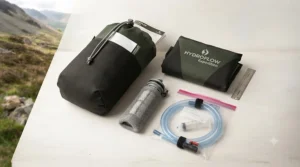
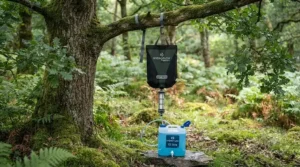
Getting a gravity filter working well for a large group is less about the kit and more about the routine around it. On the first morning of any trip, designate one adult or older Scout as the water officer for the day — not because the job is complicated, but because ownerless kit gets left half-assembled, and a half-assembled filter is a filter nobody’s drinking from. Hang the dirty reservoir noticeably higher than the clean container; the greater the height difference, the faster gravity does its work, so a proper tree branch or a tall gazebo pole beats a low fence post every time.
Setting Up a Communal Water Station
For scout camps and outdoor education centres running multiple tents or patrols off one filter, set up a dedicated communal water station rather than passing the filter tent to tent. A simple table, the hanging reservoir above it, and a clearly labelled clean container below turns a piece of kit into a self-service point that doesn’t need constant supervision. Mark “dirty in, clean out” clearly — mixing the two is the single most common hygiene failure groups report.
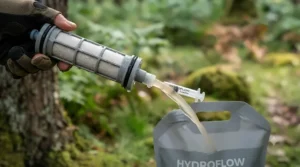
In the first 30 days of ownership, the most common mistake is over-filling the dirty reservoir with visibly silty water straight from a fast-flowing source; letting sediment settle in a separate bucket for ten minutes before decanting into the filter bag dramatically extends filter life. Backflush weekly during heavy use, even on filters marketed as backflush-free, and always store the filter slightly damp rather than bone dry, since fully drying certain membranes between trips can reduce their effective pore performance over time.
Real-World Scenarios: Who Actually Needs a Gravity Water Filter for Large Groups
The Saturday-to-Sunday scout group camping trip: A troop of 24 pitching at a recognised campsite with a standpipe technically has treated water on tap, but a gravity filter still earns its keep filtering rainwater butts for washing-up, or as backup if the standpipe queue is twenty minutes long at breakfast. Budget-conscious troops running several patrols do well spreading two or three Sawyer or BeFree units across camp rather than centralising on one expensive system everyone queues for.
The Duke of Edinburgh expedition group: Six to eight teenagers moving daily need something genuinely packable. A Platypus GravityWorks 4L or Katadyn BeFree, shared between two tent groups, filters upland stream water fast enough to fit around a tight schedule without adding significant pack weight.
The outdoor education centre running back-to-back school groups: Here, volume and reliability trump portability entirely. A fixed MSR AutoFlow XL or LifeSaver Jerrycan set up as a static communal water station, refilled by staff between sessions, removes the water logistics burden from instructors who already have thirty other things to manage that day.
Buyer’s Decision Framework
If your group moves camp daily, choose a lightweight hanging-bag system like the Sawyer or Katadyn BeFree, because portability outweighs raw capacity. If your group stays in one place for the whole trip, choose a higher-capacity basecamp unit like the MSR AutoFlow XL or LifeSaver Jerrycan, because you’ll only assemble it once and want it dispensing all weekend. If you’re travelling somewhere the water supply chain itself is uncertain — not just wild upland streams — choose a virus-rated purifier like the LifeStraw Mission over a standard filter. And if budget is genuinely tight and you’re equipping several small units rather than one big one, spread the spend across two or three Sawyer-tier filters instead of a single premium system that becomes a bottleneck.
✨ Ready to Kit Out Your Group?
🔍 Take the guesswork out of camp hydration with a filter matched to how your group actually travels and camps. Click through on any of the picks above to check current pricing and availability, and give your next trip the reliable clean water it deserves!
How to Choose a Gravity Water Filter for Large Groups
- Match capacity to group size, not aspiration. A 4-litre system serving twelve people means constant refilling; work out roughly how many litres your group drinks per hour and buy accordingly.
- Check the micron rating against your actual water sources. A 0.2-micron filter handles bacteria and protozoa fine for most UK wild water; only step up to a virus-rated purifier if travelling somewhere the supply chain itself is questionable.
- Weigh flow rate against patience. A fast 2 L/min system clears a breakfast queue quickly; a slower purifier trades speed for broader protection.
- Consider whether the group is static or mobile. Basecamp units are heavier but dispense for longer; hanging-bag systems pack down small but need more frequent refilling.
- Factor in maintenance effort realistically. A backflush-free design like the Base Camp Pro suits a busy leader with limited spare attention; a manual-clean system is fine if someone’s genuinely committed to the routine.
- Price against total litres filtered, not sticker price alone. A pricier filter with a longer membrane life can work out cheaper per litre across a full season of camps.
- Buy redundancy for genuinely large groups. Two mid-range filters running in parallel beat one premium unit as a single point of failure.
Gravity Water Filter vs Pump Filter
The core difference is effort versus speed. A pump filter forces water through the membrane by hand, which delivers water almost instantly on demand but tires out whoever’s operating it after the fifth or sixth bottle. A gravity system does the same filtration passively over several minutes, which suits a static camp perfectly but is frustrating if you need a single bottle filled right now on the move. According to the general principles outlined on Wikipedia’s overview of portable water purification, gravity-fed and pump-driven systems both rely on essentially the same membrane technologies — the difference lies entirely in how the pressure that pushes water through the filter is generated, by hand or by height.
For large groups specifically, gravity wins decisively on total throughput: hang the bag, walk away, come back to litres of clean water rather than standing there pumping for twenty minutes per person. Pump filters remain the better choice for solo hikers or very small pairs who need water on the move without waiting, but they simply don’t scale to a patrol of eight or a camp of thirty without becoming a full-time job for whoever’s holding the handle.
Gravity Water Filter for Scout Groups
Scout groups have a specific set of demands most gravity filters weren’t originally designed around: younger users who need the system to be genuinely foolproof, leaders juggling water duty alongside a dozen other responsibilities, and kit that survives being handled by enthusiastic ten-year-olds rather than careful solo hikers. The Scout Association’s network of activity centres across the UK routinely hosts hundreds of young people camping simultaneously, and the same logic that makes centralised facilities work at scale applies to smaller troop camps too: fewer, more robust units serving a communal water station beat handing every patrol its own fragile kit.
For scout group camping specifically, a backflush-free, auto-shutoff system like the Katadyn Base Camp Pro reduces the number of ways young leaders-in-training can accidentally cross-contaminate a filter, while a durable static unit like the LifeSaver Jerrycan suits a troop HQ or fixed summer camp base better than a delicate hanging bag. Whichever option a group leader picks, building water duty into the camp rota — rather than leaving it to whoever remembers — matters more than which specific filter sits on the table.
Features That Actually Matter (And Those That Don’t)
Micron rating and flow rate genuinely matter, because they determine what the filter removes and how quickly a queue clears. Filter lifespan in litres matters too, since it drives real running costs across a season. What matters far less than marketing copy suggests: exact litre-per-minute figures quoted under laboratory conditions, since real-world flow drops the moment a bag is half-empty or the water source is even slightly silty. Branded “shower attachment” add-ons, while a nice bonus for basecamp comfort, shouldn’t sway a purchase decision aimed primarily at drinking water for a group. Focus spend on the filtration technology and reservoir durability; treat accessories as a genuine but secondary bonus.
What to Expect: Real-World Performance
On paper, a 2 L/min flow rate sounds instant. In practice, that figure is measured with a freshly filled reservoir at maximum height difference — by the third refill of the day, with tired arms hanging the bag a little lower and the source water a touch murkier, expect noticeably slower output. Budget realistically for filling and hanging time as part of the camp routine, not an afterthought squeezed in before breakfast. Most groups find a rhythm within the first day or two: fill during a quiet period, let gravity work while everyone’s occupied elsewhere, and the system essentially disappears into the background of camp life rather than dominating it.
Common Mistakes When Buying a Gravity Water Filter for Large Groups
Buying based on capacity alone is the most frequent error — a huge reservoir is no use if the flow rate can’t keep pace with genuine demand from thirty people. A close second is underestimating maintenance commitment: a filter that needs regular manual backflushing works brilliantly for a dedicated leader and poorly for a rota of distracted volunteers. Groups also commonly buy a single premium unit as their only water source, creating a single point of failure if it clogs, splits, or simply goes missing mid-trip — redundancy with two cheaper units is often the wiser call. Finally, many buyers skip checking whether their chosen filter handles viruses, assuming all filtration is equivalent; for UK wild camping that’s usually fine, but for international outdoor education trips it’s a genuine gap worth closing with a purifier-rated system.
Long-Term Cost & Maintenance
Total cost of ownership across a filter’s lifetime looks very different from the sticker price. A budget Sawyer system costing under £90 but rated for an enormous filtered-litre lifetime can work out cheaper per litre than a pricier unit with a shorter-rated membrane life, especially for a troop running dozens of camps a year. Replacement cartridges, where needed, typically cost a modest fraction of the original unit price, and factoring in one or two replacement cartridges over several seasons is sensible budgeting rather than pessimism. Groups running heavy seasonal use should also budget occasional replacement of reservoir bags or hoses, since these wear faster than the filtration membrane itself through repeated packing, unpacking and rough handling.
Safety, Regulations and Water Quality on Outdoor Education Trips
Outdoor education providers running regular group trips carry a duty of care around drinking water that goes beyond personal camping. The Drinking Water Inspectorate’s guidance on cryptosporidium notes that the parasite poses a particular challenge for water treatment because of its small size and resistance to standard chlorination, which is exactly why mechanical filtration — rather than chemical treatment alone — earns its place in group outdoor kit. For UK trips, a 0.2-micron gravity filter comfortably handles bacteria and protozoa risk from wild sources; for trips abroad, or anywhere the underlying water supply itself might be compromised, step up to a virus-rated purifier and treat filtration as one part of a broader hygiene routine that includes handwashing facilities and clear labelling of treated versus untreated water at any communal water station.
FAQ
❓ How much water does a gravity filter provide for a large group camping trip?
❓ Can a gravity water filter remove viruses as well as bacteria?
❓ How often should a gravity filter be cleaned during a scout camp?
❓ Is a gravity filter better than boiling water for a large group?
❓ What size gravity filter suits a scout troop of around 20 people?
Conclusion
Choosing a gravity water filter for large groups ultimately comes down to matching the kit to how your group actually camps, not to whichever model has the flashiest spec sheet. A fast-moving Duke of Edinburgh expedition wants something light and packable; a fixed scout camp or outdoor education centre wants static capacity that dispenses reliably for days at a stretch; anyone travelling somewhere the water supply itself is uncertain needs virus-rated purification rather than standard filtration. Across the seven options here, there’s a sensible pick whether the budget is tight and the group is small, or the demand is genuinely large-scale and the kit needs to sit centre-stage as a proper communal water station. Whichever filter ends up in the kit bag, the routine around it — clear labelling, a rota, regular cleaning — matters just as much as the filter itself for keeping a group properly hydrated all season.
Recommended for You
- Gravity Water Filter for Family Camping: 7 Best Picks 2026
- Lightweight Pump Water Filter: 7 Top Picks for 2026 (Tested)
- Pump Water Filter for Group Expeditions: 7 Top Picks (2026)
Disclaimer: This article contains affiliate links. As an Amazon Associate, I earn from qualifying purchases. If you purchase products through these links, we may earn a small commission at no additional cost to you.
✨ Found this helpful? Share it with your friends! 💬🤗
