
In This Article
A lightweight LED lantern for backpacking is a compact, battery-powered or solar-assisted light that casts soft, all-round illumination instead of a narrow beam. Typically weighing under about 250 g, it lights a tent or cooking spot hands-free, packs down small, and often recharges by USB. Think of it as a campfire you can lift with one finger.

Here’s the problem with headlamps: they turn every conversation into an interrogation. Glance at your tent-mate and you blind them. Read a paperback and you get a harsh little circle of white. A lantern fixes all of that by spreading light in every direction, and the best modern ones weigh less than most lunches.
This guide compares seven real models for UK trails. They run from a 59 g pocket lantern to an inflatable that also tops up your phone. You’ll see what each spec means in practice, including how many lumens a tent really needs and why low-mode runtime tells you more than the headline brightness. Every pick rests on published specs and aggregated reviewer sentiment, never invented hands-on claims.
Whether you want a packable LED lantern for a three-day Pennine loop or a mini hiking lantern for a one-night Dartmoor bivvy, the sections below cut to what matters. Start with the shortlist.
Quick Comparison: The Lightweight LED Lantern for Backpacking Shortlist
| Product | Weight | Max output | Best for |
|---|---|---|---|
| Nitecore LR10 | 59 g | 250 lm | Gram-counting minimalists |
| Goal Zero Lighthouse Micro Flash | 68 g (some listings 87 g) | 150 lm | Lantern plus torch in one |
| Ledlenser ML4 | 71 g | 300 lm (boost) | Bright bursts, AA fallback |
| Black Diamond Moji R+ | about 86 g (listings vary) | 150-200 lm (listings vary) | All-round tent light |
| BioLite AlpenGlow Mini | 98 g | 150 lm | Dimmable colour modes, easy hanging |
| BioLite Luci Original | 125 g | up to 75 lm | Collapsible solar simplicity |
| LuminAid PackLite Max 2-in-1 | 241 g and up (by version) | 150 lm | Phone top-ups, shared tents |
Looking at the table, the Nitecore LR10 wins on weight and the Ledlenser ML4 wins on raw output. The LuminAid PackLite Max 2-in-1 is the heavy outlier because it doubles as a phone charger. If shaving grams is your priority, stay in the top three rows. If you want soft, tent-filling light, the collapsible pair at the bottom justify their extra weight.
💬 Just one click — help others make better buying decisions too!😊
Top 7 Lightweight LED Lantern for Backpacking Picks: Expert Analysis
Each entry below turns the spec sheet into trail reality, using manufacturer data and the real reviews that exist for each model. Where review pools are thin, I say so.
1. Nitecore LR10 — 59 g pocket lantern with 250-lumen burst
At 59 g, the Nitecore LR10 weighs about as much as a large egg, yet it can flare to 250 lumens on demand.
Nine high-CRI LEDs at 4500K give natural, easy-on-the-eyes colour, and the IP66 rating shrugs off driving rain. Output steps from 8 lumens (around 38 hours) through 65 lumens (about 5 hours 15 minutes) to 250 lumens (roughly an hour). In plain English, low is your all-night tent glow, medium handles cooking and kit-sorting, and high is a short sprint for finding the tent peg you dropped. It charges by micro-USB in about three hours, which feels dated beside USB-C rivals.
Based on the spec comparison, this is the lantern for gram-counters. The folding hook and magnetic base let you clip it to a ridgeline or stick it to a stove windshield. One quirk is that it always powers up on low with no mode memory, so expect a double-click habit.
Reviewers on the Budget Light Forum, who received review samples, describe a solidly built lantern that throws surprising light for its size. They also note that high mode won’t engage once the battery runs low. Retailer review pools are small (one Nordic stockist lists 4.8 from five reviews), so treat the evidence as encouraging rather than conclusive.
Pros:
- ✅ Lightest lantern in this round-up
- ✅ Three steady levels plus beacon and SOS modes
- ✅ Magnet and hook for flexible hanging
Cons:
- ❌ High mode lasts only about an hour
- ❌ Micro-USB rather than USB-C
Price: roughly the £25-£35 range at the time of research. Verdict: outstanding value per gram, so check current price.
2. Goal Zero Lighthouse Micro Flash — lantern and torch in one 68 g body
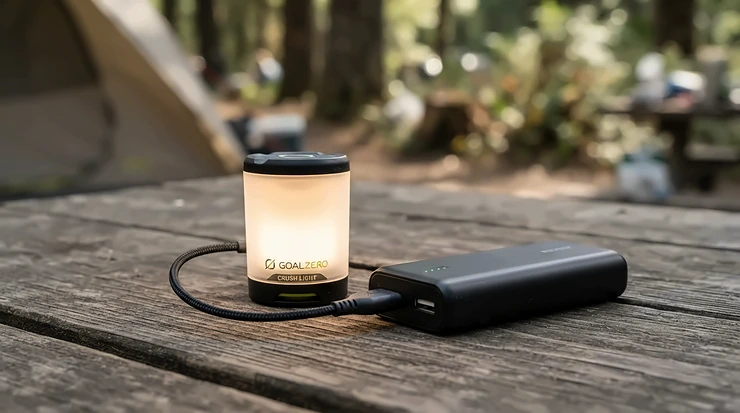
The Goal Zero Lighthouse Micro Flash is two lights in one: a four-LED lantern body plus a dedicated 120-lumen flashlight beam.
The headline is runtime. A 2,600 mAh 18650 cell is large for something this small, so the lantern runs up to 170 hours on its low setting with one side lit, or around 80 hours with both sides lit. High output reaches 150 lumens on a full battery, slipping to roughly 135 lumens as the cell drains. That means a long trip can pass without a recharge if you live on low. The IPX6 rating copes with heavy rain, and a battery indicator saves guesswork.
On paper this suits the walker who wants one gadget instead of a lantern plus a spare torch. Listings quote 68 g to 87 g, so weigh yours. Stock is also patchy: one US retailer lists it as no longer available while others still sell it, so check availability before committing.
UK reviewers at a bushcraft retailer (two reviews, both five-star) say the light is softer and kinder on the eyes than harsh white lanterns. Their one hiccup was working out how to exit test mode. A 2026 round-up from CleverHiker also named it the most portable lantern in its test group.
Pros:
- ✅ Very long low-mode runtime for its size
- ✅ Built-in flashlight beam as a bonus
- ✅ Warm, mellow light that’s easy on the eyes
Cons:
- ❌ Patchy stock and inconsistent weight listings
- ❌ Test-mode quirk confuses some new owners
Price: roughly the £25-£40 range where available. Verdict: great value if you can find one in stock.
3. Ledlenser ML4 — 300-lumen boost in a 71 g shell
The Ledlenser ML4 packs nine power LEDs into a lantern the size of a small torch, and its party trick is a 300-lumen boost.
That boost lasts around 2.5 hours, while the 5-lumen low setting runs for up to 45 hours. In practice, boost is for pitching in the dark and low is for bedtime. The IP66 rating handles British drizzle, and the body is built to survive modest drops. The real clincher is power flexibility. It ships with a rechargeable 14500 cell and a magnetic charging cable, but reviewers note it will also run on a standard AA in a pinch. On a long, unsupported route that fallback is genuine insurance.
A warm-white version also exists if you prefer a cosier tone.
Verified buyers at one European retailer call it a fantastic little lantern. They praise the modes, size, low weight and solid materials, and admit it isn’t cheap. A Hawaii-based outdoor reviewer likewise liked the light output and the saving on disposable batteries.
Pros:
- ✅ Brightest burst here at 300 lumens
- ✅ AA fallback if the rechargeable cell dies
- ✅ Weatherproof IP66 build at only 71 g
Cons:
- ❌ Boost drains the battery in about 2.5 hours
- ❌ Dearer than comparable pocket lanterns
Price: roughly the £35-£50 range. Verdict: worth the premium for the AA safety net alone.
4. Black Diamond Moji R+ — magnetic, dimmable all-rounder
The Black Diamond Moji R+ has made a name as the friendly, no-fuss lantern, with a frosted globe that spreads light without glare.
A two-button interface controls brightness, a campfire-style mode and a colour spectrum. The integrated 1,500 mAh battery recharges over micro-USB, and four embedded magnets plus fold-out hooks give you plenty of ways to hang it. One UK retailer lists it at 86 g, though other listings sit nearer 100 g, and an independent test recorded a heavier figure, so check the version you’re buying. Maximum output is quoted at 150 to 200 lumens depending on the listing, with an IPX4 splash rating.
My read of the data is that this is the best all-rounder for the typical UK trip. It’s bright enough to cook by and dim enough to read by. The main grumble is runtime. One independent tester found only about 16 hours on its low setting, far below some published claims.
OutdoorGearLab reviewers call it compact, tough though not indestructible, and easy to hang anywhere. A REI buyer who found it overkill for simple use still praised the magnetic base.
Pros:
- ✅ Frosted globe gives even, glare-free light
- ✅ Four magnets and double hooks for easy mounting
- ✅ Dimming gives fine control over brightness
Cons:
- ❌ Runtime claims vary between sources
- ❌ Only IPX4 and micro-USB charging
Price: roughly the £35-£50 range. Verdict: solid value if you’ll use the dimming.
5. BioLite AlpenGlow Mini — 98 g mood light with a built-in bungee
The BioLite AlpenGlow Mini solves hanging without extra cord: an integrated bungee strap wraps around poles and branches up to roughly an inch thick.
Output reaches 150 lumens on high for about 5 hours, or 5 lumens on low for around 40 hours. A 1,000 mAh battery recharges over USB-C in roughly three hours, and a 2-hour low-mode reserve stops it dying abruptly. The operating range of -20°C to 60°C and the IPX4 rating are also reassuring. In practice the bungee strap means no fiddling with knots at midnight, and the reserve mode buys you a lit walk to the toilet when the battery is flat.
For couples or anyone who likes warm, dimmable ambience, the spec comparison puts this near the top. Verifiable review evidence for this model is thin, though. One retailer shows a single five-star rating, and the bigger AlpenGlow 500 has attracted more reviewer attention than the Mini. Weight is 98 g on the manufacturer’s data, though one retailer lists 210 g, so verify before buying.
Pros:
- ✅ Built-in bungee for fast, knot-free hanging
- ✅ USB-C charging with a low-mode reserve
- ✅ Wide operating temperature range
Cons:
- ❌ Limited verifiable review evidence
- ❌ Only IPX4 weather resistance
Price: roughly the £35-£50 range. Verdict: fair value, especially for colder trips.
6. BioLite Luci Original — collapsible solar lantern, one inch flat
The BioLite Luci Original folds down to an inch and inflates in seconds, making it one of the most packable options here.
It weighs 125 g and puts out up to 75 lumens in the Clear version (65 in Matte). It runs about 24 hours on low and 6 hours on high, and the IP67 rating means it can take a soaking. It recharges by USB-C in around three hours or by its built-in solar panel in about seven. The pinch valve keeps inflation simple, and it’s rated to withstand about 150 lbs of pressure, which matters when it’s stuffed in a pack.
That 75-lumen ceiling is modest, but diffused through an inflated bag it feels bigger than the number suggests. Here’s the honest wrinkle: seven hours of direct sun is optimistic for the UK. Use USB-C as your main charge and treat the panel as a top-up.
Gear Junkie keeps it in its 2026 round-up as a classic inflatable that’s simple to use and stays topped up after a day in the sun. A New Zealand outdoor retailer calls it a fixture of campsite and hut cooking areas.
Pros:
- ✅ Packs flat to about one inch
- ✅ IP67 waterproof and very robust
- ✅ Simple controls with solar backup
Cons:
- ❌ Max output is modest at up to 75 lumens
- ❌ Heavier than the pocket-style options
Price: roughly the £20-£30 range. Verdict: excellent value for a collapsible.
7. LuminAid PackLite Max 2-in-1 — inflatable lantern that charges your phone
The LuminAid PackLite Max 2-in-1 is the only pick here that doubles as a power source.
A 2,000 mAh battery lights a 150-lumen turbo mode and also charges phones, headlamps and cameras through USB-A. It runs up to 50 hours at its lowest setting and is rated IP67, so it floats. It packs to about an inch and inflates to roughly six inches. Charging takes 1-2 hours by USB or 12-14 hours by solar. Weight listings range from 241 g up to about 355 g depending on the version, so verify the exact model.
My analysis is that it only makes sense if you’d otherwise carry a separate power bank. A UK retailer lists it at roughly £50, and the whole package then replaces two items rather than adding one. For a pure lantern it’s heavy.
CleverHiker rated it its best overall lantern, noting that it recharged a phone while leaving power for lighting. A Trailspace reviewer liked the brightness and strapping it to the pack for solar charging, but disliked inflating it by mouth, which can leave condensation inside.
Pros:
- ✅ Doubles as a phone charger
- ✅ Floats and IP67 waterproof
- ✅ Solar and USB charging options
Cons:
- ❌ Heaviest lantern in this round-up
- ❌ Mouth inflation can trap moisture
Price: roughly the £45-£55 range. Verdict: good value if it replaces a power bank.
Top 7 Head-to-Head: Specs, Runtime and Value
| Product | Weight | Runtime (low / high) | Charging | Rating | Price range | Best for |
|---|---|---|---|---|---|---|
| Nitecore LR10 | 59 g | 38 h / 1 h | Micro-USB | IP66 | £25-£35 | Ultralight solo trips |
| Goal Zero Lighthouse Micro Flash | 68 g | up to 170 h / 15 h | USB | IPX6 | £25-£40 | Long trips on low |
| Ledlenser ML4 | 71 g | 45 h / 2.5 h | Magnetic USB | IP66 | £35-£50 | Remote routes (AA fallback) |
| Black Diamond Moji R+ | about 86 g | varies by source | Micro-USB | IPX4 | £35-£50 | General tent use |
| BioLite AlpenGlow Mini | 98 g | 40 h / 5 h | USB-C | IPX4 | £35-£50 | Cold nights, couples |
| BioLite Luci Original | 125 g | 24 h / 6 h | USB-C or solar | IP67 | £20-£30 | Wet trips, simplicity |
| LuminAid PackLite Max 2-in-1 | 241 g and up | up to 50 h | USB or solar | IP67 | £45-£55 | Phone charging, groups |
The Nitecore LR10 and Goal Zero Lighthouse Micro Flash give the best light-per-gram, while the BioLite Luci Original gives the best price-per-night for a collapsible. The LuminAid PackLite Max 2-in-1 costs the most, but only pays back if it replaces a separate power bank. If you’re torn, the Ledlenser ML4 offers the most flexibility for the money.
How to Choose a Lightweight LED Lantern for Backpacking
Choose by weight first, then match lumens to your shelter, check low-mode runtime, confirm USB charging, and finally weigh weather rating and mounting. Here’s the sequence in detail.
- Set a weight ceiling. Most solo walkers should aim for 60-100 g. Go up to about 125 g only if you want a collapsible, and above that only if the lantern replaces another item.
- Match lumens to your space. Around 50-100 lumens is plenty for a one- or two-person tent. Cooking under a tarp justifies 150 or more.
- Read low-mode runtime. You’ll spend most nights on the dimmest setting, so low-mode hours matter more than headline brightness.
- Prefer USB charging with a safety net. Built-in batteries are convenient, but an AA fallback like the Ledlenser ML4 helps on remote routes.
- Check the weather rating. IPX4 handles splashes, while IP66 or IP67 copes with sustained UK rain.
- Check how it mounts. Hooks, magnets and bungees all matter when your tent has few attachment points.
- Consider colour. Warm light is kinder to the eyes at night than cool white.
Features That Actually Matter (And Those That Don’t)
Marketing loves big numbers, but most backpackers only use a fraction of what’s on the box. Here’s the filter.
Features that matter:
- ⚡ Weight and pack size. Every gram counts, and collapsible shapes like the BioLite Luci Original save volume even when they don’t save weight.
- 🔋 Low-mode runtime. This decides whether the lantern survives a four-night trip.
- 🌡️ Operating temperature. The BioLite AlpenGlow Mini lists -20°C to 60°C, which is genuinely useful for shoulder-season nights.
- 🪝 Mounting options. A good hook or magnet beats an extra 50 lumens.
Features that don’t:
- 🌈 Rainbow colour modes. Fun, but you won’t use them on a wet night in the Lakes.
- 💥 Inflated lumen claims. A 1,000-lumen car-camping lantern is the wrong tool for a tent.
- 📱 Phone charging. Unless it replaces a power bank, it’s weight you don’t need.
Ultralight Camping Lantern vs Headlamp vs Candle Lantern
Which light you carry depends on what you do after dark. The honest answer is often a lantern plus a headlamp, but it’s worth understanding the trade-offs.
| Option | Typical weight | Strength | Weakness | Best for |
|---|---|---|---|---|
| Ultralight camping lantern (e.g. Nitecore LR10) | 59 g and up | Even, shared light | Not for trail navigation | Tent and camp tasks |
| Ultralight headlamp | Under 100 g with batteries | Hands-free beam for walking | Glare in shared spaces | Night navigation |
| Candle lantern (e.g. UCO Original Candle Lantern) | Heavier than LED options | Warm ambience, no battery | Open flame in or near a tent | Open camps with space |
| Phone torch | No extra weight | Always with you | Drains phone, awkward to hold | Emergencies only |
A headlamp wins on the trail because it throws a directional beam you can aim. A lantern wins in camp because it lights everything around you without blinding anyone. A candle lantern adds atmosphere but brings the risks of an open flame, so keep it out of the tent. For most walkers a headlamp for navigation and an ultralight camping lantern like the Ledlenser ML4 for camp is the sweet spot.
Collapsible Lantern Design: Inflatable vs Rigid vs Hybrid
Collapsible lantern design comes in three flavours. Inflatable bags like the LuminAid PackLite Max 2-in-1 and BioLite Luci Original pack to about an inch and diffuse light across the whole bag. Rigid pocket lanterns like the Nitecore LR10 and Ledlenser ML4 are lighter but throw more directional light. Hybrids like the BioLite AlpenGlow Mini use a frosted body and a bungee strap for flexible hanging.
The trade-off is weight against volume. Inflatables save pack space but typically weigh more per lumen. Rigid lanterns weigh less but take up a little more room. If your pack is already tight, a collapsible earns its keep. If you count grams, go rigid.
Durability is a point in the inflatables’ favour. The BioLite Luci Original is rated to withstand around 150 lbs of pressure, so it survives being squashed in a pack. One practical tip is to let any inflatable dry fully before storing it, since moisture from mouth inflation can linger inside.
Mini Hiking Lantern Performance: What to Expect in Real-World Use
A mini hiking lantern lives and dies on how its numbers translate to a real night, so here’s a rough translation.
At 5-15 lumens you can find your boots and read a map. At around 65 lumens you can cook and sort kit. At 150 lumens or more the tent glows like a lit stage, which is great for cooking but pointless for sleeping. A lantern like the Nitecore LR10 on its 65-lumen setting gives about 5 hours 15 minutes, which is roughly two and a half nights at two hours each. The BioLite AlpenGlow Mini on high gives about 5 hours, but on low it stretches to around 40.
Cold changes the maths. Lithium-ion cells lose capacity at low temperatures, so keep your lantern in your sleeping bag or an inside pocket overnight. That one habit does more for winter reliability than any spec on the box.
Packable LED Lantern Running Costs and Long-Term Value
A packable LED lantern costs little to run, but total cost of ownership still deserves a look. Say you spend 20 nights a year camping for five years. A £30 lantern then works out at about 30p a night, and a £50 model at around 50p. A rechargeable battery pays itself back quickly compared with buying disposables.
Maintenance is minimal but real. Goal Zero advises keeping the Goal Zero Lighthouse Micro Flash plugged in or charging it every three to six months, and the same principle applies to most lithium-ion lanterns. Sealed batteries also mean the lantern’s life equals the battery’s life. Goal Zero quotes “hundreds of cycles”, which comfortably covers years of weekend trips.
Safety matters too. UK fire services publish guidance on charging lithium-ion batteries safely, including never charging unattended overnight and avoiding damaged cells. It’s worth reading before you leave a lantern on charge in a tent or car.
Wild Camping Kit List: Where Your Lantern Fits
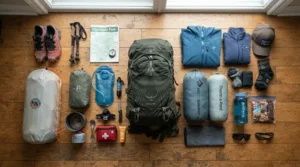
Your wild camping kit list should start with the essentials and treat the lantern as a luxury layered on top. Here’s a lightweight setup for a UK trip.
- ⛺ Shelter and sleep system: tent or tarp, mat, sleeping bag
- 🔥 Stove and fuel: the Scottish Outdoor Access Code recommends a stove over an open fire
- 💧 Water and filter: carry treatment and a spare bottle
- 🔦 Headlamp: essential for night navigation
- 💡 Lantern: the Nitecore LR10 or Goal Zero Lighthouse Micro Flash for ultralight loads
- 🔋 Power bank and cable: only if your lantern doesn’t double as one
- 🚽 Trowel and waste bags: pack out what you can
- 🗺️ Map, compass and first aid: non-negotiable
On weight, a lantern adds about 60-125 g to a wild camping kit list, which is less than most people’s spare socks. The headlamp is the one you can’t skip, because a lantern can’t navigate a trail for you. Light discipline matters too: stay on low and warm so you don’t advertise your camp across an open hillside.
Practical Usage Guide: Setup, Charging and First-30-Day Mistakes
A few habits make any lantern last longer and work better.
Setup:
- Charge fully before every trip and test the modes at home.
- Hang it from the tent apex so light spreads downward and bounces off the fabric.
- On inflatables, use the pinch valve, inflate fully, and let the lantern dry afterwards.
On the trail:
- Strap an inflatable to the top of your pack so its solar panel charges as you walk. One reviewer did exactly this with the LuminAid PackLite Max 2-in-1.
- Keep it switched off in the pack. The Nitecore LR10 needs a one-second hold to power on, which helps avoid accidental activation.
Common first-month mistakes:
- Leaving it on high all evening and flattening the battery by day three
- Storing it at zero charge for months
- Forgetting a spare charging cable
- Trusting solar alone in a British autumn
Real-World Scenarios: Three Walkers, Three Lanterns
Matching the lantern to the trip beats chasing the best spec sheet. Here are three profiles.
The solo weekend walker (Lake District, two nights, under £40). Weight and price matter most. The Nitecore LR10 or Goal Zero Lighthouse Micro Flash fits, since either adds about 60-70 g and costs well under £40. Both handle a weekend on low.
The long-distance hiker (Pennine Way, 10+ days). Resupply is rare, so the choice is between a LuminAid PackLite Max 2-in-1 and a separate power bank plus a lighter lantern. The maths often favours the latter. A Nitecore LR10 plus a dedicated power bank gives more total capacity for similar weight, though the LuminAid PackLite Max 2-in-1 is simpler if you only need one phone top-up.
The couple in a two-person tent (Dartmoor or Cairngorms, October). Colder nights and shared space favour the BioLite AlpenGlow Mini for its warm dimming and -20°C operating range, or the Black Diamond Moji R+ if you prefer magnets and a simple interface. Either provides gentle light without waking the other person.
✨ Don’t Miss These Carefully Selected Picks!
🔍 Take your next night out to the next level with these hand-picked lanterns. Click on any highlighted item to check current pricing and availability on Amazon UK. These lights will help you create a cosy, practical camp your whole group will enjoy!
Safety, Rules and Regulations for Lanterns and Wild Camping in the UK
A lantern is low-risk, but a few rules apply.
On the equipment side, look for UKCA or CE marking on the product page for electrical items, and buy from known sellers because cheap, unbranded lithium-ion cells may lack protection circuits. Never charge a damaged lantern, and unplug it when full.
On the legal side, wild camping rules differ by nation. In most of England and Wales you need the landowner’s permission. In Scotland, access rights extend to lightweight, small-group wild camping for two or three nights in one place, as set out in the Scottish Outdoor Access Code. In England, Dartmoor is the notable exception: the Supreme Court ruled in May 2025 that the public has a right to camp on the commons, with conditions, as detailed on the Dartmoor National Park Authority website. Rules can change, so always check the latest guidance before you go.
Whatever the land, leave no trace. That means packing out all rubbish, avoiding open fires and keeping your light low so you don’t disturb wildlife or other campers.
FAQ
❓ How many lumens does a backpacking tent lantern need?
❓ How long do rechargeable ultralight lanterns last on one charge?
❓ Do solar inflatable lanterns work in cloudy UK weather?
❓ What's the best mini hiking lantern for cold-weather camping?
❓ Can you use a lantern for wild camping without annoying others?
Conclusion
Choosing a lightweight LED lantern for backpacking comes down to a handful of honest trade-offs. If grams are your religion, the Nitecore LR10 is the lightest and the Goal Zero Lighthouse Micro Flash the longest-running. If you want a safety net for remote routes, the Ledlenser ML4 offers an AA fallback. For simple, all-round tent lighting, the Black Diamond Moji R+ and BioLite AlpenGlow Mini both do the job, with the latter better suited to cold nights. For collapsible simplicity, the BioLite Luci Original is the budget pick, and the LuminAid PackLite Max 2-in-1 makes sense only if it replaces a power bank.
Whichever you choose, treat it as the soft-light companion to a proper headlamp, not a replacement. A good ultralight camping lantern adds a few dozen grams and turns a cold, dark pitch into somewhere you actually want to sit.
Recommended for You
- Waterproof LED Lantern: 7 Proven Picks For Soggy UK Camps (2026)
- LED Lantern For Caravan: 7 Brilliant Picks For 2026
- LED Lantern For Family Camping: 7 Brilliant Picks (2026)
Disclaimer: This article contains affiliate links. As an Amazon Associate, I earn from qualifying purchases. If you purchase products through these links, we may earn a small commission at no additional cost to you.
✨ Found this helpful? Share it with your friends! 💬🤗
