
In This Article
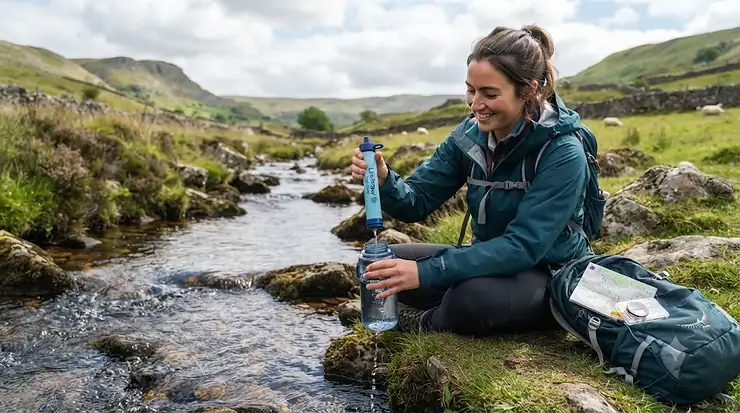
Somewhere on a Scottish ridge, three days into a route with your next resupply still a full day’s walk away, the maths becomes very simple: you can’t carry enough bottled water to last, and the stream in front of you looks clean enough to drink but you genuinely can’t be sure. This is the exact moment a portable water filter earns its place in your pack, and it’s also the moment most people realise they bought the wrong one — too heavy for the trip, too slow for a group, or simply not rated for what was actually in that water.
So what is a portable water filter? It’s a compact device — a straw, a squeeze pouch, a pump, or a filtered bottle — that physically removes bacteria, protozoa and sediment from untreated water as you drink it, without needing electricity, boiling, or chemical tablets. Some go a step further and remove viruses too, in which case they’re technically classed as purifiers rather than filters, a distinction that matters more than most buyers realise before it’s too late.
There’s a genuine health case behind this, not just outdoor-gear marketing. According to UK government guidance on giardiasis, giardia is transmitted through consumption of water contaminated by the faeces of infected animals or humans, including water from lakes and rivers — precisely the kind of source a hiker fills up from. The technique of using membranes, activated charcoal and chemical disinfection to make water safe in the field is formally known as portable water purification, and it’s a far older and more established discipline than the current wave of ultralight backpacking gear might suggest.
We’ve researched seven real, currently available filters sold on amazon.co.uk — from £15 straws through to serious military-grade purifiers — and weighed up what each is genuinely good at, where it falls short, and who it actually suits. No invented testing claims, no guessed prices, just an honest look at what you’d be trusting your gut health to.
Quick Comparison Table
| Filter | Type | Best For |
|---|---|---|
| Sawyer Squeeze | Squeeze/hollow fibre | Best all-round value for backpacking |
| LifeStraw Personal | Straw | Best budget water filter |
| Katadyn BeFree 1L | Collapsible squeeze bottle | Fastest flow rate for solo hikers |
| Grayl GeoPress | Press purifier | Only compact option that removes viruses |
| Platypus GravityWorks 4L | Gravity system | Groups and basecamp cooking water |
| MSR Guardian | Pump purifier | Serious expeditions and international travel |
| Lifesystems Water Filter Bottle | Filtered bottle | UK-designed all-in-one hydration |
Looking at this spread, the real dividing line isn’t price — it’s whether you need a filter or a purifier. Filters like the Sawyer Squeeze and LifeStraw Personal handle bacteria, protozoa and sediment, which covers the vast majority of UK upland water sources. Purifiers like the Grayl GeoPress and MSR Guardian go further and remove viruses too, which matters far more abroad than it typically does on a Lake District fell.
💬 Just one click – help others make better buying decisions too!😊
Top 7 Portable Water Filters: Expert Analysis
We picked these seven to cover the realistic spread of what UK hikers, backpackers and wild campers actually reach for — from grab-and-go straws through to genuine expedition-grade purifiers.
1. Sawyer Squeeze — the industry-standard squeeze filter
The standout feature is longevity: Sawyer rates this 0.1-micron hollow-fibre filter to treat up to 100,000 gallons (roughly 378,000 litres) before it needs replacing, which in practical terms means most owners never actually wear one out. Based on the spec comparison with rival squeeze filters, that hollow-fibre design works by physically blocking pathogens based on pore size rather than chemically adsorbing them, which is why performance doesn’t degrade the way carbon-based filters can once saturated.
What most buyers overlook about the Squeeze is its versatility — it threads onto standard bottles, works inline with a hydration bladder, and functions as a gravity filter with the included pouches, so one filter genuinely covers several use cases rather than locking you into one method. Reviewers consistently flag the same weakness though: the bundled squeeze pouches tend to develop leaks at the seams after repeated use, and most experienced backpackers replace them with sturdier third-party bags within a season.
Here’s what the spec sheet won’t tell you plainly: at 0.1 microns, this removes bacteria, protozoa (including giardia) and microplastics, but not viruses. For UK streams and rivers, that’s rarely an issue — waterborne viral contamination in British wilderness is genuinely uncommon — but it’s worth knowing before you rely on it internationally.
Pros:
- ✅ Rated to filter roughly 378,000 litres before replacement
- ✅ Works as a squeeze, inline, or gravity filter interchangeably
- ✅ Genuinely lightweight at around 85g
Cons:
- ❌ Doesn’t remove viruses, unsuitable alone for high-risk international water
- ❌ Included squeeze pouches prone to splitting at the seams over time
Typically priced in the £25-£35 range, the Sawyer Squeeze is widely regarded as the default recommendation for UK and European backcountry use, and the value case genuinely holds up at that price point.
2. LifeStraw Personal — the best budget water filter for straightforward protection
There’s no getting around it: at 46g and typically under £20, the LifeStraw Personal is about as simple and cheap as genuine filtration gets. The standout feature is its sheer minimalism — no pump, no squeeze bag, no moving parts, just a straw you drink directly through, rated to remove 99.9999% of bacteria and 99.9% of protozoa across a 4,000-litre lifespan.
Based on the spec comparison with squeeze and bottle filters, that simplicity comes with one significant trade-off that most first-time buyers don’t fully register until they’re using it: you must be physically at the water source to drink, since there’s no way to carry filtered water onward in the straw itself. That makes it a genuinely excellent backup or emergency filter, and a slightly frustrating primary filter for anyone hiking a route with infrequent water sources.
What reviewers consistently note is that its capacity, while smaller than the Sawyer Squeeze’s, is more than sufficient for most UK day hikes and short backpacking trips, and its low cost makes it an easy addition to an emergency kit even for people who already own a more capable primary filter.
Pros:
- ✅ Genuinely ultra-lightweight at 46g
- ✅ No assembly or moving parts — simplest option here to use
- ✅ Removes 99.9999% of bacteria and 99.9% of protozoa
Cons:
- ❌ Can’t carry filtered water — must drink directly at the source
- ❌ Doesn’t remove viruses, same limitation as the Sawyer Squeeze
At typically under £20, this is the cheapest genuinely protective option on this list, and a sensible backup even for hikers who carry something more versatile as their main filter.
3. Katadyn BeFree 1L — fastest flow rate for solo hikers
Where the Sawyer and LifeStraw prioritise longevity and simplicity respectively, the Katadyn BeFree 1L leads with speed. Its 0.1-micron hollow-fibre membrane is consistently rated by outdoor testers as one of the faster-flowing filters in this weight class, paired with a soft, collapsible flask that packs down flat when empty — a genuine space-saver compared to a rigid bottle filter.
Here’s what the spec comparison reveals that the marketing doesn’t emphasise: that speed and softness come at the cost of field serviceability. Unlike the Sawyer Squeeze, which can be backflushed indefinitely to restore flow rate, the BeFree’s cartridge isn’t designed to be user-maintained in the same way, and its rated lifespan of around 1,000 litres is meaningfully shorter than the Sawyer’s. For a weekend trip or week-long trek, that’s a non-issue; for a thru-hike covering months, it becomes a real consideration.
Testers who’ve used both note the BeFree’s collapsible bottle integrates more cleanly into a pack than Sawyer’s supplied pouches, and the wide-mouth opening makes refilling from shallow streams noticeably easier than narrow straw-style filters.
Pros:
- ✅ Among the fastest flow rates in this weight class
- ✅ Collapsible bottle packs flat and refills easily from shallow water
- ✅ Simple squeeze-to-drink operation with no separate parts
Cons:
- ❌ Cartridge isn’t field-serviceable in the way Sawyer’s is
- ❌ Shorter rated lifespan (around 1,000L) than the Sawyer Squeeze
Sitting in the £35-£45 range, it’s a fair trade of slightly shorter lifespan for meaningfully better day-to-day usability — a reasonable pick for solo hikers who value speed and low faff over maximum longevity.
4. Grayl GeoPress — the only compact option here that removes viruses
This is where the list shifts from filter to genuine purifier. The Grayl GeoPress uses a press-style inner cylinder that purifies roughly 710ml of water in about eight seconds, and critically, its filtration media is rated to remove viruses as well as bacteria and protozoa — a capability none of the squeeze or straw filters above can claim.
Based on the spec comparison with pump-based purifiers, the GeoPress achieves this without any electricity, batteries, or hand-pumping motion — you simply fill the outer bottle, press the inner cylinder down, and drinkable water is ready. That’s a genuinely useful design for anyone travelling internationally, where sewage-contaminated water sources are a realistic risk rather than a theoretical one, since waterborne illness prevention matters considerably more once you’re outside UK upland streams and into regions with less robust sanitation infrastructure.
Reviewers consistently flag two honest trade-offs: it’s noticeably heavier and bulkier than a squeeze or straw filter, and its replacement cartridges — needed roughly every 65 gallons — add an ongoing cost that squeeze-filter owners don’t face in the same way.
Pros:
- ✅ Only filter on this list rated to remove viruses
- ✅ Purifies water in roughly 8 seconds — genuinely fast for the capability
- ✅ No pumping, batteries or electricity required
Cons:
- ❌ Heavier and bulkier than any squeeze or straw filter here
- ❌ Replacement cartridges add a recurring cost over time
Typically priced in the £80-£90 range, with replacement cartridges around £25-£30, it’s the clear pick for international travel or emergency preparedness rather than routine UK day hikes.
5. Platypus GravityWorks 4L — best for groups and basecamp cooking water
Solo filters solve a solo problem; the Platypus GravityWorks 4L solves a different one entirely. This gravity-fed system uses two connected bags — fill the “dirty” bag, hang it up, and gravity pulls water through the filter into the “clean” bag below, with zero pumping or squeezing required once it’s set up.
What most buyers overlook about gravity systems is how well they suit group dynamics specifically: rather than each person filtering their own water individually, one person sets up the GravityWorks at camp and walks away, returning to four litres of filtered water ready for cooking, refilling bottles, or washing up. Testers highlight this hands-free operation as the standout advantage over squeeze or pump alternatives when multiple people need water from the same source.
Based on the spec comparison with solo filters, the trade-off is straightforward: at roughly 4L capacity and with two bags plus a filter unit, it’s meaningfully heavier and bulkier than anything designed for one person, and it’s genuinely awkward as your sole filter on a solo ultralight trip. The bags reportedly double usefully as an improvised solar shower or handwashing station at basecamp, a nice secondary function beyond pure filtration.
Pros:
- ✅ Fully hands-free once set up — no pumping or squeezing
- ✅ Filters 4 litres at a time, ideal for groups
- ✅ Bags double as a solar shower or handwashing station
Cons:
- ❌ Considerably heavier and bulkier than solo backpacking filters
- ❌ Overkill and awkward for solo, weight-conscious trips
At typically £85-£100, it earns its price for group trips and basecamp use specifically — a poor value choice if you’re usually hiking and camping alone.
6. MSR Guardian — serious expedition-grade virus protection
At the premium end of this list sits the MSR Guardian, a hand-pump purifier built for people whose water sources genuinely can’t be trusted — international expeditions, disaster response, or extended trips where filter reliability matters more than weight or price. Its 0.02-micron hollow-fibre membrane is rated to remove particulates, bacteria, protozoa, and — unusually for a pump filter — viruses too, putting it in the same purification class as the GeoPress but with a fundamentally different mechanism.
Based on the spec comparison with other purifiers on this list, what genuinely sets the Guardian apart is its self-cleaning design: rather than clogging progressively like most filters, a portion of the incoming water is used to continuously backflush the membrane during pumping, which testers consistently describe as producing clean, clear water with no noticeable degradation in performance even after heavy use in silty conditions. That reliability is precisely why it’s a common choice for professional and military-adjacent field use, not just recreational backpacking.
The honest trade-off, and it’s a significant one, is weight and cost. This is by a wide margin the heaviest filter on this list, and its price sits well beyond what most casual UK hikers would reasonably spend — it’s built for people whose trips genuinely demand that level of assurance, not for a weekend in the Peak District.
Pros:
- ✅ Removes viruses as well as bacteria and protozoa
- ✅ Self-cleaning design resists clogging even in silty water
- ✅ Exceptional flow rate and reliability under sustained heavy use
Cons:
- ❌ Significantly heavier than every other filter on this list
- ❌ Premium price puts it well beyond casual weekend use
Priced well into the £300-plus bracket at the time of research, this is a specialist buy for serious expedition use — most UK-based weekend hikers simply don’t need this level of capability.
7. Lifesystems Water Filter Bottle — UK-designed all-in-one hydration
Rounding out the list is a UK-designed option built specifically with British hiking conditions in mind. The Lifesystems Water Filter Bottle uses a non-woven ceramic-fibre filter cartridge housed inside a standard-looking hydration bottle, rated to remove 99.9999% of bacteria, 99.99% of viruses and 99.9% of protozoa, alongside particulates, chemicals and heavy metals — a genuinely broad-spectrum claim for a bottle-format filter.
What most buyers overlook about bottle-style filters generally is the built-in filter life indicator here specifically, which removes the guesswork around when a cartridge needs replacing — a common frustration with filters that offer no clear signal until flow rate has already degraded noticeably. Based on the spec comparison with the Grayl GeoPress, its closest rival in format, testers who’ve used both note the Lifesystems bottle has a large usable capacity and genuinely lightweight build at around 255g, though its flow rate isn’t the fastest among bottle filters tested.
One practical limitation worth flagging honestly: unlike a squeeze filter, this bottle is designed to be drunk from directly rather than used to decant filtered water into a separate container, which matters if you’re filtering for a group or need to fill a cooking pot rather than just your own bottle.
Pros:
- ✅ Broad-spectrum removal including chemicals and heavy metals
- ✅ Built-in filter life indicator removes the guesswork
- ✅ Genuinely lightweight for an all-in-one bottle format, around 255g
Cons:
- ❌ Flow rate isn’t the fastest among bottle-format filters tested
- ❌ Can’t be used to decant filtered water for cooking or sharing
At typically £40-£45, it’s a solid middle-ground pick for UK-based hikers who want broader-spectrum filtration than a basic squeeze filter without stepping up to Grayl or MSR pricing.
Top 7 Filters at a Glance
| Product | Weight | Price Range | Removes Viruses? | Best For |
|---|---|---|---|---|
| Sawyer Squeeze | ~85g | £25-£35 range | No | All-round backpacking value |
| LifeStraw Personal | ~46g | Under £20 | No | Budget backup or day hikes |
| Katadyn BeFree 1L | ~65g | £35-£45 range | No | Fast solo hydration |
| Grayl GeoPress | ~450g | £80-£90 range | Yes | International travel |
| Platypus GravityWorks 4L | ~450g | £85-£100 range | No | Groups and basecamp |
| MSR Guardian | ~510g | £300+ range | Yes | Serious expeditions |
| Lifesystems Water Filter Bottle | ~255g | £40-£45 range | Yes | UK all-in-one hydration |
The clearest pattern here is that virus removal and weight move together — every filter capable of removing viruses on this list weighs noticeably more than the bacteria-and-protozoa-only options. For pure UK wild camping, that extra weight is arguably unnecessary; for international travel or emergency preparedness, it becomes the deciding factor rather than a nice-to-have.
Water Filter for Camping vs Backpacking: Different Jobs
The phrase “water filter for camping” gets used interchangeably with backpacking gear, but the two scenarios genuinely call for different tools. Car camping or basecamp use rewards capacity and hands-free operation over weight — this is precisely where a gravity system like the Platypus GravityWorks 4L earns its keep, filtering enough water for cooking, washing and drinking for a whole group without anyone standing there pumping or squeezing. Backpacking, by contrast, punishes every extra gram carried over a multi-day route, which is why solo, lightweight options like the Sawyer Squeeze or LifeStraw Personal dominate that category instead.
What most buyers overlook when shopping for “camping” gear generically is that a filter genuinely built for a static basecamp setup, sitting in a car boot or beside a tent, doesn’t need to prioritise pack weight the way a filter carried up and down hills all day does — buying toward the wrong category means either carrying unnecessary weight or ending up under-supplied with water at camp.
Your First Filter: A Step-by-Step Usage Guide
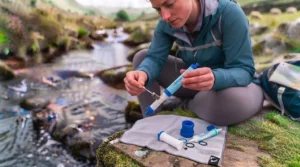
Buying the right filter is only half the job — using it correctly the first time avoids both wasted effort and, more importantly, contaminated water. Here’s the sequence that actually matters.
Start by choosing your water source carefully before the filter even comes out: moving water carries fewer pathogens than stagnant pools, and collecting upstream of livestock, paths or settlements meaningfully reduces contamination risk before filtration even begins. If the source looks murky or heavily silted, pre-filtering through a clean bandana or cloth protects the filter membrane and extends its working life considerably — silt clogs hollow-fibre membranes faster than almost anything else. From there, follow the manufacturer’s priming instructions exactly the first time you use a new filter, such as a Sawyer Squeeze or Katadyn BeFree, since most hollow-fibre filters need an initial backflush before their first use to clear manufacturing residue and confirm the membrane is intact.
A common first-trip mistake is assuming any filter works identically regardless of water temperature — several hollow-fibre membranes, including those in squeeze and bottle-style filters, can be permanently damaged if water freezes inside them, so in shoulder-season or winter conditions, keeping a filter like the Lifesystems Water Filter Bottle in an inside jacket pocket overnight rather than leaving it exposed in a tent porch genuinely matters. Finally, know your filter’s rated capacity and track it loosely — a Katadyn BeFree cartridge rated for roughly 1,000 litres will noticeably slow well before that limit if it isn’t backflushed periodically during a long trip.
Real-World Scenarios: Matching Filters to Trips
Specs only tell half the story — here’s how three genuinely different trip types point toward different filters.
If you’re planning a weekend wild camp in the Lake District or Scottish Highlands with one or two streams along the route, weight and simplicity matter more than raw capability — the Sawyer Squeeze or LifeStraw Personal cover UK conditions comfortably without adding unnecessary bulk to your pack.
If you’re heading abroad on a backpacking trip through regions with less reliable sanitation infrastructure, this is exactly the scenario where filter-only options fall short — a genuine purifier like the Grayl GeoPress removes viruses as well as bacteria and protozoa, addressing a real risk that UK-only hikers rarely need to think about.
If you’re organising a group basecamp trip — several tents, shared cooking, multiple people needing water from the same source — the Platypus GravityWorks 4L removes the bottleneck of everyone individually squeezing or pumping their own water, letting one setup serve the whole group hands-free.
How to Choose a Portable Water Filter
Cutting through marketing claims, here’s what genuinely separates a good choice from a poor one:
- Filter versus purifier first. Decide honestly whether your trips are UK-based, where filters like the Sawyer Squeeze suffice, or international, where a purifier like the Grayl GeoPress becomes genuinely necessary.
- Match capacity to trip type. A solo squeeze filter suits backpacking; a gravity system like the Platypus GravityWorks 4L suits groups and basecamps.
- Check the rated lifespan in litres, not just the price — a cheaper filter with a shorter lifespan can cost more per litre filtered over a season than a pricier one.
- Weigh flow rate against patience. The Katadyn BeFree genuinely flows faster than most alternatives; if you’re filtering for a group repeatedly, that difference adds up quickly.
- Consider field maintainability. Filters like the Sawyer Squeeze can be backflushed indefinitely; others, like the BeFree cartridge, are more disposable by design.
- Factor in freezing conditions if you hike in shoulder seasons — hollow-fibre membranes can be destroyed by ice, which changes how and where you store a filter overnight.
- Total cost across a season, not just sticker price — replacement cartridges for purifiers like the Grayl add up in a way a long-life Sawyer filter doesn’t.
Wild Camping in the UK: What It Means for Your Water Choices
If you’re planning to wild camp, it’s worth understanding the legal landscape before you’re relying on stream water miles from anywhere. According to official UK government guidance on rights of way and access, the public right to roam applies to open access land such as mountains, moors, heaths and common land in England — but this right covers walking, not automatically camping, which varies considerably depending on which part of the UK you’re in. Scotland’s position is genuinely different, with a broader statutory right to wild camp under separate access legislation, which is precisely why so many UK backpackers head north for genuinely legal, low-hassle wild camping.
The practical link to water filtration is this: the more remote and genuinely “wild” your camping spot, the less likely you are to have any alternative to natural water sources, which makes carrying a reliable filter — not an optional extra, but a genuine prerequisite for that kind of trip. A Sawyer Squeeze or LifeStraw Personal in your pack is what turns a remote Highland burn from a risk into a resource.
Water-Borne Illness Prevention: What You’re Actually Filtering Out
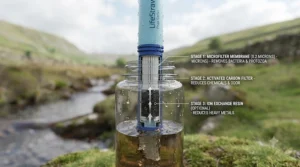
It’s worth being specific about what a portable water filter is protecting you from, because the marketing terms — “bacteria,” “protozoa,” “viruses” — can blur together without context. Giardia and Cryptosporidium are the two pathogens most commonly associated with UK upland water sources, both originating largely from livestock grazing near streams and rivers, and both capable of causing genuinely unpleasant, prolonged gastrointestinal illness. Cryptosporidium in particular is notably resistant to chemical treatment methods like chlorine tablets, which is exactly why physical filtration — rather than chemical disinfection alone — remains the more reliable method for UK conditions specifically.
Symptoms of giardiasis typically include sudden diarrhoea, bloating and stomach cramps, and according to NHS-aligned clinical guidance, the incubation period runs anywhere from several days to a few weeks after exposure — meaning symptoms can appear well after a trip has ended, making the original contaminated water source easy to overlook as the cause. This is precisely the gap a filter like the Katadyn BeFree or Sawyer Squeeze closes: physically blocking these pathogens at the point of drinking, rather than relying on hoping a stream “looks” clean.
✨ Don’t Miss These Exclusive Deals!
🔍 Get your next trip properly sorted before you set off. Click through on any of the filters above to check current pricing and availability on amazon.co.uk — a reliable portable water filter is one of the smallest, cheapest pieces of kit that can genuinely save a trip from going wrong. 🥾💧
The Weight vs Cost Trade-Off in Outdoor Gear
This trade-off shows up constantly in backpacking gear generally, and water filters are one of the clearest examples of it in action. The LifeStraw Personal costs the least and weighs the least on this list, but that combination comes with real functional limitations — no carrying capacity, no virus protection. The MSR Guardian sits at the opposite extreme: heaviest, most expensive, but genuinely the most capable and reliable option here under demanding conditions. According to gear testing from established UK outdoor publications, comprehensive comparative testing of hiking water filters consistently finds that no single filter wins across every category — flow rate, weight, capability and price all pull in different directions, and the “best” choice is really the one matched to a specific trip rather than a universal winner.
What most buyers overlook when chasing the lightest possible option is that the true cost of under-equipping isn’t measured in grams saved — it’s measured in the risk of illness on a trip where medical help might be hours or days away. The smarter framing isn’t “lightest” or “cheapest” in isolation, but the lightest and cheapest option that still genuinely matches the water sources and trip length you’re actually planning for.
Common Mistakes When Buying a Portable Water Filter
A handful of avoidable errors come up repeatedly among first-time buyers. The most common is assuming any filter automatically removes viruses — most squeeze and straw filters, including the Sawyer Squeeze and LifeStraw Personal, explicitly do not, which is fine for UK conditions but genuinely risky assumed knowledge to carry into international travel. The second is buying based on capacity alone without checking flow rate — a filter rated for hundreds of thousands of litres is of little comfort if it takes several frustrating minutes to fill a single bottle in the field. Third, buyers regularly forget about freezing risk, storing a filter in an outer pack pocket overnight in cold conditions and finding it permanently damaged the next morning. Finally, treating a purifier purchase as a one-off cost rather than accounting for ongoing replacement cartridges — relevant for both the Grayl GeoPress and, to a lesser extent, the Katadyn BeFree — leads to an inaccurate sense of long-term value.
Portable Water Filter vs Purifier vs Chemical Treatment
These three methods solve overlapping but distinct problems, and it’s worth understanding where each genuinely excels. A filter, such as the Sawyer Squeeze, physically removes bacteria and protozoa through pore size alone, working instantly with no waiting time, but stopping short of viruses. A purifier, such as the Grayl GeoPress or MSR Guardian, adds virus removal to that list, typically through a finer membrane or additional chemical-adjacent stage, at the cost of more weight, bulk or price. Chemical treatment — tablets or drops — takes a genuinely different approach entirely, killing rather than physically removing pathogens, and while lightweight and cheap, it typically requires a waiting period of thirty minutes to several hours before water is safe, plus it can leave a noticeable aftertaste that filtration avoids.
For most UK wild camping and backpacking, a filter alone genuinely suffices given the low viral contamination risk in domestic water sources. For international travel, disaster preparedness, or simply wanting maximum peace of mind, pairing a filter with chemical tablets as backup — or stepping up to a dedicated purifier like the GeoPress — closes that remaining gap.
Long-Term Cost & Maintenance
Thinking beyond the initial purchase price changes the value picture meaningfully. A Sawyer Squeeze, rated to filter roughly 378,000 litres before replacement, works out to a genuinely negligible cost per litre over its realistic lifetime — most owners simply never wear one out through normal recreational use. Compare that with the Grayl GeoPress, where replacement cartridges are needed roughly every 65 gallons; over several years of regular international travel, those recurring cartridge costs can meaningfully exceed the original purchase price of a filter like the Squeeze.
Maintenance habits matter too: hollow-fibre filters like the Sawyer Squeeze and Katadyn BeFree benefit from regular backflushing to maintain flow rate, a five-minute task that meaningfully extends working life, while filters left unmaintained after a muddy trip can clog prematurely regardless of their theoretical rated capacity. Storing any filter fully dried before long-term storage, rather than damp in a pack for weeks between trips, also reduces the risk of mould developing inside the membrane housing — a genuinely underrated maintenance step that costs nothing but attention.
Problem → Solution: Fixing Common Water Filter Headaches
A handful of specific complaints come up repeatedly — here’s what actually addresses each one.
Problem: Flow rate has slowed dramatically mid-trip. Almost always a sign the membrane has accumulated sediment — backflush the filter using the syringe or method specified for your model, such as the backflush syringe included with a Sawyer Squeeze, rather than assuming the filter has failed entirely.
Problem: Filter feels frozen or produces no water after a cold night. This is a genuine emergency for hollow-fibre filters — freezing can permanently crack the membrane. Solution: always store filters like the Katadyn BeFree inside your sleeping bag or jacket overnight in near-freezing conditions, never in an outer pocket.
Problem: Uncertain whether a filter is still working correctly after a hard knock or a freeze. Several filters, including some Lifesystems and Katadyn models, include an integrity test or filter life indicator specifically for this reason — check it rather than assuming, since a compromised filter with no visible damage can still let pathogens through.
Problem: Group members running out of patience waiting to filter water individually. This is exactly the gap a gravity system like the Platypus GravityWorks 4L solves — set it up once for the whole group rather than everyone squeezing or pumping their own supply.
Problem: Planning international travel and unsure if a UK-bought filter is sufficient. It likely isn’t for virus protection — step up to a genuine purifier like the Grayl GeoPress or MSR Guardian rather than assuming a standard hiking filter covers international water risk.
FAQ
❓ What's the best portable water filter for UK wild camping?
❓ Do I need a purifier or a filter for hiking in the UK?
❓ What's the lightest water filter for backpacking?
❓ How often do portable water filters need replacing?
❓ Can a portable water filter prevent waterborne illness completely?
Conclusion
There’s no single “best” portable water filter here, because the honest answer depends entirely on where and how you’re actually using it. For straightforward UK backpacking and wild camping, the Sawyer Squeeze remains the sensible default — light, long-lasting and genuinely versatile. If budget is the priority and you’re after a simple backup, the LifeStraw Personal does the job for very little outlay. For anyone travelling internationally or wanting genuine peace of mind around viruses, the Grayl GeoPress or MSR Guardian are worth the extra weight and cost, while groups and basecamps are far better served by a Platypus GravityWorks 4L than by everyone filtering individually.
Match the filter to the trip in front of you — the water sources you’ll actually encounter, the group size, the country — rather than chasing the lightest or cheapest option in isolation, and you’ll end up with genuinely reliable protection rather than gear that looks good on a spec sheet but falls short in the field.
Recommended for You
- Osprey Hydration Pack: 7 Best Picks amp; Buying Guide (2026)
- Best Hydration Pack UK 2026: 7 Top Picks Tested amp; Compared
- 10 Litre Water Carrier UK: 7 Best Picks Tested for 2026
Disclaimer: This article contains affiliate links. As an Amazon Associate, I earn from qualifying purchases. If you purchase products through these links, we may earn a small commission at no additional cost to you.
✨ Found this helpful? Share it with your friends! 💬🤗
