
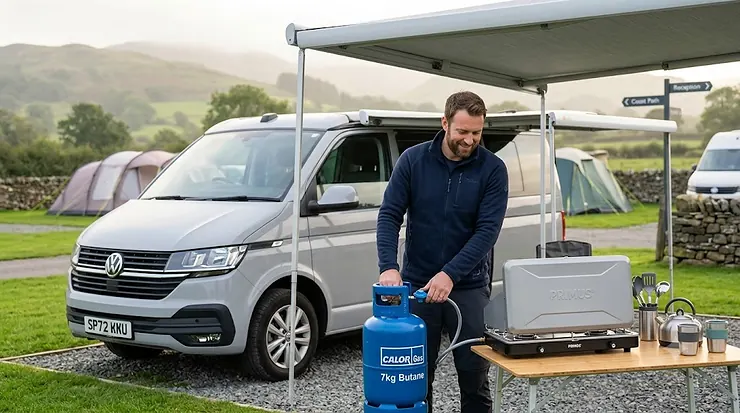
In This Article
If you’ve ever spent a soggy Tuesday evening on a campsite in the Lake District, hunched over a hissing stove that refuses to boil water, the odds are good your camping gas regulator was to blame — not the weather (although, to be fair, the weather certainly wasn’t helping). Gas regulators camping setups rely on are arguably the most overlooked piece of kit in any British camper’s arsenal. Everyone obsesses over the stove, the tent, the sleeping bag. The regulator? That little brass fitting gets shoved in a bag and forgotten about — until it fails at precisely the wrong moment.
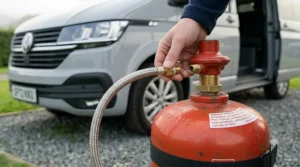
A gas regulator is the component that sits between your gas cylinder and your camping stove, reducing the high-pressure gas inside the bottle down to the safe, steady working pressure your appliance actually needs. In the UK, butane regulators are pre-set to around 28–30 mbar, while propane regulators operate at 37 mbar — and those figures are non-negotiable if you want a consistent flame and a safe setup. Without a correctly matched regulator, you’ll get either an anaemic trickle of gas or a dangerously uncontrolled surge.
What makes gas regulators camping UK buyers need to understand particularly tricky is that there’s no universal standard. Calor butane, Calor propane, Campingaz, patio gas — each uses a different fitting, a different pressure, and a different style of connection. Add in the British climate — damp, unpredictable, and never quite warm enough — and the choice of regulator becomes genuinely important rather than just a box-ticking exercise.
This guide cuts through the confusion. Whether you’re a weekend festival camper, a seasoned wild camper in the Cairngorms, or a family caravanner heading to Cornwall, here’s everything you need to know.
Quick Definition: A camping gas regulator is a pressure-reduction device that attaches to your LPG cylinder, delivering a consistent, controlled gas flow to your stove or appliance. In the UK, butane regulators are typically pre-set at 28–30 mbar; propane at 37 mbar. They come in screw-on and clip-on designs and are specific to the cylinder type they connect to.
Quick Comparison: Best Gas Regulators Camping UK 2026
| Product | Gas Type | Connection | Pressure | Best For | Price Range |
|---|---|---|---|---|---|
| Calor Campingaz 29mbar Butane Kit | Butane | Screw-on | 29 mbar | Campingaz cylinders, campsites | Under £20 |
| Huddersfield Gas 30mbar + 2m Hose | Butane | Screw-on | 30 mbar | Campingaz 907/904/901 users | Under £15 |
| JD Brands 37mbar POL Propane | Propane | POL/Hand wheel | 37 mbar | Winter camping, Calor/Flogas | Under £20 |
| BRADAS® 37mbar Propane + Hose Kit | Propane/Butane | Screw | 37 mbar | Budget buyers, BBQ & stove use | Under £15 |
| Cavagna 0.5–2 Bar Adjustable + Gauge | Propane | POL | Adjustable | High-output cooking, forges, pro use | Around £30 |
| METER STAR Adjustable Universal | Both | Universal swivel | Adjustable | Multi-gas setups, travel | Under £20 |
| Calor Essentials 29mbar Campingaz | Butane | Screw-on | 29 mbar | Entry-level camping, beginners | Under £15 |
The table above reveals something rather telling: most camping gas regulators in the UK sit at quite an accessible price point, which makes buying the wrong one all the more frustrating. The key variable isn’t price — it’s compatibility. The Cavagna adjustable unit is the outlier, aimed at users who need variable output or run multiple appliances; for the vast majority of weekend campers, a straightforward fixed-pressure model at under £20 is perfectly adequate. Pay attention to the “Gas Type” column above all else — fitting a propane regulator to a butane cylinder is not just ineffective; it’s a safety hazard.
💬 Just one click — help others make better buying decisions too! 😊
✨ Don’t Miss These Exclusive Deals!
🔍 Take your camping gas setup to the next level with these carefully selected regulators. Click on any highlighted product to check current pricing and availability on Amazon.co.uk. These picks will help you find exactly what you need for a safe, reliable outdoor kitchen.
Top 7 Gas Regulators Camping: Expert Analysis
1. Calor Campingaz 29mbar Butane Screw-On Gas Regulator Kit
The Calor-branded Campingaz regulator is, in many ways, the gold standard starting point for UK campers using Campingaz 901, 904, or 907 cylinders. That said, it’s worth understanding what “gold standard” means here: this is a reliable, straightforward, officially sanctioned regulator from one of Britain’s most trusted gas brands, not a gadget-laden premium product.
At 29 mbar output pressure, it delivers exactly the right gas flow for standard low-pressure camping stoves and portable grills. The screw-on design provides a secure, leak-resistant connection — notably more reassuring than clip-on alternatives when you’re setting up in a gusty Welsh field. Crucially, it arrives as a complete kit with a 1-metre hose and hose clips included, which is rather thoughtful since these are the parts most often left rattling around at the bottom of a cupboard back home.
UK campers particularly value this one for Calor’s brand recognition and the peace of mind that comes with it. The Gas Safe Register recommends using products from established, trusted suppliers — and Calor ticks that box definitively. Prime-eligible on Amazon.co.uk for next-day delivery.
Pros:
- ✅ Official Calor branding; reassuring for safety-conscious buyers
- ✅ Complete kit (regulator + 1m hose + clips) — nothing extra to buy
- ✅ Solid screw-on connection; minimal leak risk
Cons:
- ❌ Only compatible with Campingaz cylinders — no use with Calor Blue or Red
- ❌ 1m hose may be limiting for larger setups
Price range: Under £20 | A well-priced, trustworthy entry point for Campingaz users.
2. Huddersfield Gas 30mbar Campingaz Type Regulator with 2m Hose & Clips
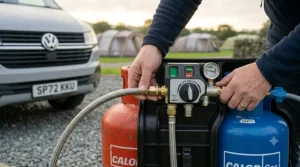
Huddersfield Gas has quietly become one of the most frequently recommended brands on Amazon.co.uk for camping gas accessories, and with good reason. Their 30mbar Campingaz-type regulator with a generous 2-metre hose is particularly popular with campers and caravan owners who want a bit more flexibility in positioning their stove relative to the gas bottle.
That extra metre of hose compared to the Calor kit might sound trivial, but in practice — when you’re cooking inside a gazebo porch, keeping the cylinder safely outside, or arranging equipment around a picnic table — the additional reach is genuinely useful. The 30mbar output (versus Campingaz’s nominal 29mbar) is within acceptable tolerance and works well across standard camping stoves.
What most buyers overlook about this model is that it’s manufactured to a solid standard for its price, using quality brass internals. UK reviewers consistently mention ease of fitting and solid build quality. It’s Prime-eligible, making it easy to grab before a last-minute camping weekend — one of those situations that seems to happen to every British camper far more than planned.
Pros:
- ✅ 2m hose — noticeably more practical than standard 1m options
- ✅ Excellent value for money
- ✅ Widely praised build quality in UK customer reviews
Cons:
- ❌ Campingaz-cylinder-only compatibility
- ❌ Third-party brand (not Calor/Campingaz official)
Price range: Under £15 | Outstanding value; ideal if the 2m hose length matters to your setup.
3. JD Brands 37mbar POL Propane Gas Regulator with Hand Wheel
Here’s where things get genuinely useful for the serious British camper: the JD Brands 37mbar POL propane regulator with hand wheel fitting, designed for Calor and Flogas red propane cylinders. And if you camp between October and April in this country — or indeed any time you venture north of Birmingham — propane is worth serious consideration over butane.
Why? Butane becomes sluggish below around 5°C and essentially stops vaporising below 0°C. Propane, by contrast, continues working at temperatures as low as -42°C. On a February weekend in the Peak District or a December glamping trip in Scotland, that difference is the gap between a hot breakfast and a very cold, very grumpy morning. The JD Brands regulator connects via the standard POL fitting used by Calor and Flogas propane bottles, with a no-spanner hand wheel design that speeds up connection considerably in cold, gloved hands.
UK customer feedback highlights the excellent fit on standard Calor propane bottles and the notably easy installation. At this price point, it represents solid value for anyone running a propane setup.
Pros:
- ✅ Works in cold British weather where butane won’t
- ✅ No-spanner hand wheel — quick, gloveable connection
- ✅ Compatible with Calor & Flogas propane cylinders
Cons:
- ❌ POL fitting only — not for Campingaz or butane cylinders
- ❌ Fixed 37mbar — no adjustability
Price range: Under £20 | The go-to propane choice for autumn and winter UK campers.
4. BRADAS® 37mbar Gas Regulator 1.5kg/h with 1m Hose & 2 Hose Clamps
The BRADAS® regulator is a complete propane/butane connection kit from a European brand that’s gained a solid foothold on Amazon.co.uk — and it’s not difficult to see why. It offers a complete setup right out of the box: regulator, 1-metre gas hose, and two hose clamps, at a price that makes it one of the most accessible full kits in the UK market.
The 37mbar output and 1.5kg/h flow rate make it suitable for typical camping stoves and small barbecues. It’s the kind of regulator a budget-conscious buyer or a first-time camper should consider — not because it cuts corners, but because it does the job without unnecessary complexity. Post-Brexit import context is worth a brief mention here: BRADAS® is a European brand, so UK buyers benefit from Amazon’s standard consumer protection under the Consumer Rights Act 2015, including the 14-day cooling-off period for online purchases.
For a family buying their first proper camping stove setup and wanting everything included without a head-scratching compatibility puzzle, this kit is rather sensible.
Pros:
- ✅ Complete kit — regulator, hose, and clips included
- ✅ Budget-friendly without sacrificing core function
- ✅ Suitable for both propane and butane (check cylinder compatibility)
Cons:
- ❌ Lesser-known brand; limited long-term durability data from UK reviewers
- ❌ 1m hose on the shorter side for some setups
Price range: Under £15 | A tidy budget-friendly kit that punches above its price.
5. Cavagna 0.5–2 Bar Adjustable Propane Gas Regulator with Pressure Gauge
Now we’re into genuinely different territory. The Cavagna adjustable propane regulator operates in a completely different league to the fixed-pressure units above — and it’s priced accordingly. The 0.5–2 bar adjustable output with integrated pressure gauge gives you granular control over gas flow, making it suitable for everything from a gentle simmer on a camping stove to high-output applications like outdoor cooking with wok burners, pizza ovens, or even small forges.
Cavagna is an Italian brand with a strong reputation in the gas equipment industry, and their products are well-regarded across the UK market. The POL inlet fits the full range of Calor and Flogas propane cylinders from 3.9kg up to the large 47kg variety. The pressure gauge is a genuinely useful feature — it gives you a real-time read on output, which is particularly handy when you’re running multiple appliances from a single cylinder.
What most buyers overlook about the Cavagna adjustable regulator is that it requires assembly of the outlet nozzle. This is straightforward but not mentioned clearly on all listings, so don’t be caught out. A small number of UK Amazon reviewers have reported receiving units with cosmetic damage suggesting returns — worth inspecting on arrival.
Pros:
- ✅ Adjustable pressure — versatile across cooking applications
- ✅ Integrated pressure gauge for real-time monitoring
- ✅ Reputable Cavagna brand; robust build quality
Cons:
- ❌ Requires nozzle assembly — not quite plug-and-play
- ❌ Premium price for casual campers who don’t need adjustability
Price range: Around £25–£35 | Best value for serious outdoor cooks needing flexible gas output.
6. METER STAR 1LB Adjustable Universal Gas Regulator Set with 80cm Hose
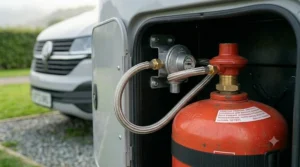
The METER STAR adjustable universal regulator is an interesting proposition — designed to work with both 1LB (small) propane bottles and standard screw-thread butane canisters via a swivel adapter. It’s the kind of kit that appeals to solo backpackers, wild campers, and festival-goers who want flexibility without carrying multiple regulators.
The G1/4 inch left-thread and 1/2 inch flare swivel universal thread system means it can bridge different cylinder formats, which is rather clever for those who travel with different gas setups across Europe (where Campingaz cartridges are often more available than UK cylinders). The 80cm hose is on the shorter side but manageable for compact stove setups.
It won’t replace a dedicated Calor propane regulator for home-base camping, but as a travel-oriented, versatile backup option it earns its place. UK buyers should note this is a compact unit built for lighter-duty use — it’s not designed for high-output cooking or large cylinders.
Pros:
- ✅ Works with multiple cylinder formats — genuinely versatile
- ✅ Adjustable pressure for fine-tuning flame output
- ✅ Compact and lightweight — backpack-friendly
Cons:
- ❌ 80cm hose is quite short
- ❌ Not suitable for large cylinders or high-output appliances
Price range: Under £20 | A clever multi-format option for flexible campers and European travellers.
7. Calor Essentials 29mbar Low Pressure Butane Gas Regulator (Campingaz)
The Calor Essentials range exists to offer a more affordable entry point under the trusted Calor brand, and this 29mbar low-pressure butane regulator is essentially the stripped-back version of the full Calor kit reviewed in position one. It’s designed specifically for Campingaz cylinders (901, 904, and 907) and delivers exactly the regulated output those cylinders require.
What you sacrifice versus the full Calor kit is the included hose and clips — this is the regulator alone, so factor in the additional cost of a separate gas hose (BS3212/1 compliant hose is the correct specification for low-pressure UK camping use) and hose clips. For someone replacing a regulator they already have hose for, this is the budget-smart choice. For a first-time buyer, the full kit in position one makes more sense.
UK customer feedback is generally positive, noting solid build quality for the price. Prime delivery makes it easily available for last-minute trips, which rather suits the impulsive nature of most British camping decisions.
Pros:
- ✅ Official Calor brand at a lower price point
- ✅ Correct 29mbar for Campingaz cylinders
- ✅ Reliable, consistently reviewed product on Amazon.co.uk
Cons:
- ❌ Hose and clips sold separately — hidden additional cost
- ❌ Campingaz-only compatibility
Price range: Under £15 | Best for those replacing a regulator and already owning a compatible hose.
How to Choose a Camping Gas Regulator in the UK: A Practical Framework
Choosing a gas regulator for camping is less complicated than it appears once you understand the three key variables. Here’s a structured way to think through it:
- Identify your gas cylinder type first. Before anything else, know what’s in your gas bottle. Calor butane (blue bottle), Calor propane (red), Campingaz (901/904/907), patio gas (green) — each requires a specific regulator type. Fitting the wrong one is a safety issue, not just an inconvenience.
- Match the connection type. UK regulators use either screw-on or clip-on (push-fit) connections. Screw-on provides a more secure fit — worth it for camping where setup happens on uneven ground in variable conditions.
- Consider your season. If you camp between October and April, choose propane. Butane becomes unreliable below around 5°C, which in Britain means roughly six months of the year in most regions.
- Think about output. Standard fixed-pressure regulators (28–37mbar) suit the vast majority of camping stoves. If you’re running a wok burner, pizza oven, or multiple appliances, consider an adjustable regulator like the Cavagna unit.
- Check hose compatibility. UK camping gas regulations specify BS3212/1-compliant hose for low-pressure setups. If you’re buying a regulator without a hose, make sure your existing hose meets this standard and isn’t past its service date.
- Budget sensibly. A basic Campingaz-compatible regulator costs under £15. There’s genuinely no need to overspend for casual camping — save your budget for a decent stove.
If you use Campingaz cylinders → positions 1, 2, or 7 above. If you camp in autumn/winter or at elevation → position 3 (propane). If you need flexibility across cylinder types → position 6. If you cook seriously outdoors → position 5 (Cavagna adjustable).
Getting It Set Up Safely: A Practical Usage Guide
There’s a rather underappreciated art to setting up a camping gas regulator correctly, and it matters. Liquefied petroleum gas — whether butane or propane — is heavier than air, meaning any leak will pool at ground level rather than dissipating upwards. In a tent or enclosed awning, this is a serious risk. Here’s how to approach it sensibly.
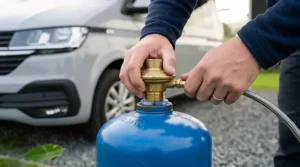
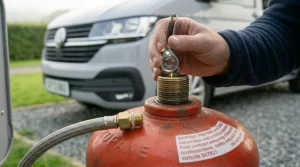
Connection: For screw-on regulators, remember that most UK LPG connections use a left-hand thread — you tighten by turning anti-clockwise. It’s one of those things that catches out even experienced campers. Hand-tighten firmly (a spanner may be needed for some types), but avoid over-tightening, which can damage the sealing washer.
Leak testing: Before lighting anything, apply soapy water around all connections. Bubbles indicate a leak — no exceptions, no shortcuts. Close the cylinder valve, disconnect, check the connection, and try again.
Cylinder positioning: Keep the gas cylinder outside any enclosed cooking area and upright at all times. The Scouts Association’s safety guidance explicitly recommends keeping bottles outside the confines of cooking tentage — sound advice that British campers would do well to take seriously.
Damp weather care: British weather being what it is, check that your regulator’s rubber seal hasn’t swollen, cracked, or deteriorated after long storage. Replace regulators every 10 years — the manufacturer’s recommended service life — or sooner if there’s any visible deterioration.
Hose inspection: Inspect hoses at the start of each camping season. Look for cracking, kinking, or perished rubber, particularly where the hose meets the fittings. Always use BS3212/1-compliant hose for low-pressure setups (up to 50mbar), as standard rubber tubing is not suitable — LPG attacks and corrodes natural rubber.
✨ Also useful: After use, always close the cylinder valve first and let the gas in the system burn off before closing the appliance valve. It keeps the internal components cleaner and removes residual pressure from the hose.
Gas Regulators Camping: Real UK Scenarios — Who Needs What?
Understanding which regulator suits you is easier with a bit of context. Here are three common British camping profiles and the best match from the list above.
🏕️ The Weekend Warrior (South of England, Spring/Summer) Sarah and her partner take the tent to Glastonbury and assorted music festivals across the summer months. They use a compact Campingaz stove and a 904 cylinder. They need simplicity, low cost, and reliability. Best match: Calor Essentials 29mbar (Position 7) — or the full kit (Position 1) if they don’t have a hose yet. Butane is perfectly fine for the UK’s warmer months and festival-friendly gas costs.
🏔️ The Four-Season Camper (Scotland, Year-Round) James wild camps in the Cairngorms and doesn’t stop when the calendar says November. He uses a two-burner stove with a Calor propane bottle. The temperature regularly sits below 5°C overnight. Best match: JD Brands 37mbar POL Propane Regulator (Position 3). Propane’s ability to vaporise in freezing temperatures isn’t a luxury for James — it’s the difference between cooking and not. Butane would be essentially useless on a cold Scottish morning.
👨👩👧👦 The Family Caravanner (Yorkshire Dales, Mixed Season) The Patel family tow a tourer and use a larger Campingaz 907 cylinder to power their caravan’s hob. They want reliability, a decent hose length, and don’t want to fiddle about. Best match: Huddersfield Gas 30mbar + 2m Hose Kit (Position 2). The 2-metre hose gives them positioning flexibility, the quality is well-reviewed by UK buyers, and the price leaves budget for the other 47 things a caravanning family needs to buy before a trip.
Common Mistakes When Buying Gas Regulators Camping UK
British campers tend to make a handful of predictable errors when buying gas regulators. Avoid these and you’ll save yourself both money and a cold evening staring at a stove that won’t light.
Mistake 1: Buying a regulator without checking the cylinder fitting. This is by far the most common. Calor butane, Calor propane, Campingaz, and patio gas all use different fittings. There’s no workaround — you need the right regulator for your specific cylinder type.
Mistake 2: Ignoring the season. Butane in winter is a UK-specific trap that catches out campers who buy based on summer experience. If you camp between October and March anywhere in Britain, propane deserves serious consideration.
Mistake 3: Overlooking hose condition. Buying a new regulator and connecting it to a deteriorating old hose is rather like fitting new tyres to a car with failing brakes. Liquid Gas UK guidance recommends replacing hoses that show any signs of cracking, kinking, or surface perishing.
Mistake 4: Assuming a gauge means accuracy. The butane regulators with built-in level gauges reviewed on Amazon.co.uk receive notably mixed feedback on gauge accuracy. They give a rough indication — useful, but don’t treat them as precision instruments.
Mistake 5: Buying a US-market regulator. Worth mentioning for those browsing broadly: US propane fittings differ from UK standards. A regulator sourced from an American retailer may not connect to Calor or Campingaz cylinders and will certainly not be calibrated to UK mbar settings.
UK Safety Standards & Legal Requirements for Camping Gas Regulators
The Health and Safety Executive (HSE) provides guidance on LPG use in the UK, and while most of its specific regulations target commercial installations, the underlying principles apply to campers and outdoor users too. Here’s what matters in practice.
Regulator service life: Liquid Gas UK (the UK trade association for the LPG industry) recommends a maximum 10-year service life for gas regulators. If you’re still using a regulator your parents bought for camping in 2012, it’s time for a fresh one.
BS EN 16129: This is the current British/European standard covering regulators for LPG appliances, including camping equipment. Products sold on Amazon.co.uk in this category should conform to relevant standards — look for mention of EN compliance in product specifications.
Hose standard: For low-pressure regulated gas (up to 50mbar — which covers all standard camping setups), the correct hose specification is BS3212/1 (or the updated BS EN 16436). Cheap generic tubing from non-LPG sources is not appropriate and potentially dangerous.
Carbon monoxide awareness: All LPG appliances, including camping stoves, produce carbon monoxide in use. Never use a camping stove inside a sealed tent or vehicle. Carbon monoxide is odourless and colourless — the NHS advises that even brief exposure to high concentrations can be fatal. Proper ventilation isn’t optional.
Post-Brexit note: Products sold on Amazon.co.uk from EU suppliers should carry UKCA or CE marking (CE remains recognised for many product categories post-Brexit). When buying gas safety equipment, stick to products with clearly documented compliance markings.
Features That Actually Matter (And Those That Don’t)
The gas regulator market has a few features that sound impressive but add little real-world value — and a few that genuinely do matter. Here’s an honest assessment.
Features that matter:
- Correct pressure output (mbar) — non-negotiable; butane at 28–30mbar, propane at 37mbar.
- Cylinder compatibility — the fitting type is everything.
- Build material — brass internals last; cheap alloy alternatives corrode.
- Hose inclusion and length — particularly valuable for first-time buyers or those replacing old kit.
- Adjustability (for serious cooks) — genuinely useful if you need variable output for wok cooking or multiple appliances.
Features that don’t matter as much:
- Level/pressure gauges on budget butane units — accuracy is inconsistent across most sub-£20 options; use cylinder weight as a better indicator of remaining gas.
- Brand prestige beyond Calor/Campingaz — mid-range options from Huddersfield Gas, BRADAS®, and JD Brands perform comparably for standard camping use at lower prices.
- Colour and aesthetics — a red vs silver regulator makes no functional difference whatsoever.
Price Range & Value Analysis: GBP
| Price Tier | What You Get | Best For |
|---|---|---|
| Under £15 | Basic fixed-pressure regulator, sometimes with hose | Beginners; budget camping; single-cylinder setups |
| £15–£25 | Named brand or complete kit; better-quality internals | Most UK campers; regular weekend use |
| £25–£40 | Adjustable pressure; integrated gauge; premium brands | Serious outdoor cooks; multi-appliance setups |
| £40+ | Professional/industrial adjustable regulators | Catering, events, campervan conversions |
For the vast majority of British campers, the sweet spot sits firmly under £20. Spending more than that on a gas regulator for occasional camping trips is unnecessary unless you specifically need adjustable pressure output. The mid-£15–£25 range rewards those buying a complete kit (regulator + hose + clips), which eliminates the hassle of sourcing compatible accessories separately.
Worth noting: UK Amazon prices include 20% VAT, unlike some international sites that display pre-tax prices. What you see is what you pay — rather sensible, if you ask me.
Long-Term Cost & Maintenance: What to Expect
A well-maintained gas regulator from a decent brand should last 10 years. In practice, most British camping equipment gets used intensively for a few weekends a year and stored — often in slightly damp garages or the corners of garden sheds — for the rest of the time. That storage environment matters.
Annual maintenance checklist:
- Inspect the rubber sealing washer for cracking or deformation — replace if in doubt (washers cost pennies)
- Check the regulator body for corrosion, particularly around any joints
- Inspect the attached or connected hose for surface cracking or perishing
- Test connections with soapy water at the start of the season before the first use
- Store the regulator with the outlet protected — a small cap or wrapped in a dry cloth prevents debris entering
Running cost context: The regulator itself is a one-off purchase. The ongoing cost is the gas — and in the UK, propane and butane pricing varies by supplier and cylinder size. Campingaz canisters from camping retailers tend to be more expensive per unit of gas than Calor cylinders from builders’ merchants or supermarkets; however, the convenience of the smaller format is genuinely worth something on a weekend trip where you won’t use a full large cylinder.
Frequently Asked Questions: Gas Regulators Camping UK
❓ What pressure regulator do I need for camping in the UK?
❓ Can I use a butane regulator with a propane cylinder in the UK?
❓ How long does a camping gas regulator last in the UK?
❓ Is it safe to use a camping gas stove inside a tent in wet UK weather?
❓ Do gas regulators need to meet UK standards for camping use?
Conclusion
Choosing the right gas regulators camping setup doesn’t need to be complicated, but it does need to be correct. Compatibility with your specific cylinder type is the non-negotiable starting point. Beyond that, the choice comes down to whether you camp in warm months (butane serves you well) or venture out in autumn and winter (propane is worth the small extra effort). For the majority of British weekend campers, a quality Campingaz-compatible regulator from Calor or Huddersfield Gas at under £20 covers all the bases.
For those who cook more seriously outdoors, the Cavagna adjustable unit with its integrated pressure gauge is a worthwhile step up. And for the backpacker who travels between gas systems and wants a single versatile solution, the METER STAR universal setup is a practical choice.
Above all, treat your gas regulator as a safety component, not an afterthought. Check it annually, replace the hose if in doubt, test connections before every trip, and never cook inside an enclosed tent or vehicle. Do those things and your camping gas setup will be reliable, safe, and quite honestly the least dramatic part of any British camping adventure.
✨ Don’t Miss These Exclusive Deals!
🔍 Found your ideal match above? Click any highlighted product to check current pricing and real-time availability on Amazon.co.uk. All picks are Prime-eligible for fast delivery before your next trip!
Recommended for You
- Price Camping Gaz Refills: 7 Best UK Deals to Buy in 2026
- 7 Best Propane Cylinders Camping in 2026
- Best Value Camping Gas Canisters UK 2026: 7 Top Picks
Disclaimer: This article contains affiliate links. As an Amazon Associate, I earn from qualifying purchases. If you purchase products through these links, we may earn a small commission at no additional cost to you.
✨ Found this helpful? Share it with your mates! 💬🤗
