
In This Article
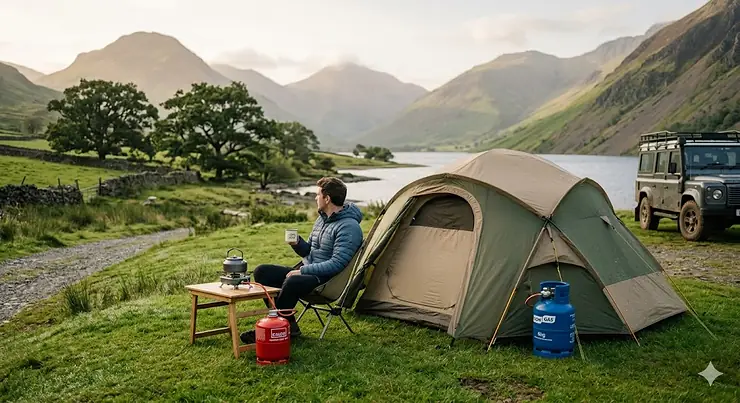
There’s a particular kind of dread that hits about thirty seconds before the kettle should be boiling: the flame sputters, sighs, and dies, and you realise your gas has chosen this exact moment — drizzling, dim, somewhere outside Pitlochry — to give up. Propane cylinders camping kit doesn’t get much glory. Nobody photographs their gas canister for the campsite group chat. But get the wrong one, or the wrong size of the right one, and it becomes the only thing you think about for the rest of the trip.
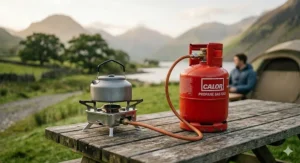
This guide cuts through the genuinely confusing world of UK camping gas — propane, butane, the blended stuff in between, screw-fit versus clip-on, and why the big green bottle on the caravan site isn’t something you can simply add to an Amazon basket. We’ve gone through what’s actually stocked and well-reviewed on Amazon.co.uk, rather than recycling a spec sheet, so you can work out what suits your tent, your stove, and your tolerance for fiddly valve threads. 🇬🇧
What is propane cylinder camping gas? It’s liquefied petroleum gas (LPG) stored under pressure in a small portable container, used to fuel camping stoves, lanterns and heaters. Pure propane performs well in the cold, which is why most UK “camping gas” is actually a propane-butane or propane-isobutane blend, balancing cold-weather reliability with cost and weight.
Quick Comparison Table
| Product | Type | Size | Best For | Price Range |
|---|---|---|---|---|
| Coleman Performance Gas (C300) | Propane/isobutane screw-fit | ~227–240g | Solo backpackers | £6–£10 |
| Campingaz CV300 Plus | Butane/propane 80/20, Easy Clic | 240g | Campingaz stove owners | £15–£20 (4-pack) |
| Campingaz CV470 Plus | Butane/propane 80/20, Easy Clic | 450g | Family cooking, longer trips | £20–£28 (4-pack) |
| Primus Power Gas | Propane/isobutane blend, screw-fit | 100g/230g/450g | Year-round reliability seekers | £8–£23 |
| GoSystem PowerSource | Butane/isobutane/propane, screw-fit | 100g/220g | Cold-weather and budget trips | £5–£12 |
| GoSystem 2350 | Butane/propane 70:30, screw-fit | 350g | Lanterns, blowtorches, weed burners doubling as camp kit | £10–£15 |
| JD Brands Propane Regulator (37mbar POL) | Regulator accessory | N/A | Anyone running a full-size Calor/Flogas propane bottle | £8–£16 |
A glance at this table tells its own story: the screw-fit EN417 canisters (Coleman, Primus, GoSystem) dominate solo and backpacking setups because they’re light, disposable, and universally compatible, while Campingaz’s Easy Clic system locks you into its own ecosystem — brilliant if you already own a Campingaz stove, mildly infuriating if you don’t. The regulator earns its spot because, confusingly, it’s the only propane product on this list that connects to a genuinely large cylinder; everything else above it is a small, throwaway canister.
💬 Just one click — help others make better buying decisions too! 😊
✨ Don’t Miss These Exclusive Deals!
🔍 Take your camping kit to the next level — click through to check current pricing and availability on Amazon.co.uk. These picks will help you find exactly what fits your stove.
Top 7 Propane Cylinders & Camping Gas: Expert Analysis
1. Coleman Performance Gas Cartridge (C300)
Coleman’s screw-fit canister is the everyday workhorse of UK gas cartridges, and it fits any stove using the EN417 standard — not just Coleman’s own. It’s a three-season propane/isobutane mix, which means it’ll happily run a single-burner stove for a weekend without sulking the moment the sun dips. Worth flagging: Coleman’s cans run slightly taller and narrower than rival brands at the same fill weight, so they’ll squeeze into some integrated cookpots (handy) while refusing to fit inside others (less handy) — check your stove’s storage compartment before assuming a swap is plug-and-play.
This is the canister for someone doing a couple of nights a month, not committing to a full LPG ecosystem. UK reviewers consistently rate it for reliability on Trangia-style and pocket-rocket stoves, with the odd grumble about the non-standard dimensions catching people out.
✅ Pros: widely compatible, reliable ignition, easy to find
✅ Good three-season performance
✅ Competitively priced for casual use
❌ Slightly non-standard canister height/width
❌ Not the best choice below freezing — look at the Extreme/winter variants instead
Price: around £6–£10 per canister.
2. Campingaz CV300 Plus
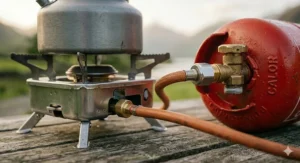
The CV300 Plus uses Campingaz’s Easy Clic Plus valve system — a 45-degree twist-lock rather than a screw thread — which only works with Campingaz-compatible stoves and regulators. That’s the catch and the charm in one: once you’re in the ecosystem, swapping canisters mid-trip (even before they’re empty) is genuinely effortless, no faffing with threads in the rain. The 240g butane/propane blend (80/20) is tuned for steady performance through a typical damp British shoulder season rather than Arctic conditions.
What the spec sheet won’t tell you is how much this matters on a wet campsite morning with cold hands: a push-and-twist connection beats trying to align a screw thread by feel inside a tent porch.
✅ Pros: tool-free swap, made and quality-controlled in France, widely stocked
✅ Reliable ignition in cool, damp conditions
✅ Good for families running a Campingaz stove or grill
❌ Locked into the Campingaz/Easy Clic ecosystem
❌ Needs a compatible regulator — not interchangeable with screw-fit gear
Price: around £15–£20 for a 4-pack.
3. Campingaz CV470 Plus
The bigger sibling of the CV300, the CV470 Plus holds 450g of the same 80/20 butane/propane mix, and it’s the one to reach for if you’re cooking for more than yourself or running a stove for several consecutive days. Campingaz themselves note this blend performs across “All Season” conditions, with reviewers on Amazon.co.uk repeatedly praising how quickly it boils water even in a breezy awning.
If you’re feeding a family from a two-burner Campingaz stove over a long weekend, this is the size that stops you doing the maths on whether you’ve packed enough gas — one CV470 will comfortably outlast a CV300 by roughly the weight difference, which sounds obvious but matters when you’re also hauling a windbreak, a cool box and three children’s bikes.
✅ Pros: long runtime, easy mid-use swap, consistent flame
✅ Suits two-burner stoves and small camping grills
✅ Reduces the number of swaps on multi-day trips
❌ Heavier to pack for backpackers
❌ Same ecosystem lock-in as the CV300
Price: around £20–£28 for a 4-pack.
4. Primus Power Gas
Primus, the Swedish stove maker whose kit has summited Everest and reached the South Pole, sells its Power Gas screw-fit canister in 100g, 230g and 450g sizes, using a propane-isobutane blend designed to keep performing as the canister empties and the temperature drops — a known weak point of cheaper butane-heavy mixes, which lose pressure fast once they’re three-quarters used. It’s compatible with most EN417 stoves, including popular all-in-one systems.
This is the canister for someone who’s fed up with a flame that dies to a whisper on the second morning of a trip. The premium pricing reflects that consistency, plus Primus’s carbon-offsetting on production — a detail that’ll matter to some buyers and not at all to others, but it’s there if you’re weighing it up.
✅ Pros: stable performance as the canister empties, strong cold-weather behaviour
✅ Trusted stove brand heritage
✅ Comes in three sizes for trip length
❌ Pricier per gram than GoSystem or Coleman
❌ Smallest size is genuinely tiny — fine for one night, not much more
Price: around £8–£23 depending on size.
5. GoSystem PowerSource
GoSystem’s PowerSource cartridge blends butane, isobutane and propane, and it’s rated effective down to -20°C — comfortably colder than the UK ever gets outside a Cairngorms winter, so for most British camping it’s overkill in the best possible way. It uses a self-sealing, double-skin safety valve, and at 100g or 220g it’s aimed squarely at people who want a no-fuss overnight fix without committing to a multipack.
It’s the budget-conscious choice on this list, and reviewers tend to mention exactly that: solid performance for the price, if not quite the longevity some buyers expect from a single can. One recurring theme in UK reviews is that it pairs well with small pocket-rocket style stoves where a tall, narrow canister would be awkward.
✅ Pros: genuinely cold-rated, double-skin safety valve, low cost
✅ Compact size suits ultralight kit
✅ Easy to find on Amazon.co.uk from multiple sellers
❌ Some buyers report inconsistent burn time can-to-can
❌ Smaller sizes run out faster than expected on multi-meal trips
Price: around £5–£12.
6. GoSystem 2350 (350g, 70:30 Butane/Propane)
A slightly different beast: the 2350 leans heavier on propane (a 70:30 butane-propane mix) than most of GoSystem’s other cartridges, which gives it more punch and better cold-weather behaviour, effective down to -15°C. It’s marketed across stoves, blowtorches, lanterns and even weed burners, which tells you it’s built for raw output rather than delicate simmering.
For camping specifically, this is the one to grab if your “stove” doubles as a multi-tool — say, a camp kitchen setup that also needs to light a fire blower or run a lantern off the same fuel. It’s not the most elegant single-purpose camping canister, but the versatility is genuinely useful if you’re trying to standardise on one fuel type across several bits of kit.
✅ Pros: higher propane content for stronger output, works in colder conditions
✅ Cross-compatible with lanterns and torches, not just stoves
✅ EN417 threaded, so fits most screw-on gear
❌ Marketed broadly rather than camping-specific, so packaging can feel generic
❌ 350g is an awkward in-between size — heavier than a quick overnighter needs
Price: around £10–£15.
7. JD Brands Propane Gas Regulator (37mbar, POL fitting)
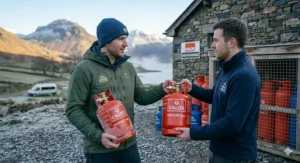
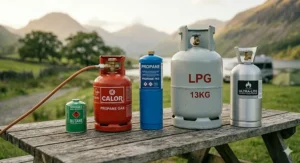
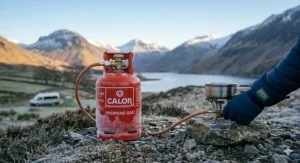
Here’s the honest twist in this list: if what you actually want is a large refillable propane cylinder — the kind that runs a caravan hob or an awning heater for a fortnight — Amazon.co.uk won’t sell you the cylinder itself. Full Calor or Flogas propane bottles (3.9kg, 6kg, 13kg) are handled through an exchange scheme at petrol stations, hardware shops and Calor stockists, not posted out by courier, because of dangerous goods carriage rules. What Amazon does sell, reliably and well-reviewed, is the regulator that connects your stove or hob to that exchanged bottle.
This JD Brands unit is a 37mbar hand-wheel regulator with the standard UK POL screw thread, fitting both Calor and Flogas propane cylinders without needing a spanner. UK reviewers — including several running it on static caravans through winter — describe it as solid, easy to fit, and a sensible like-for-like swap every few years, since regulators are a wear item worth replacing on a schedule rather than waiting for a failure.
✅ Pros: fits standard UK POL propane cylinders, no tools required, well-reviewed for caravan/camping use
✅ Cheap insurance against an ageing regulator
✅ Compatible with both Calor and Flogas bottles
❌ Doesn’t include the cylinder itself — buy or exchange that locally
❌ Not compatible with butane (21mm clip-on) or Patio Gas (27mm clip-on) cylinders — check your bottle’s fitting first
Price: around £8–£16.
Practical Usage Guide: Getting the Most From Your Camping Gas
Store cylinders upright, outside the tent or caravan, away from direct sunlight — and in the UK specifically, away from standing water, since a damp pitch is just as likely to corrode a valve as frost is to crack one. A drizzly bank holiday weekend does more cumulative damage to gas kit than most people assume; a £3 silicone cap or a dry bag goes a long way.
Before you pack, weigh or shake a partly-used canister to judge how much is left — a kitchen scale at home is the only properly reliable method, since “shake and guess” is notoriously unreliable on isobutane blends. For UK storage between trips, a cool shed or garage beats a damp shed corner; never store cylinders in a heated room or anywhere near an ignition source.
A common first-month mistake: connecting a screw-fit stove to a partially threaded canister and assuming it’s seated because gas flows. Always do a soapy-water leak check around the joint before lighting up — bubbles mean stop, don’t light. It costs thirty seconds and has saved a great many eyebrows.
Real-World Scenario: Three UK Camping Profiles
The solo wild camper in the Lake District needs weight over everything — a 100g GoSystem PowerSource or Primus Power Gas canister, paired with a pocket-rocket stove, covers a weekend of porridge and tea without adding noticeable bulk to a 40-litre pack.
The family with an awning at a Camping and Caravanning Club site is cooking proper meals for four over several days, which is exactly where the Campingaz CV470 Plus earns its keep on a two-burner stove — fewer swaps, less faff, more time actually eating.
The static caravan owner running a hob and heater all winter isn’t buying canisters at all — they’re on an exchanged 6kg or 13kg Calor propane bottle, and the only thing worth ordering online is a JD Brands-style regulator as a five-year replacement, since regulators degrade quietly and without warning.
How to Choose a Propane Cylinder for Camping in the UK
- Check your stove’s connection type first. EN417 screw-fit, Campingaz Easy Clic, or full-size POL — these aren’t interchangeable without an adapter, and buying the wrong gas is the single most common returns reason.
- Match the gas mix to the season. Pure propane and propane-heavy blends (GoSystem 2350, Primus Power Gas) handle cold mornings far better than butane-heavy mixes, which struggle below around 0°C.
- Size for trip length, not optimism. A 100g canister suits one night; budget roughly 100–150g per person per day of proper cooking, more in the cold.
- Decide disposable versus refillable. Small canisters are convenient but wasteful over a season; a refillable Calor bottle plus regulator pays for itself if you camp regularly.
- Factor in where you’re travelling. Ferry and Eurotunnel rules cap how much LPG you can carry — check before a Continental trip (see FAQ below).
- Buy the regulator separately if needed, and treat it as a replaceable part, not a lifetime fitting.
- Keep a spare canister, always — running out on the second night is the most preventable camping disaster there is.
Propane vs Butane: Which Wins in British Weather
Pure butane is cheap and energy-dense but effectively stops vaporising below around 0°C, which rules it out for anything beyond a mild summer evening. Propane vaporises down to roughly -40°C, making it the dependable choice for shoulder-season and winter camping, but pure propane cylinders need sturdier (and bulkier) construction to hold the higher pressure. That’s exactly why most UK camping gas — Campingaz’s CV range, GoSystem PowerSource, Primus Power Gas — splits the difference with a blend: propane for cold-start reliability, butane or isobutane to keep the canister lighter and cheaper. For anything from autumn through spring in Britain, a blend with meaningful propane content beats pure butane every time.
Common Mistakes When Buying Camping Gas Cylinders
The most expensive mistake is buying a Campingaz Easy Clic canister for a screw-fit stove (or vice versa) — they share shelf space at most outdoor shops and look deceptively similar in photos online. The second is underestimating cold-weather drop-off: a butane-heavy canister that works fine in July will barely limp along on a frosty October morning. And the third, specifically British one, is assuming any propane product on Amazon ships as a full cylinder — as covered above, large refillable bottles go through local exchange, not parcel delivery, for safety and carriage reasons.
UK Regulations, Safety Standards & Legal Requirements
Camping gas cylinders and cartridges fall under guidance from the Health and Safety Executive, which covers storage, ventilation and handling of LPG, while installations in caravans and motorhomes follow the BS EN 1949 standard. Practical safety advice — store outside, keep ventilated, never use a cooker as a heater — is echoed by Liquid Gas UK, the trade body for the LPG industry, in its public guidance sheets. None of this is heavy admin for a weekend camper; it mostly boils down to common sense, properly written down.
Long-Term Cost & Maintenance in the UK
For occasional campers, disposable EN417 canisters are the cheapest entry point — no deposit, no commitment, buy what you need. For anyone camping more than a handful of weekends a year, a refillable propane cylinder on an exchange scheme works out considerably cheaper per kilogram of gas over a season, even accounting for the upfront cylinder deposit and a regulator. The trade-off is bulk and weight, which is exactly why this guide splits into “small disposable canisters” for backpacking and tents, and “regulator plus exchanged bottle” for caravans, awnings and static pitches.
FAQ
❓ Can I take propane gas cylinders on a ferry or through the Channel Tunnel to camp in Europe?
❓ Why can't I buy a full Calor propane cylinder on Amazon.co.uk?
❓ What's the difference between Campingaz Easy Clic and EN417 screw-fit canisters?
❓ How long does a 230g camping gas canister last?
❓ Are empty camping gas canisters recyclable in the UK?
Conclusion
There’s no single “best” propane cylinder for camping — there’s the one that fits your stove’s connection, suits the season you’re travelling in, and matches how much faff you’re willing to tolerate at 7am in the rain. For most weekend tent campers, a screw-fit EN417 canister from Coleman, GoSystem or Primus covers it without complication. Campingaz owners are better served staying inside that ecosystem with the CV300 or CV470. And anyone running a caravan or awning off a full-size bottle should stop browsing canisters altogether and go straight to a decent regulator, because the cylinder itself was never going to turn up in a cardboard box anyway.
Recommended for You
- Best Value Camping Gas Canisters UK 2026: 7 Top Picks
- Best Gas Canisters Camping UK 2026: 7 Top Picks Reviewed
- Best Camping Chopping Boards UK 2026: 7 Top Picks Tested
Disclaimer: This article contains affiliate links. As an Amazon Associate, I earn from qualifying purchases. If you purchase products through these links, we may earn a small commission at no additional cost to you.
✨ Found this helpful? Share it with your mates! 💬🤗
