
In This Article
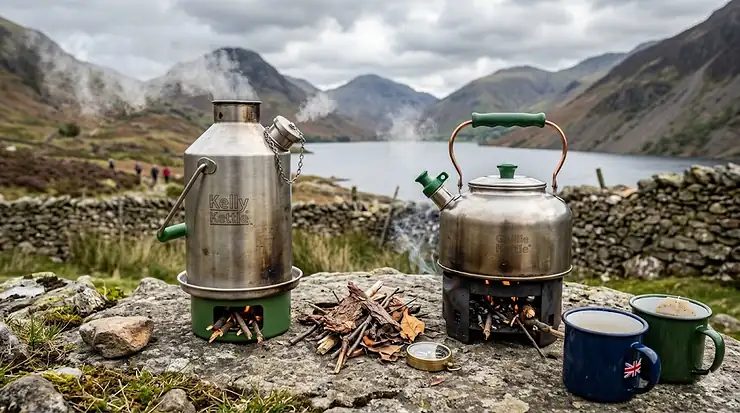
Picture yourself on a windswept Scottish hillside, rain lashing down, desperate for a warm cuppa. Your gas canister’s empty, and you’re freezing. This is precisely where storm kettles prove their worth. The Kelly Kettle vs Ghillie Kettle debate has captivated UK campers for over a century, and for good reason—these ingenious devices boil water using nothing but twigs, pine cones, and whatever natural fuel you can scavenge.
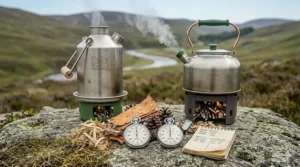
Both brands share a fascinating heritage rooted in traditional Irish and English craftsmanship. Kelly Kettle originated in Ireland’s County Mayo during the 1890s, where fishermen on Lough Conn needed reliable hot water in brutal weather conditions. Meanwhile, Ghillie Kettle traces its lineage to Birmingham’s George Marris & Co., who produced the legendary “Sirram Volcano Kettle” in the 1920s. According to Wikipedia, these chimney kettles were even standard issue for the New Zealand Army during World War II, where they earned the nickname “Benghazi boilers”.
The Kelly Kettle vs Ghillie Kettle comparison isn’t just about heritage—it’s about choosing the right tool for your adventures. Kelly Kettle offers stainless steel durability with Irish roots, while Ghillie Kettle champions British manufacturing with their distinctive whistle feature. Both promise to boil water in 3-5 minutes using virtually any combustible material, making them perfect for wild camping tea sessions when you’re miles from civilisation.
Whether you’re a bushcraft enthusiast, weekend camper, or preparing for power outages, understanding these campfire alternatives can transform your outdoor experience. With climate consciousness driving many campers away from disposable gas canisters, volcano kettle for camping options have never been more relevant. Let’s explore which storm kettle deserves a spot in your rucksack.
Quick Comparison Table
| Feature | Kelly Kettle | Ghillie Kettle |
|---|---|---|
| Origin | County Mayo, Ireland (1890s) | Birmingham, England (1920s) |
| Manufacturing | Ireland & international | Hand-spun in England |
| Whistle | Optional green whistle | Integrated whistle (signature feature) |
| Material Options | Aluminium & Stainless Steel | Aluminium & Hard Anodised |
| Size Range | 0.6L (Trekker), 1.2L (Scout), 1.6L (Base Camp) | 0.5L (Maverick), 1L (Explorer), 1.5L (Adventurer) |
| Price Range (UK) | £49.95–£102.95 | £54.99–£86.99 |
| Boil Time | 3-5 minutes | 3-6 minutes |
| Warranty | 2 years anti-leak | 10 years (subject to normal wear) |
| Best For | Versatile camping & complete kits | British craftsmanship enthusiasts |
| Unique Feature | Extensive accessory ecosystem | Traditional hand-spinning process |
💬 Just one click – help others make better buying decisions too! 😊
✨ Don’t Miss These Exclusive Deals!
🔍 Take your wild camping adventures to the next level with these carefully selected products. Click on any highlighted item to check current pricing and availability on Amazon.co.uk. These tools will help you create authentic bushcraft brewing experiences your mates will love!
Top 7 Storm Kettles: Expert Analysis
1. Kelly Kettle Scout 1.2L Aluminium
The Kelly Kettle Scout represents the sweet spot for most UK campers—not too bulky, not too small. This 1.2-litre aluminium model has earned its reputation through decades of reliable service in the Irish wilderness, and it’s now become a staple amongst British outdoor enthusiasts.
Key Specifications:
- Capacity: 1.2 litres (approximately 5 mugs)
- Weight: 540g (incredibly lightweight)
- Material: Anodised aluminium
- Dimensions: 32cm height when nested
The Scout’s anodised aluminium construction strikes an excellent balance between weight and durability. At just over half a kilogram, it’s light enough for multi-day hikes yet robust enough to withstand the inevitable knocks of camp life. UK customers consistently praise its rapid boiling time—one reviewer mentioned boiling a full kettle in “5 minutes flat” using just a small handful of twigs.
Customer feedback from Amazon.co.uk reveals particular appreciation for how well it performs in wet conditions. “Took almost a minute for the fire to really get going strongly, but after that, brilliant,” notes one British buyer. The green whistle accessory (included) provides a reassuring alert when water reaches boiling point, though some users mention it can get quite hot during use.
Price Range: £49.95–£62.95 on Amazon.co.uk
✅ Pros:
- Exceptionally lightweight for backpacking
- Proven reliability in wet British weather
- Large accessory range available
❌ Cons:
- Aluminium can dent if dropped onto rocks
- Chain handle gets hot (consider gloves)
2. Kelly Kettle Base Camp 1.6L Stainless Steel
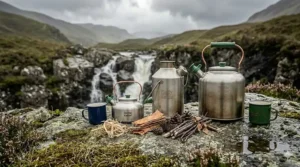
The Kelly Kettle Base Camp is the heavyweight champion for car camping, fishing trips, and family adventures. This stainless steel beast prioritises capacity and longevity over portability, making it ideal for situations where weight isn’t your primary concern.
Key Specifications:
- Capacity: 1.6 litres (approximately 6-7 mugs)
- Weight: 1.25kg
- Material: All-welded stainless steel construction
- Warranty: 2-year anti-leak guarantee
UK reviewers consistently describe this model as “a brilliant piece of kit that boils water very quickly and is very well made.” The all-welded construction eliminates rivets, traditionally weak points in kettle design. One Scottish camper reported using it throughout recent power cuts, noting it was “an excellent method of heating water quickly.”
The Base Camp’s larger capacity makes it perfect for groups. Cambridge Conservation Volunteers use two of these to provide tea for volunteer waves during conservation work. The stainless steel variant resists corrosion brilliantly in Britain’s damp climate—a crucial consideration for equipment that’ll spend time in sheds and garages between adventures.
Price Range: £64.95–£89.95 on Amazon.co.uk
✅ Pros:
- Excellent for groups and families
- Stainless steel won’t corrode
- Superb build quality with no rivets
❌ Cons:
- Heavy for backpacking (1.25kg)
- Takes more fuel due to larger capacity
3. Kelly Kettle Ultimate Scout Kit
For those serious about bushcraft brewing, the Ultimate Scout Kit represents exceptional value. This comprehensive package includes the 1.2L kettle plus an impressive array of cooking accessories that transform your storm kettle into a complete outdoor kitchen.
Kit Includes:
- 1.2L Stainless Steel Scout Kettle with green whistle
- Cook set (pot, pan/lid, two grill pieces, gripper handle)
- Hobo Stove (converts fire base into standalone stove)
- 2 stainless steel cups
- 2 stainless steel plates
- Pot-Base Support (eliminates scorch marks)
- Drawstring carry bag
British buyers love the versatility this kit provides. “Burns so efficiently, this is a great piece of quality kit and worth every penny,” raves one UK purchaser. The Hobo Stove accessory deserves special mention—it sits atop the fire base, allowing you to cook whilst water boils in the kettle above. Brilliant engineering that maximises fuel efficiency.
The pot support is particularly appreciated by allotment holders and garden campers, as it prevents scorching lawns or wooden decking. Total kit weight sits at approximately 2.25kg—manageable for car camping but potentially excessive for long-distance hiking.
Price Range: £96.14–£112.00 on Amazon.co.uk
✅ Pros:
- Complete cooking solution in one purchase
- Excellent value compared to buying separately
- Hobo Stove adds tremendous versatility
❌ Cons:
- Bulky package for minimalist campers
- Learning curve for using all components effectively
4. Ghillie Kettle Adventurer 1.5L Aluminium
The Ghillie Kettle Adventurer represents traditional British craftsmanship at its finest. Still hand-spun in England using techniques dating back over a century, this kettle carries a certain heritage that appeals to those valuing provenance alongside performance.
Key Specifications:
- Capacity: 1.42 litres (approximately 5 mugs)
- Weight: 900g
- Material: Lightweight aluminium construction
- Dimensions: 34cm × 18.5cm
- Includes: Safety whistle, carry bag, instructions
The Adventurer’s integrated whistle represents Ghillie’s signature feature. Unlike Kelly Kettle’s removable whistle, Ghillie incorporates it into the design, providing that reassuring audible alert when water reaches boiling point. UK Scout groups particularly appreciate this safety feature for working with young people.
British customers on Amazon.co.uk consistently praise its performance. “Boils faster than an electronic kettle,” claims one delighted buyer. Another used it successfully during recent storms, calling it “an excellent method of heating water quickly” when power cuts struck. The allotment crowd loves it too—”I collected small twigs and scraps of paper and the water boiled very quickly” reports one happy gardener.
According to Ghillie Kettle’s official website, these kettles remain the only camping kettles traditionally hand-spun and manufactured in England—a point of pride featured on ITV’s “Made in Britain” and Discovery Channel’s “How it’s Made”.
Price Range: £59.95–£69.95 on Amazon.co.uk
✅ Pros:
- Genuine British manufacturing (increasingly rare)
- Integrated whistle for added safety
- Excellent performance in wind and rain
❌ Cons:
- Chain can be fiddly when hot
- Whistle won’t sound if overfilled
5. Ghillie Kettle Adventurer Hard Anodised 1.5L
The Hard Anodised Adventurer takes Ghillie’s classic design and applies a superior surface treatment. Hard anodising creates a coating 2-4 times stronger than standard anodising, bringing the aluminium’s durability closer to titanium whilst maintaining easy machinability.
Key Specifications:
- Capacity: 1.42 litres
- Weight: 900g
- Material: Hard anodised aluminium (30-40 microns deep, BS.ISO.1007 compliant)
- Warranty: 10 years (subject to normal wear and tear)
- Colour: Silver/grey (previously dark grey/black with dye)
Recent UK buyers note that Ghillie changed their anodising process by removing the dye previously used for appearance. The kettles now sport a silver/grey colour whilst maintaining the same protective depth and British Food Standard compliance—purely cosmetic, with no performance impact.
“I bought one of these firstly as a bit of fun, and secondly as a way of saving bottled gas while away camping,” explains one British camper. “Took it away on a camping weekend, and used it to boil all the water we needed—for drinking, cooking, and washing up. Boils much quicker than on the gas.”
The hard anodised surface significantly improves scratch resistance—crucial for equipment that’ll spend time rattling around in car boots and getting dragged through bracken. One reviewer beautifully summarised it: “Ghillie-goodness. Works with a practical precision, a well-designed and produced kettle that draws on tradition. When the end of civilisation comes, this will provide hot water for a nice cuppa tea.”
Price Range: £54.99–£86.99 on Amazon.co.uk
✅ Pros:
- Superior surface durability
- 10-year warranty demonstrates confidence
- Complies with British Food Standards
❌ Cons:
- Slightly more expensive than standard aluminium
- Requires good fuel supply for larger capacity
6. Ghillie Kettle Maverick 0.5L
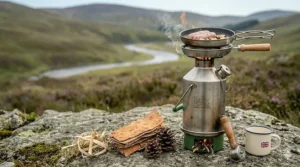
The Ghillie Kettle Maverick is the bantamweight contender—perfect for solo adventurers, wild camping enthusiasts, and those prioritising every gram in their pack. This half-litre kettle represents the minimum viable size for storm kettle technology.
Key Specifications:
- Capacity: 0.5 litres (approximately 2 mugs)
- Weight: Ultra-lightweight (exact weight varies by model)
- Material: Hard anodised aluminium
- Ideal for: Solo camping, ultralight backpacking, emergency kits
British bushcrafters love the Maverick for woodland trips. “Bought this Ghillie kettle for trips into the woods, it’s a perfect size for one person making a brew or boiling up enough water to rehydrate a meal,” reports one UK user. “Superb build quality with no weak points at the rolled seams and good quality fasteners to the chain. This is a very efficient kettle, boiling half a litre of water in under 4 minutes.”
The compact dimensions make it genuinely packable for wild camping trips where every cubic centimetre counts. However, the small capacity means frequent refills for groups. One reviewer noted it works brilliantly for emergency preparedness: “Well worth the money if the power goes off as well!”
For fire starting, UK users recommend super dry tinder. “I use a knife and a Magnesium fire stick. Cotton wool catches the sparks and instantaneously catches fire,” suggests one experienced camper. The Maverick’s smaller chamber requires less fuel overall but demands finer materials to establish the chimney effect quickly.
Price Range: £64.95–£74.95 on Amazon.co.uk
✅ Pros:
- Genuinely ultralight for backpacking
- Quick boiling time despite small size
- Perfect for solo adventurers
❌ Cons:
- Limited capacity requires frequent refilling
- Small fuel chamber needs careful fire management
7. Kelly Kettle Trekker 0.6L Stainless Steel
The Kelly Kettle Trekker occupies similar territory to the Ghillie Maverick but with Kelly’s signature robust construction. This 0.6-litre model uses stainless steel rather than aluminium, accepting a small weight penalty for superior longevity.
Key Specifications:
- Capacity: 0.6 litres (approximately 2-3 small mugs)
- Material: Stainless steel construction
- Designed for: Backpacking, cycling trips, kayaking
- Works in: Extreme weather including storms
The Trekker represents Kelly Kettle’s solution for the ultralight market. Whilst slightly heavier than aluminium alternatives, the stainless steel construction eliminates concerns about denting and provides peace of mind for rough treatment. Several UK customers mention using it for cycling adventures where weight matters but durability cannot be compromised.
“Perfect for solo camping,” notes one British user. The 0.6-litre capacity hits a sweet spot—enough for a decent brew plus rehydrating a freeze-dried meal, without the bulk of larger models. Kelly’s reputation for working in “extreme weather” rings true; these kettles function brilliantly in Scotland’s worst conditions where conventional stoves struggle.
The Trekker accepts all Kelly Kettle accessories, meaning you can add the Hobo Stove, cook sets, and pot support as your needs evolve. This modularity represents a key advantage over fixed kits—start minimal, expand later.
Price Range: £54.95–£68.00 on Amazon.co.uk
✅ Pros:
- Stainless steel eliminates denting concerns
- Compatible with full Kelly accessory range
- Superb in extreme British weather
❌ Cons:
- Heavier than aluminium alternatives
- Small capacity for groups
Understanding Storm Kettle Technology
How Volcano Kettles Actually Work
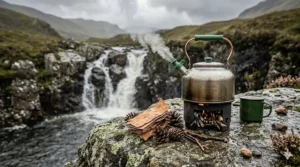
Storm kettles employ a deceptively simple yet brilliantly effective design that’s remained largely unchanged since the 1890s. The secret lies in their double-walled chimney construction—water surrounds a central fire chamber, creating an upward draft that feeds the flames whilst extracting maximum heat.
When you light fuel in the base, hot air rises through the central chimney. This creates negative pressure at the bottom, drawing fresh oxygen-rich air through the vents. The resulting “chimney effect” accelerates combustion dramatically, generating intense heat that rapidly transfers through the thin metal walls into the surrounding water jacket. Physics doing what physics does best, really.
The beauty of this design becomes apparent in challenging conditions. Wind, rather than being the enemy, actually improves performance by increasing air flow through the system. Rain? The water jacket and enclosed fire chamber protect the flames. This explains why storm kettles earned their reputation amongst Irish fishermen and New Zealand soldiers—they work when everything else fails.
According to traditional Mongolian and Chinese hot-pot designs (which may have inspired these kettles), the central chimney configuration maximises heat transfer whilst minimising fuel consumption. You’re not heating air around a pot; you’re channelling combustion products directly through water.
The Science Behind Rapid Boiling
Storm kettles achieve their impressive 3-6 minute boiling times through several complementary mechanisms. First, the surface area to volume ratio exceeds conventional kettles—thin walls and extended height mean more metal contacts more water. Second, the chimney draft maintains consistently high temperatures rather than fluctuating flames. Third, the enclosed design prevents heat loss to wind.
British testing by organisations including the Camping and Caravanning Club has demonstrated that storm kettles can outperform gas stoves in windy conditions whilst using virtually free fuel. The UK fire services note these kettles contain the fire effectively, reducing wildfire risk compared to open camp fires—an important consideration given England experiences an average of 26,500 grass and moorland fires annually.
Kelly Kettle vs Ghillie Kettle: Direct Comparison
Build Quality and Materials
Both manufacturers prioritise durability, but their approaches differ. Kelly Kettle’s stainless steel models feature all-welded construction eliminating rivets—traditionally the first failure point. Their aluminium versions use anodising for corrosion resistance. Ghillie Kettle champions the traditional hand-spinning process, with skilled craftspeople manipulating flat aluminium over specially designed chucks—labour-intensive but producing seamless components.
The material choice impacts more than weight. Stainless steel withstands abuse better but conducts heat slightly less efficiently. Aluminium boils water faster but dents more easily. Hard anodised aluminium (Ghillie’s speciality) splits the difference—the coating adds significant surface hardness whilst maintaining aluminium’s thermal properties.
UK buyers report both brands lasting decades with proper care. The key differentiator isn’t quality per se, but manufacturing philosophy. Kelly Kettle has scaled production internationally whilst maintaining Irish design roots. Ghillie Kettle proudly remains a British cottage industry, with kettles still hand-spun in England—increasingly rare in modern manufacturing.
Performance in British Weather Conditions
Britain’s weather demands equipment that functions in horizontal rain, gale-force winds, and bone-chilling cold. Both storm kettle brands excel here, having proved themselves in the Irish and Scottish wilderness where conditions can be genuinely brutal.
Multiple UK reviews emphasise performance in adverse weather. “Works in storm or hurricane conditions,” notes Kelly Kettle’s specifications. Ghillie customers report success “in wet and windy conditions” using both kettles. The chimney design’s inherent wind resistance means gusty British hilltops actually improve performance—increased oxygen flow accelerates combustion.
Fuel availability in UK conditions deserves mention. Britain’s damp climate means finding dry tinder can challenge beginners. Experienced users recommend carrying emergency fire-starting materials—cotton wool soaked in petroleum jelly, birch bark, or commercial fire starters. One Scottish user notes: “The wood we find on site isn’t always dry so getting the fire lit can be a problem. We recently found a BBQ Fan which is ideal for blowing air through the fire to get it started.”
Price and Value Proposition
Kelly Kettle products range from £49.95 to £102.95 on Amazon.co.uk, whilst Ghillie Kettles span £54.99 to £86.99. Direct price comparison proves difficult due to varying capacities, materials, and included accessories.
The value equation extends beyond initial purchase price. Consider fuel costs—zero, permanently. A camper using disposable gas canisters might spend £15-30 annually, meaning either kettle pays for itself within 2-4 seasons. Factor in British manufacturing for Ghillie (supporting domestic industry) or Kelly’s Irish heritage and extensive accessory ecosystem.
Ultimate Scout and Base Camp kits offer compelling value by bundling cooking equipment. Buying components separately costs significantly more. Solo campers might prefer standalone small kettles, whilst families and groups benefit from complete kits. The 2-10 year warranties demonstrate manufacturer confidence—these aren’t disposable products.
Choosing Your Perfect Storm Kettle
Capacity Considerations for UK Campers
Capacity selection demands honest assessment of typical usage. Solo wild campers thrive with 0.5-0.6L models—enough for brew and meal, minimal pack weight. Weekend warriors with mates need 1.2-1.5L capacity. Family car camping or Scout groups require 1.6L+.
British campers should consider multi-use scenarios. That compact 0.5L Maverick might suit hillwalking but prove inadequate for allotment tea breaks with friends. Conversely, lugging a 1.6L Base Camp up Snowdon seems masochistic. Many experienced UK campers own two kettles—ultralight for backpacking, larger for car camping.
Calculate your maximum group size then add one person’s capacity for safety margin. A 1.2L kettle comfortably serves three people (allowing two rounds), whilst 1.6L handles four to five. Remember these kettles boil water rapidly, so making multiple batches remains practical for occasional larger groups.
Material Selection Guide
Aluminium Advantages:
- Lightweight (crucial for backpacking)
- Excellent heat conduction (faster boiling)
- More affordable than stainless steel
- Adequate durability for careful users
Stainless Steel Benefits:
- Superior impact resistance
- Won’t dent if dropped
- Better corrosion resistance in coastal environments
- Looks better after years of use
Hard Anodised Aluminium:
- Combines lightweight with improved durability
- Surface hardness approaches stainless steel
- Maintains aluminium’s thermal advantages
- Complies with British Food Standards
British conditions favour corrosion-resistant materials. Coastal campers face salt spray; highland adventurers encounter aggressive Scottish weather. Stainless steel or hard anodised aluminium excel here. Those primarily using maintained campsites might prioritise weight savings with standard aluminium.
Budget Recommendations
Under £60: Basic aluminium models from either brand deliver core functionality. Kelly Kettle Scout Aluminium (£49.95) or Ghillie Adventurer (£59.95) represent excellent entry points.
£60-£85: Hard anodised Ghillie models or Kelly stainless steel variants provide enhanced durability worth considering for frequent users.
£85-£110: Complete kits like Kelly’s Ultimate Scout offer remarkable value, bundling cooking equipment that costs significantly more purchased separately.
Budget Maximisation Tips:
- Start with basic kettle; add accessories later
- Consider warranty length as value indicator
- Factor lifetime fuel savings versus gas stoves
- UK manufacturing (Ghillie) supports domestic industry
Remember these kettles last decades. A £100 kit used monthly for 20 years costs merely £0.42 per use—extraordinary value for reliable hot water anywhere.
Essential Accessories and Add-Ons
Hobo Stoves and Cooking Attachments
The Hobo Stove transforms your storm kettle’s fire base into a standalone wood-burning camp stove. This ingenious accessory sits atop the base, supporting pots and pans whilst the kettle boils above. British bushcrafters adore this dual functionality—boil water whilst frying breakfast simultaneously.
Kelly Kettle’s Hobo Stove (£18-25) fits Scout and Base Camp models, packing inside the fire base for transport. Compatible with any pot or pan, it significantly extends the kettle’s versatility. UK campers report excellent performance cooking everything from porridge to bacon.
Cook sets deserve consideration too. Stainless steel pots, pans, grippers, and grill pieces integrate beautifully with the kettle system. These nest inside larger models for compact storage—the hallmark of well-designed camping equipment.
Fire Starting and Fuel Management
Whilst storm kettles burn virtually anything combustible, getting initial ignition in damp British conditions requires preparation. Essential fire-starting kit includes:
Recommended Fire Starters:
- Cotton wool with petroleum jelly (waterproof, burns hot)
- Birch bark strips (nature’s firelighter, common in UK woods)
- Commercial fire starters (reliable backup)
- Magnesium fire stick (works when wet)
- Fatwood splinters (resinous pine, burns even damp)
UK campers should always carry emergency tinder. Relying solely on ambient fuel proves challenging after prolonged rain—standard British weather, essentially. One experienced user suggests: “Small handful of fine twigs finished the job quickly. Several handfuls of fallen autumn leaves helped a bit but you’ll need quite a lot.”
The Muddy Faces outdoor education resource recommends maintaining a safety zone around operating kettles, especially when working with young people. Fuel should be gathered beforehand—dry sticks approximately pencil thickness work brilliantly, with finer kindling for starting.
Storage and Transportation Solutions
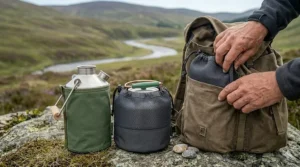
Both manufacturers provide drawstring carry bags, but serious UK campers often upgrade. Heavy-duty canvas bags with padding protect kettles during vehicle transport. Some British suppliers offer custom bags with compartments for accessories.
For backpacking, nest smaller items inside the kettle—cups, pot supports, fire starters. This maximises space efficiency whilst providing cushioning. Kelly Kettle’s nested design (fire base inverts inside chimney) proves particularly clever for compact storage.
Consider a dedicated storage location at home. Hanging kettles in sheds or garages allows air circulation, preventing moisture accumulation. Remove the bung between uses to prevent debris entering the water chamber—simple maintenance that significantly extends lifespan.
Maintenance and Longevity
Cleaning and Care Tips
Storm kettles require minimal maintenance but benefit from basic care routines. After each use, allow complete cooling before handling. Empty remaining water and invert to drain fully—trapped moisture encourages corrosion, even in stainless steel.
Post-Use Cleaning:
- Remove ash from fire base whilst still slightly warm (easier than cold)
- Wipe exterior with damp cloth to remove soot
- Rinse interior water chamber with clean water
- Dry thoroughly before storage
- Remove and store bung separately
British water quality varies significantly by region. Hard water areas (Southeast England, parts of Midlands) cause limescale buildup. Descale periodically using diluted white vinegar—fill, boil briefly, leave overnight, rinse thoroughly. Never use harsh chemicals that might affect drinking water safety.
Inspect chain and cork stopper regularly. Chains can corrode at connection points; replace at first signs of weakness. Cork stoppers compress over time; replacements cost merely £3-5 from manufacturers.
Troubleshooting Common Issues
Kettle Won’t Boil/Takes Too Long:
- Insufficient fuel—kettles need continuous feeding during boiling
- Wet fuel—even storm kettles struggle with saturated wood
- Blocked chimney—check for debris obstructing airflow
- Too much fuel—overpacking restricts oxygen flow
Whistle Won’t Sound:
- Overfilled—must leave space for steam pressure
- Blocked whistle hole—clean with thin wire
- Worn cork—replace if cracked or compressed
Leaking Seams: Both manufacturers offer warranties covering manufacturing defects. Kelly provides 2-year anti-leak guarantee; Ghillie offers 10 years subject to normal wear. Contact manufacturers directly—UK customer service receives consistent praise.
Stubborn Soot: External discolouration proves inevitable with wood-burning equipment. Some campers embrace the patina as character; others prefer pristine appearance. For thorough cleaning, use specialist stove cleaner or create paste from bicarbonate of soda and water, applied with gentle scrubbing.
UK-Specific Storage Considerations
Britain’s damp climate demands careful storage. Garages and sheds experience significant humidity fluctuation, potentially causing corrosion. Store kettles clean and completely dry, ideally with bung removed for air circulation.
Coastal campers face accelerated corrosion from salt spray. Rinse kettles thoroughly with fresh water after seaside use, paying particular attention to crevices. Consider applying light food-safe oil to steel components for extended storage periods.
Winter storage deserves mention. Water trapped inside kettles can freeze, potentially causing damage. Ensure complete drainage before storing during cold months. Some UK owners store kettles indoors during winter—kitchen cupboards maintain stable temperature and humidity.
Safety and Legal Considerations
UK Camping Fire Regulations
Understanding British fire regulations proves essential for responsible storm kettle use. According to UK Government guidance on fire safety outdoors, England experiences approximately 26,500 grass, heathland, and moorland fires annually—73 fires every single day.
Key UK Regulations:
Private Property: Generally permitted on your own land, provided smoke doesn’t drift over public roads affecting visibility, and you’re not burning materials generating dangerous fumes (plastics, chemicals).
Campsites: Most UK campsites prohibit open fires but many allow contained cooking devices including storm kettles. The fire base contains combustion effectively, distinguishing these kettles from banned campfires. Always check individual site policies.
National Parks: Regulations vary significantly. England and Wales require landowner permission before lighting any fire. Scotland’s Outdoor Access Code permits fires in certain circumstances but explicitly warns: “Never light an open fire during prolonged dry periods or in areas such as forests, woods, farmland or on peaty ground.”
Wild Camping: In areas where wild camping is permitted (primarily Scotland), fires remain controversial. Many experienced outdoors people recommend avoiding fires entirely for genuine wild camping, using only cooking stoves. The contained nature of storm kettles makes them more acceptable than open fires, but always seek landowner permission where possible.
UK fire services emphasise that tents can be destroyed in merely 60 seconds. When using storm kettles near tents:
- Maintain minimum 6 metres distance
- Position on stable, non-flammable surface
- Keep bucket of water nearby
- Never leave unattended whilst burning
Safe Operation Practices
Storm kettles operate at extremely high temperatures. British Scout groups and outdoor education centres have developed comprehensive safety protocols:
Before Lighting:
- Clear 2-metre radius of flammable materials
- Position kettle on stable, level surface
- Check wind direction relative to tents/people
- Assign dedicated fire tender (especially for groups)
- Ensure everyone knows safety distance boundaries
During Operation:
- Feed fuel gradually—never overstuff chamber
- Avoid synthetic materials (release toxic fumes)
- Use gloves when handling—chains get extremely hot
- Monitor continuously—never leave unattended
- Keep children and pets beyond safety perimeter
After Use:
- Allow complete cooling (minimum 30 minutes)
- Douse with water to ensure fully extinguished
- Scatter cooled ash widely (excellent fertiliser)
- Never place hot kettle on flammable surfaces
The contained fire base significantly reduces wildfire risk compared to open campfires. However, during prolonged dry periods (increasingly common in British summers), consider postponing use. Many National Parks implement temporary fire bans during extreme fire risk conditions.
Environmental Responsibility
Storm kettles align beautifully with sustainable camping principles. Zero dependence on fossil fuels, no disposable cartridges, and fuel sourced from immediate surroundings minimises environmental impact. However, responsible foraging matters.
Sustainable Fuel Collection:
- Gather only dead, fallen material—never break branches from living trees
- Collect from wide area rather than stripping single location
- Avoid disturbing wildlife habitats
- Take only what you need
- Consider bringing backup fuel for pristine environments
British woodlands contain diverse ecosystems depending on fallen wood. The Woodland Trust notes that deadwood provides crucial habitat for countless species. In sensitive locations, bringing your own fuel (sustainably sourced wood pellets, for example) proves more environmentally responsible than local collection.
Leave No Trace principles apply. Scatter cold ash widely—don’t leave concentrated piles. Remove all unburned material. On beaches, build kettles below high tide line where waves will naturally clean the area. In woodlands, ensure fire sites remain invisible after departure.
Storm Kettles vs Traditional Camping Solutions
Comparing Against Gas Stoves
The storm kettle versus gas stove debate centres on priorities: convenience versus self-sufficiency, weight versus fuel independence.
Gas Stove Advantages:
- Instant ignition (no fire-building skills required)
- Precise temperature control for cooking
- Lighter for short trips (initially)
- Faster setup
Storm Kettle Advantages:
- Zero ongoing fuel costs
- Functions when gas canisters empty
- Superior wind resistance
- No altitude performance degradation
- Eco-friendly with minimal waste
- Works in extreme cold
For British campers, the calculation shifts based on trip duration. Weekend warriors might prefer gas convenience, whilst extended adventures favour storm kettles’ fuel independence. Many experienced UK campers carry both—gas for cooking complexity, storm kettle for boiling water.
Alternative Campfire Solutions
Comparing storm kettles against campfire alternatives reveals distinct niches:
Traditional Campfires: Romantic ambiance, unlimited cooking capacity, but require more fuel, leave significant traces, often prohibited on UK sites.
Rocket Stoves: Similar principle to storm kettles but designed for cooking rather than water boiling, typically bulkier.
Trangia/Alcohol Stoves: Lightweight, simple, but fuel can be expensive and difficult to source in remote British locations.
Portable Solid Fuel Stoves: Compact and reliable but generate less heat than storm kettles, struggle in wind.
Storm kettles occupy a unique space—rapid water boiling specialist tools that excel in their specific purpose whilst accepting limitations for broader cooking tasks. Adding a Hobo Stove expands capabilities significantly.
Benefits vs Traditional Alternatives
| Criterion | Storm Kettles | Gas Stoves | Campfires |
|---|---|---|---|
| Fuel Cost | Free (natural materials) | £5-10 per canister | Free (gathering time) |
| Wind Resistance | Excellent (improves performance) | Poor without windshield | Moderate |
| Setup Time | 5-10 minutes | 1-2 minutes | 15-30 minutes |
| Environmental Impact | Very Low | Moderate (cartridge waste) | High (scarring, regulations) |
| UK Legal Status | Generally permitted | Widely permitted | Often prohibited |
| Weight (500ml capacity) | 540-900g | 150-300g | N/A |
| Boil Speed (1L) | 3-5 minutes | 4-6 minutes | 10-20 minutes |
| Reliability | Extremely high | Moderate (affected by cold/altitude) | Weather dependent |
Frequently Asked Questions
❓ What's the difference between Kelly Kettle and Ghillie Kettle?
❓ Can you use storm kettles in UK National Parks?
❓ How long do storm kettles last with proper care?
❓ What's the best storm kettle for solo wild camping in Scotland?
❓ Can storm kettles boil water safely for drinking in UK conditions?
Conclusion
The Kelly Kettle vs Ghillie Kettle debate ultimately reveals more similarities than differences—both deliver exceptional performance using century-old technology that works brilliantly in British conditions. Your choice hinges on personal priorities rather than objective superiority.
Choose Kelly Kettle if you value:
- Extensive accessory ecosystems and modularity
- Irish heritage and international production scale
- Stainless steel durability options
- Complete kit variations for families
Select Ghillie Kettle if you prioritise:
- Traditional British manufacturing and supporting UK industry
- Integrated safety whistle as standard feature
- Hand-spun craftsmanship using historical techniques
- Lighter weight hard anodised options
Both brands have equipped generations of British campers, fishermen, and outdoor enthusiasts. The real winner? Anyone who discovers the joy of brewing proper tea in wild places using nothing but twigs and ingenuity. These kettles transform camping from gas-dependent convenience to self-sufficient adventure.
For most UK campers, I’d recommend starting with either the Kelly Kettle Scout Aluminium (£49.95) or Ghillie Adventurer (£59.95). Both deliver core functionality at accessible prices. As your confidence grows, expand with accessories or upgrade to stainless steel models for enhanced durability.
Storm kettles represent more than camping equipment—they’re freedom from fuel concerns, connection to outdoor heritage, and conversation starters at every campsite. Whether you choose Irish innovation or British tradition, you’re investing in equipment that’ll serve faithfully through decades of adventures across Britain’s magnificent but challenging landscapes.
The next time you’re huddled on a windswept Scottish hillside, rain lashing down, watching flames dance inside your storm kettle whilst water rapidly approaches boiling point, you’ll understand why these simple devices have captivated outdoor enthusiasts for over 130 years. That first sip of steaming tea, earned through your own efforts in brutal conditions, tastes absolutely brilliant.
Recommended for You
- 7 Best Wood Burning Camping Stoves UK 2026
- 7 Best Ultralight Backpacking Stoves UK 2026
- Jetboil vs MSR Backpacking Stove: 7 Best UK Models (2026)
Disclaimer: This article contains affiliate links. If you purchase products through these links, we may earn a small commission at no additional cost to you. Prices shown are approximate and may vary. All products were researched using Amazon.co.uk pricing as of April 2026.
✨ Found this helpful? Share it with your mates! 💬🤗
