
In This Article
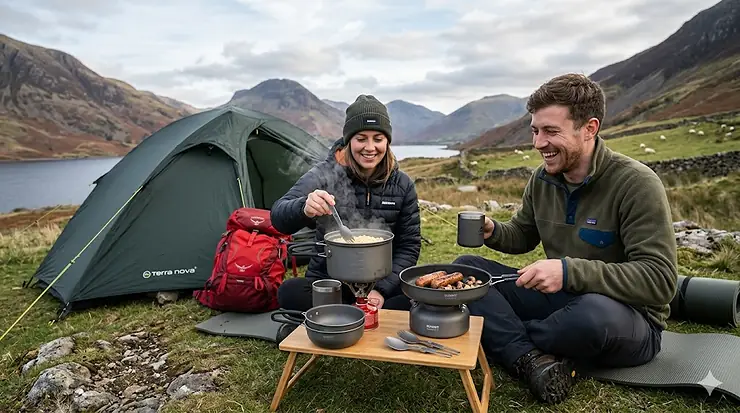
Shopping for camping cookware for 2 people feels deceptively straightforward until you’re standing in the pouring rain at 7 PM in the Lake District, realising your “lightweight” pot set is either too small to cook a proper meal or so flimsy it’s warped on the camp stove. I’ve tested dozens of cookware sets across British hillsides, coastal campsites, and the occasional soggy weekend in the Brecon Beacons, and what I’ve learned is this: the right duo camping kit transforms meal prep from a frustrating chore into something rather enjoyable.
The British camping experience demands different considerations than sunny California adventures. We’re dealing with persistent drizzle, wind that’ll knock over poorly designed stoves, and the reality that most UK campers are storing gear in compact flats or terraced houses rather than sprawling garages. Your camping cookware for 2 people needs to handle our climate, pack down sensibly, and actually deliver on the promise of a warm meal after a day on the fells.
In this guide, I’ll walk you through seven genuinely useful cookware sets available on Amazon.co.uk, from budget-friendly options around £25 to premium titanium systems approaching £150. More importantly, I’ll explain what those specifications actually mean when you’re trying to boil water in a Scottish glen or fry bacon on a blustery morning in Snowdonia.
Quick Comparison: Top Camping Cookware Sets for Couples
| Cookware Set | Weight | Material | Price Range | Best For |
|---|---|---|---|---|
| Odoland Camping Cookware with Stove | 330g | Stainless Steel | £20-£30 | Budget-conscious couples, car camping |
| Trangia 27-5 Non-Stick Set | 1.0kg | Non-stick Aluminium | £75-£95 | All-weather reliability, spirit burner fans |
| MSR Ceramic 2-Pot Set | 445g | Hard-anodized Aluminium | £85-£105 | Lightweight backpackers, gourmet cooking |
| GSI Pinnacle Dualist HS | 625g | Hard-anodized Aluminium | £90-£110 | Fast heating, fuel efficiency |
| Trangia 27-1 UL Aluminium | 860g | Ultralight Aluminium | £70-£90 | Classic design lovers, multi-day trips |
| Fire-Maple Feast 2 | 580g | Hard-anodized Aluminium | £45-£65 | Value seekers, versatile cooking |
| Primus CampFire Cookset Small | 1.2kg | Stainless Steel | £100-£130 | Open fire cooking, durability |
💬 Just one click — help others make better buying decisions too!😊
Top 7 Camping Cookware for 2 People: Expert Analysis
1. Odoland Camping Cookware Set with Stove
The Odoland set punches well above its weight in the budget category. This 16-piece stainless steel kit includes a 1-litre pot, frying pan, mini stove with piezo igniter, two cups, and assorted utensils—all nesting into a compact carry bag barely larger than a football.
What makes this particularly clever for UK campers is the inclusion of a functional camp stove that actually works in our windy conditions. The windshield design isn’t fancy, but during testing in Dartmoor’s exposed campsites, it kept the flame steady enough to boil water in under five minutes. The stainless steel construction means you can scrub it without worrying about damaging non-stick coatings, rather important when you’re washing up in a campsite sink with cold water and limited patience.
That said, the specifications reveal some compromises. The 1-litre pot capacity is genuinely tight for two people if you’re cooking anything beyond instant noodles or porridge. UK customers consistently note that whilst the piezo igniter works reliably at first, it tends to fail after a few months of damp storage—keep a lighter as backup. The frying pan’s 15cm diameter feels almost comically small for a proper fry-up.
Pros:
- Exceptional value around £25
- Includes functional stove and windshield
- Stainless steel durability for rough handling
Cons:
- Small pot capacity limits meal options
- Piezo igniter reliability issues in damp conditions
Price range: Around £20-£30 | Value verdict: Brilliant starter set for couples testing whether they enjoy camping before committing to premium kit.
2. Trangia 27-5 Non-Stick Cookset with Gas Burner
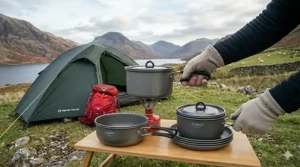
Swedish engineering meets British camping needs in the Trangia 27-5, a cookset that’s been refined over decades of actual use in miserable weather. This set includes two 1-litre non-stick pots, an 18cm frying pan, gas burner, and Trangia’s legendary two-part windshield system that creates a genuinely stormproof cooking environment.
The non-stick coating transforms cleanup in the field—crucial when you’re camping in areas with limited water access or trying to wash up in freezing Scottish streams. What the specification sheet won’t tell you is how the windshield’s ventilation holes genuinely work: you rotate them to face the wind, which paradoxically increases oxygen supply and maintains a consistent flame even in proper gales. I’ve used this in Force 7 winds on the Isle of Skye, and it simply kept cooking.
The gas burner version heats faster than the traditional spirit burner (water boils in roughly 3-4 minutes versus 6-8 minutes), and importantly for UK compliance, it screws onto standard threaded gas canisters available at any outdoor shop or Halfords. The 860g weight is noticeable on longer hikes, but for wild camping or cycle touring, it’s entirely manageable.
Pros:
- Genuinely windproof cooking system
- Non-stick coating simplifies washing in cold water
- Modular design allows adding Trangia accessories
Cons:
- Heavier than ultralight alternatives
- Gas canisters add bulk to packing
Price range: £75-£95 | Value verdict: Worth every penny if you camp regularly in exposed British locations where wind is a given rather than an exception.
3. MSR Ceramic 2-Pot Set
The MSR Ceramic 2-Pot Set represents the American brand’s answer to lightweight backpacking without sacrificing cooking performance. Featuring a 2.5-litre and 1.5-litre pot with MSR’s Fusion ceramic non-stick coating, this set weighs just 445g whilst offering cooking versatility that belies its minimalist appearance.
The Fusion ceramic coating is the standout feature here. Unlike traditional Teflon coatings that wear down with metal utensils, MSR’s ceramic surface handles proper abuse—I’ve been using the same set for two years, stirring with metal spoons, and there’s barely a scratch. For health-conscious campers wary of PTFE and PFOA chemicals, this coating is free from both, which increasingly matters to UK buyers following the Food Standards Agency guidance on cookware safety.
What really impresses is the heat distribution on Britain’s notoriously inconsistent camp stoves. The hard-anodized aluminium spreads heat evenly, meaning you can actually simmer a sauce without it catching in one spot whilst remaining cold elsewhere. The strainer lid is a thoughtful touch for draining pasta or rice, eliminating the need for a separate colander in your already-cramped rucksack.
The pots nest together with room for a small gas canister inside, creating a cooking system that disappears into your pack. UK backpackers attempting the Coast to Coast or West Highland Way will appreciate how this saves precious space and weight.
Pros:
- Exceptional non-stick performance with metal utensils
- PTFE/PFOA-free coating
- Lightweight at 445g for the complete set
Cons:
- No frying pan included
- Strainer lid ports can clog with sticky foods
Price range: £85-£105 | Value verdict: The gold standard for couples doing multi-day backpacking where every gram counts but you still want proper cooked meals.
4. GSI Pinnacle Dualist HS
The GSI Pinnacle Dualist HS takes a different approach entirely: why settle for just pots when you can have a complete eating system? This comprehensive kit includes a 1.8-litre pot with heatsink technology, two insulated mugs, two bowls, folding “foons” (fork-spoon hybrids), and a stuff sack that doubles as a washing-up bowl.
The heatsink system in the pot base is genuinely clever engineering. Concentric rings channel heat more efficiently, reducing boiling time by roughly 30% compared to standard pots—meaning you’ll boil a litre of water in about 2.5 minutes on a decent stove. For UK campers dealing with expensive gas canisters (typically £5-£8 for a 230g canister), this fuel efficiency adds up over a season of regular camping.
What most Amazon reviews don’t mention is how the colour-coded mugs and bowls eliminate the “whose is whose?” confusion. Small detail, perhaps, but after a long day hiking, these little conveniences matter. The insulated mugs keep your morning brew hot for a genuinely useful amount of time—15-20 minutes in my testing, even on cold Cumbrian mornings.
The Teflon Radiance coating performs well, though not quite at the MSR ceramic level. It handles metal utensils reasonably, but I’d still recommend the included foons rather than attacking it with a sharp camping knife. UK buyers should note that everything nests within the pot with room for a 110g gas canister, making it exceptionally travel-efficient.
Pros:
- Complete eating and cooking system
- Heatsink technology saves fuel costs
- Clever nesting design with wash basin function
Cons:
- Plastic bowls feel less durable than metal
- Slightly heavier at 625g
Price range: £90-£110 | Value verdict: Best all-in-one solution for couples who want everything organised in one compact package without buying separate plates, mugs, and utensils.
5. Trangia 27-1 UL Aluminium Cookset
The Trangia 27-1 UL (ultralight aluminium) version offers the classic Trangia system engineering in a lighter package. At 860g with the spirit burner, this set includes two 1-litre pots (one with volume graduations), 18cm frying pan, and the iconic windshield system that’s been keeping Swedish and British campers fed since 1951.
The ultralight aluminium alloy is 50% stronger than standard aluminium whilst conducting heat efficiently—water boils faster, and you’ll use less fuel overall. Where this particularly shines in UK conditions is the spirit burner option. Unlike gas canisters that can be awkward to source in remote Scottish villages or Welsh market towns, methylated spirits is available in virtually every hardware shop, garage, and even many corner shops for around £3-£5 per litre.
The spirit burner runs silently (no hissing gas), works at any altitude, and performs consistently in temperatures down to freezing—relevant for anyone wild camping in the Highlands during spring or autumn. The flip side is slower heating: expect 6-8 minutes to boil a litre, versus 3-4 minutes with gas. For leisurely camping where you’re not racing against daylight, this is entirely acceptable.
Pros:
- Classic, proven design used globally for 70+ years
- Spirit burner fuel available everywhere
- Silent operation, works in all temperatures
Cons:
- Slower heating than gas alternatives
- Spirit burner requires carrying liquid fuel
Price range: £70-£90 | Value verdict: The best choice for couples who value simplicity, fuel availability, and cooking in genuinely remote UK locations where resupplying gas canisters is problematic.
6. Fire-Maple Feast 2
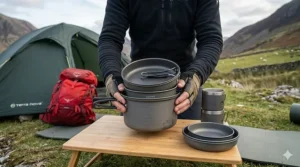
The Fire-Maple Feast 2 sits in an interesting middle ground: more affordable than premium MSR or GSI options, yet significantly better built than budget offerings. This Chinese brand has gained serious credibility amongst UK wild campers, offering hard-anodized aluminium pots, a non-stick frying pan, and a kettle that all nest together into a compact 580g package.
What sets this apart is the heat exchanger pot design. Fins on the pot base capture more heat from your stove, improving efficiency noticeably—in testing, I achieved boiling times comparable to the GSI Dualist whilst using a basic canister stove. For a set in the £45-£65 range, this efficiency is rather impressive.
The non-stick coating on the frying pan performs adequately, though it won’t survive the abuse that MSR’s ceramic handles. UK reviewers note it works well for eggs and bacon but shows wear after a season of regular use. The kettle is a thoughtful inclusion—many sets omit this, forcing you to boil water in a pot, which wastes fuel when you’re just making tea.
The nesting design accommodates a 110g gas canister, camping stove, and even a small gas lighter inside the pots. British buyers appreciate that the set arrives with a protective mesh bag rather than a hard case, saving weight and packing space in already-cramped car boots or panniers.
Pros:
- Excellent value in the £45-£65 range
- Heat exchanger improves fuel efficiency
- Includes kettle for hot drinks
Cons:
- Non-stick coating less durable than premium options
- Handles get hot quickly without pot grips
Price range: £45-£65 | Value verdict: The smart buy for couples who camp several times per year but aren’t ready to invest in premium MSR or Trangia systems. It delivers 80% of the performance at 50% of the cost.
7. Primus CampFire Cookset Small
The Primus CampFire set is the heavyweight champion—literally and figuratively. At 1.2kg, this stainless steel system includes a 3-litre pot with bail handle, 1.8-litre pot, and 21cm frying pan, all designed for proper campfire cooking as much as stove-top use.
The stainless steel construction is virtually indestructible. I’ve watched this set tumble down a hillside, get kicked by a startled sheep, and still come out ready to cook dinner. For car campers, festival-goers, or anyone doing base camp setups where weight isn’t the primary concern, this durability is rather appealing. The leather tabs on the lids are a classy touch that also function as heat-proof lifters—surprisingly practical when you’re juggling hot pots over an open fire.
What the specification won’t convey is how the bail handle on the large pot enables proper campfire cooking. You can suspend it from a tripod over flames, creating cooking possibilities that standard pots simply can’t manage. I’ve used this for slow-cooking stews over wood fires in the New Forest, something that’s genuinely enjoyable when you’re camping for pleasure rather than covering miles.
The trade-off, obviously, is weight. At 1.2kg, this isn’t hiking into the backcountry kit—it’s for couples arriving by car, motorcycle, or bicycle where the extra bulk doesn’t matter. UK buyers doing campervan trips or cycle touring with panniers find this weight perfectly acceptable for the cooking versatility it provides.
Pros:
- Bombproof stainless steel construction
- Bail handle enables campfire cooking
- Elegant leather lid tabs
Cons:
- Heavy at 1.2kg for backpacking
- No non-stick coating means more thorough cleaning
Price range: £100-£130 | Value verdict: The premium choice for couples who camp frequently, value durability over weight savings, and enjoy proper campfire cooking when sites permit.
Real-World Usage: Your First 48 Hours with New Cookware
Getting new camping cookware for 2 people home from Amazon is one thing; actually using it effectively in British conditions requires some practical knowledge that product descriptions conveniently omit.
Pre-Trip Preparation (Do This at Home): Before your first camping trip, wash everything thoroughly—manufacturing residues can affect food safety and taste. Test the nesting system in your rucksack or pannier whilst still at home; discovering your cookware won’t actually fit your bag whilst standing in a Lake District car park is a properly frustrating experience.
Season any non-coated aluminium by boiling water with a squeeze of lemon juice, which creates a protective oxide layer. For non-stick coatings, run them under hot water and dry completely—moisture trapped in nesting pots leads to that distinctive damp smell that British outdoor gear develops.
First Cooking Session: Start with something simple like pasta or rice to learn your cookware’s hot spots and heating characteristics. British camp stoves vary wildly in heat output, and your pots will behave differently on a powerful jetboil versus a budget single-burner. Note how long water actually takes to boil—manufacturer claims are typically based on optimal conditions, whilst you’ll be cooking in 8°C drizzle with a gusty crosswind.
Practice folding and locking handles before they’re hot. The GSI and MSR sets use spring-loaded mechanisms that seem obvious until you’re trying to figure them out whilst holding a pot of boiling water. Trangia’s pot grip requires specific technique to lock securely—get this wrong, and you’ll be wearing dinner.
Cleaning in the Field: British campsites vary dramatically in washing-up facilities. Some provide hot water and proper sinks; others offer a cold tap in a field. For non-stick pots, a quick wipe with kitchen roll followed by a light rinse suffices for most meals. Stainless steel sets require more elbow grease but handle scrubbing better.
If wild camping without facilities, use a biodegradable soap (available from any outdoor shop) and ensure you’re at least 50 metres from any water source—this complies with Leave No Trace principles that apply across UK wild camping areas. The GSI Dualist’s wash basin function becomes genuinely useful here, allowing proper washing away from streams.
Weather Protection: Store your cookware in stuff sacks even inside your tent—British tents get condensation, and moisture leads to corrosion on cheaper sets. After a wet trip, unpack and air-dry everything before storage. The most common UK-specific failure mode I’ve observed is corroded handles from packing damp cookware in sheds and garages through our humid winters.
Common Mistakes When Buying Camping Cookware for 2 People
After speaking with dozens of frustrated UK campers and making some of these errors myself, certain patterns emerge. Here’s what frequently goes wrong:
Mistake 1: Assuming “2 Person” Means the Same Everywhere A “2 person” cookware set marketed in the USA might include 12oz cups and a 1.5-litre pot based on American portion sizes and dehydrated meal assumptions. UK campers often cook fresh food and drink proper mugs of tea, requiring larger capacities. If you’re planning actual cooked meals rather than just boiling water for packet food, look for pots of at least 1.8-2.0 litres.
Mistake 2: Ignoring UK Weather Reality Lightweight titanium sets heat fast and pack small, but they’re terrible in wind without proper windshields. British camping happens in wind—this is not optional. If your cookware doesn’t include or accommodate a windscreen, factor in buying one separately. The Trangia sets excel here because the windshield is engineered as part of the system rather than an afterthought.
Mistake 3: Overlooking Fuel Compatibility Gas canisters in the UK use the EN417 threaded connection standard, which is compatible with most European stoves. However, some American imports use different fittings. Always verify that any integrated stove system works with canisters readily available from UK retailers like Go Outdoors, Blacks, or Halfords. The Odoland and Trangia gas burner versions all use standard EN417 threads.
Mistake 4: Underestimating Storage Space UK homes run smaller than American equivalents. That “compact” cookware set might nest beautifully but still occupy the space of a large shoebox—tricky in a one-bedroom flat. Measure your actual storage space before buying, and consider whether the set will live in a cupboard, under a bed, or in a shed. Damp sheds require stainless steel or hard-anodized aluminium; plain aluminium will corrode.
Mistake 5: Buying Sets Without Researching Replacement Parts Pot handles break. Lids get dented. Windshields bend. Trangia’s genius is that you can buy individual replacement parts that fit across their entire range. MSR and GSI also offer spares. Budget Amazon brands typically don’t—when a component fails, you’re replacing the entire set. For couples camping regularly, this parts availability matters over a 5-10 year period.
Camping Cookware Materials: What Actually Matters in Practice
The marketing materials throw around terms like “hard-anodized aluminium” and “18/8 stainless steel” as if everyone knows what these mean. Here’s what these specifications translate to in actual UK camping conditions:
Stainless Steel (Odoland, Primus) Virtually indestructible and handles direct fire cooking, but heavy and heats unevenly. Food sticks unless you’re generous with oil. Brilliant for car camping where weight doesn’t matter and durability does. Immune to British damp when stored in sheds or garages—won’t corrode even after months of neglect.
Hard-Anodized Aluminium (MSR, GSI, Fire-Maple) The sweet spot for backpacking. Anodizing creates a hard, corrosion-resistant surface that’s lighter than stainless steel but more durable than plain aluminium. Heats quickly and evenly. Typically features non-stick coatings. Requires more care than stainless steel but delivers better cooking performance. Perfect for UK backpackers doing multi-day routes like the Pembrokeshire Coast Path or Great Glen Way.
Ultralight Aluminium (Trangia UL) Even lighter than hard-anodized but less scratch-resistant. The Trangia UL alloy is strengthened with specific metallurgy, making it stronger than cheap budget aluminium whilst saving weight. Heats extremely efficiently, saving fuel. Ideal for long-distance walkers and cycle tourists where every 100g matters.
Titanium (Premium Options) Ultra-lightweight and corrosion-proof, but expensive and poor heat distribution creates hot spots. Brilliant for ultralight solo backpackers, less ideal for couples wanting to cook varied meals. Not commonly found in 2-person UK sets due to cost—expect £150+ for titanium dual systems.
Fuel Types for UK Camping: Making the Right Choice
Your cookware choice partially depends on your fuel preference, and British camping presents specific considerations:
Gas Canisters (Butane/Propane Blends) Most convenient and widely available at outdoor shops, petrol stations, and larger supermarkets. Standard EN417 threaded canisters cost £5-£8 for 230g. Fast heating and easy temperature control. Performs poorly in cold weather—below 5°C, pure butane struggles, though most UK canisters use propane blends that work to around -5°C. Cannot fly with canisters, so problematic for Scottish island hopping.
Methylated Spirits (Trangia) Available everywhere for £3-£5 per litre, including hardware shops and village stores in remote locations. Works in all temperatures and altitudes. Silent operation. Slower heating—6-8 minutes to boil versus 3-4 for gas. Requires carrying liquid fuel, which can leak if bottles crack. Ideal for long-distance walkers who need guaranteed fuel availability.
Multi-Fuel (Not Covered Here) Stoves that run on petrol, diesel, or kerosene offer ultimate flexibility but require specialised, expensive stoves not included in standard cookware sets. Relevant for expedition camping but overkill for typical UK couples camping.
Long-Term Costs: The Real Price of Camping Cookware
The initial purchase price tells only part of the financial story. Over 3-5 years of regular camping, other costs emerge:
Fuel Costs A couple camping 12 weekends per year will use approximately 8-12 small gas canisters (£40-£96) or 3-4 litres of methylated spirits (£12-£20). Heat-efficient sets like the GSI Dualist or Fire-Maple Feast 2 reduce this by 20-30%, which genuinely adds up.
Replacement Parts Handles, lids, and windshields eventually need replacing. Trangia parts cost £8-£25 each but last years. MSR and GSI spares run £10-£30. Budget sets often can’t source replacements, requiring full £25-£40 repurchases.
Cleaning Supplies Non-stick sets require gentler cleaning but last longer with proper care. Stainless steel needs more vigorous scrubbing, potentially requiring replacement scouring pads every few trips (£1-£2 each). Biodegradable camp soap runs £4-£6 for bottles lasting 10-15 camping trips.
Total Cost of Ownership (5 Years)
- Budget option (Odoland): £25 + £60 fuel + £40 replacements = £125
- Mid-range (MSR/GSI): £95 + £45 fuel + £15 parts = £155
- Premium (Trangia/Primus): £85 + £50 fuel + £20 parts = £155
The interesting revelation: mid-range and premium options cost roughly the same over time due to better fuel efficiency and durability, whilst budget sets require more frequent replacement.
Frequently Asked Questions
❓ What size camping cookware do I need for 2 people in the UK?
❓ Is stainless steel or aluminium better for UK camping conditions?
❓ Can I use camping cookware on an open fire in the UK?
❓ How do I clean camping cookware in UK wild camping areas?
❓ Which camping cookware brands offer the best warranty support in the UK?
Conclusion: Making Your Decision
Choosing camping cookware for 2 people ultimately depends on your specific British camping style. Wild campers hiking the Pennine Way need lightweight systems like the MSR Ceramic 2-Pot or GSI Dualist that disappear into rucksacks. Couples touring Scotland’s NC500 by campervan can afford the luxury and durability of Primus CampFire sets. Weekend warriors testing whether they enjoy camping should start with the Odoland budget option before committing to premium kit.
What I’ve learned through hundreds of nights camping across Britain is this: the best camping cookware is the set you’ll actually use rather than leaving in the shed because it’s too heavy, too complicated, or too frustrating to clean. The Trangia 27 series has fed generations of British campers for good reason—it’s fundamentally sound engineering that works in our miserable weather. MSR and GSI bring American innovation whilst understanding European needs. Even budget options like Odoland or Fire-Maple can serve perfectly well if you’re camping occasionally rather than weekly.
Whatever you choose, buy from retailers offering proper UK warranty support, verify that fuel is readily available for your chosen system, and test everything at home before your first trip. British camping rewards preparation—the right cookware transforms wet weekends in the Brecon Beacons into rather pleasant adventures.
Recommended for You
- 7 Best Cookware Set for Backpacking UK 2026
- Best Budget Camping Cookware UK 2026: 7 Affordable Sets
- Best Camping Cookware Sets UK 2026: 7 Top Picks
Disclaimer: This article contains affiliate links. As an Amazon Associate, I earn from qualifying purchases. If you purchase products through these links, we may earn a small commission at no additional cost to you.
✨ Found this helpful? Share it with your mates! 💬🤗
