
In This Article
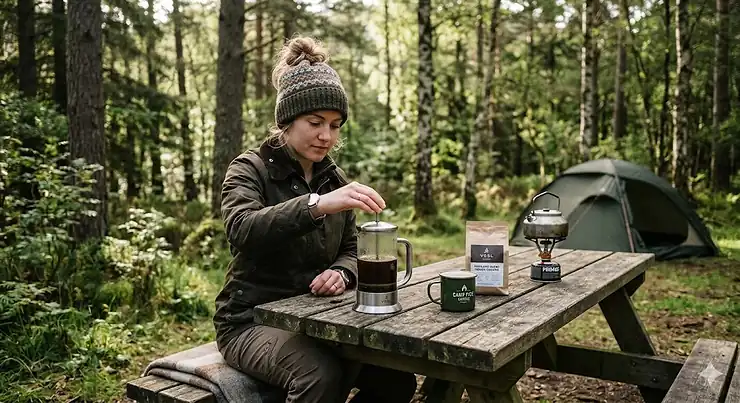
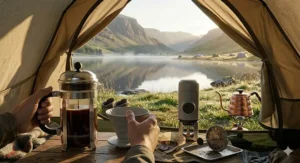
Picture this: you’ve just crawled out of a tent somewhere in the Lake District, boots damp, breath misting in the grey morning air, and the only thing standing between you and a fully functioning human brain is a decent cup of coffee. The question is — how are you making it?
The french press vs pour over camping debate is one that quietly divides walkers, wild campers, and weekend adventurers across Britain. Both methods are simple. Both are affordable. Both can produce genuinely excellent coffee far from the nearest Costa. But they’re not the same thing, and choosing the wrong one for your trip can mean tepid, gritty disappointment at precisely the moment you need it least.
Here’s the short version: french press camping is immersive — you steep coarse grounds in hot water, plunge, and pour. Full-bodied, oils intact, rich and robust. Pour over camping sends hot water through grounds and a filter, drip by drip, producing something cleaner and brighter with more nuance. One suits the group camper who brews by firelight; the other appeals to the solo backpacker who packs light and likes ritual. Both have their place on British trails.
This guide cuts through the marketing noise, tests the real-world trade-offs, and recommends seven products actually available on Amazon.co.uk — so you can make a proper decision before your next trip to Dartmoor, Snowdonia, or somewhere windswept and wonderful.
Quick Comparison: French Press vs Pour Over Camping at a Glance
| Feature | French Press | Pour Over |
|---|---|---|
| Flavour Profile | Full-bodied, rich, oily | Clean, bright, nuanced |
| Ease of Use | Very simple | Requires technique |
| Cleanup | Messier (wet grounds) | Easier (filter disposal) |
| Weight | Moderate–heavy | Lightweight |
| Filters Needed? | No | Yes (paper/mesh) |
| Group Brewing | Excellent | Slow for groups |
| Best For | Car camping, groups | Backpacking, solo use |
| Price Range (Amazon.co.uk) | £15–£80 | £10–£60 |
From the table above, neither method is universally “better” — they’re optimised for different campers. If you’re loading a car boot with gear for a weekend in the Brecon Beacons, a good french press is your friend. If you’re fastpacking solo through the Scottish Highlands with every gram accounted for, a collapsible pour over is the far smarter choice. The rest of this guide exists to help you figure out which category you fall into.
💬 Just one click — help others make better buying decisions too! 😊
✨ Don’t Miss These Exclusive Deals!
🔍 Take your camping coffee to the next level with these carefully selected products. Click on any highlighted item to check current pricing and availability on Amazon.co.uk. These picks will help you find exactly what you need!
Top 7 Camping Coffee Makers: Expert Analysis (French Press & Pour Over)
1. GSI Outdoors JavaPress French Press
The GSI Outdoors JavaPress is what happens when someone who actually camps designs a French press. No glass to smash. No flimsy handle to snap off on day three. The double-walled, BPA-free polypropylene construction keeps coffee genuinely hot for a solid 30–40 minutes — which matters when you’re faff-ing around with camp chairs and trying to light a stove in a stiff Pennines breeze.
At around 470ml (roughly four cups), this is sized perfectly for two people or a solo camper who fancies a generous mug. The coil filter system works well at keeping grounds out of your cup — not perfectly, mind, but better than many. The JavaPress folds down into an impressively compact shape, which any backpacker will appreciate.
Who is this for? The JavaPress is the sensible choice for the British hiker who wants reliable, no-drama coffee without coddling expensive kit. UK reviewers on Amazon.co.uk consistently praise its durability and portability. One common note: the plunger benefits from a slow, patient press — rush it and you’ll regret it.
✅ Lightweight and shatterproof
✅ Double-walled for heat retention
✅ Compact folding design
❌ Holds grounds in suspension if rushed
❌ Capacity limited for larger groups
Price range: around £20–£35 | Available on Amazon.co.uk, often Prime-eligible for next-day delivery.
2. ESPRO P0 Ultralight Travel Press
The ESPRO P0 is the press that serious coffee people bring camping when they refuse to apologise for caring. It’s a vacuum-insulated stainless steel bottle containing a patented micro-filter that genuinely stops fine grounds from entering your cup — a problem that plagues most french press designs, including glass café versions. The double micro-filter means you can brew stronger, use a finer grind, and still sip cleanly to the last drop.
At 473ml and weighing just 370g, it’s backpack-appropriate. Where it really earns its price tag (in the £40–£60 range on Amazon.co.uk) is in cold conditions: the vacuum insulation keeps coffee piping hot for two-plus hours — something you’ll appreciate on an October morning in the Cairngorms when the temperature is hovering around 3°C. It doubles as a travel mug once pressed; screw on the lid and hike.
The main compromise is capacity. Because the filter assembly takes up internal space, you’re yielding closer to 280–300ml of actual coffee per brew, not the full 473ml. For solo campers, that’s fine. For two people, expect to brew twice.
✅ Exceptional filtration — virtually grit-free
✅ Excellent insulation for cold British mornings
✅ Compact and trail-ready
❌ Effective yield is lower than the stated volume
❌ Premium price point
Price range: around £45–£60 | Available on Amazon.co.uk, Prime-eligible.
3. Stanley Classic Stay Hot French Press
Stanley’s reputation for indestructibility is well-earned, and the Classic Stay Hot French Press delivers on every front. Made from 18/8 stainless steel, this press has no pretensions about subtlety: it’s heavy, capacious (1 litre / roughly eight cups), and built to survive the sort of treatment that would finish lesser kit in a long weekend. If you’re car camping in a campervan on the North Yorkshire Moors and want to brew a proper round for four people, this is your tool.
The insulated body keeps coffee hot for a genuinely impressive four or more hours. The press mechanism is smooth and solid. It looks good in that rugged, vintage American thermos way that plays well against a campfire.
The trade-off is weight: at around 700g, this is not a backpack companion. It’s a basecamp brewer — the sort of thing you leave on the table while people wander in and out of tents. UK Amazon.co.uk reviews rate it highly for its build quality and thermal performance, though a few note the plunger could be smoother on first use.
✅ Enormous capacity for groups
✅ Outstanding heat retention
✅ Near-indestructible stainless construction
❌ Too heavy for backpacking
❌ Requires separate mugs
Price range: around £50–£80 | Available on Amazon.co.uk, Prime-eligible for next-day delivery in most UK postcodes.
4. AeroPress Go Travel Coffee Press
Strictly speaking, the AeroPress Go isn’t a pour over or a french press — it’s something more interesting than either. The brewing chamber combines immersion steeping with forced air pressure extraction, producing coffee closer to a concentrated espresso than either of its rivals, yet it’s lighter than a GSI JavaPress and produces virtually zero sediment. The “Go” edition comes with its own mug that doubles as the carry case, a rather elegant solution for space-constrained packing.
Why include it here? Because in the french press vs pour over camping debate, the AeroPress Go is the answer many experienced British outdoors folk actually land on. It weighs just 300g complete, brews in under two minutes, and cleans up in seconds — a push of the plunger ejects a neat puck of compressed grounds. No scraping. No grounds stuck to the bottom. That matters when you’re miles from running water in the Black Mountains.
One caveat: it brews one cup at a time. For solo travellers and duos this is fine; for a group of four, the maths gets tedious.
✅ Exceptionally clean cup
✅ Ultra-fast cleanup
✅ Compact mug-included design
❌ Single-serve only
❌ Slight learning curve for best results
Price range: around £30–£45 | Available on Amazon.co.uk, wide availability, Prime-eligible.
5. GSI Outdoors Ultralight Java Drip (Pour Over)
At a staggering 9g, the GSI Ultralight Java Drip is roughly the weight of a pound coin. It’s a collapsible pour over cone made from silicone, and it drops onto virtually any mug or cup you’re already carrying. Use standard Hario-style #2 or #4 paper filters (widely available in UK supermarkets and online) and you’re brewing clean, bright, filter-quality coffee with no additional gear.
This is the pour over method at its purest. No mechanism, no moving parts, nothing to break. Water at around 90–94°C (just off the boil — let it sit for 45 seconds) poured slowly in circles over a medium-fine grind produces a cup with noticeably more clarity than any french press, picking up delicate fruity or floral notes in better-quality beans. It’s the method speciality coffee roasters — the kind found all over Edinburgh, Manchester, and Bristol these days — actually use.
The limitation is obvious: you need filters, which means you’re carrying consumables and packing out used paper (the leave-no-trace consideration is real, as noted by outdoor specialists like Adventure Alan). And pouring technique matters; a rushed pour produces weak, underextracted coffee. But get it right, and nothing in this list will outperform it on flavour nuance.
✅ Virtually weightless
✅ Produces the cleanest cup of any method
✅ Pairs with any mug or vessel
❌ Requires paper filters (consumables, waste)
❌ Technique-dependent — less forgiving than french press
Price range: around £10–£20 | Available on Amazon.co.uk, often bundles well with filter papers.
6. MiiR Pourigami Portable Pour Over
The Pourigami is the gadget that makes coffee nerds smile on first sight. Three flat titanium panels slot together origami-style to form a stable pour over dripper, then fold completely flat — roughly the thickness of a paperback — for packing. It’s clever, well-made, and produces consistently good results when paired with proper #2 filters.
At around 85g in titanium, it’s heavier than the GSI silicone option but far more rigid and stable on a camp table or uneven rock. The flat-pack design means it slides into a pack’s side pocket without fuss. UK campers doing multi-day Wainwrights or Munro-bagging weekends will appreciate how little space it claims.
The Pourigami rewards patience. You need to bloom your grounds (pour a small amount of hot water and wait 30 seconds for the CO₂ to escape), then pour in slow, deliberate spirals. Rush it, and water flows through too fast for proper extraction — the flavour suffers noticeably. Get it right, and this thing produces café-quality pour over at 900 metres above sea level, which remains a minor miracle regardless of how many times you do it.
✅ Incredibly compact flat-pack design
✅ Durable titanium construction
✅ Excellent cup quality when technique is right
❌ Requires careful pouring technique
❌ Needs separate vessel/mug to brew into
Price range: around £35–£55 | Available on Amazon.co.uk. Worth pairing with a quality insulated mug given it offers no heat retention itself.
7. Snow Peak Titanium French Press
Snow Peak is the Japanese outdoor brand that quietly makes some of the most refined camping kit on earth, and their Titanium French Press is the proof. Single-wall titanium construction means you can place it directly over a gas burner or campfire to both boil your water and brew — eliminating the need for a separate pot. At 179g, it’s remarkably light for a full french press.
The single-wall caveat is worth flagging: titanium doesn’t insulate like double-walled steel, so coffee cools faster than with the Stanley. In practice, you brew and pour immediately — which is how most people actually drink camp coffee anyway. The taste is clean and oil-rich, as you’d expect from a press. The craftsmanship is exceptional.
At its price point (around £60–£90 on Amazon.co.uk), this isn’t a beginner’s purchase. It’s the choice of the experienced camper who values multi-functionality — boil water, brew coffee, drink from it — and is prepared to invest in kit that will last a decade without complaint. UK reviewers note it cleans well and resists the tannin staining that affects cheaper metals.
✅ Can brew directly over a flame
✅ Ultralight titanium construction
✅ Multi-functional: pot, press, and cup
❌ Single-wall means faster heat loss
❌ Premium price
Price range: around £60–£90 | Available on Amazon.co.uk. Check availability as this is a specialist item with variable stock.
Real-World Scenarios: Which Method Suits Your British Adventure?
The Weekend Car Camper at a Site in the Cotswolds
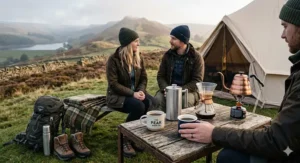
You’ve got a car boot. Weight is irrelevant. You’re camping with three or four friends, and the Sunday morning coffee round is a social event as much as a caffeine delivery system. French press wins here, clearly. The Stanley Classic Stay Hot makes enough for everyone in a single brew, stays hot while you argue about who’s doing breakfast, and can take being knocked off a table by a Labrador. Bring a quality pre-ground medium-dark roast, a basic kettle, and you’re sorted.
The Solo Backpacker on the West Highland Way
Every gram matters. You’re wild camping, water comes from streams, and your pack is already heavier than it should be. Pour over — specifically the GSI Ultralight Java Drip — is the call. It adds almost nothing to pack weight, uses paper filters you fold flat, and brews a genuinely excellent cup. Pack out the used filter in a zip-lock bag. Leave the campsite cleaner than you found it.
The Midweek Wild Camper in Dartmoor
Solo or with one companion, a two-day loop, staying one night in the field. You want quality without faff. The ESPRO P0 Ultralight Travel Press threads the needle: compact, insulated, clean-tasting, and it serves as your travel mug on the morning walk. No spare vessel needed. It’s the most practical single-purchase solution for this sort of trip.
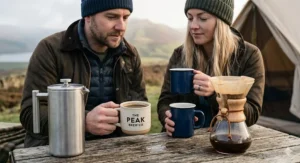
How to Brew Better Coffee Outdoors: A Practical Field Guide
Getting good coffee from either method outdoors comes down to four variables: water temperature, grind size, ratio, and patience. The science behind extraction is well documented — the Specialty Coffee Association recommends a water temperature between 90–96°C for optimal extraction. Off a rolling boil in the UK, you want to let water sit for 45–60 seconds before pouring.
For french press camping: Use a coarse grind (like breadcrumbs, not sand). A ratio of roughly 1:15 — one gram of coffee to 15ml of water — is a reliable starting point. Add your grounds, pour water slowly to saturate evenly, and steep for four minutes. Press slowly and with intention. Then pour immediately into your cup; leaving coffee in contact with the grounds post-press continues extraction and turns it bitter.
For pour over camping: A medium-fine grind is your target — finer than french press, coarser than espresso. The critical step most campers skip is the bloom: pour just enough water to saturate the grounds (roughly twice the weight of the coffee), wait 30 seconds, then continue pouring in slow spirals. This releases CO₂ trapped in fresh coffee and dramatically improves flavour. Total brew time should be two to three minutes.
A few field-specific tips for British conditions:
- Cold mornings: Pre-heat your vessel by filling with hot water for a minute before brewing. Temperature loss in an unheated mug can drop your coffee from excellent to mediocre in under a minute.
- Wind: If you’re using a pour over outdoors, wind cooling the brew during extraction is a real problem. Try brewing in a sheltered spot, or cup your hand around the dripper.
- Water quality: UK tap water is generally fine, but water from streams should be filtered or boiled. Hard water in southern England can dull flavour — a small travel filter can help if you’re heading to the Peak District or Yorkshire Dales.
- Leave No Trace: Used coffee grounds from a french press should be packed out, not scattered — coffee grounds can disrupt soil microbiology. The Woodland Trust advises minimising any organic waste left in woodland and natural environments.
French Press vs Pour Over Camping: The Deeper Comparison
Let’s be precise about what you’re actually choosing between, because the differences go beyond the obvious.
Flavour: What Does “Full-Bodied” Actually Mean?
French press coffee retains the coffee’s natural oils — the lipids that give it mouthfeel and richness. These oils are trapped by paper filters in pour over, which is why pour over tastes lighter and cleaner. Neither is objectively better; it depends on the coffee and the drinker. If you’re using a quality single-origin light roast from a speciality roaster (London has dozens; Edinburgh, Manchester, and Bristol are increasingly well-served), the pour over will let those delicate flavours sing. A darker, more robust blend brewed in a french press tastes boldly, satisfyingly coffeeish in a way that suits a chilly British morning beautifully.
Cleanup: The Honest Assessment
French press grounds are a genuine field nuisance. They’re wet, they don’t compress, and scraping them out without water nearby is a messy business. Pour over is simpler: lift the paper filter, squeeze excess liquid, fold it, bag it. Done. If you’re camping where water is scarce or where waste management matters — any Site of Special Scientific Interest (SSSI), for instance, and much of the UK’s most beautiful walking country qualifies — the pour over’s cleaner disposal gives it a meaningful practical advantage.
Cost Over Time
Both methods have low upfront costs relative to alternatives like pod systems or moka pots. The ongoing cost difference is small but real: pour over requires paper filters at roughly £5–£10 per 100 (standard Hario V60 #02 filters from Amazon.co.uk). French press needs nothing additional. Over a season of camping trips, the difference is negligible but exists.
Camping Coffee Methods Comparison
| Factor | French Press | Pour Over | AeroPress |
|---|---|---|---|
| Grounds Cleanup | Messy | Easy (filter) | Very easy (puck) |
| Brew Time | 4–5 min | 2–3 min | 1–2 min |
| Skill Required | Low | Medium | Medium |
| Kit to Carry | Press only | Dripper + filters | All-in-one kit |
| Coffee Quality | Rich, robust | Clean, nuanced | Strong, smooth |
| Group Size | 1–8+ | 1–2 optimal | 1–2 optimal |
The table confirms what experienced campers tend to already know: french press scales effortlessly for groups; pour over is best as a personal ritual for one or two. The AeroPress (via the Go version) is the pragmatist’s choice — objectively the most versatile single option, though neither a pure french press nor a pure pour over.
✨ Don’t Miss These Exclusive Deals!
🔍 Upgrade your outdoor coffee game with these tried-and-tested products. Click any highlighted item to check current pricing and availability on Amazon.co.uk — and never suffer a bad camp coffee again.
What to Expect: Brewing in Real British Conditions
Here’s what the product spec sheets don’t tell you: camping coffee behaves differently in the UK than it does in testing labs or sun-drenched American national parks.
Cold temperatures: Britain’s camping season runs from April to October in most of the country, but “April” in Scotland or November in the Lake District can mean 2–5°C by morning. At those temperatures, your coffee loses heat faster than the manufacturer’s insulation claims suggest. Double-walled and vacuum-insulated vessels (ESPRO P0, Stanley Classic) retain heat significantly better than single-wall designs (Snow Peak, cheap stainless presses). Budget for this.
Wind and rain: Pour overs are inherently more wind-sensitive during brewing. The cooling effect of a decent breeze on a paper filter during extraction is real and measureable. If you’re regularly camping in exposed spots — Dartmoor, the Cairngorms, coastal Wales — a french press is operationally simpler in bad weather. No filter to soak, no delicate pouring ritual to maintain in a gale.
Water: The UK’s tap water varies from very soft (Scotland, Wales) to notably hard (South East England). Hard water contains minerals that can over-extract coffee, producing astringency — particularly noticeable in delicate pour over brews. Stream and river water, even in apparently pristine upland areas, should always be boiled first; Natural England recommends treating all wild water sources before consumption.
Pack weight reality: For most British day walkers and weekend campers, the weight difference between a 200g pour over setup and a 470g french press is irrelevant. For Munro-baggers covering 30km+ days with full camping gear, it absolutely isn’t.
How to Choose: A Buyer’s Decision Framework
If you’re still not sure which method suits you, work through this:
- How many people are you brewing for? One or two: either works. Three or more: french press is significantly more practical.
- Are you backpacking or car camping? Backpacking strongly favours the lightness and simplicity of a collapsible pour over or the ESPRO travel press. Car camping removes weight as a factor entirely.
- How much do you care about coffee flavour? If you’re using supermarket pre-ground and just want caffeine, a basic french press is perfectly adequate and simpler. If you’re bringing quality beans and a hand grinder, a pour over will give you more expressive results.
- Are you camping in exposed, windy, or wet conditions? French press handles difficult conditions more gracefully.
- What’s your cleanup tolerance? Pour over is faster and easier to clean in the field, particularly where water is limited.
- What’s your budget? French press: reliable options from around £20. Pour over: from around £10 for a basic silicone dripper. Both methods have premium options north of £60.
Common Mistakes When Buying Camping Coffee Kit
Buying glass. In a home kitchen, glass french presses are lovely. In a rucksack or bouncing around a car boot, they’re an accident waiting to happen. Stainless steel or BPA-free polypropylene only for outdoor use.
Ignoring weight. The difference between a 180g pour over kit and a 700g stainless french press sounds academic until you’re 15km into a two-day walk. Check actual weight specifications, not just the marketing description.
Choosing a press that’s too large. A solo camper with an 8-cup french press is carrying dead weight and producing lukewarm coffee. Match capacity to party size.
Forgetting the grinder. Pre-ground coffee is fine, but it degrades noticeably within a week of opening. A hand grinder — the Hario Mini Mill and 1Zpresso JX are both available on Amazon.co.uk — adds 200–300g of pack weight but delivers markedly better results. Worth it for multi-day trips.
Assuming UK prices match US ones. Many camping coffee products are imported, and post-Brexit pricing means some items carry slightly higher UK retail prices than their US equivalents. Always check Amazon.co.uk pricing against what reviews reference — products like the Snow Peak Titanium Press or MiiR Pourigami can vary meaningfully in UK GBP pricing versus US dollar.
Frequently Asked Questions
❓ Is french press or pour over easier for a camping beginner?
❓ Can I do pour over camping without paper filters?
❓ What grind size should I use for camping french press?
❓ Which camping coffee method is lightest for backpacking?
❓ Are camping french presses and pour overs available with fast delivery on Amazon.co.uk?
Conclusion: Which Should You Choose?
The honest answer: it depends, and anyone who tells you otherwise is selling something.
French press camping wins for groups, simplicity, and cold, wet British mornings when you want coffee that tastes like coffee and not like a delicate sensory experiment. The GSI JavaPress and Stanley Classic Stay Hot represent the best of the type at different price points — both available on Amazon.co.uk and both proven over seasons of real outdoor use.
Pour over camping wins for solo adventurers, backpackers counting grams, and anyone who cares enough about flavour nuance to brew with care. The GSI Ultralight Java Drip is the entry point that costs almost nothing and weighs even less. The MiiR Pourigami is the upgrade for those who want something more refined.
And if you genuinely can’t decide? Buy the AeroPress Go. It borrows from both methods, outperforms both on cleanup, and produces a reliably excellent cup under most conditions. It won’t be the final word for the committed french press devotee or the pour over purist — but for most British campers, most of the time, it’s simply the best single purchase you can make.
Whatever you choose, brew it right, drink it hot, and enjoy wherever it is you’ve managed to drag yourself. That’s the whole point.
✨ Don’t Miss These Exclusive Deals!
🔍 Ready to upgrade your camp kitchen? Check current pricing and availability on Amazon.co.uk for all the products mentioned above. A great cup of coffee is waiting for you at the campsite.
Recommended for You
- Best Camping French Press UK 2026: 7 Unbreakable Picks (Under £60)
- Best Camping Coffee Makers for One Person UK 2026 (Top 7)
- Best Camping Coffee Makers UK 2026: 7 Expert Picks for Every Outdoor Brewer
Disclaimer: This article contains affiliate links. As an Amazon Associate, I earn from qualifying purchases. If you purchase products through these links, we may earn a small commission at no additional cost to you.
✨ Found this helpful? Share it with your mates! 💬🤗
