
In This Article
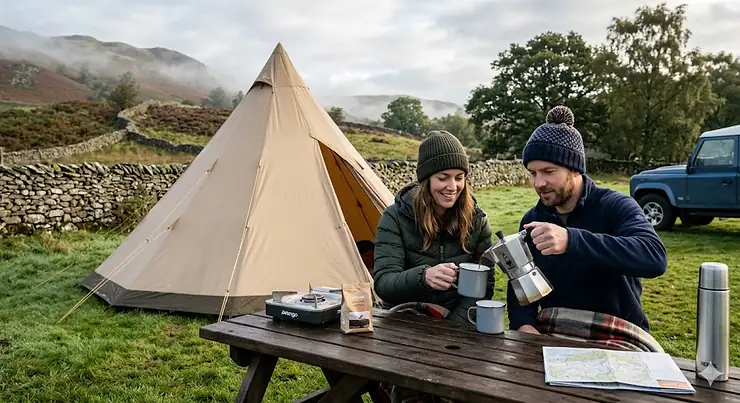
You’ve dragged yourself out of a slightly damp sleeping bag at half six. The Peak District is doing its best impression of a grey flannel blanket. Your tent pegs are still holding, just about. And somewhere in your rucksack is a small device that — if you’ve planned well — is about to make the next twenty minutes genuinely rather excellent.
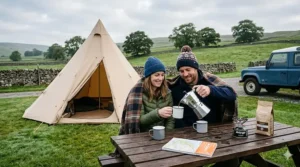
That’s the thing about camping coffee makers. In the context of British outdoor life, they aren’t a luxury. They’re morale. And with the UK camping scene growing year on year — The Guardian notes that domestic camping has seen a sustained surge since 2020, with millions of Brits swapping the Costa del Sol for the Cairngorms — getting your morning brew sorted properly has never mattered more.
So what exactly are camping coffee makers? Put simply, they’re compact brewing systems designed to produce decent coffee without mains electricity, a kitchen worktop, or anything that resembles a civilised setup. The best ones weigh under 400 grams, survive being hurled into a rucksack repeatedly, and still manage to produce something you’d actually choose to drink. They range from manual espresso machines barely larger than a hip flask to insulated French press pots that double as cooking vessels — and in 2026, the category has never been better.
This guide covers seven of the best camping coffee makers currently available on Amazon.co.uk, with real-world analysis, UK-specific advice, and a frank opinion on what’s actually worth your money.
Quick Comparison: 7 Best Camping Coffee Makers at a Glance
| Product | Type | Weight | Capacity | Price Range | Best For |
|---|---|---|---|---|---|
| AeroPress Go | Pressure/pour-over hybrid | ~211g | ~235ml | £30–£40 | Solo all-rounders |
| WACACO Nanopresso | Manual espresso | ~336g | 80ml shot | £55–£70 | Espresso purists |
| OutIn Nano | Electric self-heating espresso | ~370g | 50ml shot | £65–£85 | Tech-forward campers |
| Bialetti Moka Express (3-cup) | Stovetop espresso | ~320g | ~150ml | £15–£25 | Budget car campers |
| GSI Outdoors Commuter JavaPress | French press mug | ~316g | ~443ml | £25–£35 | Everyday hikers |
| GSI Outdoors Ultralight Java Drip | Pour-over dripper | ~11g | 1 cup | £8–£15 | Ultralight backpackers |
| Stanley Classic Stay-Hot French Press (32oz) | Insulated French press | ~680g | ~950ml | £40–£60 | Groups & car campers |
The table above tells you what each maker is — but not whether it belongs in your pack. The AeroPress Go and GSI Java Drip sit at opposite ends of the weight spectrum yet both produce excellent results; the real question is how many people you’re caffeinating and how many grams you can spare. The OutIn Nano is the only battery-powered option here, which matters enormously once you’re off-grid on a three-night wild camp.
💬 Just one click — help others make better buying decisions too! 😊
✨ Don’t Miss These Exclusive Deals!
🔍 Take your outdoor coffee ritual to the next level with these carefully chosen picks. Click any highlighted product to check current pricing and availability on Amazon.co.uk — and find exactly what your next adventure needs!
Top 7 Camping Coffee Makers: Expert Analysis
1. AeroPress Go — The Swiss Army Knife of Camp Coffee
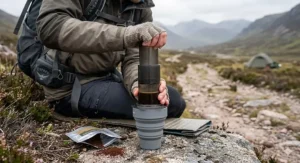
The AeroPress Go is, frankly, the easiest recommendation in this entire guide. It combines pressure extraction, immersion steeping, and pour-over technique into one compact system that weighs about the same as a large apple. In under two minutes, it produces a cup that’s rich, smooth, and conspicuously free of bitterness — the last quality being one that lesser camping coffees singularly fail to deliver.
The real-world meaning of those specs: the ~211g body and its nesting mug tuck into the top pouch of most 35-litre packs without drama. One hundred biodegradable micro-filters are included, which is thoughtful for UK campers given how many sites now ask you to leave no trace. The plastic components are BPA-free and, based on years of reported use, essentially indestructible.
What most British buyers overlook is how well the AeroPress handles the UK’s variable water quality. Unlike a Moka pot that requires finely ground coffee to work properly, the AeroPress is forgiving across grind sizes — coarser grinds give a cleaner result similar to pour-over; finer grinds push you towards espresso territory. Pack a small hand grinder alongside it and you’ll be happier than you have any right to be at a muddy campsite in North Wales.
UK reviewers on Amazon.co.uk consistently praise its versatility and the quality of the coffee relative to the price. The minor niggles — the mug cools quickly in cold weather, being uninsulated — are real but manageable with a decent camp mug.
✅ Versatile brewing styles (espresso, Americano, cold brew)
✅ Biodegradable filters — ideal for Leave No Trace camping
✅ Virtually unbreakable plastic construction
❌ Supplied mug loses heat quickly in British autumnal conditions
❌ Requires a separate vessel to boil water
Price range: £30–£40. Outstanding value — possibly the single best pound-for-pound camping coffee maker available in the UK.
2. WACACO Nanopresso — Proper Espresso, No Plug Required
There’s something deeply satisfying about producing a genuine crema-topped espresso in the middle of a field, entirely by hand, while it is absolutely pouring down outside. The WACACO Nanopresso makes this possible. It operates via a hand-pumped piston system that generates up to 18 bar of pressure — the same ballpark as a decent home machine — without requiring so much as a single AA battery.
The practical upshot: 18 bar pressure means proper espresso, not just strong coffee. Real crema. Real extraction. At around 336g, it’s heavier than the AeroPress but smaller than a pint glass, and it fits neatly into most hip-belt pockets. It accepts finely ground coffee directly (an NS Adapter is available separately for Nespresso-compatible capsules), which gives you flexibility depending on your setup.
This is the one to choose if espresso is non-negotiable — if the thought of a drip filter makes you wince, or if your camping companion is the sort of person who winces at the thought of a drip filter. UK reviewers note that it performs well through repeated use, though a few have mentioned cosmetic staining from spills on the outer casing. Worth wiping down promptly after each use.
The Nanopresso requires a bit of practice to master the pumping action consistently. Give it three or four uses and it becomes second nature. It’s not for the camper who wants a no-fuss morning routine, but for the espresso enthusiast who considers the ritual as important as the result.
✅ Genuine 18-bar espresso pressure — real crema, real extraction
✅ No batteries or electricity needed
✅ Compatible with optional Nespresso capsule adapter
❌ Requires finely ground coffee and a firm tamping technique
❌ Learning curve — three or four uses before you dial it in
Price range: £55–£70. The most capable manual espresso option currently on Amazon.co.uk.
3. OutIn Nano — The Battery-Powered Breakthrough
The OutIn Nano changes the equation entirely. It’s the first camping espresso machine on this list that heats its own water — no stove needed, no kettle, just the device itself and a USB-C charge. Three built-in lithium cells (3×2500mAh) heat 50ml of water from room temperature to approximately 92°C in around three to four minutes, then push it through at 20-bar pressure to produce a proper espresso shot.
What this means in practice is considerable. You can make espresso from inside a tent at 5am, in the back of a campervan parked at a beauty spot, or at a summit shelter waiting out a Lake District drizzle — all without lighting a stove. The IPX6 waterproofing rating is particularly relevant in the UK; this thing can tolerate being used in damp conditions without flinching.
Battery life delivers approximately five shots from room-temperature water on a single charge, or substantially more if you’re using pre-boiled water. Car charging via 12V/24V adapter is supported, which makes it an excellent companion for motorhome and campervan users. UK reviewers on Amazon.co.uk have been effusive — one noted it as more consistent than setups costing many times the price.
The honest caveat: it produces a single espresso shot at a time, and recharging mid-camp requires either a power bank or a 12V socket. For a couple who both want a morning coffee, that’s two sequential waits. Fine for most people, faintly irritating for a few.
✅ Fully self-heating — no stove, no kettle required
✅ IPX6 waterproof rating — genuinely outdoor-ready
✅ USB-C and 12V/24V car charging compatible
❌ One shot per charge cycle (approx. five shots per full charge)
❌ Slightly bulkier and heavier than manual alternatives
Price range: £65–£85. Premium pricing for a genuinely innovative device — worth every penny for the electrically-minded camper.
4. Bialetti Moka Express (3-Cup) — The Unimprovable Classic
The Moka pot was patented by Alfonso Bialetti in 1933. Ninety-three years later, the Bialetti Moka Express remains essentially unchanged — and the reason for that is the same reason vintage Land Rovers still appear in farmer’s fields: when something works, you don’t tinker with it. The Moka Express forces pressurised steam through finely ground coffee and into an upper chamber, producing a strong, full-bodied brew that sits somewhere between espresso and drip coffee in intensity.
The 3-cup model is the sweet spot for UK camping: light enough to carry (around 320g), capable enough to produce two proper mugs of strong coffee per cycle. It works beautifully on a gas camping stove and most spirit stoves — though note that the standard aluminium version is not induction-compatible without an adapter, which matters if you’ve got one of the newer induction-capable camping stoves.
This is the camping coffee maker for car campers who like strong coffee and dislike anything that feels overly fiddly. Set it on the stove, go and sort your guy ropes, come back to coffee. It requires finely ground coffee (not all pre-ground supermarket coffee is ground fine enough, so bear that in mind), but at a price of around £15–£25, it leaves enough in your budget to invest in a proper grinder.
UK reviewers reliably mention its robustness — the aluminium body takes knocks without complaint, making it a rather different proposition from the fragile glassware typically used in a home cafetière.
✅ Extremely low price — best budget option on this list
✅ Robust aluminium construction, effectively indestructible
✅ Produces intense, full-bodied coffee with zero electricity
❌ Not induction-compatible without a separate adapter
❌ Requires genuinely fine-ground coffee for best results
Price range: £15–£25 (3-cup). Remarkable value — a strong contender for the most coffee per pound spent.
5. GSI Outdoors Commuter JavaPress — The Clever French Press
The GSI Outdoors Commuter JavaPress solves a genuine problem: how to brew a generous mug of French press coffee without a separate press, a separate mug, and the usual faff of transferring hot liquid between containers. The answer is an inner sleeve that replaces the traditional plunger rod entirely — push it down, it presses the grounds, then stays in place as a second insulating wall. It’s a quietly brilliant piece of design.
The 443ml capacity produces one very large mug or two smaller ones — appropriate for a solo camper who drinks a lot of coffee, or a couple sharing a morning. The BPA-free copolyester body is shatter-resistant, which matters more than you’d expect once you’ve watched a glass French press explode on a rocky campsite (an experience that tends to cure you of glass-based outdoor cookware permanently).
The nylon-wrapped insulated sleeve keeps coffee reasonably warm during the brewing process, which is genuinely useful in British spring and autumn mornings where ambient temperatures can kill an uninsulated cup in short order. Weighing around 316g, it’s competitive with the other manual options here.
This is the one for campers who genuinely enjoy the French press flavour profile — a full-bodied, slightly oily cup with more texture than a filtered brew — and want to replicate it without compromise outdoors. It’s not for ultralight backpackers (the AeroPress Go or Java Drip are better there), but for weekend wild campers and festival-goers, it earns its place.
✅ All-in-one press and mug design — no extra vessels needed
✅ Shatter-resistant construction — survives the inevitable drop
✅ Insulated sleeve keeps coffee warmer for longer
❌ Not ideal for groups — capacity limited to one large mug
❌ Coarser grind required; not suitable for espresso-style coffee
Price range: £25–£35. A smart, genuinely original design that outperforms its modest price.
6. GSI Outdoors Ultralight Java Drip — The Backpacker’s Secret Weapon
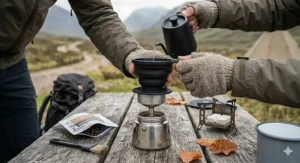
Eleven grams. That’s the weight of the GSI Outdoors Ultralight Java Drip. For context, a standard car key weighs about the same. Yet unfold its three clip-on nylon legs, attach them to your mug, drop in some medium-ground coffee, and pour hot water through — and you get a clean, bright, genuinely good cup of pour-over coffee in roughly three minutes. No filters required (the built-in nylon mesh does the job), no fuss, and no meaningful impact on your pack weight.
The Ultralight Java Drip is the purist’s choice for anyone counting grams. It collapses flat to a size barely larger than a credit card, stuffs into a hip-belt pocket, and works with any standard mug or wide-mouth water bottle. The brewing method — slow pour-over — rewards a little patience but produces a notably clean cup, free of the sediment you sometimes encounter with French press methods.
The honest trade-off: it produces only one cup at a time, it requires boiling water separately, and the legs can feel slightly imprecise when attaching to mugs with unusual rim profiles. None of these are dealbreakers for the dedicated ultralight packer, but they’re worth knowing.
For backpackers tackling long-distance routes — the West Highland Way, Hadrian’s Wall Path, or the Pennine Way — this is the obvious choice. It adds essentially nothing to your load while meaningfully improving your mornings.
✅ Virtually weightless — 11g including the mesh filter
✅ Collapses completely flat; disappears into any pack
✅ Produces a clean, bright cup of pour-over coffee
❌ One cup at a time only — slow for groups
❌ Legs can feel slightly unstable on awkward mug profiles
Price range: £8–£15. The least expensive option here, and arguably the most elegant solution for backpackers.
7. Stanley Classic Stay-Hot French Press (32oz) — The Camp Coffee Workhorse
Some camping coffee makers are designed for one person and their minimalist soul. The Stanley Classic Stay-Hot French Press is designed for four people who want proper coffee before they’ve properly woken up. Its 32oz (950ml) stainless steel body brews enough for a solid round, keeps it hot for four hours thanks to vacuum insulation, and takes the sort of physical punishment that one expects at a British campsite — mud, gravel, accidental drops, and being sat on at least once per trip.
The 18/8 stainless steel build means no glass to shatter and no rust to worry about through six months of British damp. The folding handles are a smart detail — they press flush against the body for packing, reducing the footprint significantly. Boiling water on a camp stove and pouring it in takes five minutes; the mesh plunger filter keeps grounds separated reasonably well, though a few UK reviewers note some fine sediment slips through.
This is the camping coffee maker for car campers and motorhome users who prioritise volume and convenience over weight savings. A family camped in the Lake District, a group of friends at a music festival in a Somerset field, a couple who drink a lot of coffee and want to do it properly — for all of these, the Stanley earns its place in the boot. At around 680g, it’s the heaviest option here by some margin, which is only relevant if you’re actually carrying it on your back (in which case, don’t).
✅ Generous 32oz capacity — genuinely serves a group
✅ 4-hour heat retention — coffee stays hot through a slow morning
✅ Near-indestructible stainless steel build
❌ At ~680g, too heavy for backpacking use
❌ Fine sediment can occasionally pass through the mesh filter
Price range: £40–£60 (32oz). The best group camping coffee maker on this list — buy once, use for years.
From Tent to Cup: Mastering Outdoor Coffee Brewing in the British Countryside
Even the best camping coffee maker produces disappointing results without a little know-how. The single most important variable — and the one most often ignored — is water temperature. Unlike at home, where your kettle reliably hits 100°C, a camping stove in a gale is a more unpredictable beast. For pour-over and AeroPress brewing, 92–96°C is ideal; fully boiling water can produce bitter results. Remove your kettle from the heat and wait forty-five seconds before pouring.
Water quality matters significantly on the road. UK tap water varies enormously by region — London water is notoriously hard, which can flatten coffee flavours; Scottish highland water, by contrast, is beautifully soft and tends to produce brighter, more nuanced cups. If you’re wild camping in remote areas and treating water before use, note that heavily chlorinated treatment tablets can affect flavour; a brief boil usually drives off residual chlorine.
Grind fresh where possible. A small hand grinder — a Hario Mini Mill or similar — weighs around 100–200g and transforms the quality of any brewing method. Pre-ground coffee begins oxidising within about fifteen minutes of grinding; on a multi-day trip, the difference between freshly ground and pre-ground beans is conspicuous. Store whole beans in a small sealed container, grind each morning, and you’ll wonder how you ever settled for anything less.
In cold and damp British conditions, pre-warm your mug with a splash of boiling water before brewing. It sounds fussy. It’s actually the difference between a coffee that stays at a good temperature for ten minutes and one that’s lukewarm before you’ve left the tent.
UK Camping Coffee Profiles: Which Maker Is Right for You?
The solo backpacker on a long-distance route — Hadrian’s Wall Path, the South Downs Way, or the West Highland Way — needs something that adds essentially nothing to their pack. The GSI Outdoors Ultralight Java Drip at 11g is the obvious answer, or the AeroPress Go for someone who values brewing versatility over pure weight savings. Neither will disappoint; both will feel disproportionately impressive in context.
The espresso-obsessed couple on a glamping weekend in the Cotswolds or Brecon Beacons deserves either the WACACO Nanopresso (if they enjoy the ritual of manually pumping a proper shot) or the OutIn Nano (if they’d rather press a button while still half-asleep in a shepherd’s hut). Both produce genuine espresso. The OutIn asks nothing of you; the Nanopresso asks for a bit of technique in exchange for a slightly more satisfying experience.
The family of four at a Peak District campsite, catering to children on hot chocolate and adults desperately in need of caffeine, will be best served by the Stanley Classic Stay-Hot French Press. Its capacity, heat retention, and near-indestructibility make it the most practical choice when children are involved — and when “the kids knocked over the coffee again” is a sentence you need to survive with dignity.
The festival regular — Leeds, Glastonbury, Green Man, pick your muddy field — needs something compact and low-maintenance. The Bialetti Moka Express runs on a gas canister stove, weighs almost nothing, and produces strong coffee that feels like a significant achievement at 8am surrounded by a field of questionable humanity.
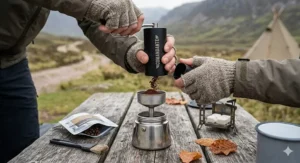
How to Choose Camping Coffee Makers in the UK
Choosing the right camping coffee maker isn’t complicated, but it does require a clear-eyed assessment of what you actually need. The consumer advice team at Which? consistently advises matching outdoor gear to specific use cases rather than buying the most impressive-sounding option — and with camping coffee makers, this is exactly right.
- Start with weight constraints. Backpacking? Nothing above 250g. Car camping? Weight is irrelevant — prioritise capacity instead.
- Consider your brewing style. If you drink espresso at home, you’ll want espresso camping. If you drink filter coffee, the AeroPress or Java Drip will feel immediately familiar.
- Count the people. One person: almost anything works. Two to three people: French press or AeroPress with multiple pressings. Four or more: Stanley or similar large-capacity press.
- Think about your power situation. Wild camping with no electricity? Avoid the OutIn Nano unless you’ve got a large power bank. Car camping or motorhome? The OutIn becomes very appealing.
- Factor in the faff threshold. At 6am on a cold October morning in Snowdonia, how much patience do you actually have? Honest answer: not much. The simpler the device, the more you’ll use it.
- Budget realistically. The Bialetti at £15–£25 produces stronger coffee than devices costing five times as much. Spending more buys portability, versatility, and espresso pressure — not necessarily better flavour.
- Check stove compatibility. Moka pots don’t work on induction without an adapter. AeroPress and manual espresso makers need separate boiling. Factor this into your overall camp kitchen setup.
Common Mistakes When Buying Camping Coffee Makers
The single most common mistake British buyers make is assuming that any portable coffee maker will work with their existing camp stove setup without checking. The Bialetti Moka Express, for instance, requires a gas or spirit stove — it is incompatible with induction without an adapter. If your camping kitchen runs on an induction hob (increasingly common in motorhomes and campervans), this matters.
Second: buying solely on Amazon ratings without reading UK-specific reviews. The Amazon star rating system aggregates reviews globally, and a product lauded by American reviewers camping in dry Colorado heat may behave differently during a three-day drizzle in the Yorkshire Dales. Look specifically for reviews from British buyers — they’ll tell you how it handles moisture, cool temperatures, and the particular psychological requirements of the British outdoor experience.
Third: ignoring grind compatibility. The Nanopresso and Bialetti Moka Express both require genuinely fine coffee — finer than most pre-ground supermarket coffee. Buying either of these without budgeting for a grinder, or sourcing appropriately ground espresso beans, is a shortcut to disappointment. The AeroPress Go, by contrast, is remarkably forgiving across grind sizes and is therefore significantly more beginner-friendly.
Finally: underestimating cleaning requirements. A camping coffee maker that takes fifteen minutes to clean properly will quickly get cleaned badly and eventually not at all. The AeroPress Go and GSI Java Drip clean in seconds; the Nanopresso requires slightly more attention; the Bialetti Moka should be rinsed and dried promptly to prevent oxidation of the aluminium body.
Camping Coffee Makers vs Traditional Alternatives: The Honest Verdict
| Method | Setup Required | Typical Weight | Coffee Quality | Best For |
|---|---|---|---|---|
| Camping coffee maker (AeroPress etc.) | Minimal | 100–700g | Excellent | Most campers |
| Instant coffee sachets | None | ~5g per sachet | Poor–Acceptable | True emergencies only |
| Percolator pot | Camp stove | 500g+ | Good–Variable | Groups, traditionalists |
| Coffee bags | None | ~5g per bag | Fair | Ultralight, no compromise |
| Stovetop espresso (Moka) | Gas stove | ~320g | Very Good | Budget espresso lovers |
The comparison above confirms what most experienced campers already know: instant coffee sachets are the nuclear option, deployed only when everything else has gone wrong. Coffee bags — similar to tea bags — have improved markedly in recent years and are worth keeping as an emergency backup, but they can’t match the flavour of any proper brewing method. The percolator pot earns its place for large groups, particularly on multi-night car camping trips where fuel economy and coffee volume both matter.
The dedicated camping coffee makers — AeroPress, French press, Moka pot — win on every quality measure. The gap between an AeroPress cup and a good instant is significant enough to be noticeable even at altitude, even at 6am, even when it is unequivocally, biblically raining.
What to Expect in Wet British Weather (and How to Plan for It)
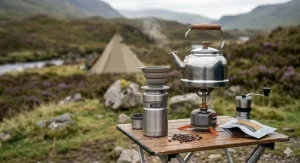
British conditions are particular. This needs to be said plainly: the outdoor coffee experience in the Scottish Highlands in November is a different proposition from a dry June morning in the Cotswolds, and your equipment needs to reflect that.
Manual espresso makers like the Nanopresso lose heat quickly in cold or wet environments. Pre-heat the coffee chamber with a splash of boiling water before loading your grounds — this simple step makes a measurable difference to extraction quality when ambient temperatures are low. The OutIn Nano, being self-contained and self-heating, is actually more consistent in cold conditions than most manual alternatives.
French press coffee makers lose temperature rapidly if the outer vessel is uninsulated. The GSI Commuter JavaPress and Stanley Stay-Hot both address this with insulated construction; the standard Bialetti Moka Express doesn’t — pour immediately after brewing and drink promptly, rather than letting it sit.
The Ramblers Association, which manages and promotes thousands of walking routes across the UK, notes that most serious walkers now plan for year-round conditions on British trails. Your coffee setup should follow the same logic. Keep everything in a waterproof drysack. Store ground coffee in a sealed container — the British damp will stale it faster than you’d expect. And on genuinely cold days, pre-warm your mug first. Always.
Long-Term Cost & Maintenance in the UK
| Product | UK Price Range | Annual Filter Cost | Lifespan Estimate | Cost Per Cup (Est.) |
|---|---|---|---|---|
| AeroPress Go | £30–£40 | ~£5 (350 replacement filters) | 5–10 years | Under £0.05 |
| WACACO Nanopresso | £55–£70 | £0 (no filters) | 5–8 years | Under £0.04 |
| OutIn Nano | £65–£85 | £0 (no filters) | 3–5 years (battery-limited) | Under £0.08 |
| Bialetti Moka Express | £15–£25 | ~£3 (replacement gaskets every 1–2 years) | 10–20+ years | Under £0.03 |
| GSI Commuter JavaPress | £25–£35 | £0 | 4–7 years | Under £0.04 |
| GSI Ultralight Java Drip | £8–£15 | £0 | 3–5 years | Under £0.02 |
| Stanley French Press | £40–£60 | £0 | 10–15 years | Under £0.03 |
The cost-per-cup figures above assume regular use and include the initial purchase price amortised over the product’s lifespan. The Bialetti Moka Express and Stanley French Press both emerge as exceptional long-term value — particularly the Bialetti, which has a plausible lifespan measured in decades rather than years if the rubber gasket (available cheaply in the UK) is replaced occasionally. The OutIn Nano’s battery-limited lifespan is the honest caveat for its premium position; lithium batteries degrade over charging cycles, and by year four or five you may notice a reduction in shots-per-charge.
Replacement parts availability in the UK matters too. Bialetti gaskets and filter plates are widely available. AeroPress filters can be ordered on Amazon.co.uk in bulk. WACACO spare parts are available directly from the brand or via Amazon.co.uk. The Stanley French Press is effectively maintenance-free for its first decade.
Features That Actually Matter (And Those That Don’t)
Actually matters:
- Weight and packed size — not the number on the spec sheet, but whether it fits your actual pack alongside your actual kit
- Stove compatibility — check before buying, not after
- Cleaning simplicity — in the field, you won’t maintain anything complicated for long
- Heat retention — in British conditions, this is the difference between a satisfying cup and a lukewarm regret
Doesn’t matter nearly as much as the marketing implies:
- Bar pressure above 15 — 18-bar vs 20-bar in manual espresso makers is a marginal difference in the field; both produce excellent crema
- The number of included accessories — most camping coffee kits include items you’ll use twice and then leave at home
- Brand colourways — the forest green OutIn Nano and the Bialetti Moka Express produce equally good coffee regardless of which shade best matches your tent
- Compatibility with capsules — convenient, yes; essential, no; the NS adapter for the Nanopresso is a useful add-on, but committing to capsule dependency on a camping trip requires carrying a supply of pods that are slightly at odds with a Leave No Trace ethic
The Buyer’s Decision Framework
If any of the following descriptions sounds like you, here’s the short answer:
- “I’m backpacking solo and every gram matters” → GSI Ultralight Java Drip. Nothing else comes close at that weight.
- “I’m backpacking solo and I want the best coffee I can reasonably carry” → AeroPress Go. Every time.
- “I want proper espresso and I don’t mind a bit of technique” → WACACO Nanopresso.
- “I want proper espresso and I want to press a button” → OutIn Nano.
- “I’m car camping with a family and I need volume” → Stanley Classic Stay-Hot French Press.
- “I want strong coffee for £20 and I already have a gas stove” → Bialetti Moka Express (3-cup), no contest.
- “I’m a couple going camping for a weekend” → GSI Commuter JavaPress or AeroPress Go, depending on whether you prefer French press or filtered coffee at home.
Frequently Asked Questions About Camping Coffee Makers in the UK
❓ What is the best camping coffee maker for backpacking in the UK?
❓ Can I use a Moka pot on a camping stove in the UK?
❓ Are camping espresso makers available on Amazon.co.uk with Prime delivery?
❓ How do I clean a camping coffee maker after use without a kitchen sink?
❓ Do camping coffee makers work well in cold British weather?
Conclusion: Your Next Outdoor Morning Is About to Get Significantly Better
The right camping coffee maker is, by an honest measure, one of the best investments you can make in your outdoor life. Not because it’s technically impressive (though several of these are), but because a genuinely good coffee at 7am in a wet and beautiful British landscape is one of those small, disproportionately meaningful pleasures that makes you glad you made the effort to leave your comfortable sofa in the first place.
If you’re buying nothing else from this guide: the AeroPress Go is the most reliable single recommendation for the majority of British campers. It’s versatile, it’s forgiving, it produces excellent coffee, and it costs around £30–£40. For espresso enthusiasts, the Nanopresso earns serious respect. For ultralight backpackers, the Java Drip is almost absurdly good for its price. And for anyone feeding a group before the day starts properly, the Stanley Stay-Hot French Press is the quiet workhorse you’ll use on every trip for the next decade.
Whatever you choose, buy once and buy well. The UK outdoors is too good to be experienced with mediocre coffee.
✨ Don’t Miss These Exclusive Deals!
🔍 Click any highlighted product name in this guide to check current pricing and availability on Amazon.co.uk. These carefully selected picks are the best available for UK buyers right now — find your perfect outdoor brew and make your next camping trip the one you’ll actually remember.
Recommended for You
- Best Camping Ovens UK 2026: 7 Expert Picks for Outdoor Baking
- Best Camping Toasters UK 2026: 7 Expert-Tested Options
- Best Melamine Camping Dinnerware Sets UK 2026: 7 Shatterproof Picks
Disclaimer: This article contains affiliate links. As an Amazon Associate, I earn from qualifying purchases. If you purchase products through these links, we may earn a small commission at no additional cost to you.
✨ Found this helpful? Share it with your mates! 💬🤗
