
In This Article
There’s a particular kind of misery that only British campers truly understand. It’s day two at a muddy field somewhere in Somerset. The sun has — bafflingly — appeared. You reach into your cool box expecting a cold drink and find instead a lukewarm soup of melted ice, soggy crisps, and what was formerly cheese. Sound familiar? A good cool box doesn’t just keep things cold. It’s the difference between a genuinely enjoyable trip and a slow-motion food safety disaster with camping chairs.

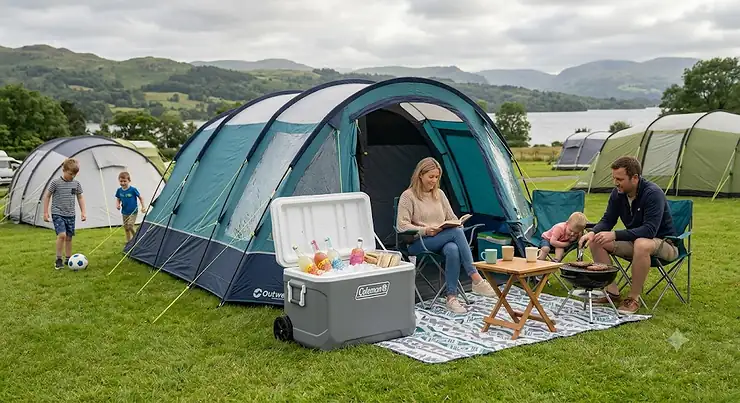
Coleman cool box review searches spike every spring for a reason: after more than 120 years in the outdoor equipment business, Coleman remains the benchmark against which every rival is quietly measured. Their cool boxes — particularly the Xtreme and Convoy ranges — have earned genuine cult status on British campsites, festival fields, and pebbly beaches from Cornwall to the Cairngorms. But which Coleman cool box is actually right for you? The answer depends enormously on how many people you’re feeding, how long you’re away, whether you’re dragging it across a Glastonbury field or lifting it into a Honda CR-V’s boot.
This Coleman cool box review covers seven models available on Amazon.co.uk right now, tested and analysed for real British conditions — which is to say, ambient temperatures that rarely hit 30°C but often hit “unexpectedly warm for a Tuesday.” We’ll tell you which one earns its space in the boot, which handles the typical British weekend trip with quiet authority, and which one you should skip entirely.
Quick Comparison Table: Coleman Cool Boxes at a Glance (UK 2026)
| Model | Capacity | Ice Retention | Wheels | Price Range | Best For |
|---|---|---|---|---|---|
| Coleman Xtreme 50QT Wheeled | 47L | Up to 5 days | ✅ Yes | £90–£110 | Families, festivals |
| Coleman Xtreme 70QT | 66L | Up to 5 days | ❌ No | £100–£130 | Large groups, long trips |
| Coleman Convoy 28QT | 29L | Up to 3 days | ❌ No | £75–£95 | Couples, weekend trips |
| Coleman PRO 45QT | 42.5L | Up to 4 days | ❌ No | £170–£210 | Serious campers, heavy use |
| Coleman Xtreme Marine 28QT | 26L | Up to 2 days | ❌ No | £50–£70 | Day trips, beach, fishing |
| Coleman Xtreme 52QT | 48L | Up to 4 days | ❌ No | £85–£105 | Car camping, weekend |
| Coleman Convoy Heavy-Duty | 47L+ | Up to 5 days | ✅ Yes | £120–£160 | Rugged outdoor, worksites |
The table above makes one thing immediately obvious: Coleman’s sweet spot for most UK buyers sits in the £90–£130 range, where you get genuinely impressive ice retention without paying YETI money. The wheeled models earn their keep on campsite gravel and festival walkways; the non-wheeled options tend to be lighter and suit those who prioritise car boot efficiency over rolling convenience. If you’re stuck between the 50QT and 70QT, read the product sections carefully — capacity difference is meaningful, but so is the weight penalty.
💬 Just one click — help others make better buying decisions too! 😊
✨ Don’t Miss These Exclusive Deals!
🔍 Take your outdoor adventures to the next level with these carefully selected Coleman cool boxes. Click on any highlighted item to check current pricing and availability on Amazon.co.uk. Find exactly the model your trip deserves!
Top 7 Coleman Cool Boxes: Expert Analysis for UK Buyers
1. Coleman Xtreme 50QT Wheeled Cool Box — The Nation’s Favourite for Good Reason
The 50QT Wheeled Xtreme is, without question, the cool box that most UK campers should buy. It’s not the flashiest, nor the most expensive — but with a 47-litre capacity, up to five days of ice retention, four lid-mounted cup holders, and a telescoping steel handle on all-terrain wheels, it quietly solves every problem a family of four will encounter over a long weekend in Wales.
The polyurethane foam insulation is injected directly into the HDPE casing with no air gaps — Coleman’s approach here differs from cheaper rivals that use loose polystyrene, which leaves thermal weak spots. In British summer conditions (typically 20–27°C, rather than the scorching heat Coleman’s five-day claim is calibrated against), expect performance that meets or exceeds the stated ice retention. A UK reviewer noted it kept contents cold during an entire five-day stint at Glastonbury, which is about as real-world a torture test as you can run. The lid holds up to 113 kg — useful as impromptu seating when the camping chairs are occupied.
What most buyers overlook: the wheels genuinely cope with festival gravel and campsite paths, but on soft, wet grass (which is, let’s be honest, Britain’s default terrain) they’re less helpful. Plan on carrying it for the last stretch to your pitch. Available on Amazon.co.uk, Prime-eligible.
✅ Five-day ice retention confirmed by UK users
✅ 84-can capacity, holds 2-litre bottles upright
✅ Robust HDPE construction built to outlast several summer seasons
❌ Wheels struggle on soft or waterlogged ground
❌ Limited colour options on Amazon UK (primarily black)
Price range: around £90–£110 — exceptional value for the performance delivered.
2. Coleman Xtreme 70QT Cool Box — When Size Genuinely Matters
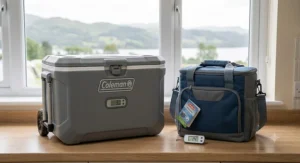
Step up to the 70QT and you step up to 66 litres of cold storage — roughly the equivalent of a large kitchen mixing bowl’s worth of extra space compared to the 50QT. That might not sound dramatic, but for a family of five or six heading to a week-long summer campsite with a roof tent and ambitions to avoid the camp shop entirely, it’s the difference between comfort and constant compromise.
The insulation system is identical to the 50QT: thick injected PU foam in both the lid and walls, with HDPE construction inside and out. At 8.9 kg empty, it’s noticeably heavier than its wheeled sibling, and without wheels this becomes relevant once you load it up with ice and provisions — expect 15–20 kg loaded, which is a two-person lift on any serious terrain. The lid-as-seat function supports the same 113 kg limit, the cup holders are present, and the drain valve means you’re not tipping half a litre of cold water over your trainers at pack-up time.
This is the model for larger families or anyone supplying a base camp for an extended trip. UK camping platform TentLife, which tested Coleman Xtreme models across multiple summer trips, found the 70QT ideally suited to larger families managing meal planning across multiple days without resupply runs — a genuine quality-of-life improvement when you’re based somewhere remote.
✅ 66L capacity — ample for week-long family trips
✅ Full PU foam insulation including lid, up to five days retention
✅ Strong, sit-on lid; practical drain plug
❌ Heavy at 8.9 kg empty — you’ll want two people for serious lifting
❌ No wheels — significant consideration for longer carries
Price range: around £100–£130, depending on retailer.
3. Coleman 28QT Convoy Cool Box — The Weekend Essential That Delivers Quietly
The Convoy 28QT is a different beast from the Xtreme range, and it’s worth understanding the distinction clearly. Where the Xtreme relies on injected foam insulation in a classic design, the Convoy brings a deliberately more rugged sensibility: thick rubber latches, rust-resistant hinges, a nylon rope handle, antibacterial interior liner, and a rotomoulded polyurethane foam construction that feels genuinely indestructible.
At 29 litres, it’s the right size for a couple heading out Friday to Sunday, or a solo adventurer with ambitions above a single-day trip. T3’s reviewer filled the Convoy with 16 canned drinks, a pint of milk, and a dozen slim ice packs and left it sealed for 67 hours — nearly three full days — and found the drinks still acceptably cold and the milk still fresh for a cup of tea. That’s the benchmark for a British summer weekend trip, and the Convoy meets it comfortably. The injection-moulded lid supports considerable weight as a seat, and everything from hinges to latches has been overengineered relative to the price point.
The design is deliberately utilitarian — grey and scratchy rather than fashionable — but for campers who regard cool boxes as tools rather than lifestyle accessories, that’s entirely beside the point. Available on Amazon.co.uk in the £75–£95 range; Prime next-day delivery available.
✅ Tough rubber latches and rust-resistant hinges — built for repeated use
✅ Antibacterial liner — proper hygiene for food storage
✅ Compact enough for smaller cars and solo trips
❌ 29L won’t stretch beyond a weekend for families
❌ Plain aesthetics — won’t win any style awards
Price range: £75–£95 — well priced for the build quality on offer.
4. Coleman PRO 45QT Cool Box — The Serious Camper’s Workhorse
The Coleman PRO range represents a step up in build ambition: this is the model Coleman introduced for buyers who’ve outgrown the Xtreme’s relatively basic design but can’t quite justify (or simply don’t want to justify) paying YETI prices. At 42.5 litres with up to four days of ice retention and a dual-person carrying strap, it balances genuine performance with practical real-world features.
T3’s reviewer, who tested the PRO 45QT on a three-day, four-person camping trip in Wales at around 27°C, reported it performed admirably even when loaded with more food and drink than ideal ice ratios would strictly permit. The PRO’s full foam insulation — with the insulated lid contributing meaningfully to cold retention — makes it meaningfully better-sealed than the standard Xtreme when you’re talking about ambient temperatures on a particularly warm British afternoon. The drain plug is well-designed: easy to open with one hand, positioned to empty the box without gymnastics.
The PRO sits around £170–£210 in the UK market, which places it at roughly half the cost of the YETI Roadie 48 — a comparison worth making explicitly, because the performance gap between the two doesn’t justify a £200+ premium for most UK campers who aren’t making ice retention their primary identity.
✅ Superior build quality over the standard Xtreme range
✅ Four-day ice retention verified in real UK conditions
✅ Two-person strap handle — thoughtful for heavier loads
❌ Pricier than the Xtreme — the step-up needs to be worth it for your use case
❌ No wheels — larger loads require more lifting effort
Price range: £170–£210, and at the lower end of that range, genuinely excellent value.
5. Coleman Xtreme Marine 28QT Cool Box — The Beach Day Specialist
The Xtreme Marine range exists for one specific scenario: prolonged sun exposure near water. UVGuard additives in the exterior plastic protect the casing against the yellowing and brittleness that standard cool boxes develop over repeated summers at the seaside. Stainless steel hinges resist the salt air that slowly corrodes standard metal fittings. This is a detail most buyers never notice — until the hinges rust and the lid stops seating properly.
At 26 litres, the Marine 28QT is a day trip cool box first and foremost. It keeps contents cold for up to two days with adequate ice, making it perfect for a full day at the beach, a fishing session, or a picnic that’s running longer than planned. The compact footprint means it fits neatly in the back of a car without sacrificing boot space for everything else. UK buyers near the coast — Cornwall, Norfolk, the Scottish islands — will appreciate the corrosion-resistant design more than most.
It’s not a camping cool box in the multi-day sense, but that’s not what it’s for. For its specific purpose, it’s rather well considered.
✅ UV-resistant lid prevents yellowing and cracking from sun exposure
✅ Stainless steel hinges resist salt corrosion — proper coastal durability
✅ Compact 26L — ideal for day trips, beach sessions, fishing
❌ Two-day ice retention limits it to day trips and short outings
❌ Too small for family camping beyond a single day
Price range: £50–£70 — sharp pricing for a genuine specialist product.
6. Coleman Xtreme 52QT Cool Box — The Practical Middle Ground
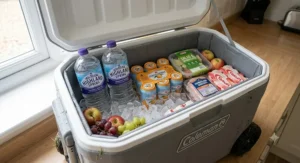
The 52QT occupies a slightly awkward position in the Coleman line-up — it’s larger than the compact Convoy but doesn’t have the 50QT’s wheels. At 48 litres, it sits between the wheeled 50QT and the larger 70QT as a stationary workhorse designed primarily for car camping where the cool box stays in or next to the vehicle.
The PU foam insulation delivers up to four days of cooling, and the external dimensions (70 x 38 x 44 cm) make it one of the more car-boot-friendly shapes in the range — narrower than the wheeled 50QT, which matters when you’re loading a Skoda Octavia already half-full of a tent, sleeping bags, and a portable barbecue. The moulded side handles are comfortable for two-person carries. No wheels, but lighter than the 70QT.
For car campers who park directly at their pitch (common at established UK campsites), the absence of wheels is a reasonable trade for the slightly more manageable footprint. Available on Amazon.co.uk, typically eligible for Prime delivery.
✅ 48L capacity — serious storage without the 70QT’s weight penalty
✅ Narrower footprint suits smaller car boots
✅ Four-day ice retention — sufficient for most weekend trips
❌ No wheels — less portable than the 50QT
❌ A little overshadowed by the 50QT Wheeled for most buyers’ needs
Price range: £85–£105.
7. Coleman Convoy Heavy-Duty Insulated Cool Box — The Rugged Long-Hauler
The larger Convoy model takes everything that works about the 28QT Convoy and scales it up for extended outdoor use and genuinely demanding conditions. Rugged wheels, rope handles, antibacterial liner, and rubber lining around the lid for a tighter cold seal — plus a built-in bottle opener that reveals the beer-centric soul of this design — make this the model aimed at serious campers, caravanners, and anyone whose outdoor life involves conditions that would quickly humble a standard cool box.
Coleman claims up to five days of ice retention, and the rubber lid seal meaningfully contributes to that performance over the Xtreme’s more basic lid design. At around £120–£160 on Amazon.co.uk, it’s priced above the standard Xtreme range but below the PRO — a sensible middle ground for buyers who want heavy-duty construction but find the PRO’s aesthetics too refined for their purposes.
The antibacterial liner is genuinely important for multi-day food storage: it’s not a marketing detail but a practical feature that matters when meat and dairy are sitting in a cool box for four-plus days. UK buyers heading to more remote campsites without easy shop access will understand the value immediately.
✅ Heavy-duty construction with rubber lid seal for superior cold retention
✅ Antibacterial liner — essential for serious food storage
✅ Built-in bottle opener is a small but dearly appreciated detail
❌ Heavier than the standard Xtreme range — not for minimal-kit trips
❌ Price premium over Xtreme requires justification if your use case is modest
Price range: £120–£160.
How to Get the Best Performance From Your Coleman Cool Box
A cool box performs exactly as well as you let it. Coleman’s five-day ice retention claim comes with an asterisk the size of a tent peg: it assumes you’ve done the groundwork. Here’s what makes the practical difference in British conditions.
Pre-chill the box before use. An empty cool box at room temperature (typically 18–20°C in a British house) will immediately begin warming your ice when you load it. Put a sacrificial bag of ice in the night before your trip, drain it in the morning, then load your actual provisions. This one step alone can add half a day or more to your effective cooling period.
The 2:1 ice ratio is real, but flexible. Coleman’s recommendation of roughly 0.4 kg of ice per litre of capacity is aggressive for most buyers. A pragmatic approach for a weekend trip is to pack the bottom layer with ice, add food and drink, then pack another ice layer on top. Cold air falls; warm air rises. Ice on top is more efficient than ice on the bottom.
Keep the box in the shade. This sounds obvious and yet, on every British campsite in July, you’ll see cool boxes sitting in direct sunlight on someone’s picnic table. A shaded cool box can maintain temperature 30–40% longer than one in direct sun — a meaningful difference on a warm afternoon. Under a groundsheet suspended between tent poles, inside the tent’s outer porch, or in the car with the windows cracked all work.
Resist the urge to open it constantly. Every time the lid opens, you’re exchanging the cold air inside for warm ambient air. Group your access times — morning and evening food prep rather than constant rummaging.
Drain carefully, not enthusiastically. The cold water at the bottom of your cool box is still doing useful work — it’s chilling the food sitting in it. Don’t drain unless the water level is genuinely inconvenient or you’re packing up. When you do drain, do it before the final pack — the drain plug on most Coleman models runs cleanly and quickly with the box slightly tilted.

Real-World UK Scenarios: Which Coleman Cool Box Fits Your Life?
Understanding which model suits you comes down to honest self-assessment about how you actually camp, not how you imagine you do.
The Glastonbury Family. Four people, five days, the logistical ambition of feeding everyone without queuing at the overpriced food stalls every meal. This is exactly the Coleman Xtreme 50QT Wheeled’s territory. The wheels handle the long walk from the car park to your campspot better than any alternative in this price range. Load it the night before with pre-chilled food and a full bag of ice, keep it in shade, and it will see you through the week without drama. Five-day ice retention, 47 litres, £90–£110. The maths works.
The Weekend Couple. Two people, Friday to Sunday, not an enormous amount of gear. The Coleman 28QT Convoy is the answer — compact, indestructible, and genuinely sized for two people’s worth of food and drink without the overkill of a 47-litre box you’ve only half-filled. At under £90, it’s the sort of purchase you make once and keep for a decade.
The Coastal Day-Tripper. Driving to the Pembrokeshire coast, spending the day at a beach, heading home that evening. The Xtreme Marine 28QT’s UV-resistant construction and salt-resistant hinges make more sense here than any standard Xtreme model — prolonged sun and sea air are exactly the conditions where the Marine’s specific features earn their keep. At around £50–£70, it’s the lowest commitment entry point in the range.
The Serious Camper. Someone who takes extended trips to more remote locations, cares about food safety seriously, and wants a box that justifies itself over multiple seasons. The Coleman PRO 45QT earns its premium here — tested in Wales at genuine summer temperatures with a full food load, it performed above expectations. Half the cost of a comparable YETI, and built well enough to last.
Passive Cool Box vs Electric Cool Box: What UK Buyers Need to Know
This debate comes up constantly, and it’s worth addressing directly rather than sidestepping it with a vague “it depends.” For most UK buyers in most scenarios, a passive cool box like any model in Coleman’s range is the right choice.
Electric cool boxes — which use a 12V thermoelectric system powered by your car’s cigarette lighter socket or a separate power bank — sound appealing on paper. No ice required, runs continuously, maintains a set temperature. In practice, their performance is considerably more nuanced. Thermoelectric systems (the type found in most consumer-grade electric cool boxes) cool to approximately 20–25°C below ambient temperature — meaning on a 28°C summer afternoon, the interior might reach 3–8°C, which is barely adequate for meat and dairy. They also draw continuously from your vehicle’s battery: overnight use at a campsite without the engine running risks a flat battery by morning.
Compressor-style electric cool boxes — think Dometic or Engel at the higher end — do genuinely refrigerate to set temperatures regardless of ambient heat, but cost significantly more (£300–£800+) and weigh considerably more than a passive Coleman. For the vast majority of British campers who are away for two to five days and have reliable access to bagged ice at a local shop or campsite reception, a Coleman Xtreme or Convoy is simply the more practical tool.
The Food Standards Agency recommends keeping perishable foods below 5°C — something a well-loaded passive cool box with adequate ice achieves comfortably for several days, and something a cheap thermoelectric box may struggle to guarantee on a warm day.
How to Choose a Coleman Cool Box: 6 Criteria That Actually Matter
- Capacity relative to group size. As a rough guide: 20–30L for one or two people for a weekend; 40–50L for a family of four for up to a week; 60L+ for large groups or extended trips. Don’t oversize significantly — a half-empty cool box with a small amount of ice performs worse than a well-packed, correctly sized one.
- Ice retention vs trip length. Two-day retention (Marine range) suits day trips. Three-day retention (Convoy) suits a standard British weekend. Five-day retention (Xtreme, Convoy Heavy-Duty) suits longer holidays or festivals. There’s no point paying for five-day retention if you’re always home Sunday evening.
- Wheels or no wheels? Wheels add weight and bulk but transform the experience on hard surfaces. If you’re ever pulling it more than 50 metres across a campsite or festival, pay for wheels. If it goes from your car boot to a fixed pitch beside the car, skip them.
- Insulation type. Coleman’s injected PU foam (used across the Xtreme and Convoy ranges) is meaningfully better than the loose polystyrene panels used by cheaper alternatives, because it fills every cavity with no thermal weak spots. This is worth understanding when comparing to budget rivals.
- Construction material and climate resistance. For coastal or wet-weather use (which, in Britain, means most summers), the Marine range’s UV-resistant exterior and stainless steel hinges justify their price. For general use, standard HDPE is robust enough for years of use.
- Budget realism in GBP. Coleman’s sweet spot for UK buyers is £75–£130. Below £70, construction quality tends to deteriorate. Above £200, you’re entering territory where a Coleman PRO justifies itself only for genuinely heavy, sustained use — and above £300, you’re making a YETI-adjacent lifestyle choice rather than a practical one. According to Which?, value for money is consistently the most important purchase factor for UK outdoor equipment buyers, and Coleman performs strongly against this criterion across their range.
Common Mistakes When Buying a Cool Box in the UK
Ignoring the ice requirement. A cool box doesn’t cool — it insulates. Without adequate ice or ice packs, even the best Coleman Xtreme is just a slightly fancier bag. Budget for ice on every trip: a 5 kg bag from a petrol station costs roughly £3–£5 and is essential kit.
Buying too large for your car. The Coleman 70QT’s outer dimensions (79 x 41 x 44 cm) are substantial. Measure your boot before you order. A cool box that only fits in the back seat is a cool box that blocks the rear view mirror and creates a secondary headache.
Underestimating the condensation issue. In Britain’s notably damp climate, the exterior of a cold cool box will accumulate condensation on the outside when ambient humidity is high. This isn’t a fault — it’s physics — but a few minutes of it sitting on a wooden camping table or car boot lining can leave marks. A cheap waterproof mat under the box solves the problem entirely.
Choosing an electric box based on power alone. As noted above, cheap thermoelectric electric cool boxes don’t actually refrigerate — they reduce temperature relative to ambient, which may not be adequate. If you’re considering an electric model, do the temperature arithmetic for your typical conditions, or invest in a compressor-type unit.
Skipping the pre-chill. As covered in the usage guide above, this single mistake probably costs more effective cooling time than any other. Pre-chill your box the night before every trip.
Assuming the five-day claim is unconditional. Coleman’s ice retention figures are measured at high ambient temperatures (32°C) with adequate ice ratios. In milder UK conditions, you may approach or exceed the stated figure — but this is luck, not a guarantee. Plan on 60–70% of the stated maximum for realistic British conditions with typical packing.

FAQ: Coleman Cool Box Questions UK Buyers Ask Most
❓ Are Coleman cool boxes worth the money compared to cheaper alternatives?
❓ How long does a Coleman cool box keep ice in typical UK summer temperatures?
❓ What size Coleman cool box do I need for Glastonbury or a UK festival?
❓ Can I use a Coleman cool box on a boat or near the sea in the UK?
❓ Does Amazon.co.uk offer free delivery on Coleman cool boxes?
Conclusion: The Coleman Cool Box That’s Right for You
After reviewing seven models across Coleman’s UK range, the pattern is clear. For most British buyers — the camping family, the festival-goer, the day-tripper who takes their cold drinks seriously — Coleman’s Xtreme range represents the most sensible, best-value choice available on Amazon.co.uk.
The Coleman Xtreme 50QT Wheeled is the default recommendation: five-day ice retention, wheels that cope with most British terrain, 47 litres of capacity, and a price point that doesn’t require a lengthy internal justification process. If you only read one product section in this Coleman cool box review, let it be that one.
Step down to the Convoy 28QT for weekend couples and solo adventurers who appreciate indestructible construction in a compact format. Step up to the PRO 45QT for serious campers who want meaningfully better build quality and are prepared to pay accordingly. Choose the Marine 28QT if your cool box will spend its summers on the Welsh coast or the Norfolk Broads rather than a field in the Peak District.
Whatever you choose: pre-chill it, pack it well, keep it in the shade, and it will reward you with cold drinks and fresh food through whatever the British summer decides to throw at you — which, if recent years are any guide, could be anything from a biblical downpour to an unexpected heatwave, sometimes within the same afternoon.
✨ Don’t Miss These Exclusive Deals!
🔍 Ready to keep your food and drinks cold all summer? Click any highlighted product name to check current pricing on Amazon.co.uk and get yours delivered — often next day with Prime. These picks are tried, tested, and trusted by UK campers.
Recommended for You
- Best Passive Cool Box UK 2026: 7 Expert Picks Reviewed
- Gas Regulators Camping: 7 Best UK Picks in 2026
- Price Camping Gaz Refills: 7 Best UK Deals to Buy in 2026
Disclaimer: This article contains affiliate links. As an Amazon Associate, I earn from qualifying purchases. If you purchase products through these links, we may earn a small commission at no additional cost to you. Prices quoted are indicative ranges only — check Amazon.co.uk for current pricing as costs change frequently.
✨ Found this helpful? Share it with your mates! 💬🤗
