
In This Article
It’s 2 a.m. The lake is a sheet of black glass, the owl across the water has finally shut up, and your bite alarm has just done what bite alarms do. You want light, and you want it now, without fumbling for a dying USB lamp. That is the old-school promise of a gas lantern for night fishing. In 2026 it deserves testing rather than blind faith.
Let’s be straight about the trade-off. One UK carp site, Fishing Again, points out that LED bivvy lights have largely displaced gas lanterns because they are safer, lighter and simpler. On all three counts, fair enough. Yet a mantle lantern still does things a small LED can’t. It floods a whole swim for cooking and rig-tying, it runs on a cartridge you may already carry for the stove, and it doesn’t sulk when it’s minus two. The glow comes from a gas mantle, a fragile mesh heated until it shines. It’s the same trick that lit Victorian streets.
This guide pulls together manufacturer specs, UK retailer listings and independent reviews for seven real lanterns. It is analysis, not a diary of hands-on testing, and where verified reviews were thin I say so. You’ll also get what most buying guides skip: how to run a bivvy gas lantern without turning your shelter into a hazard, why bivvy ventilation matters more than lumens, and how to find a light that doesn’t spook fish. One rule up front: the lantern lives outside your sleeping space. Always.
Quick Comparison: Gas Lantern for Night Fishing at a Glance
| Lantern | Light output | Weight | Fuel connection | Best For |
|---|---|---|---|---|
| Campingaz Lumostar Plus PZ | 80W, dimmable | ~370g | Easy Clic Plus cartridges | All-round bankside convenience |
| Campingaz Lumogaz Plus | 80W | ~280g | Easy Clic Plus cartridges | Budget buyers |
| Primus EasyLight Duo | Up to 490 lumens | Just under 200g | Duo valve, most valved cartridges | Long burn time |
| Kovea Observer | ~35 lux | ~140–170g | Screw-thread isobutane | Compact value and backup |
| Kovea Premium Titanium Gas Lantern | ~40 lux | ~150g | Screw-thread butane | Corrosion resistance |
| Snow Peak GigaPower Lantern Auto | ~400 lumens (80W) | 128g | Screw-thread isobutane/propane | Premium build, soft light |
| Primus Micron Lantern | 235 lumens (mesh version) | 124g | Screw-thread canisters | No-glass durability |
On paper, the Primus EasyLight Duo has the headline brightness and the widest burn range. The Campingaz Lumostar Plus PZ wins on convenience thanks to piezo ignition and a detachable head. Lux (the Kovea figures) and lumens aren’t directly comparable, so read them as “compact table lamp” versus “swim-wide glow”. Budget buyers should look at the Campingaz Lumogaz Plus and Kovea Observer, but check cartridge compatibility before buying anything.
💬 Just one click — help others make better buying decisions too!😊
Top 7 Gas Lantern for Night Fishing Options: Expert Analysis
1. Campingaz Lumostar Plus PZ — best all-rounder for bankside ease
Piezo ignition and a detachable head turn the fiddliest job, changing a mantle in the dark, into a quick one. The listed output is 80W, with stepless dimming reported from roughly 10W upwards. It weighs about 370g. Fuel runs through the Easy Clic Plus connection, giving around 6h 20min on a CV300 Plus and up to 12h on a CV470 Plus. Consumption is roughly 38g per hour at full whack. In practice, a standard cartridge buys you a long evening at full power, but several nights if you dim it. The globe guard and chain handle suit a brolly spreader or bankstick.
Here’s the catch most listings gloss over. Easy Clic Plus is proprietary, and one UK retailer states plainly that threaded Coleman C500 cartridges won’t fit. You’re committing to Campingaz CV cartridges. For a carp fishing lantern doing “kitchen light” duty, that’s a fair price for convenience.
Model-specific reviews were thin at research time. Across the wider Lumostar family, reviewers praise the brightness, the low dimming and the modest gas use, with occasional complaints about clogging. One buyer of replacement mantles reported fitting this lantern for night fishing and being pleased.
Pros:
- ✅ Piezo ignition and detachable head for quick mantle swaps
- ✅ Wide dimming range stretches cartridge life
- ✅ Globe guard protects glass from bankside knocks
Cons:
- ❌ Locked into Campingaz Easy Clic Plus cartridges
- ❌ Heavier than the screw-thread rivals here
Expect roughly £20–£37 depending on retailer, which makes it strong value if you’re happy inside the Campingaz ecosystem.
2. Campingaz Lumogaz Plus — best budget workhorse
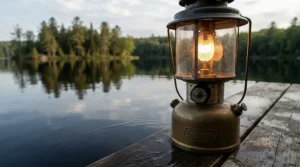
Think of this as the Lumostar’s no-frills sibling. It is simple, light and cheap. The listing gives 80W, about 280g, an integrated hanging and carry handle, a globe guard and the same runtime figures: 6h 20min on a CV300 Plus and 12h on a CV470 Plus. That 280g is roughly 90g lighter than the Campingaz Lumostar Plus PZ. Ounces matter when you’re already barrowing a bivvy, rods and a week’s bait.
The listing I found doesn’t mention piezo ignition, and the “PZ” in the Lumostar’s name is the clue. So assume you’ll need a lighter. For an angler who always has one in the pocket anyway, that is hardly a drama. The same Easy Clic Plus limitation applies, though: Campingaz cartridges only.
I couldn’t verify written reviews for this model, so this verdict rests on specifications and its shared design with the better-documented Campingaz range. Stock also looked patchy at the stockist level, so check availability and mantle compatibility before you commit. Mantles for the wider Campingaz range are sold in packs of three.
Pros:
- ✅ Lighter than the Lumostar at the same 80W rating
- ✅ Integrated handle and globe guard
- ✅ Same long runtime figures on larger cartridges
Cons:
- ❌ No piezo ignition listed, so carry a lighter
- ❌ Patchy stock and no verified reviews found
Expect well under £30 where stocked, which is an honest budget pick if you’re sure about the cartridge system.
3. Primus EasyLight Duo — best long burn time, up to 36 hours
The headline here is the range. Primus quotes 4 to 36 hours, depending on the brightness you dial in. The lantern puts out up to 490 lumens, weighs just under 200g, and has piezo ignition and a burner the maker describes as almost noiseless. The “Duo” valve is the clever bit. It fits most valved cartridges, threaded or not, so one cartridge type can feed both your stove and your lantern.
What does 36 hours actually mean? It means the lowest glow, a reading-light level that could stretch across a long weekend. The 4-hour end is the full-power flood. One UK retailer quotes a narrower 12–24 hour range, so treat the figures as “depends on dial and cartridge size”. For carp work, I’d run it low and keep it as a long burn time lantern rather than a floodlight.
Reviewers on a German outdoor retailer’s page highlight easy brightness adjustment. I couldn’t verify a deep UK review pool.
Pros:
- ✅ Enormous burn range from 4 to 36 hours
- ✅ Duo valve accepts most valved cartridges
- ✅ Piezo ignition with smooth, stepless dimming
Cons:
- ❌ Glass globe needs a protective case in transit
- ❌ Full 490 lumens is far too bright for a quiet swim
Roughly £45–£65 is my reading of UK and European listings, and it’s good value if long burn time is your priority.
4. Kovea Observer — best compact value and backup
Small enough to live in the lid of a tackle box. The Kovea Observer measures about 60 × 60 × 110mm, weighs roughly 140–170g depending on the listing, and has one-touch piezo ignition, a hanging ring and chain, and a plastic carry case. It quotes 35 lux illumination and about 38g of gas per hour. That is the same hourly gas use as the bigger Campingaz lanterns, so you’re getting less light per gram. That makes it a table lamp, not a swim floodlight.
The upside is compatibility. It fits most generic screw-type isobutane cartridges, so the cartridge from your stove will do. As a gas backup for a night session where your main light is an LED, it makes real sense. It uses a small dual-tie mantle, so carry spares.
Ratings on a marketplace listing were positive, but without written reviews I wouldn’t lean on them.
Pros:
- ✅ Fits common screw-thread cartridges
- ✅ Tiny, light and includes a hard case
- ✅ Hanging chain suits a brolly spreader
Cons:
- ❌ Modest 35 lux output
- ❌ Gas use equals bigger lanterns for less light
Expect under £30, which makes it a sensible backup rather than a main light.
5. Kovea Premium Titanium Gas Lantern — best corrosion resistance and bug-proofing
Titanium doesn’t rust, and lakesides are damp, so that matters. The KL-805 combines a titanium body with a wire-frame glass guard. It adds mesh-lined air holes to keep insects and debris out of the nozzle. It offers about 40 lux, runs on screw-type butane, and the related Firefly listing quotes 32g per hour. That is the lowest hourly consumption in this group, so a cartridge should last a little longer than in the Kovea Observer. Weight is roughly 150g. It’s pitched at backpackers, but carp anglers have a different reason to like it: moths and midges swarm round lanterns in summer, and a nozzle-clogging mesh is a quiet bonus.
I couldn’t find verified reviews for this model. The listings I found were mostly from specialist importers, so UK stock may be limited or third-party. Check the seller and returns before buying.
Pros:
- ✅ Titanium body resists lakeside corrosion
- ✅ Mesh-lined air holes keep bugs out of the burner
- ✅ Lowest hourly gas use of the group
Cons:
- ❌ Pricier than the Observer for similar output
- ❌ Patchy UK availability
Roughly £40–£55 is a premium, but it suits anglers who hate fiddling with clogged nozzles.
6. Snow Peak GigaPower Lantern Auto — best premium build with a soft light
Snow Peak’s GL-100A weighs just 128g and has a stainless steel base, a glass globe and auto ignition. It claims 80W equivalent and about 400 lumens. Runtime depends heavily on the cartridge. A Japanese retailer lists roughly 4h 45min on a 110g can, about 8h 55min on a 250g can, and around 18 hours on a 500g can. For a typical 230–250g cartridge, that’s close to a night at full power. You’d still need a bigger cartridge for a multi-night trip.
Reviewers on Trailspace praise the light weight, the adjustable output and the soft, pleasant glow compared with LED. They also warn that the top of the lantern gets hot and that you should carry a lighter in case the auto igniter fails. GearJunkie notes the glass globe can break. Snow Peak sells an optional mesh globe, which is worth considering for rough swims.
Pros:
- ✅ Warm, pleasant light with adjustable output
- ✅ Very light at 128g
- ✅ Optional mesh globe reduces breakage worries
Cons:
- ❌ Top of the lantern gets very hot
- ❌ Premium price and limited UK stock
Expect roughly £70–£90, which is justified only if build quality and light colour are priorities.
7. Primus Micron Lantern — best for no-glass durability
The steel mesh version weighs about 124g, puts out 235 lumens, has EasyTrigger piezo ignition and comes with a nylon sack and one mantle. Primus quotes 4–36 hours. A glass version offers 360 lumens for about 155g. The real selling point is simple: there’s no glass to smash. Anyone who has dropped a lantern into a rod pod in the dark will see the appeal.
Be realistic about burn time, though. OutdoorGearLab found it ran only about 90 minutes on the highest setting from a mini backpacking canister. A bigger cartridge helps, but full brightness is thirsty. One reviewer on the Woodlore site liked that it lit first time, had no glass, dimmed well and put out some warmth.
Pros:
- ✅ Steel mesh globe has no glass to break
- ✅ Very light at about 124g
- ✅ Adjustable output with piezo ignition
Cons:
- ❌ 235 lumens is modest for the money
- ❌ Burns gas quickly at full brightness
Roughly £55–£75 is steep for the output, so it’s best for rough-and-ready anglers who value toughness.
Side-by-Side: How the Seven Stack Up
| Lantern | Published burn time | Price range | Review evidence found | Best For |
|---|---|---|---|---|
| Campingaz Lumostar Plus PZ | 6h 20min (CV300 Plus) to ~12h (CV470 Plus) | £20–£37 | Family reviews positive; model-specific thin | Easy handling |
| Campingaz Lumogaz Plus | Same figures as above | Well under £30 | None verified | Budget |
| Primus EasyLight Duo | 4–36h | £45–£65 | Retailer reviewers praise dimming | Long burn time |
| Kovea Observer | Roughly 6h per 230g cartridge (my estimate from 38g/h) | Under £30 | Ratings only | Compact backup |
| Kovea Premium Titanium Gas Lantern | Not published (~32g/h) | £40–£55 | None verified | Corrosion resistance |
| Snow Peak GigaPower Lantern Auto | ~4h 45min (110g) to ~18h (500g) | £70–£90 | Positive Trailspace reviews | Premium build |
| Primus Micron Lantern | 4–36h (about 1.5h on a mini can at max) | £55–£75 | One retailer review plus OutdoorGearLab | No-glass durability |
Looking at the table, the Campingaz Lumostar Plus PZ delivers the best blend of convenience and price, but only if you accept the Easy Clic Plus lock-in. The Primus EasyLight Duo earns its premium if you want one cartridge for stove and lantern. Buyers prioritising toughness should compare the Primus Micron Lantern with the Snow Peak GigaPower Lantern Auto, and treat the Kovea Observer as the budget fallback.
✨ Don’t Miss These Exclusive Deals!
🔍 Take your night sessions to the next level with these carefully selected lanterns. Click on any highlighted item to check current pricing and availability. A reliable light will help you stay safe, organised and ready when the alarm sounds!
What Is a Gas Lantern for Night Fishing?
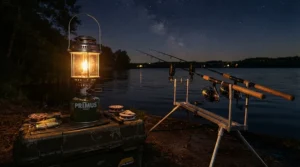
A gas lantern for night fishing is a portable mantle lantern powered by a gas cartridge. The burning gas heats a fragile mesh mantle until it glows white, lighting your swim for cooking, rig-tying and unhooking. Unlike an LED, it makes heat and needs fresh air, so it belongs outside your sleeping space.
The design is old but effective. Modern lanterns use the same Welsbach principle as Victorian street lighting, and the mantle does the work, not the flame. That explains three quirks. First, a new mantle must be burned off before first use, which turns the fabric into a brittle ash mesh. Second, that mesh is fragile once burned, so a bump can crumble it. Third, brightness depends on gas flow, which is why dimmable lanterns stretch a cartridge so far.
For anglers, a carp fishing lantern of this type has a distinct role. It excels at wide, warm light for chores and struggles at subtle, low-level glow. If you want a faint light for checking the clock, an LED does that better. Mantles sold for modern camping lanterns are labelled non-radioactive, so check the packaging before buying spares.
How to Choose a Gas Lantern for Night Fishing
Here’s a short checklist, with the reasoning behind each step.
- Decide its job. A cooking and rig-tying light needs 80W-class output. A backup only needs a compact table lamp.
- Match the cartridge system. Easy Clic Plus lanterns need Campingaz CV cartridges. Screw-thread models share cartridges with most stoves, which simplifies packing.
- Judge burn time in grams per hour. Quoted hours are meaningless without cartridge size. Divide the gas in your cartridge by hourly consumption.
- Check the dimming range. A lantern that dims low saves gas and keeps the swim calmer.
- Think about the globe. Glass gives a more even glow but breaks. Steel mesh survives knocks but offers less diffusion.
- Look at ignition and mantle access. A detachable head makes night-time mantle changes far less stressful.
- Consider the season. Winter sessions suit propane-rich cartridges. One UK listing describes the Coleman C300 Xtreme as designed for extremely low temperatures.
Bivvy Gas Lantern Rules: Where It Lives and Where It Never Goes
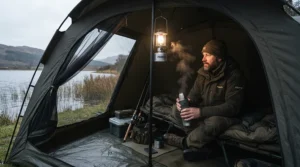
Let’s settle the biggest question on this page. A bivvy gas lantern should never burn inside a closed sleeping space. Official guidance warns that gas appliances can create dangerous carbon monoxide levels in tents and awnings, and fuel-burning lamps are included in that advice.
So where does it go? Three rules keep things sensible.
First, light it outside, in open air, on stable ground or hung from a bankstick well clear of fabric. Hot glass and nylon do not mix. Second, turn it off before you get in. A lantern left burning while you doze is the classic route to trouble. Third, keep a safe separation between lantern and sleeping bag, brolly material and rod gear.
What do you use inside? Use a battery or rechargeable LED. It’s boring advice and it’s right. This is why many UK anglers treat gas as an “outside work light” and LED as the “inside light”.
If you use a brolly system with an open front, treat that as outdoors only when the front is genuinely open and wind can pass through. When in doubt, move the lantern further out. The rest of this guide assumes this rule is non-negotiable.
Bivvy Ventilation: The Non-Negotiable Safety Guide
Ventilation sounds like a chore until you see what’s at stake. NI Direct’s guidance warns that carbon monoxide can build up quickly in enclosed spaces, including tents and awnings. It is odourless, which is why it is so dangerous.
Good bivvy ventilation does two jobs. It reduces condensation, the enemy of a comfortable session, and it keeps air moving. But ventilation is not a licence to burn gas inside. Even with vents open, you should keep fuel-burning devices outside.
Practical habits help:
- Open every vent before you settle, even in winter.
- Keep door panels slightly open when possible.
- Never bring a hot lantern or stove inside to “warm things up”.
- Consider a battery-powered carbon monoxide alarm as a cheap extra layer.
- Learn the symptoms: headache, dizziness, nausea, drowsiness and confusion are warning signs.
If you wake with a headache or feel nauseous, get outside into fresh air immediately and seek medical help. Don’t assume it’s just tiredness. The symptoms are easy to mistake for flu or a bad meal, which is exactly why this risk deserves attention.
Light That Doesn’t Spook Fish: Taming a Gas Lantern at the Swim
A bright white lantern and wary carp are not natural allies. On this point the angling evidence is practical rather than scientific. Rick Golder, writing in Carpology, reports that waving lights around can scare fish, and that shining a torch toward a hooked fish at night has startled it into an unexpected charge. Other UK retailers advise using red or dimmed light to reduce disturbance.
Here’s the awkward truth: a gas lantern can’t be switched to red. It only offers white, so your tools are placement and discipline. To find a light that doesn’t spook fish, think like this:
- Keep the lantern behind and to the side of the bivvy, away from the water’s edge.
- Dim it as low as it will go when you’re not working.
- Use the bivvy body as a shield so no direct beam crosses the swim.
- Switch it off while playing, netting or unhooking fish.
- Use a red-mode headtorch for close-in tasks.
I’d treat these as sensible precautions, not guarantees. No study I found proves that dimmed gas light is safe for carp. The honest approach is to minimise light spill, avoid sudden changes, and judge your venue. If the fish are heavily pressured, an LED with a red mode may be the better tool.
Long Burn Time Lantern Maths: What a Cartridge Really Gets You
Burn-time claims are only useful once you do the sums. A long burn time lantern is really two things: a dimmable lantern and a big cartridge.
Take the hourly gas figures. The Campingaz Lumostar Plus PZ and Kovea Observer both quote about 38g per hour. The Kovea Premium Titanium Gas Lantern quotes about 32g. A 230g cartridge divided by 38g gives roughly six hours at full power. That’s a back-of-envelope figure, but it matches Campingaz’s own 6h 20min claim on a CV300 Plus.
Now think about a winter night of 12 or more hours of darkness. At full power, you’d need two or three cartridges. Dim the lantern to a fraction and the sums look kinder. That is why the Primus EasyLight Duo and Primus Micron Lantern quote 36 hours at the lowest setting.
Practical advice follows:
- Choose a larger cartridge for multi-night trips. A 440g cartridge such as the Coleman C500 suits threaded lanterns, though not Easy Clic Plus ones.
- Light only when needed.
- Carry one spare cartridge more than you think you need.
Also bear in mind that Primus Micron Lantern testing found short runs at maximum brightness on a mini canister. Quoted maximum hours are always best-case.
Carp Fishing Lantern vs LED Bivvy Light
| Feature | Gas lantern | LED bivvy light (e.g. RidgeMonkey Bivvy-Lite Duo) |
|---|---|---|
| Light colour | White only, warm glow | White and red modes |
| Heat | Produces heat and a hot globe | Cool |
| Safe inside a bivvy | No | Yes |
| Run time | Cartridge-dependent | Battery-dependent |
| Cold weather | Cartridge choice matters | Battery capacity can drop |
| Weight | Light plus cartridge | Very light |
| Best For | Outdoor work light | Inside the bivvy |
The RidgeMonkey Bivvy-Lite Duo was reviewed by Total Carp as offering white and red light, four settings, magnetic fitting and a rechargeable battery. That tells you what LEDs do well: low-level, flexible, safe light. A gas lantern does the opposite, delivering strong light outdoors with extra care.
Looking at the comparison, most anglers will want both. Use the Campingaz Lumostar Plus PZ or similar outside for cooking and rigs, then switch to LED before you settle. If you can only buy one, an LED is safer for a beginner, and a gas lantern is a bonus for people who value warm light and cartridge simplicity.
Night Session Essentials Beyond the Lantern
Lighting is only one piece of the kit. These night session essentials make a gas lantern safer and more useful.
- Spare mantles. Mantles are fragile after burning, and Campingaz sells small mantles in packs of three.
- A spare cartridge. One more than the maths suggests.
- A lighter or matches. Piezo igniters fail.
- A red-mode headtorch. For netting and unhooking.
- An LED bivvy light. For inside the shelter.
- A battery carbon monoxide alarm. A cheap extra layer.
- A hard case or sleeve. Protects glass in transit.
- A stable base. A flat board or bankstick holder prevents tipping.
Think of night session essentials as layers. The lantern handles outdoor chores, the headtorch handles precise tasks, and the LED handles comfort. Keep each tool in its lane and you’ll avoid most late-night problems.
✨ Ready to Build Your Night Kit?
🔦 Check current prices on the lanterns above and pair them with a safe LED for inside the bivvy. A small investment now means fewer problems at 3 a.m. when the fish arrive!
Practical Usage Guide: Setting Up Your Lantern Before Dark
Practise at home first. Fiddling with a mantle in the dark is a miserable introduction.
- Fit and burn the mantle in daylight. Fit it, then burn it off with the globe removed and the gas off, as a reviewer of a similar Kovea lantern described. Some retailers advise burning the mantle with a match before first use.
- Connect the cartridge. Screw-thread models need a firm, even seat. A Campingaz Easy Clic Plus model needs its own cartridge type.
- Check for leaks. If you smell gas, disconnect and move away.
- Light on low. Open the valve slowly, then use the piezo igniter.
- Position it outside. Hang it from a bankstick or place it on a stable base, away from fabric.
- Adjust the glow. Start low, then go higher only for chores.
- Shut down properly. Turn off the valve, let the globe cool, then detach the cartridge for storage.
A few maintenance habits go a long way. Let the lantern cool completely before handling the mantle. Keep spare mantles in a small tub. Wipe glass clean so light output stays even.
Problem → Solution: Fixing Common Night-Session Lantern Headaches
Problem: the light looks dim and yellow. A worn mantle is the usual culprit. Replace it and check that the gas flow is steady.
Problem: the mantle crumbles in transit. Burned mantles are brittle. Carry the lantern in its case and keep spares ready.
Problem: the lantern won’t light. First confirm the cartridge connection is fully seated. A forum user struggling with a mini lantern found that an extra eighth or quarter turn sometimes made the difference. Also check you’re using the right cartridge type: the Coleman C500 is stated not to suit Easy Clic Plus lanterns.
Problem: fish bolt when you switch on. Reduce brightness, shield the swim and light it only when needed.
Problem: moths and midges swarm. Move the lantern away from your bivvy opening and consider a mesh-protected design like the Kovea Premium Titanium Gas Lantern.
Problem: you wake with a headache. Don’t ignore it. The Public Health Agency notes that carbon monoxide poisoning symptoms can resemble flu or food poisoning, and advises going outside into fresh air and seeking urgent medical help.
Real-World Scenarios: Which Lantern for Which Angler?
The weekend summer angler. A 48-hour session, solo, with a bivvy and brolly. Budget around £50. The Primus EasyLight Duo suits this angler, since one cartridge feeds both stove and lantern, and the low setting gives long burn time. Pair it with an LED inside.
The winter syndicate regular. Three nights, cold, frequent sessions. A Campingaz Lumostar Plus PZ with larger CV470 Plus cartridges offers convenient handling and a long runtime. Carry extra cartridges and spare mantles, and keep the lantern strictly outside.
The student on a tight budget. About £30 total. The Campingaz Lumogaz Plus or Kovea Observer covers the basics. Choose based on the cartridge you already own, and buy a cheap LED for inside.
The minimalist, rough-swim angler. Low weight, frequent knocks. The Primus Micron Lantern or Snow Peak GigaPower Lantern Auto (with a mesh globe) offers durability and light weight. Accept the premium price for tougher gear.
In every scenario, the principle is the same: pair a gas lantern for outside work with an LED for inside comfort.
FAQ
❓ Which cartridge fits a gas lantern for night fishing?
❓ How often should I replace the mantle?
❓ Is a gas lantern cheaper to run than an LED bivvy light?
❓ What is the best long burn time lantern for winter carp sessions?
❓ Where can I buy a carp fishing lantern in the UK?
Conclusion
So, is a gas lantern for night fishing still worth carrying in 2026? Yes, with conditions. It’s a brilliant outdoor work light: warm, bright and capable of lighting a whole swim without draining a battery. It’s a poor inside light, and a risky one if you ignore ventilation. Treat it as a tool that lives outside the bivvy, and pair it with an LED for sleeping.
If you want the easiest all-round option, the Campingaz Lumostar Plus PZ offers piezo ignition, dimming and a clear runtime. Budget anglers can look at the Campingaz Lumogaz Plus or Kovea Observer. For long burn time, the Primus EasyLight Duo is the standout on paper. If durability matters most, consider the Primus Micron Lantern or the Snow Peak GigaPower Lantern Auto with its mesh globe, and keep the Kovea Premium Titanium Gas Lantern in mind if corrosion and insects bother you.
Whichever you choose, remember the basics: check cartridge compatibility, carry spare mantles, keep the flame outside, dim it when fish are close, and never sleep with it lit.
Recommended for You
- Butane Camping Lantern: 7 Brilliant Picks For UK Campers (2026)
- Gas Lantern Vs LED Lantern: 7 Brilliant Picks For UK Campers (2026)
- Gas Camping Lantern: 7 Brilliant Picks For UK Campers (2026)
Disclaimer: This article contains affiliate links. As an Amazon Associate, I earn from qualifying purchases. If you purchase products through these links, we may earn a small commission at no additional cost to you.
✨ Found this helpful? Share it with your friends! 💬🤗
