
In This Article
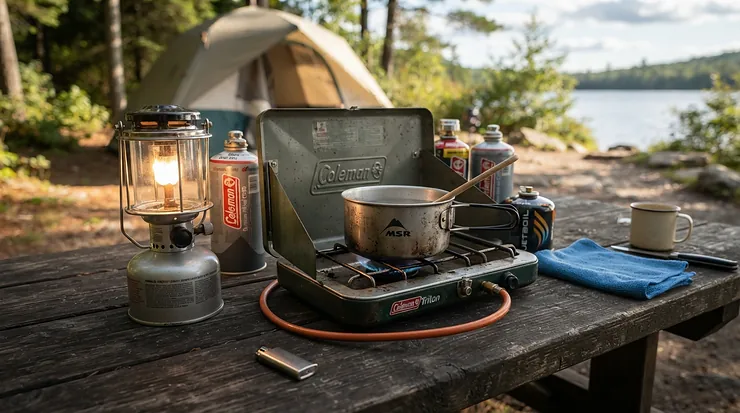
A butane camping lantern is a portable gas light that burns butane-based fuel from a pre-filled canister to heat a fabric mantle until it glows. It gives bright, warm, all-round light with no batteries or mains power. That makes it a favourite for campsites, fishing trips and power cuts.
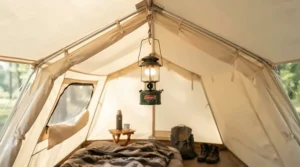
Picture the scene. It’s 9pm in a Lake District field, the drizzle has finally paused, and your phone torch is the only thing standing between you and the midges. A good butane camping lantern fixes that in about four seconds. Click, hiss, glow. Suddenly you have a pool of warm light big enough for a card game, the washing-up bowl and an argument about who forgot the tin opener.
But you can’t buy blind in this category. The word “butane” does a lot of heavy lifting on the box, and the fine print matters. Which valve fits which canister? What happens to the flame near freezing? Can you actually buy refills near the campsite? Get one of those wrong and you own a very elegant paperweight.
So this guide does the homework. You’ll find seven real models across budget, mid-range and premium tiers, plus an honest read on what each butane canister lantern does well. There are dedicated sections on butane fuel limitations in cold weather, stove and lantern compatibility, canister availability in the UK, and why a small gas lantern for tents needs more care than the marketing suggests. Everything rests on published specifications and aggregated retailer feedback, with no invented hands-on claims. Prices appear as ranges only, so check the current price before you buy.
Quick Comparison: Seven Butane Camping Lantern Options at a Glance
Here’s the short version before the detail. The table lines up the seven models by connector, weight, indicative price range and who each one suits best.
| Lantern | Fuel connection | Weight | Price range | Best For |
|---|---|---|---|---|
| Campingaz Lumostar Plus PZ | Easy Clic Plus valve cartridges | about 370 g | around £20-£35 | First-time campers wanting easy lighting |
| Campingaz Lumogaz Plus | Easy Clic Plus valve cartridges | about 280 g | under £30 | Budget car camping |
| Primus EasyLight Duo | Duo valve (threaded and non-threaded) | about 190-205 g | roughly £35-£50 | Travellers mixing cartridge types |
| Kovea Observer | Screw-on isobutane canisters | 168 g | roughly £25-£40 | Backpackers counting grams |
| Kovea Premium Titanium Gas Lantern | Screw-type canisters | ultralight (check listing) | roughly £45-£65 | Weight-obsessed minimalists |
| Highlander Gas Field Lantern | Threaded cartridges | about 340 g | roughly £25-£40 | Family campers wanting a threaded fit |
| Snow Peak GigaPower BF Lantern | Screw-type isobutane | about 1,025 g | premium, roughly £170-£250 | Group tables and glamping |
Prices are indicative ranges at the time of research and vary by retailer, so check current price.
Looking at the table, the two Campingaz models are the easiest on the wallet and the easiest to live with if you’ll buy fuel in UK shops. The Primus EasyLight Duo is the clever pick for anyone juggling different cartridge types. The Kovea Observer and Kovea Premium Titanium Gas Lantern suit people who measure their rucksack in grams rather than litres. The Highlander Gas Field Lantern sits in the sensible middle for families who prefer a threaded connector. Only the Snow Peak GigaPower BF Lantern plays in a different league, with over a kilo of weight, serious output and a serious price. Brightness is quoted in watts, lux or lumens depending on the brand, and those figures can’t be compared directly, so treat connector and weight as your dependable filters.
💬 Just one click — help others make better buying decisions too!😊
Top 7 Butane Camping Lantern Options: Expert Analysis
Each lantern below gets the same treatment: what the specs mean in practice, who it suits, and what reviewers say where genuine review data exists. Where independent reviews are thin, I say so rather than fill the gap.
1. Campingaz Lumostar Plus PZ — best all-rounder for first-timers
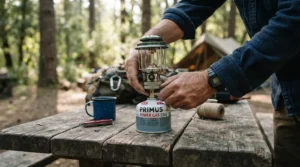
The headline feature is the piezo igniter, which turns lighting into a single click, handy when it’s windy and your lighter has gone missing.
The Campingaz Lumostar Plus PZ is an 80W lantern weighing roughly 370 g. It runs on Campingaz CV270, CV300 or CV470 Plus valve cartridges through the Easy Clic Plus connector. Published figures give about 6 hours 20 minutes on a CV300 Plus and around 12 hours on a CV470 Plus, which works out at about 38 g of gas an hour. In practice, one 450 g cartridge covers a long weekend of evenings. The detachable head matters more than it sounds. Mantles are fragile, and removing the head turns a replacement into a two-minute job.
Based on the spec comparison, this is the lantern for people who want the least friction between “unpacked” and “lit”. The globe guard and carry bag suit families, whose kit tends to be thrown rather than placed. The trade-off is the proprietary connector. You’re tied to Campingaz-style cartridges, which is fine in Britain but limiting if you already own screw-thread canisters. The review pool I could verify is small, but feedback on retailer listings is positive, with buyers mentioning good value and solid quality rather than any standout flaw.
Pros:
- ✅ Piezo ignition lights without matches
- ✅ Detachable head makes mantle changes simple
- ✅ Globe guard and carry bag included
Cons:
- ❌ Proprietary Easy Clic Plus connector only
- ❌ Heavier than screw-thread backpacking lanterns
Expect around £20-£35 at UK retailers (check current price). For a piezo-equipped, guarded lantern, that is strong value.
2. Campingaz Lumogaz Plus — budget no-frills light
Simplicity is the selling point here. There are fewer parts, a sturdy hanging handle and an 80W burner doing one job.
The Campingaz Lumogaz Plus shares its cartridge system and quoted runtimes with its pricier sibling, with roughly 6 hours 20 minutes on a CV300 Plus and about 12 hours on a CV470 Plus. It weighs around 280 g, which is about 90 g less than the Campingaz Lumostar Plus PZ. The retailer listings I reviewed don’t mention a piezo igniter, so assume you’ll light it with a match or lighter. They also don’t mention the detachable head, so mantle changes may be fiddlier.
Where it shines is compatibility. Campingaz markets it alongside the Bleuet Micro Plus stove, so one cartridge can feed both. For car campers, caravanners and festival-goers who would rather spend money on gas than gadgets, that’s a sensible trade. I couldn’t verify a meaningful independent review pool, so the evidence here is the spec sheet and the brand’s reputation rather than crowd feedback.
Pros:
- ✅ Lowest-cost way into Campingaz lantern lighting
- ✅ Shares cartridges with Campingaz stoves
- ✅ Lighter than the Campingaz Lumostar Plus PZ
Cons:
- ❌ No piezo igniter listed
- ❌ Detachable head not listed, so mantle access may be fiddly
Budget around under £30 (check current price). It’s a bargain if you already own Campingaz kit.
3. Primus EasyLight Duo — one lantern, two valve standards
The standout trick is the Duo valve, which fits both threaded (Lindal) and non-threaded cartridge valves.
The Primus EasyLight Duo weighs roughly 190-205 g depending on the listing. It offers stepless brightness up to a stated 490 lumens and uses a piezo igniter with a notably quiet burner. Primus quotes burn times from about 4 to 36 hours, depending on brightness and cartridge size. In plain English, the dimmer you run it, the longer your canister lasts, and the lowest settings are where it earns its keep. It needs a mantle fitted before first use, and one is supplied.
Here’s what to weigh: this is the one to buy if you camp across borders, or own both a screw-thread stove and a Campingaz one. The Duo valve sidesteps the connector lottery entirely. Retail listings I found averaged in the mid-4s out of 5 across roughly 60-110 ratings. A small minority were one-star, and buyers highlighted easy brightness adjustment.
Pros:
- ✅ Duo valve fits threaded and non-threaded cartridges
- ✅ Wide brightness range stretches fuel economy
- ✅ Compact at around 205 g or less
Cons:
- ❌ Costs more than the Campingaz pair
- ❌ Mantle needs fitting before first use
Expect roughly £35-£50 (check current price). The flexibility justifies the premium for mixed-fuel campers.
4. Kovea Observer — pocketable at 168 grams
Weight is the headline: at 168 g, it’s lighter than a full mug of tea.
The Kovea Observer measures about 60 x 60 x 110 mm. It has push-button piezo ignition, a stated 35 lux output and fuel consumption of about 38 g an hour. It screws onto most generic isobutane canisters, comes with a hanging ring and chain, and ships in a protective plastic case. On paper, a 230 g screw-thread canister gives around six hours of light. That is plenty for a backpacking weekend with sensible dimming.
My take: 35 lux lights a table, a cooking spot or an awning doorway, not a field. It’s an atmosphere-and-tasks lantern, which is exactly what solo and two-person trips need. A retailer listing showed roughly 4.3 out of 5 from about 100 ratings, mostly five-star with a small cluster of one-star reports. Treat it as broadly positive but not flawless.
Pros:
- ✅ Just 168 g and genuinely pocketable
- ✅ Piezo ignition included
- ✅ Fits most screw-type isobutane canisters
Cons:
- ❌ 35 lux suits small areas only
- ❌ Tiny mantles need careful handling
Budget roughly £25-£40 (check current price). It’s superb value for lightweight camping.
5. Kovea Premium Titanium Gas Lantern — titanium frame, wire-guard minimalism
The titanium construction and hollow wire-frame glass guard are all about shaving grams without making it look cheap.
The Kovea Premium Titanium Gas Lantern (code KGL-0805K) is rated at about 40 lux and uses screw-type canisters. According to Kovea, the titanium resists corrosion and heat, and the air holes are mesh-lined to keep bugs and debris out of the nozzle. A clogged nozzle is a classic cause of sulky, sputtering flames, so that detail is more practical than it sounds. The design disassembles easily for mantle replacement.
The open wire guard means more exposure to breeze than a solid shield, so expect some flicker in wind. The lantern suits backpackers who care about weight and looks, and damp UK weather won’t bother a titanium body. I couldn’t find a meaningful independent review pool, so judge it on the specification.
Pros:
- ✅ Titanium body resists corrosion and keeps weight low
- ✅ Mesh-lined air holes keep bugs out
- ✅ Easy to disassemble for mantle changes
Cons:
- ❌ Premium price for modest 40 lux
- ❌ Little independent review data available
Expect roughly £45-£65 (check current price). It’s a luxury for weight-watchers, not a necessity.

6. Highlander Gas Field Lantern — British-brand threaded-cartridge workhorse
The pitch is simplicity: it fits most threaded gas cartridges, so you aren’t tied to one brand’s fuel.
Highlander is a Scottish outdoor brand dating back to the 1980s. Its Highlander Gas Field Lantern weighs about 340 g and measures roughly 15.5 x 10 x 8.5 cm, with adjustable brightness, a carry and hanging handle, and a frosted glass globe. Frosting diffuses the light, which is kinder on the eyes in a small awning than a bare mantle glare. Universal mantle three-packs for Highlander lanterns sell at UK retailers for a few pounds, so upkeep stays cheap.
The lantern suits family campers who prefer standard screw-thread cartridges, like the Coleman C500, to a proprietary system. Independent reviews were hard to verify, and the enthusiastic copy I found came from a retailer bundle listing, which is promotion rather than a review. It’s a sensible mid-range candidate, but weigh it on specs.
Pros:
- ✅ Fits most threaded gas cartridges
- ✅ Frosted glass gives softer, less glaring light
- ✅ Universal mantles cost just a few pounds
Cons:
- ❌ Heavier and bulkier than backpacking models
- ❌ Piezo ignition isn’t confirmed in listings
Budget roughly £25-£40 (check current price). Good value for threaded-fuel households.
7. Snow Peak GigaPower BF Lantern — 170W premium for group camps
The headline is raw output: 170W, which is roughly double the Campingaz lanterns’ rating.
The Snow Peak GigaPower BF Lantern (GL-300A) pairs a glass globe with a stainless-steel base, aluminium alloy and brass parts, and an auto-igniter. It weighs about 1,025 g and measures roughly 13 cm across by 25 cm tall. It runs on isobutane and ships with a reinforced hard case. Higher output usually means a thirstier burner, so expect canisters to empty faster than the 38 g/h of the smaller models. Check Snow Peak’s published consumption before planning fuel.
This lantern makes sense for a group table, a gazebo, a glamping pitch or a power-cut kit. It’s overkill for a solo wild camper. Only a handful of reviews turned up, with one retailer listing a single brief thumbs-up, which is too little to draw conclusions from.
Pros:
- ✅ 170W output lights a whole group table
- ✅ Auto-igniter and hard case included
- ✅ Stainless-steel and brass build feels durable
Cons:
- ❌ Over a kilogram before adding gas
- ❌ Premium price puts it out of casual reach
Expect roughly £170-£250 (check current price). It’s a statement lantern for people who camp with company.
To round up the seven: the Campingaz Lumostar Plus PZ and Campingaz Lumogaz Plus win on cost and convenience. The Primus EasyLight Duo wins on flexibility. The Kovea Observer and Kovea Premium Titanium Gas Lantern win on weight. The Highlander Gas Field Lantern wins on standard-thread simplicity, and the Snow Peak GigaPower BF Lantern wins on brute illumination.
Practical Usage Guide: Setting Up Your Butane Canister Lantern
Most first-month problems with a butane canister lantern are setup mistakes, not faulty kit. Here’s the sequence that avoids them.
- Pick the right spot. Use the lantern outdoors or in genuinely open air. The NHS guidance on carbon monoxide poisoning is blunt: gas appliances can build up the odourless gas in enclosed spaces, and camping stoves shouldn’t be used inside a tent.
- Fit the mantle gently. Mantles arrive as fragile fabric sleeves. Tie or slot one on, trim excess, then burn it off outdoors by holding a flame near it, as the instructions describe. After burn-off it turns to brittle ash, so don’t touch it.
- Connect the cartridge upright. For Easy Clic Plus, push and turn until you hear the click. For threaded models, thread gently and stop at snug. Over-tightening damages seals.
- Light low, then adjust. Open the valve slightly, click the igniter, then raise brightness. A mid setting stretches fuel and mantle life.
- Shut down properly. Close the valve, let the globe cool, then detach. Resealable cartridges can be removed part-used.
Common mistakes in the first 30 days include carrying the lantern while lit, hanging it too close to fabric, and packing a loose mantle where it’ll shatter. A small spare mantle pack costs a few pounds, so keep one in the kit bag.
Real-World Scenarios: Which Butane Camping Lantern Fits Your Trip?
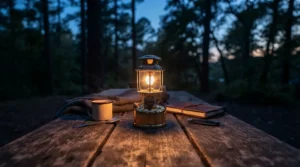
Specs only matter once you map them to a trip. These three profiles show how the reasoning plays out.
The family of four on a Cornish campsite, four nights, car camping. You’ll burn roughly four hours of light an evening, so about 16 hours in total. At the 38 g/h quoted for smaller models, that’s more than one 450 g cartridge, so pack two. The Campingaz Lumostar Plus PZ suits this profile, because piezo ignition and a globe guard cope with children and chaos. Stock the fuel in advance, because Cornish village shops don’t always carry gas.
The solo backpacker, October in the Cairngorms. Weight and cold dominate. The Kovea Observer or Kovea Premium Titanium Gas Lantern keep the load tiny, and a screw-thread canister shares fuel with most backpacking stoves. Keep the canister warm before lighting, and use the lantern outside the tent, not in it.
The group weekend or power-cut kit. If you’re lighting a gazebo or a dining table, the Snow Peak GigaPower BF Lantern brings the output. A cheaper route is the Highlander Gas Field Lantern plus a few spare mantles.
A simple decision framework helps. If you already own a Campingaz stove, choose an Easy Clic Plus lantern. If you own a screw-thread stove, choose Kovea, Highlander or Snow Peak. If you own both, the Primus EasyLight Duo is your tie-breaker.
How to Choose a Butane Camping Lantern
Choosing well takes about ten minutes of thought and saves a lot of faff later.
- Match the connector first. Stove and lantern compatibility decides whether one canister can feed both. Check the valve type before anything else.
- Balance weight against brightness. Backpackers should favour grams. Car campers can afford 300 g to 1 kg of extra light.
- Check the ignition. Piezo saves matches and fumbling. Confirm it’s actually listed.
- Think about the season. Near-freezing nights punish butane-heavy fuel, so read the cold-weather section below.
- Look at mantle access. A detachable head or easy-to-disassemble body makes upkeep painless.
- Plan your refills. Canister availability in the UK is good for popular formats and patchier for niche ones. Buy what your local shops stock.
- Decide where it will live. If it will be used in or near a tent, read the tent safety section before buying.
Brightness figures need a pinch of salt, since watts, lux and lumens measure different things. Use them to compare within a brand, not across brands.
Butane Fuel Limitations in Cold Weather: What UK Campers Need to Know
Britain rarely gets Arctic cold, but a clear autumn night at altitude easily dips to freezing. That’s exactly where butane fuel limitations in cold weather start to bite.
The physics is straightforward. Pure n-butane boils at around -0.5°C, isobutane at roughly -11.7°C and propane at about -42°C. Below its boiling point, a fuel simply stops turning to gas fast enough to feed a burner. Canisters are almost always blends: Campingaz CV Plus cartridges are 80/20 butane/propane, and Coleman’s C500 is 70/30. The Appalachian Mountain Club’s explanation adds two points that matter. Propane burns off first in sub-freezing conditions, leaving a butane-rich canister that can stop working long before it’s empty. Vaporising fuel also chills the canister itself, so even above freezing a long run can starve the flame.
What helps:
- Warm the canister in a pocket before lighting.
- Stand it on an insulating pad, never frozen ground.
- Run the lantern dimmer, which draws less gas and chills less.
- Consider an isobutane/propane blend such as Campingaz’s CV470 All Season, but check it’s compatible with your lantern first.
Direct-mount lanterns hold the canister upright, so you can’t use the inverted-canister tricks some remote stoves allow. Campingaz’s own manual categorises the Lumostar Plus PZ as a direct-pressure butane appliance, so treat -5°C as a warning zone for any model.
Stove and Lantern Compatibility: Matching Valves, Threads and Cartridges
Stove and lantern compatibility is the single most useful thing to understand before spending a penny. Three families dominate, and they don’t mix.
Campingaz Easy Clic Plus is a proprietary quarter-turn bayonet system for CV270, CV300 and CV470 Plus cartridges. It isn’t compatible with threaded EN417 valves. EN417 screw-thread cartridges (the 7/16″ Lindal-style valve) are the standard for most backpacking and camping canisters, including Coleman’s C500. Older piercing cartridges, such as Campingaz’s C206 GLS, are a third, separate format.
| Connector family | Typical cartridge | Lanterns that use it | Shares fuel with |
|---|---|---|---|
| Easy Clic Plus | Campingaz CV270/CV300/CV470 Plus | Campingaz Lumostar Plus PZ, Campingaz Lumogaz Plus | Campingaz Bleuet Micro Plus, Twister, party grill |
| EN417 screw thread | Coleman C500, generic isobutane/propane | Kovea Observer, Kovea Premium Titanium Gas Lantern, Highlander Gas Field Lantern, Snow Peak GigaPower BF Lantern | Most backpacking stoves; Vango Blaze runs on C500 |
| Duo valve (both) | Either standard | Primus EasyLight Duo | Stoves in either camp |
Best For: Campingaz households choose row one, screw-thread households row two, and mixed kit row three.
The takeaway is that the right lantern is the one that already speaks your stove’s language. Sharing one cartridge between stove and lantern saves weight, money and a trip to the shop. The Primus EasyLight Duo is the only one here that bridges both standards.

Canister Availability in the UK: Where to Buy and What It Costs
Canister availability in the UK is generally good, but it depends on which format you chose. Campingaz CV300 Plus (240 g) and CV470 Plus (450 g) cartridges are stocked widely, including Argos and Decathlon UK, and a recent review notes they’re easy to find in UK shops. Coleman’s C500 (440 g, EN417 thread) turns up at outdoor retailers such as GO Outdoors.
At the retailers I checked, indicative ranges were:
- CV300 Plus: roughly £5-£10.
- CV470 Plus: around £10-£15.
- Coleman C500 six-packs: roughly £25-£40.
At about 38 g of gas an hour, a 450 g cartridge costing around £12 works out at roughly £1 per hour of light. Pennies, then, compared with the pleasure of an evening you can actually see.
Two practical wrinkles. Several UK retailers sell gas cartridges in-store or click-and-collect only because couriers restrict gas shipments, so don’t assume next-day delivery. Stock also varies, and some listings show items sold out. Buy before you travel, especially for rural pitches, and check current price and availability. Stocking a spare cartridge costs little and saves a long drive to the nearest hardware shop.
Small Gas Lantern for Tents: Safety, Regulations and Realistic Use
Searching for a small gas lantern for tents is understandable, because compact models like the Kovea Observer look made for it. But the honest answer is that “for tents” should mean camping trips with tents, not burning gas inside one.
UK health bodies are unambiguous. The NHS says not to use a camping stove inside a tent. Northern Ireland’s nidirect advice on camping carbon monoxide risks goes further. It says never take a gas stove, light or heater into a tent, caravan or cabin unless it’s a permanent fixture, correctly installed and maintained. Public Health Wales adds that gas lamps need plenty of ventilation to avoid producing carbon monoxide. The gas is colourless and odourless, which is what makes it dangerous.
Realistic use looks like this:
- Hang the lantern outside from a pole, branch or frame, so light spills across the pitch and through the doorway.
- Use it on a camping table or at the cooking area, well clear of fabric.
- Never leave it lit and unattended, or burning while you sleep.
- Keep an LED lantern for inside the tent.
A butane lantern is a brilliant outdoor light. Treat it that way and you get the atmosphere without the risk.
Butane Canister Lantern vs LED Lantern: Which Is Better?
Neither wins outright. They solve different problems, and many campers carry both.
| Factor | Butane canister lantern | LED lantern |
|---|---|---|
| Light quality | Warm, wide, atmospheric | Varies; often cooler, adjustable |
| Running cost | Around £1 an hour of gas | Batteries or recharging |
| Cold weather | Fades near freezing | Battery capacity also drops in cold |
| Inside a tent | No, ventilation and carbon monoxide risk | Yes, safe |
| Setup | Mantle, cartridge, ignition | Switch on |
| Best For | Outdoor evenings and group tables | Sleeping areas and quick tasks |
The sensible read of this table: pick the butane lantern for outdoor atmosphere and group light, and an LED model for the tent interior and midnight toilet trips. The gas lantern’s warm glow is hard to beat at a table, but its mantle, cartridge and ignition routine make it a poor fit for quick, casual tasks. If you only want one, choose by where the light will live. Outside points to gas. Inside a tent points to LED. Many campers’ kit ends up as one of each.
Frequently Asked Questions
❓ How many canisters should I pack for a weekend with a butane camping lantern?
❓ Are replacement mantles easy to find in the UK?
❓ Can I refill the cartridge from a butane canister lantern to save money?
❓ Is it safe to leave a butane camping lantern burning overnight?
❓ What is the cheapest butane camping lantern to run per evening?
Conclusion
The best butane camping lantern is the one that matches your fuel, your season and your pitch. For most UK campers buying a first lantern, the Campingaz Lumostar Plus PZ is the easy, low-risk choice. The Campingaz Lumogaz Plus is the thrifty alternative if you’d rather spend on gas. If you juggle cartridge types, the Primus EasyLight Duo removes the connector headache. Backpackers should look at the Kovea Observer or the Kovea Premium Titanium Gas Lantern, family campers who like standard threads at the Highlander Gas Field Lantern, and group hosts at the Snow Peak GigaPower BF Lantern.
Remember the three truths that matter more than any spec. Butane struggles near freezing, so keep canisters warm. Connectors decide stove and lantern compatibility, so check before you buy. And a gas lantern belongs outside the tent, hung where the glow reaches the pitch and the carbon monoxide doesn’t reach you.
Recommended for You
- Gas Lantern Vs LED Lantern: 7 Brilliant Picks For UK Campers (2026)
- Gas Camping Lantern: 7 Brilliant Picks For UK Campers (2026)
- Lightweight LED Lantern For Backpacking: 7 Proven Picks (2026)
Disclaimer: This article contains affiliate links. As an Amazon Associate, I earn from qualifying purchases. If you purchase products through these links, we may earn a small commission at no additional cost to you.
✨ Found this helpful? Share it with your friends! 💬🤗
