
In This Article
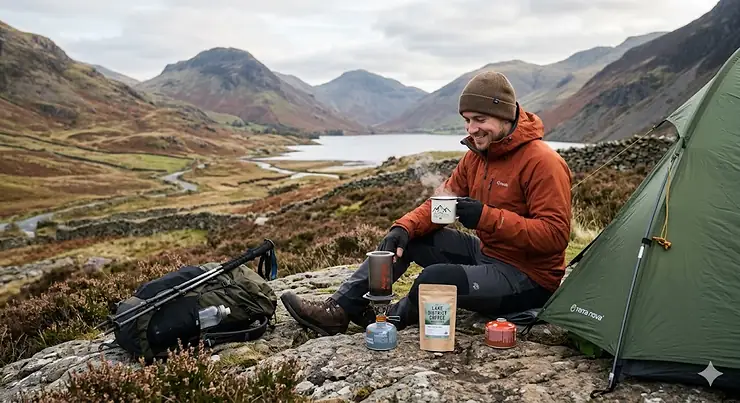
There’s a particular kind of magic to drinking a proper coffee in the middle of nowhere. Tent pegs barely dried from last night’s drizzle, boots still damp from the morning grass, a grey Lakeland sky doing its best impression of a dishcloth — and then: a genuinely excellent cup of coffee, steaming in your hands. Perfect. The thing is, most camping coffee kit is designed with groups in mind, or — worse — appears to assume that solo campers are perfectly happy with freeze-dried instant. They are not.
Camping coffee makers for one person are a different beast entirely. You need something light enough to forget it’s in your rucksack, robust enough to survive a rough evening in a bivi bag, compatible with your gas stove on a soggy British morning, and capable of producing a cup that justifies the effort. Tall order? Not really. This guide cuts through the noise, covers seven of the best options available on Amazon.co.uk right now, and tells you exactly which brewer suits which type of solo camper — from the Dartmoor wild-camper counting grams to the festival-goer who just wants a flat white without the £4.50 queue.
A quick note on what separates a good camping coffee maker from the landfill fodder cluttering cheaper listings: weight and packability matter, but brew quality matters more. No point saving 30g if every cup tastes like recycled cardboard. The picks below all strike that balance — albeit in very different ways.
Quick Comparison: Best Camping Coffee Makers for One Person
| Product | Brew Style | Approx. Weight | Price Range | Best For |
|---|---|---|---|---|
| AeroPress Go | Hybrid (espresso/French press/pour-over) | ~240g | £30–£40 | Most solo campers |
| Wacaco Nanopresso | Espresso | ~336g | £50–£70 | Espresso devotees |
| Bialetti Moka Express 1-Cup | Stovetop espresso | ~280g | £15–£25 | Budget traditionalists |
| GSI Outdoors Ultralight Java Drip | Pour-over | ~11g | £10–£20 | Ultralight backpackers |
| Hario V60 Plastic Dripper (Size 01) | Pour-over | ~90g | £10–£20 | Quality-conscious campers |
| Stanley Adventure All-In-One Boil + Brew | French press + pot | ~400g | £35–£50 | Car campers, minimalists |
| MSR MugMate Coffee/Tea Filter | Immersion/drip | ~28g | £12–£20 | Weight-obsessed trekkers |
The table tells part of the story. What it doesn’t tell you is that the AeroPress Go outperforms every option above on versatility-per-gram, while the Nanopresso is the only one in this list that produces a genuinely crema-topped espresso shot without any gas or electricity. The Bialetti, meanwhile, is the choice that looks coolest on Instagram and tastes best with a strong dark roast — though you’ll need a working stove to use it. Budget-watchers should note the real outlier: the GSI Ultralight Java Drip costs less than a round of drinks and weighs almost nothing.
💬 Just one click — help others make better buying decisions too! 😊
✨ Don’t Miss These Exclusive Deals!
🔍 Take your solo camping coffee to the next level with these carefully selected products. Click on any highlighted item to check current pricing and availability on Amazon.co.uk. Whether you’re after espresso intensity or ultralight convenience, there’s a perfect brew waiting for you!
Top 7 Camping Coffee Makers for One Person: Expert Analysis
1. AeroPress Go — The Swiss Army Knife of Solo Coffee
There’s a reason the AeroPress Go shows up on practically every serious camping coffee list going. It’s because it genuinely earns it. The Go is the compact travel version of the original AeroPress — the chamber, plunger, stirrer, scoop, and a healthy stack of paper micro-filters all nest neatly inside a lidded mug that doubles as a travel case. The whole package weighs around 240g and takes up barely more space than a medium apple.
What actually separates the Go from the crowd isn’t the packaging, though — it’s the brew. The patented pressure-plus-immersion method produces a cup that’s genuinely low in bitterness, clean, and surprisingly full-bodied, all in under two minutes. You can dial it toward a French press style (longer steep, coarser grind), a pour-over (finer grind, faster press), or something espresso-adjacent (fine grind, concentrated output). For British campers dealing with variable altitude and wind-driven temperature drop — hello, Snowdonia and the Cairngorms — this flexibility is genuinely useful. If your gas burns cool on a ridge, you can adjust brew time rather than accepting a flat result.
UK buyers should note it’s available on Amazon.co.uk with Prime delivery, and the filters are compostable, which matters if you’re camping in a National Park and following Leave No Trace principles.
UK reviewers consistently praise the clean-up process: eject the puck, rinse with a splash of water, done. When you’re sharing a stream-fed water supply with three other tents, that efficiency is not trivial.
✅ Versatile brewing styles
✅ Fast clean-up — minimal water needed
✅ Light, compact, shatterproof
❌ Paper filters mean carrying a supply
❌ Learning curve on first use — watch a quick video
Price range: £30–£40 — strong value for a brewer that does everything well.
2. Wacaco Nanopresso — Proper Espresso, Anywhere
The Wacaco Nanopresso is the one for people who simply refuse to accept that camping means compromising on espresso. And fair enough — life is short. The Nanopresso is a hand-pump manual espresso maker weighing around 336g, producing up to 18 bar of pressure with nothing but your palm and hot water. No batteries, no electricity. Just physics and stubbornness.
The result is a proper 30ml espresso shot with a dense, genuine crema — not the pale, watery impression of espresso you get from some alternatives. In testing across the camping community, it consistently produces café-quality output that seriously impresses. The catch? It does require finely ground coffee and boiling water, and the multi-part construction means more fiddling and slightly more washing-up than something like the AeroPress. On a cold, grey morning in the Brecon Beacons with numb fingers, that’s worth factoring in.
The Nanopresso is available on Amazon.co.uk and is compatible with standard finely ground coffee out of the box, with a separate NS Adapter available if you prefer Nespresso-compatible pods. No UK-specific voltage concerns — it’s entirely manual.
UK buyers who’ve reviewed it frequently comment on the quality of the crema and describe it as “better than most high street coffee shop shots.”
✅ Genuine crema espresso without electricity
✅ No batteries or power required
✅ Compact and durable
❌ More components to clean
❌ Requires finely ground coffee and some technique
Price range: £50–£70 — a premium investment, but the only true espresso option on this list.
3. Bialetti Moka Express 1-Cup — The Classic That Earns Its Place
Invented in 1933 by Alfonso Bialetti and barely changed since, the Moka Express is one of those rare objects that’s already been perfected. The art deco octagonal aluminium body, the ergonomic handle, the satisfying gurgle as pressurised steam forces water up through the grounds — it’s a brewing ritual as much as a practical tool. The one-cup version is ideal for solo camping, weighing around 280g and producing a small but intensely strong shot that can be drunk neat or diluted into an Americano.
What most buyers overlook about the Moka Express is how forgiving it is on the campsite. Unlike the AeroPress, there’s no technique to learn. Fill the base chamber with water, pack the basket with medium-fine ground coffee, screw on the top, set it on your gas stove, and wait. It’s ready in under three minutes. That’s genuinely useful at 6am in a field in Northumberland when thinking is still optional. The aluminium construction means it’s light and durable, though it does require a bit more care on cleaning — avoid soap, rinse with water only, and dry thoroughly to prevent oxidation in Britain’s reliably damp conditions.
One minor point for UK buyers: the Moka Express is designed for gas hob use, so it works perfectly with standard camping gas stoves. It is not induction-compatible (you’d want the stainless steel Bialetti Musa for that), which isn’t a concern at a campsite but worth knowing.
✅ No learning curve
✅ Iconic, durable design
✅ Budget-friendly
❌ Requires gas stove — not freestanding
❌ Aluminium needs careful drying in wet UK conditions
Price range: £15–£25 — the most affordable quality brewer on this list by a comfortable margin.
4. GSI Outdoors Ultralight Java Drip — For When Every Gram Counts
The GSI Ultralight Java Drip is an absurdity of engineering in the best possible sense. It weighs around 11g — roughly the same as a £1 coin — and folds flat enough to slot under a standard fuel canister. You place it on top of your mug, drop in a standard V60-style paper filter, add ground coffee, and pour over hot water. Pour-over coffee, essentially, in a package that costs less than a cinema ticket and weighs almost nothing.
What most buyers overlook about the Java Drip is that it produces a noticeably cleaner, brighter cup than a French press or percolator. Paper micro-filtration removes the oils and fine particles that French press coffee tends to carry — which translates, practically speaking, to a cup with clearer flavours and less grit. For pour-over enthusiasts who’ve been carrying a Hario V60, this is the backpacking substitute that actually delivers.
The trade-off is that it does require standard paper filters (V60 size 01 or 02 fit well), which means a small supply to carry. It’s also uninsulated, so you need to work reasonably quickly in the cold or use a preheated mug. For the Pennine Way through-hiker or anyone doing a multi-day solo in the Cairngorms, where base weight is a genuine obsession, this might be the single best value camping coffee purchase available on Amazon.co.uk.
✅ Virtually weightless — around 11g
✅ Bright, clean pour-over flavour
✅ Nests under fuel canister — brilliant space-saving design
❌ Needs paper filters to carry
❌ Slow in very cold conditions without a preheated mug
Price range: £10–£20 — outstanding value for ultralight camping coffee.
5. Hario V60 Plastic Dripper (Size 01) — The Pour-Over Purist’s Pick
The Hario V60 is arguably the most trusted pour-over coffee dripper in the world among serious coffee people, and the plastic Size 01 version makes it genuinely viable for solo camping. Weighing around 90g and priced under £20 on Amazon.co.uk, it’s light enough to justify and durable enough not to worry about. The V60’s distinctive spiral ridges and single large drainage hole allow remarkably precise control over extraction — slow pour for more body, faster for brightness — in a way that flat-bottomed drippers simply don’t match.
Why does this matter at a campsite? Because pour-over quality is extremely sensitive to water temperature and flow rate, and the V60 rewards a bit of attention. If you’re the kind of solo camper who brings a hand-grinder and a specific single-origin Ethiopian bean, the V60 is the brewer that makes the most of that investment. If you’re brewing pre-ground supermarket coffee at 6am without your glasses, the AeroPress is more forgiving.
For UK buyers specifically: the V60 Size 01 uses Hario’s own VCF-01 paper filters, which are widely available from Amazon.co.uk and most independent coffee shops on the high street. Using UK tap-water softened through a camping filter will actually improve extraction noticeably — the V60 is sensitive enough to reward this.
✅ Professional pour-over extraction quality
✅ Light and affordable
✅ Widely available filters in the UK
❌ Requires some technique and attention
❌ No insulation — needs preheated mug in cold British weather
Price range: £10–£20 — a bargain for the quality of coffee it’s capable of producing.
6. Stanley Adventure All-In-One Boil + Brew — The Car Camper’s Complete Kit
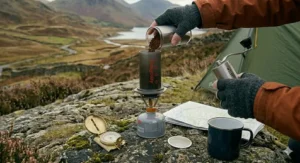
The Stanley Adventure All-In-One is a different proposition entirely from the ultralight options above — and that’s precisely the point. It combines a 1-litre stainless steel pot with a built-in French press mechanism, meaning you boil your water and brew your coffee in the same vessel, reducing the number of items to carry and wash. For solo car camping, weekend festival trips, or anyone arriving at a campsite by van rather than on foot, this is an elegantly efficient bit of kit.
The stainless steel double-wall construction keeps your brew warm for longer — a meaningful advantage on a cold morning at a Derbyshire campsite where temperatures can drop several degrees between breakfast and whenever you’ve actually found your boots. The capacity allows you to brew a generous mug rather than a precise shot, which suits the relaxed pace of car camping rather better than backpacking.
Where the Stanley is less ideal: it’s heavier than everything else on this list, at around 400g. It also produces French press-style coffee, which means some sediment in the cup — unavoidable with mesh filtration, and honestly a matter of personal tolerance. UK reviewers rate it highly for durability, with several noting it has survived years of festivals and road trips without complaint.
✅ Boil and brew in one vessel — less to carry and wash
✅ Keeps coffee warmer for longer
✅ Extremely durable stainless steel construction
❌ Heavier — best for car camping, not backpacking
❌ Some sediment in the cup (French press style)
Price range: £35–£50 — excellent value for a car camping coffee-and-cook setup.
7. MSR MugMate Coffee & Tea Filter — The Minimalist Wildcard
The MSR MugMate is the odd one out in this list, and deliberately so. It’s not a brewer in the traditional sense — it’s a stainless steel mesh filter that clips to the rim of any mug, allowing you to brew directly in your cup without any separate vessel. You add ground coffee to the mesh basket, pour over boiling water, let it steep for a few minutes, then remove the basket and drink. Immersion brewing, essentially, in a device that weighs around 28g and costs under £20.
What most buyers overlook is how well this works as a French press substitute for solo camping — without the fragile glass or bulky stainless pot. The mesh filtration allows some oils through, producing a rich, full-bodied cup rather than the brightness you’d get from paper-filtered methods. It’s also entirely reusable, which matters for Leave No Trace campers who’d rather not deal with wet paper filters at altitude.
The MugMate isn’t for espresso lovers or pour-over perfectionists. It’s for the solo camper who wants genuine brewed coffee with minimal faff, maximum durability, and near-zero weight impact. If you’re heading into the Peak District or wild camping in the Scottish Highlands and your pack is already straining, this is the option worth knowing about.
✅ Under 30g — barely registers in a pack
✅ No paper filters needed — fully reusable
✅ Works with any mug
❌ Some sediment — not for grit-averse coffee drinkers
❌ Less control over extraction than dedicated brewers
Price range: £12–£20 — the ultralight reusable alternative to paper filter methods.
How to Use Your Solo Camping Coffee Maker in British Conditions
British camping weather deserves its own section in any honest gear guide. The mild-but-relentless dampness, the wind that arrives from a direction no one predicted, the morning temperatures that stubbornly refuse to behave like June — these all affect how your coffee maker performs, and how you should use it.
Keep it dry the night before. Condensation inside your brew device — particularly paper filters for the V60 or AeroPress — affects flavour and extraction. Store everything in a dry bag or sealed pocket overnight. In the Lakes or Dartmoor, where morning dew borders on aggressive, this is not optional advice.
Preheat your mug. In temperatures below about 10°C (common at altitude even in summer), an unheated mug will drop your brew temperature by 10-15°C before you’ve taken a sip. Pour a small amount of boiling water into your mug, swirl it, discard, then brew directly. The difference is significant with pour-over methods in particular.
Wind affects your stove. If you’re using a gas stove to heat water for the AeroPress or pour-over, a windshield is worth the minimal extra weight. A canister stove at full burn in steady wind can lose 30–40% efficiency, meaning longer wait times and colder water. Aim for 90–95°C for AeroPress and pour-over (just off the boil, not furiously rolling), and around 85–90°C for a Moka pot to avoid bitter extraction.
Clean with minimal water. On UK campsites and especially wild camping spots, water is precious or awkwardly located. The AeroPress puck-ejection system requires almost no water. For the Moka Express, a quick rinse and thorough shake-dry is sufficient — avoid soap on the aluminium at all costs. The MugMate and GSI Java Drip can be wiped clean with a small cloth and rinsed with a splash.
Carry a small cloth. Not glamorous advice, but drying your brewer before storage — especially on a damp campsite — prevents mould and corrosion. Aluminium and uncoated stainless steel both suffer in sustained moisture, and “sustained moisture” is essentially the description of any British camping weekend from October through May.
Solo Camping Coffee: Which Brewer for Which UK Camper?
Every camping setup is different. Here’s how to match the brewer to your actual situation rather than the marketing copy.
The Dartmoor or Cairngorms wild camper — counting grams, carrying everything on their back for 3+ days — wants the GSI Ultralight Java Drip or MSR MugMate. Under 30g, virtually indestructible, works with anything. If they insist on flavour above all else, the AeroPress Go is the compromise: heavier, but so much better in the cup.
The festival camper (Glastonbury field, car park within reasonable distance) wants something that feels like a treat without the complexity of a gas stove. The AeroPress Go wins again here — it works with water heated on a simple camping kettle, produces excellent coffee in two minutes, and fits in a jacket pocket on the way to the main stage.
The Peak District weekend walker who drives to the trailhead and camps for two nights near the car — the Stanley All-In-One Boil + Brew is the relaxed choice. No micro-decisions about grind size, just a pot of good French press coffee before a long day on the moors.
The espresso purist who finds anything short of crema personally offensive — Wacaco Nanopresso, no debate. Worth every penny of the premium for the quality of shot it produces.
The budget-conscious camper doing their first overnight in the New Forest — the Bialetti Moka Express 1-Cup at around £15–£25 is the best entry point going. Buy it once, keep it for a decade, and feel quietly superior while using it.
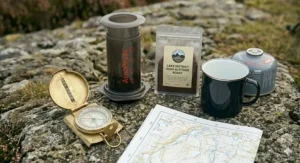
How to Choose Camping Coffee Makers for One Person in the UK
Choosing the right solo camping coffee maker comes down to four honest questions:
1. How do you carry your kit? If you’re backpacking any serious distance — anything over 10km, say — weight matters enormously. The GSI Java Drip and MSR MugMate are the only realistic choices for genuine ultralight use. The AeroPress Go at 240g sits in the “worthwhile compromise” zone. The Stanley and Nanopresso are car camping kit.
2. What coffee do you actually want? Espresso: Nanopresso or Bialetti Moka Express. Clean, bright filter coffee: Hario V60 or GSI Java Drip. Full-bodied, rich cup: AeroPress, Stanley French Press, or MSR MugMate. If you honestly don’t care as long as it’s hot and caffeinated: Bialetti, no further deliberation needed.
3. Are you using a gas stove? The Bialetti Moka Express and Stanley All-In-One both require an open flame or gas stove to function. The AeroPress, Nanopresso, V60, Java Drip, and MugMate need only hot water — from any source. According to Which? magazine, the most-returned camping equipment includes stove-dependent items bought without checking compatibility first. Don’t be that person.
4. How much washing-up are you willing to do? Honest answer required. The AeroPress wins the clean-up stakes by a landslide — one puck ejection, one rinse, done. The Nanopresso has more parts. The Moka Express needs more care. The MugMate and Java Drip are simple mesh rinses. French press-style brewers generate the most wet-grounds faff.
Common Mistakes When Buying Solo Camping Coffee Equipment
Buying stovetop-only kit without a compatible stove. The Bialetti Moka Express is brilliant — but if your camping stove has a tiny burner head or an unstable canister mount, a small aluminium pot with a low centre of gravity and no handle can tip. Test stability on a flat surface at home before trusting it at 6am on a hillside.
Ignoring grind size. Every brewer on this list has an optimal grind setting. Using pre-ground espresso blend in an AeroPress will produce over-extracted bitterness. Using coarse French press grind in a pour-over dripper means weak, under-extracted coffee and a filter that runs through in 30 seconds. The Specialty Coffee Association publish free brew guidelines, and it’s worth spending five minutes with the relevant section before your first trip.
Choosing by weight alone. The GSI Java Drip weighs 11g. The AeroPress Go weighs 240g. The difference in a loaded 12kg pack is imperceptible. If you’re choosing the Java Drip over the AeroPress purely for the weight saving, make sure the coffee quality trade-off is worth it to you — and for many people it won’t be.
Not checking UK availability. Several highly-rated camping coffee makers sold on Amazon.com either don’t ship to the UK or arrive via third-party sellers at inflated prices after post-Brexit import adjustments. All seven picks in this guide are verified as available directly on Amazon.co.uk.
Expecting espresso from non-espresso kit. The AeroPress produces a concentrated, espresso-style brew. It is not espresso. If you want proper crema and genuine espresso pressure, only the Nanopresso and Bialetti Moka Express deliver that on a campsite. Adjusting expectations saves disappointment on the first morning of a trip.
Benefits vs Traditional Alternatives
| Method | vs Instant Coffee | vs Cafetière at Home |
|---|---|---|
| AeroPress Go | 🏆 Far better quality, barely more faff | Comparable quality, significantly more portable |
| Moka Express | 🏆 Much stronger, richer flavour | Espresso-style intensity you can’t get from a home cafetière |
| Pour-over (V60/Java Drip) | 🏆 Cleaner, more complex flavour | Very close — arguably better with good beans |
| Nanopresso | 🏆 Genuine espresso, no comparison | Better in intensity; home machine wins on convenience |
| MSR MugMate | Slightly better quality | More sediment than home cafetière |
The table confirms what most experienced campers eventually conclude: instant coffee has its place in emergency kit, but for anyone camping more than once a year, a dedicated brewer pays off immediately in cup quality. According to research published by the British Coffee Association, coffee consumption has grown year-on-year since 2015, with outdoor and on-the-go brewing methods seeing the sharpest uptick — a trend that shows no signs of reversing.
The home cafetière comparison is also instructive. Most of the brewers above produce coffee comparable to a quality home cafetière — with the V60 and AeroPress arguably exceeding it when good beans and correct technique are used.
Real-World Performance in British Weather
British camping conditions are a specific test that most gear reviews, written primarily for American audiences, ignore entirely. Here’s what actually matters when the temperature is 8°C, it’s raining sideways, and your hands are mildly hypothermic.
The AeroPress Go performs consistently well in cold temperatures — the pressure-based brewing is less affected by minor water-temperature variance than pour-over methods. If your water has dropped to 85°C by the time it’s poured, the AeroPress still produces a drinkable cup. The V60 at the same temperature starts producing under-extracted, thin coffee.
The Bialetti Moka Express doesn’t care about ambient temperature at all — it heats from below and is fully enclosed. This makes it the most weatherproof option in the list for cold, damp mornings. The one caveat: aluminium conducts cold rapidly, and the handle can get extremely cold to hold. Bring a small cloth.
The GSI Java Drip and Hario V60 benefit significantly from a preheated mug and some wind protection. In a sheltered pitch on a dry morning, they’re excellent. On a fully exposed November ridgeline in the Yorkshire Dales — a different story.
The Nanopresso’s manual pump mechanism can feel stiff in cold temperatures; warming it briefly in a jacket pocket before use makes a noticeable difference. Cold hands make the pressing action harder.
For guidance on wild camping in the UK — including where it is and isn’t legally permitted — Natural England and NatureScot publish clear guidance. Wild camping is generally legal in Scotland under the Land Reform (Scotland) Act 2003, while England and Wales require landowner permission except in Dartmoor National Park, which recently had its right-to-camp status clarified legally.
Price Range & Value Analysis
| Price Tier | Best Pick | What You Sacrifice vs Higher Tier |
|---|---|---|
| Under £20 | GSI Ultralight Java Drip / Bialetti Moka Express (1-cup) | Versatility, convenience |
| £20–£40 | AeroPress Go | Espresso intensity |
| £40–£70 | Wacaco Nanopresso | Pack weight |
| £35–£55 | Stanley All-In-One | Portability on foot |
The clearest value outlier here is the AeroPress Go. For between £30 and £40 on Amazon.co.uk, it delivers brewing versatility and cup quality that exceeds brewers costing twice as much. If you’re undecided and your budget allows, it’s the recommendation that holds up across the widest range of camping scenarios.
The Bialetti Moka Express at under £25 is the best budget play for anyone with a gas stove who prioritises coffee intensity over everything else. Buy once, use forever — genuinely.
Note: all prices above are indicative ranges based on research at time of writing. Amazon.co.uk prices fluctuate regularly — check current pricing before purchasing. All prices include 20% UK VAT.
✨ Don’t Miss These Exclusive Deals!
🔍 Whether you’re going ultralight or car camping in style, these seven solo coffee makers represent the best options on Amazon.co.uk right now. Click on any highlighted product to check current pricing and availability — and don’t forget to check for Prime delivery if you need it quickly!
FAQ: Camping Coffee Makers for One Person
❓ What is the best camping coffee maker for one person in the UK?
❓ Are camping coffee makers gas stove compatible?
❓ Can I use a Bialetti Moka pot on a camping gas stove in the UK?
❓ What is the lightest coffee maker for solo backpacking in the UK?
❓ Do I need to pack out coffee grounds when wild camping in the UK?
Conclusion
The perfect camping coffee maker for one person doesn’t exist in the singular — it exists in the context of how you camp. The backpacker grinding out miles on the Pennine Way needs different kit from the weekend car camper parked in a Cotswold field with a hamper in the boot. That’s what this guide is designed to reflect.
If there’s one recommendation that holds up across the most scenarios — and we’d stake our thermos on it — it’s the AeroPress Go. Lightweight, forgiving, brilliantly versatile, and available on Amazon.co.uk right now, it is the closest thing the camping world has to a universal answer. But the Bialetti Moka Express at under £25 is the budget purchase that’s hard to argue against, the GSI Java Drip is a marvel of minimalist engineering, and the Nanopresso is the choice for anyone who believes espresso is not a luxury but a right.
Whatever you choose, the verdict is unanimous: you’re better off with a proper camping coffee maker for one person than anything instant. The morning deserves better.
✨ Don’t Miss These Exclusive Deals!
🔍 Find your perfect solo camping brew with these carefully selected options on Amazon.co.uk — click any highlighted product to check current pricing. Happy camping! ☕🏕️
Recommended for You
- Best Camping Coffee Makers UK 2026: 7 Expert Picks for Every Outdoor Brewer
- Best Camping Ovens UK 2026: 7 Expert Picks for Outdoor Baking
- Best Camping Toasters UK 2026: 7 Expert-Tested Options
Disclaimer: This article contains affiliate links. As an Amazon Associate, I earn from qualifying purchases. If you purchase products through these links, we may earn a small commission at no additional cost to you.
✨ Found this helpful? Share it with your mates! 💬🤗
