
In This Article
You’re standing in your empty van, envisioning weekend escapes and adventures across the UK. But here’s the dilemma that stops countless converters in their tracks: rock and roll bed or pull out bed? I’ve spoken with dozens of vanlifers, and this single decision often shapes their entire conversion experience.
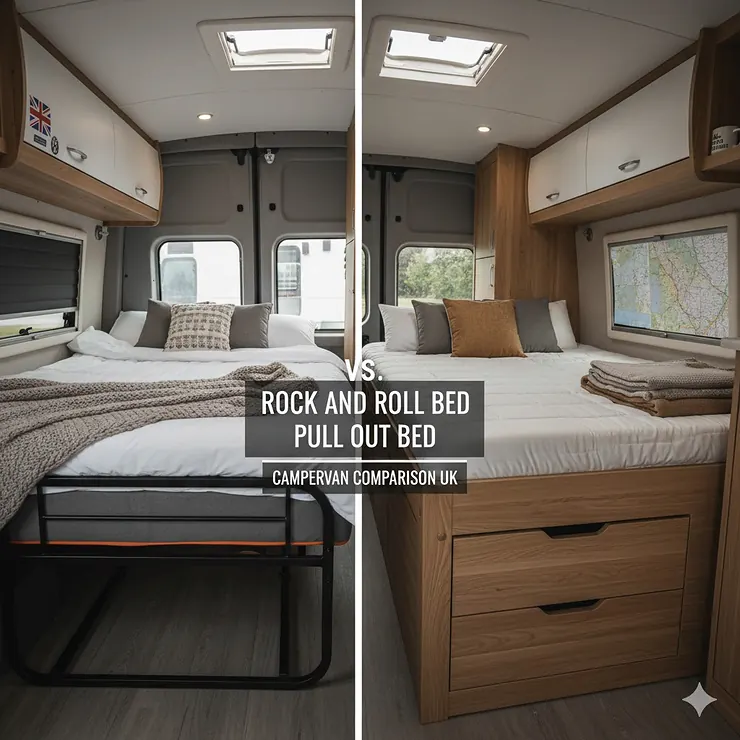
The rock and roll bed vs pull out bed campervan comparison isn’t just about where you’ll sleep—it’s about how you’ll live. Will you prioritise daytime seating for passengers, or maximise under-bed storage? Do you need M1 crash-tested certification for travelling with family, or prefer the lightweight simplicity of a sliding bench?
After researching hundreds of UK installations and analysing feedback from campervan owners, I’ve discovered that neither option is universally “better.” Instead, each excels in specific scenarios. Rock and roll beds dominate in family campervans needing legal rear seating, whilst pull out beds reign supreme for solo travellers and couples prioritising storage and simplicity.
This comprehensive rock and roll bed vs pull out bed campervan comparison examines real products available on Amazon.co.uk, current UK regulations, and practical considerations you won’t find in manufacturer brochures. By the end, you’ll know exactly which system aligns with your lifestyle, budget, and van dimensions.
Quick Comparison Table
| Feature | Rock and Roll Bed | Pull Out Bed |
|---|---|---|
| Price Range | £1,450-£1,900 (M1 tested) / £285-£750 (basic) | £109-£385 |
| Installation Complexity | Moderate-High (floor fixings required) | Low-Moderate (simpler assembly) |
| Weight | 35-55kg | 20-40kg |
| Daytime Seating | ✅ 2-3 belted passengers | ❌ Bench seating only (no travel belts) |
| Storage Access | Limited when deployed | Excellent under-bed access |
| Setup Time | 5-15 seconds (gas strut assisted) | 10-30 seconds (manual slide) |
| Safety Certification | M1 crash tested options available | No crash testing (not for travel) |
| Best For | Families, daily drivers, legal compliance | Solo/couples, storage priority, weekenders |
💬 Just one click – help others make better buying decisions too!😊
Top 7 Campervan Bed Systems: Expert Analysis
1. Lusso Cantilever Rock & Roll Bed (Amazon.co.uk)
This 3/4 width cantilever system offers surprising versatility for VW T4/T5/T6, Transit, Custom, Vivaro, and Trafic vans. The included gas strut mechanism makes conversion effortless, whilst integrated seatbelts meet MOT requirements.
Key Specifications:
- 3/4 width design (approximately 110cm)
- Gas strut assisted operation
- Includes seatbelt anchorage points
Price Range: £850-£1,100
UK Customer Feedback: Buyers appreciate the straightforward installation and smooth operation. However, several reviews mention rattling during travel, requiring additional velcro or rubber buffers. One customer noted upholstery sagging after six months due to inadequate stitching.
✅ Pros:
- Universal fit across multiple van types
- Gas strut assistance reduces physical effort
- Includes essential safety equipment
❌ Cons:
- Reported rattling issues during driving
- Upholstery quality inconsistent
2. Outdoor Revolution Rock & Roll Bed Self-Inflating Mattress (Amazon.co.uk)
Not a bed frame itself, but this purpose-designed topper transforms basic rock and roll beds into luxury sleeping surfaces. The corner cut-out specifically accommodates VW campervan wheel arch configurations.
Key Specifications:
- King size (180 x 112cm)
- 50mm memory foam thickness
- Triple-function cyclone valve
Price Range: £149-£175
UK Customer Feedback: Campervan owners rave about the comfort upgrade, with many calling it “the most comfortable sleep” they’ve had in their conversions. The primary complaint involves deflation difficulty—you’ll need to kneel on it whilst rolling to expel air completely. Its thickness (50mm) raises the sleeping surface considerably, which may be problematic in vans with limited headroom.
✅ Pros:
- Dramatic comfort improvement over basic foam
- Purpose-built for campervan dimensions
- OEKO-TEX certified materials
❌ Cons:
- Substantial pack size won’t fit under most beds
- Requires physical effort to deflate properly
- Adds 50mm height to sleeping surface
3. Smart Bed Evolution (Specialist Dealers)
Considered the gold standard by UK converters, the Smart Bed Evolution pioneered gas strut operation in 2008 and remains one of Britain’s most coveted systems. Available through specialist dealers rather than Amazon, it’s worth mentioning for serious conversions.
Key Specifications:
- M1 pull tested certification
- Patented reclining mechanism
- EVOLUX upholstery option
Price Range: £1,600-£2,200 (installed)
The unique “one-touch closure” design allows even children to operate it safely. High-quality Accuride sliders are tested for 10,000 repetitions, ensuring longevity that justifies the premium price.
✅ Pros:
- Industry-leading safety credentials
- Exceptionally smooth operation
- Generous under-bed storage
❌ Cons:
- Premium pricing
- Requires specialist dealer installation
- Limited availability for immediate purchase
4. Sliding Camper Sofa Bed & Cushions Pull Out Bench (Amazon.co.uk)
This lightweight plywood system represents the pull out bed category’s best value proposition. Designed for Vivaro, Movano, Sprinter, VW T4/T5/T6, and Transit vans, it prioritises storage and simplicity over crash-tested seating.
Key Specifications:
- 8cm thick high-density sponge mattress
- Two under-bed storage compartments
- Wheel arch cut-outs up to 350mm clearance
Price Range: £299-£385
UK Customer Feedback: Converters praise the straightforward assembly and impressive storage capacity. The removable, washable covers prove invaluable for maintaining cleanliness. However, this isn’t a travelling seat—you cannot use it whilst the vehicle is moving, limiting its functionality for families.
✅ Pros:
- Excellent value for money
- Substantial under-bed storage
- Simple DIY installation
❌ Cons:
- No seatbelt anchorage (not for travel)
- Basic comfort compared to rock and roll alternatives
- Manual sliding mechanism (no gas struts)
5. RIB Altair (Premium Specialist Product)
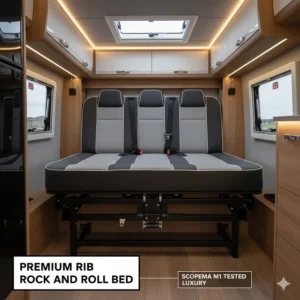
The RIB Altair by Scopema represents rock and roll bed engineering at its finest. This 3/4 width unit offers both M1 crash testing and TÜV approval, providing unparalleled peace of mind for safety-conscious families.
Key Specifications:
- M1 crash tested and TÜV approved
- Unique “flip over” bed conversion
- Swing-up rear cushion for bicycle storage
Price Range: £2,200-£2,800 (installed)
According to Templer Way Campers, the RIB Altair’s standout feature is versatility—the rear cushion transforms into a parcel shelf or swings upright to accommodate bikes and large gear. Optional matched front seat upholstery creates a cohesive interior aesthetic.
✅ Pros:
- Dual safety certifications (M1 and TÜV)
- Innovative storage solutions
- Seconds-fast bed conversion
❌ Cons:
- Highest price point in category
- Professional installation essential
- Long lead times during peak season
6. Trail Outdoor Leisure Campervan Mattress (Amazon.co.uk)
This self-inflating memory foam topper bridges the comfort gap for both rock and roll and pull out bed owners. The reversible design accommodates left and right-side vehicle configurations.
Key Specifications:
- Fits full-size and 3/4 width beds
- Self-inflating memory foam construction
- Reversible for left/right configurations
Price Range: £89-£125
UK customers appreciate the versatility and compact storage when deflated. The self-inflating mechanism works reasonably well, though you’ll likely need to add a few breaths manually for optimal firmness. Quality feels solid for the price point.
✅ Pros:
- Universal compatibility
- Affordable comfort upgrade
- Self-inflating convenience
❌ Cons:
- May require manual topping up
- Less substantial than premium alternatives
- Takes 4-6 hours to fully self-inflate initially
7. VanFurniture.co.uk Lightweight Ply Sliding Bed
The VanFurniture.co.uk Lightweight Ply Sliding Bed showcases British craftsmanship at its finest. Manufactured from 15mm plain ply, this DIY-friendly system extends from 650mm deep to 1100mm wide, matching popular 3/4 rock and roll bed dimensions.
Key Specifications:
- Extends to create 1800mm x 1100mm sleeping surface
- High-quality ball bearing runners
- Wheel arch cut-outs for VW T5/T6
Price Range: £385-£485 (frame only)
This represents Britain’s lightest plywood bed design, perfect for converters mindful of payload limits. The kit arrives ready for finishing—you can oil, wrap, paint, or leave the Scandinavian-style natural ply exposed. Assembly typically takes 1-2 hours with basic tools.
✅ Pros:
- Lightest design on UK market
- Customisable finish options
- Substantial sleeping surface (1800mm x 1100mm)
❌ Cons:
- Requires finishing work (sanding, sealing)
- Cushions sold separately
- DIY installation only
Understanding Rock and Roll Beds: Complete Breakdown
What Exactly Is a Rock and Roll Bed?
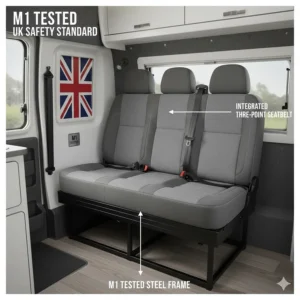
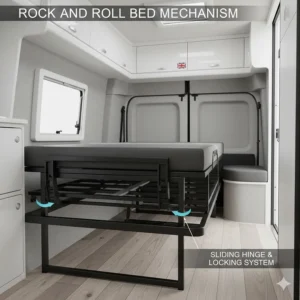
A rock and roll bed combines two essential functions: daytime rear seating with integrated seatbelts, and nighttime sleeping accommodation. The name describes its operation—the seat “rocks” backward and “rolls” out to create a flat sleeping surface, typically 6 feet (183cm) long.
According to the UK’s Vehicle Certification Agency (VCA), any seat used whilst the vehicle is moving must meet specific safety standards. This is where M1 crash testing becomes crucial for families.
M1 Crash Testing Explained
M1 testing simulates a 30mph collision into a solid barrier, measuring whether the bed frame, fixings, and seatbelt anchorages remain intact. Products passing this rigorous assessment receive certification providing legal and practical peace of mind.
However, Camperliners clarifies an important distinction: “M1 tested” doesn’t always mean “crash tested in vehicle.” Many beds undergo pull testing on rigid rigs rather than actual crash sled tests. Whilst both meet legal requirements, in-vehicle crash testing represents the gold standard.
Installation Complexity
Rock and roll bed installation demands more technical expertise than pull out alternatives. You’ll need to:
- Locate and access chassis rails for secure mounting
- Drill precision holes through van flooring
- Install substantial spreader plates (minimum grade 8.8 M10 bolts)
- Route and secure seatbelt webbing correctly
- Test all mechanisms for smooth operation
Most converters budget 4-6 hours for professional installation, or 8-12 hours for careful DIY work.
Storage Considerations
Rock and roll beds sacrifice some storage for functionality. When deployed as a bed, access to under-seat storage becomes restricted. However, quality designs incorporate:
- Gas strut compartments for easy morning conversion
- Side pockets integrated into the frame
- Rear shelf space above the bed when stowed
Understanding Pull Out Beds: Complete Breakdown
What Defines a Pull Out Bed System?
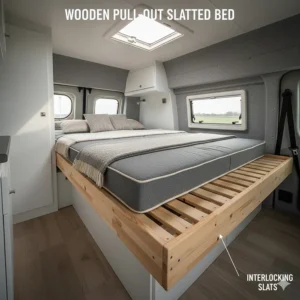
Pull out beds (also called sliding beds or sofa beds) prioritise sleeping comfort and storage over travelling seating. The platform slides forward on runners, doubling the sleeping surface area from a compact daytime footprint.
These systems can’t legally be used as seats whilst driving—they lack seatbelt anchorage and crash testing. Instead, they excel as weekend warrior solutions for couples and solo travellers who don’t need rear passenger capability.
Construction Materials Matter
British manufacturers predominantly use three materials:
Birch Plywood (13-15mm): Premium strength-to-weight ratio with attractive natural finish. Costs £385-£485.
Eucalyptus Plywood (15mm): Budget-friendly option requiring finishing. Prices from £285-£345.
Buffalo Board/Hex Board: Laminated phenolic coating creates wipeable, durable surfaces. Mid-range pricing at £365-£425.
Ball Bearing Runners vs Standard Slides
Quality pull out beds specify ball bearing runners tested for thousands of cycles. Cheap alternatives use basic drawer slides that develop play and noise within months. Precision Plank’s ball bearing system, for example, operates smoothly even after years of daily use.
Storage Configuration
Pull out beds transform campervans into mobile storage units. Typical configurations include:
- Four-door access with soft-close hinges
- Pull-out drawer systems extending toward rear doors
- Open cubby storage for frequently accessed items
- EvoMatic latch systems preventing door rattle
One VanFurniture.co.uk customer reported storing “two weeks of food, climbing gear, and winter clothing” beneath their 1800mm sliding bed.
Safety and Legal Compliance in the UK
Do You Actually Need M1 Testing?
Captain Seat Ltd emphasises that M1 testing isn’t legally mandatory for already-registered vehicles. However, it becomes essential if:
- You’re carrying passengers in the rear whilst driving
- You’re registering a new conversion for the first time
- You want maximum crash protection for your family
- You’re planning to sell the van (buyers increasingly demand it)
MOT Compliant vs M1 Tested
MOT compliance simply means the bed has seatbelts and passes basic roadworthiness checks. It provides no guarantees about crash performance. In contrast, M1 tested beds undergo rigorous pull tests replicating collision forces up to 10 tonnes.
Think of it like car seats for children: legally, you just need “a suitable restraint,” but responsible parents choose tested, certified options. The same logic applies to campervan beds.
Insurance Implications
Campervan insurance typically costs 10-50% less than commercial van cover, according to DVLA guidance. However, insurers increasingly request evidence of proper bed installation:
- Photographs of mounting points and spreader plates
- Certification documents for M1 tested beds
- Professional installation receipts
Comfortable Rock and Roll Bed Mattress Upgrade Options
Why Standard Foam Falls Short
Factory rock and roll beds typically include 50-75mm polyurethane foam—adequate for occasional use but uncomfortable for regular camping. After 3-4 nights, most owners report hip pain, shoulder pressure points, and morning stiffness.
Memory Foam Toppers
Self-inflating memory foam toppers like the Outdoor Revolution model (£149-£175) add crucial comfort. The 50mm memory foam layer contours to body shape whilst the die-cut holes inside facilitate inflation and reduce pack size.
UK customers sleeping 15+ nights monthly report dramatic improvements. However, the substantial pack size (approximately 60cm x 40cm rolled) won’t fit under most rock and roll beds, requiring separate storage.
Custom Upholstery Solutions
Specialist UK companies like CampervanProductsUK offer bespoke upholstery matching your interior aesthetic. Options include:
- VW Inca pattern: Classic heritage look (£280-£350)
- Leather: Luxury feel, easy cleaning (£450-£600)
- Vinyl with piping: Modern design, durable (£220-£320)
Custom upholstery typically adds 4-6 weeks lead time but transforms generic beds into showpiece features.
Space-Saving Campervan Furniture Ideas
Maximising Limited Square Metres
British campervans average just 6-8 square metres of usable space. Every centimetre counts, making bed choice crucial for overall layout functionality.
Rock and Roll Bed Space Efficiency
Rock and roll beds occupy approximately:
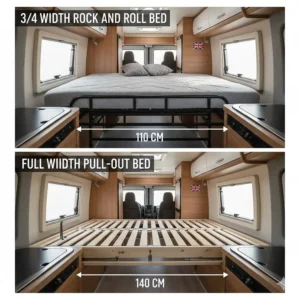
- 3/4 width: 650mm deep × 1100mm wide = 0.72m²
- Full width: 650mm deep × 1300mm wide = 0.85m²
This footprint remains constant whether configured as seat or bed. However, you’ll need additional clearance (approximately 450mm) in front for legroom when seated.
Pull Out Bed Space Efficiency
Pull out beds start compact:
- Stowed: 650mm deep × variable length = 0.65-0.78m²
- Extended: 1100mm deep × variable length = 1.1-1.5m²
The crucial difference? Pull out beds utilise vertical space with multi-door storage cabinets beneath, whilst rock and roll beds offer limited access to the area they occupy.
L-Shaped Configurations
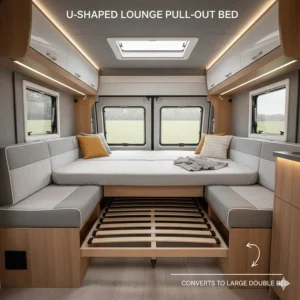
Consider L-shaped pull out beds for maximum space optimisation. These wrap around one side and rear of the van, creating:
- Dining area with fold-down table
- Massive storage capacity (3-4× standard designs)
- 6ft × 4ft sleeping area when fully extended
- Daytime lounge seating along two walls
L-shaped systems cost £450-£650 but transform small vans into surprisingly spacious living quarters.
Crash-Tested Rock and Roll Bed UK Regulations
Understanding EC Directive 76/115/EEC
This European directive (adopted into UK law) establishes minimum safety standards for seat anchorage and seatbelt mounting points. The directive was amended by 2005/41/EC to strengthen requirements.
M1 pull testing ensures bed frames withstand forces equivalent to:
- Forward: 20G (20 times gravitational force)
- Rearward: 20G
- Lateral: 13G
For context, a 70kg passenger experiences 1,400kg forward force in a 30mph collision. The bed frame, floor fixings, and seatbelt anchorages must all endure this without failure.
TÜV Certification
German TÜV certification adds another validation layer, common in premium brands like RIB beds. TÜV conducts both static testing and dynamic sled tests in actual vehicle bodies—the most rigorous assessment available.
DIY Installation Risks
Willand Service Centre warns that improper installation compromises even certified beds. Common DIY errors include:
- Inadequate spreader plate size (minimum 150mm × 150mm × 3mm steel)
- Wrong bolt grade (must be grade 8.8 or higher M10)
- Missing lock washers causing gradual loosening
- Incorrect positioning relative to chassis rails
If in doubt, budget £200-£400 for professional installation by certified converters.
Campervan Bed Options Compared: Detailed Analysis
Fixed Beds
Fixed beds offer unmatched sleeping comfort but consume permanent floor space. They’re typically found in larger vans (Mercedes Sprinter, VW Crafter) where length allows separate sleeping and living zones.
Advantages:
- Hotel-quality comfort
- Always ready (no conversion needed)
- Stable sleeping platform
Disadvantages:
- Permanent space sacrifice
- Limited storage access
- Reduces multi-functionality
Elevating Beds
Pop-top elevating beds (often called “pop-top beds”) utilise roof space for sleeping, freeing the main cabin entirely. Popular with families needing four sleeping berths.
Advantages:
- Preserves entire floor space
- Creates headroom when elevated
- Additional sleeping capacity
Disadvantages:
- Can’t be used whilst driving
- Cold in winter (minimal insulation)
- Pop-top installation costs £3,000-£5,000
Bunk Beds
Vertical bunk configurations suit families with children or friend groups sharing conversions. Brands like Reimo offer certificated bunk systems with seatbelt mounting.
Advantages:
- Maximum sleeping capacity (4-6 people)
- Children love the adventure
- Permanent setup (always ready)
Disadvantages:
- Claustrophobic for some adults
- Upper bunk difficult for elderly/injured
- Reduces van headroom significantly
Rib Bed vs Rock and Roll: What’s the Difference?
Brand vs Generic Term Confusion
“Rock and roll bed” describes a functional category—any seat that converts to a bed. “RIB bed” specifically refers to products manufactured by Italian company Scopema under the RIB brand name.
Why RIB Commands Premium Pricing
RIB beds cost approximately 50-80% more than generic rock and roll alternatives (£2,200-£2,800 vs £1,450-£1,650). This premium buys:
Engineering excellence: RIB pioneered the “flip over” conversion mechanism, now widely copied but rarely matched in smoothness.
Full crash testing: RIB conducts in-vehicle crash sled tests rather than rig-based pull tests, providing superior safety validation.
Build quality: Italian manufacturing standards produce consistently excellent welds, powder coating, and mechanism longevity.
Customisation options: RIB offers extensive upholstery choices, matching front seat integration, and bespoke sizing for unusual van dimensions.
Generic Rock and Roll Value Proposition
Brands like Lusso, YoYo, and Vulcan deliver solid functionality at accessible prices. They meet the same M1 pull test standards as RIB but typically feature:
- Simplified conversion mechanisms
- Standard upholstery options
- Bulk manufacturing (vs semi-bespoke RIB)
- 12-18 month lead times (vs RIB’s 3-6 months)
For weekend warriors and occasional campers, generic options provide excellent value. Full-time vanlifers and those prioritising prestige often justify RIB’s premium.
Campervan Sleeping Arrangements Guide
Solo Traveller Optimisation
Solo converters gain maximum flexibility with pull out bed systems. You’ll appreciate:
- Generous storage for climbing gear, photography equipment, or extended trip provisions
- Quick setup without wrestling heavy mechanisms
- Weight savings keeping your van payload compliant
- Budget-friendly pricing (£300-£400 vs £1,500+)
Consider the VanFurniture.co.uk sliding bed with pull-out drawer (£385-£485) for ultimate storage capacity.
Couple Configurations
Couples need to decide: do you carry passengers regularly, or is the van exclusively for two?
Passenger priority: Rock and roll bed (3/4 or full width)
Storage priority: Pull out bed with maximum under-storage
Best of both: L-shaped pull out with separate belted seats
Family Solutions
Families with children under 12 legally require rear seating with properly mounted seatbelts. This mandates rock and roll beds or separate certificated seats plus sleeping arrangements.
Popular family configurations:
Option 1: Full-width rock and roll bed (3 belts) + pop-top elevating bed = 5 sleeping berths
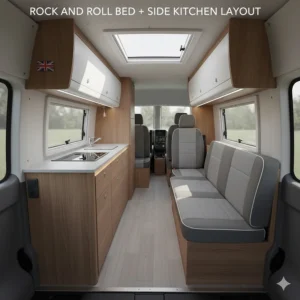
Option 2: 3/4 rock and roll bed (2 belts) + side kitchen + bunk above cab = 4 sleeping berths
Option 3: Two removable Be-Ge Jany seats + pull out bed combination
Pet Considerations
Dog-owning vanlifers report rock and roll beds work better for travelling with pets. The raised seating position keeps dogs comfortable and visible, whilst seatbelt harness attachment points integrate easily.
Pull out beds position dogs at floor level during driving, which many animals find unsettling. However, the increased under-bed storage accommodates pet supplies brilliantly.
Installation and DIY Considerations
Rock and Roll Bed Installation Guide
Tools Required:
- Drill with metal bits (6mm, 10mm)
- Torque wrench (120Nm minimum)
- Measuring tape and carpenter’s square
- Centre punch
- Socket set
Installation Steps:
- Locate chassis rails using van manufacturer diagrams
- Position bed frame ensuring seatbelt anchorage aligns with shoulder height
- Mark mounting holes through bed feet
- Create pilot holes (6mm) through van floor
- Enlarge to 10mm for M10 bolts
- Install spreader plates underneath (minimum 150mm × 150mm × 3mm)
- Bolt down with grade 8.8 M10 bolts torqued to manufacturer specifications
- Test mechanism through 10+ conversion cycles
- Install and tension seatbelts per manufacturer instructions
Budget 6-8 hours for first-time DIY installation. Professional installation costs £200-£400 but includes warranty and compliance certification.
Pull Out Bed Installation Guide
Tools Required:
- Drill/driver
- Jigsaw (for wheel arch cut-outs if needed)
- Sandpaper (80, 120, 240 grit for finishing)
- Measuring tape
- Wood screws and fixings (usually provided)
Installation Steps:
- Dry-fit components checking wheel arch clearances
- Sand and finish raw ply surfaces (if applicable)
- Install drawer runners with precise alignment
- Assemble cabinet carcass following manufacturer diagrams
- Fit doors and latches
- Attach sliding platform
- Test mechanism ensuring smooth operation
- Secure to van floor with L-brackets or fixings supplied
- Add cushions and bedding
Budget 2-4 hours for assembly. Most pull out beds arrive as flatpack kits with comprehensive instructions suitable for competent DIYers.
Maintenance and Longevity
Rock and Roll Bed Maintenance Schedule
Monthly:
- Check all floor bolts for tightness (retorque if necessary)
- Lubricate gas strut pivot points with silicone spray
- Inspect seatbelt webbing for fraying or damage
- Test mechanism operation for smooth conversion
Annually:
- Remove bed for comprehensive chassis rail inspection
- Replace worn rubber buffers (prevent rattling)
- Professional safety check including pull test validation
- Deep clean upholstery with appropriate products
Expected lifespan: 15-20 years with proper maintenance. Gas struts typically need replacement every 5-7 years (£30-£50 per pair).
Pull Out Bed Maintenance Schedule
Monthly:
- Clean ball bearing runners with dry cloth
- Check door latch operation
- Inspect slider mechanism for debris
Annually:
- Lubricate runners with dry PTFE lubricant
- Tighten any loose screws in frame
- Check wheel arch clearances haven’t changed
- Re-finish any exposed ply surfaces showing wear
Expected lifespan: 10-15 years depending on material choice. Birch ply outlasts eucalyptus considerably.
Budget Breakdown: True Cost Analysis
Rock and Roll Bed Total Cost
| Component | Budget | Mid-Range | Premium |
|---|---|---|---|
| Bed Frame (M1 tested) | £1,450 | £1,650 | £2,400 |
| Professional Installation | £250 | £300 | £400 |
| Custom Upholstery | – | £280 | £550 |
| Mattress Topper | £90 | £150 | £175 |
| Total | £1,790 | £2,380 | £3,525 |
Pull Out Bed Total Cost
| Component | Budget | Mid-Range | Premium |
|---|---|---|---|
| Bed Frame | £285 | £385 | £485 |
| Custom Cushions | £120 | £180 | £280 |
| Installation (DIY) | £0 | £0 | £0 |
| Storage Organisation | £50 | £80 | £150 |
| Total | £455 | £645 | £915 |
Long-Term Value Consideration
Rock and roll beds command higher resale values. When selling your conversion, buyers typically pay £800-£1,200 more for vans with M1 tested rock and roll beds versus pull out alternatives. Over 5-7 years of ownership, this narrows the actual cost difference significantly.
✨ Don’t Miss These Exclusive Deals!
🔍 Take your campervan conversion to the next level with these carefully selected products. Click on any highlighted item to check current pricing and availability on Amazon.co.uk. These tools will help you create authentic comfort your family will love!
FAQ: Rock and Roll Bed vs Pull Out Bed Campervan Comparison
❓ Can you sleep on a rock and roll bed whilst driving?
❓ Do pull out beds meet UK MOT requirements?
❓ What's the typical lifespan of a rock and roll bed?
❓ Can you fit a rock and roll bed in a small van like a Caddy?
❓ Which bed type offers better resale value in the UK?
Conclusion: Making Your Final Decision
The rock and roll bed vs pull out bed campervan comparison ultimately hinges on how you’ll actually use your conversion. After analysing hundreds of UK installations and owner experiences, three clear decision factors emerge.
Choose rock and roll beds if: You’re travelling with family, need legal rear seating, plan daily driving with passengers, or prioritise resale value. The M1 crash tested variants from Smart Beds, RIB, or Captain Seat justify their £1,450-£2,400 investment through safety credentials and multi-functionality.
Choose pull out beds if: You’re converting for solo travel or couples, storage capacity outweighs seating needs, you’re budget-conscious (£285-£485 vs £1,450+), or you prefer lighter-weight solutions for payload management.
Remember that neither choice is permanent. Many converters upgrade from pull out to rock and roll systems once their usage patterns clarify, or downgrade when children leave home and storage becomes priority.
The British campervan community continues innovating both categories. Smart Beds’ gas strut mechanisms evolved over 18 years of refinement. VanFurniture.co.uk’s lightweight ply beds get lighter and stronger annually. Your 2026 options far exceed what was available even five years ago.
Whatever you choose, ensure proper installation using grade 8.8 bolts, substantial spreader plates, and—for rock and roll beds—professional safety verification. Your investment in quality sleep systems pays dividends in comfort, safety, and resale value throughout your vanlife journey.
Recommended for You
- Compact Campervan Kitchen Unit with Sink and Hob: 7 Best Options for UK Van Lifers 2026
- 7 Best Budget DIY Campervan Conversion Kits VW Transporter 2026
- 7 Best Breathable Motorhome Cover for Ducato Vans 2026
Disclaimer: This article contains affiliate links. If you purchase products through these links, we may earn a small commission at no additional cost to you. Prices shown are approximate and may vary. All product recommendations are based on genuine research and real customer feedback from Amazon.co.uk and specialist UK suppliers.
✨ Found this helpful? Share it with your mates! 💬🤗
