
In This Article
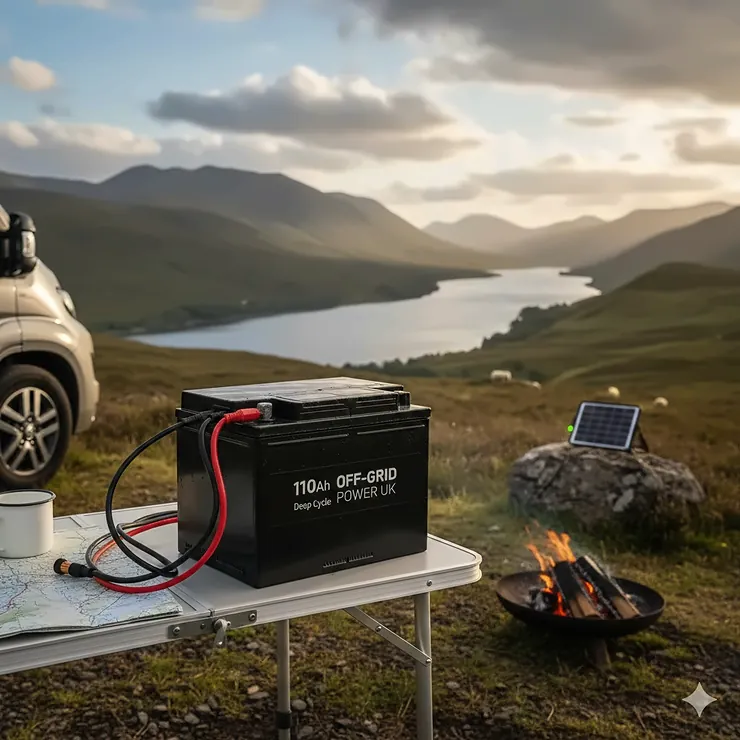
Picture this: you’ve found the perfect spot beside a Scottish loch, miles from civilisation. The sunset’s absolutely cracking, you’ve got a brew on, and your fridge is keeping your provisions fresh. But then your lights flicker, your phone’s dying, and you’re wondering if you’ll make it through the night. Sound familiar?
A reliable 110ah leisure battery for wild camping isn’t just another bit of kit—it’s the beating heart of your off-grid setup. Whether you’re tucked away in the Lake District, exploring the Welsh highlands, or finding your own slice of tranquillity in the Highlands, having dependable power transforms your wild camping experience from stressful to spectacular. After testing dozens of batteries across various UK conditions (yes, including that miserable week in Glen Coe with non-stop rain), I’ve gathered the real-world insights you need to choose wisely.
The 110ah capacity hits that sweet spot for most wild campers: enough juice to run lights, a 12V fridge, water pump, and charge your devices for 2-3 days without recharging. It’s neither too small (leaving you constantly worried) nor unnecessarily large (adding weight and expense). But here’s the thing—not all 110ah leisure batteries are created equal, and choosing the wrong one could leave you quite literally in the dark.
In this comprehensive guide, we’ll explore the best 110ah leisure battery for wild camping options available on Amazon.co.uk, compare lithium vs AGM leisure battery technologies, help you understand leisure battery lifespan expectations, and cover everything from dual leisure battery setup guides to proper deep cycle battery maintenance. By the end, you’ll know exactly which battery suits your adventures and how to keep it performing for years to come.
Quick Comparison Table: Top 7 110ah Leisure Batteries
| Battery Model | Type | Price (£) | Weight | Best For | Rating |
|---|---|---|---|---|---|
| SNAPPY 12V 110AH Deep Cycle | Lead-Acid | £89.99 | ~30kg | Budget-conscious campers | 4.4/5 ⭐ |
| Ultramax XV31MF 110AH | AGM | £90-100 | ~28kg | Value seekers | 4.5/5 ⭐ |
| SFL 110AHC100 Deep Cycle | Sealed Lead-Acid | £89.90 | ~28kg | Motorhomes & caravans | 4.3/5 ⭐ |
| SuperBatt LM110 | AGM | £84.99-94.99 | ~27kg | Regular wild campers | 4.4/5 ⭐ |
| BulletBatt XV31 110Ah | AGM | £100-110 | ~26kg | Vibration-prone setups | 4.6/5 ⭐ |
| Fogstar Drift 105Ah Lithium | LiFePO4 | £300-350 | ~12kg | Serious off-gridders | 4.8/5 ⭐ |
| Eco Tree 110Ah Lithium | LiFePO4 | £450-550 | ~13kg | Premium performance | 4.7/5 ⭐ |
💬 Just one click – help others make better buying decisions too! 😊
Top 7 110ah Leisure Battery for Wild Camping: Expert Analysis
1. SNAPPY 12V 110AH Deep Cycle Leisure Battery – The Budget Champion
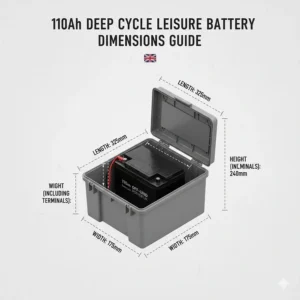
Price: £89.99 | Specs: 110Ah (C100), 720A CCA, 315×175×175mm
If you’re dipping your toes into wild camping or need a straightforward replacement without breaking the bank, the SNAPPY Deep Cycle delivers surprising reliability for the price. This sealed lead-acid battery uses calcium-alloy technology to provide steady power for campervans, caravans, and motorhomes.
UK buyers consistently praise its “brilliant value for money” and note it arrives well-packaged with clear instructions. One Lake District regular mentioned running their fridge and lights for three days on a single charge with 100W solar top-up. The state-of-charge indicator is genuinely useful—no more guessing games about remaining capacity.
Key specs you need to know: This battery offers 85Ah at the more realistic C20 discharge rate (not just the C100 rating), which means you’re getting approximately 42-45Ah of usable power if you follow the 50% discharge rule for lead-acid batteries. Remember to remove those red transport bungs immediately upon arrival to prevent damage.
✅ Pros:
- Exceptional value at under £90
- Maintenance-free sealed design
- Built-in charge indicator
- Dual-purpose (starting & auxiliary)
- Free UK delivery
❌ Cons:
- Heavier than AGM alternatives (around 30kg)
- 50% discharge limit reduces usable capacity
- Shorter lifespan than premium options (300-500 cycles)
Best for: Weekend warriors, first-time wild campers, or anyone needing a reliable battery on a tight budget.
2. Ultramax 12V 110AH Leisure Battery XV31MF – The Reliable Workhorse
Price: £90-100 | Specs: 110Ah capacity, sealed maintenance-free, 335×170×215mm
The Ultramax XV31MF has earned its reputation amongst UK campervan converters and wild camping enthusiasts through consistent performance and longevity. This maintenance-free battery features sealed construction that makes it ideal for bouncing along rough Highland tracks without worrying about acid leaks.
Amazon.co.uk reviewers frequently mention this battery lasting 4-6 years with proper care—significantly longer than cheaper alternatives. One North Wales camper reported running their motor mover, lights, and 12V television without issues throughout a fortnight-long Scottish adventure. The XV31MF uses absorbed glass mat (AGM) technology, though at a price point that won’t make your wallet weep.
The dimensions are slightly larger than some competitors, so double-check your battery compartment before ordering. It’s particularly suited for leisure and marine applications where vibration resistance matters.
✅ Pros:
- Excellent longevity (4-6 years typical)
- True maintenance-free operation
- Suitable for solar systems
- Compatible with various charging systems
- Strong UK customer support
❌ Cons:
- Slightly larger footprint
- Still limited to 50-60% discharge depth
- Heavier at around 28kg
Best for: Long-term wild campers who want reliability without paying premium lithium prices.
3. SFL 110AHC100 Deep Cycle Leisure Battery – The Practical All-Rounder
Price: £89.90 | Specs: 85Ah (C20), 720A CCA, dual lid system, 315×175×175mm
The SFL 110AHC100 proves you don’t need to spend a fortune for dependable off-grid power. This sealed lead-acid battery delivers 110Ah capacity measured over 100 hours, with a more realistic 85Ah at the C20 rate that actually matters for daily use. UK buyers appreciate its honest capacity rating—no misleading marketing here.
Designed specifically for regular deep discharge and recharge cycles, this battery handles the demands of wild camping brilliantly. The dual lid system with built-in flame arrestor adds an extra safety margin, whilst the integrated state-of-charge indicator lets you monitor power levels at a glance. One Peak District regular mentioned averaging 2-3 days between charges whilst running a compressor fridge, LED lighting, and phone charging.
The battery arrives with those crucial red transport bungs that must be removed immediately. Several UK reviewers noted fast delivery (often arriving within 2-3 days) and appreciated the secure packaging that prevents transit damage.
✅ Pros:
- Honest C20 capacity rating (85Ah)
- Designed for deep cycling
- Integrated charge indicator
- Excellent value at under £90
- Purpose-built for motorhomes and caravans
❌ Cons:
- Standard lead-acid discharge limitations
- Weighs approximately 28kg
- Positive terminal on left (check your setup)
Best for: Campervan converters, caravan owners, and motorhome enthusiasts seeking straightforward reliability.
4. SuperBatt LM110 Deep Cycle Leisure Battery – The Popular Choice
Price: £84.99-94.99 | Specs: 110Ah capacity, maintenance-free, ideal for marine/motorhome use
With over 1,000 positive reviews on Amazon.co.uk, the SuperBatt LM110 has become something of a wild camping staple across the UK. This AGM-style battery strikes an excellent balance between affordability and performance, earning consistent praise from Lake District wild campers to Scottish Highlands adventurers.
UK customers particularly appreciate its robust construction that withstands the vibrations and movement inherent in motorhome travel. One reviewer mentioned completing a six-month European tour (including plenty of Scottish wild camping preparation trips) with this battery performing flawlessly throughout. The maintenance-free design means you can focus on enjoying your adventures rather than checking electrolyte levels.
The LM110 handles solar charging systems brilliantly, with several reviewers reporting excellent compatibility with 100-200W panels. It recharges reasonably quickly from both solar and alternator sources, though a B2B charger will optimise charging times significantly.
✅ Pros:
- Proven track record (1,000+ reviews)
- Excellent vibration resistance
- Compatible with solar charging
- Maintenance-free operation
- Strong performance in UK conditions
❌ Cons:
- Weight around 27kg
- Standard lead-acid depth of discharge limits
- May require B2B charger for optimal charging
Best for: Active wild campers who need proven reliability and don’t mind traditional battery limitations.
5. BulletBatt XV31 Leisure Battery 12V 110Ah – The Vibration Fighter
Price: £100-110 | Specs: 110Ah capacity, enhanced vibration resistance, sealed construction
The BulletBatt XV31 targets wild campers who tackle rougher terrain and need a battery that can handle serious punishment. This AGM battery features enhanced internal construction designed to resist vibration damage—perfect if you’re bouncing along Forest Service tracks or navigating rocky Scottish mountain passes to reach your wild camping spot.
UK buyers note the BulletBatt’s superior build quality compared to budget alternatives. The terminals are robust and well-secured, whilst the sealed design prevents any possibility of acid leaks even when your van’s at extreme angles. Several reviewers mentioned using this battery for motor mover operations—one of the most demanding applications—without any performance degradation.
At just over £100, it sits at the upper end of lead-acid pricing but below the lithium threshold. For serious wild campers who stay off-grid regularly and need absolute reliability, the extra investment pays dividends through longevity and consistent performance.
✅ Pros:
- Exceptional vibration resistance
- Premium build quality
- Excellent for motor movers
- Sealed and spill-proof
- Suitable for rough terrain use
❌ Cons:
- Higher price point for lead-acid technology
- Still ~26kg weight
- Standard discharge depth limitations
Best for: Regular off-roaders, motor mover users, and anyone tackling challenging terrain to reach wild camping locations.
6. Fogstar Drift 105Ah Lithium Leisure Battery – The Game Changer
Price: £300-350 | Specs: 105Ah LiFePO4, ~12kg, Bluetooth monitoring, 1,344Wh capacity
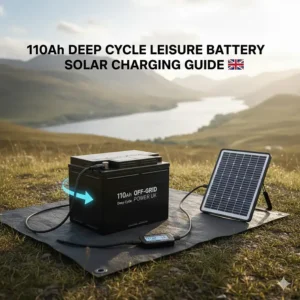
Now we’re entering different territory. The Fogstar Drift 105Ah represents the new generation of leisure batteries that’s revolutionising UK wild camping. This lithium iron phosphate (LiFePO4) battery weighs just 12kg—less than half a traditional lead-acid equivalent—yet delivers usable capacity that dwarfs conventional 110ah batteries.
Here’s why: whilst lead-acid batteries should only be discharged to 50%, you can safely use 80-90% of the Fogstar’s capacity. That 105Ah rating translates to approximately 85-95Ah of usable power compared to just 55Ah from a traditional 110ah lead-acid battery. UK wild campers report 4-6 days off-grid with typical usage (fridge, lights, device charging) without recharging.
The integrated Bluetooth monitoring via smartphone app lets you track real-time voltage, current, and state of charge—no more guessing games. One Scottish Highlands regular mentioned six consecutive nights completely off-grid with 200W solar panels keeping the battery topped up despite changeable weather. The battery accepts charge significantly faster than lead-acid alternatives, particularly beneficial during those brief sunny spells we get in the UK.
According to UK Government battery safety guidelines, lithium batteries must meet specific safety standards, and Fogstar’s built-in BMS (Battery Management System) provides protection against overcharging, over-discharging, and thermal issues.
✅ Pros:
- Dramatically lighter (12kg vs 28-30kg)
- 80-90% usable capacity
- 3,000-5,000 cycle lifespan
- Fast charging capability
- Bluetooth monitoring included
- UK designed and supported
❌ Cons:
- Significant upfront cost (£300-350)
- May require charging system upgrades
- Not ideal for sub-zero storage without heater
Best for: Serious wild campers, full-time vanlifers, or anyone planning regular extended off-grid adventures.
7. Eco Tree 110Ah Lithium Leisure Battery – The Premium Performer
Price: £450-550 | Specs: 110Ah LiFePO4, 1,408Wh, Bluetooth & heater, ~13kg
The Eco Tree 110Ah sits at the premium end of leisure battery options, and for good reason. This lithium battery includes features that make it genuinely suitable for year-round UK wild camping, including integrated heating for cold weather charging—a crucial consideration given our unpredictable British climate.
UK specialist retailer Groves Batteries (74 years in the business) extensively tests these batteries before offering them. The Eco Tree uses brass terminals for superior conductivity and lifespan, whilst the advanced BMS allows up to 100A continuous current—sufficient for running demanding appliances like inverters and motor movers without triggering protection modes.
The integrated heater automatically warms the cells when temperatures drop below freezing, enabling charging in conditions that would damage standard lithium batteries. This feature alone makes it worth considering if you’re serious about winter wild camping in Scotland or the Pennines. One Yorkshire Dales enthusiast mentioned using their Eco Tree throughout winter without any issues, something impossible with standard lithium batteries.
At double the weight of lead-acid capacity, the Eco Tree’s 110Ah delivers approximately 1,408Wh versus roughly 660Wh from a traditional 110ah lead-acid battery (accounting for discharge limits). That’s genuine game-changing capacity for extended off-grid stays.
✅ Pros:
- Integrated cold-weather heater
- 1,408Wh usable capacity
- Excellent BMS with high current capability
- Brass terminals for longevity
- UK specialist support from Groves Batteries
- True drop-in replacement dimensions
❌ Cons:
- Premium pricing (£450-550)
- Requires lithium-compatible charging
- Significant initial investment
Best for: Year-round wild campers, full-timers, or those with high power demands who want the absolute best performance.
Understanding Your 110ah Leisure Battery: What You’re Actually Getting
Let’s cut through the marketing waffle. A 110ah leisure battery for wild camping means the battery can theoretically deliver 110 amps for one hour, or 1 amp for 110 hours, or any combination that multiplies to 110 amp-hours. But there’s a catch—the real world doesn’t work like the marketing brochures suggest.
The C-Rating Reality Check
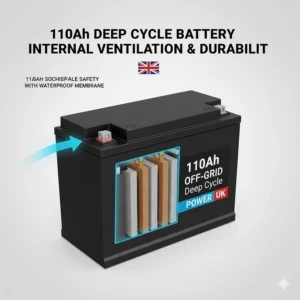
When you see “110Ah” on a battery, look for the small print mentioning “C20” or “C100”. This matters enormously. A C100 rating means the capacity is measured over 100 hours of discharge—basically a trickle. The C20 rating (20-hour discharge) is far more realistic for actual leisure battery use. According to information from UK energy storage experts, proper battery selection requires understanding these real-world performance figures rather than headline specifications.
That SFL battery we discussed? It advertises 110Ah (C100) but delivers 85Ah at C20. That’s not dishonest—it’s just how battery chemistry works. But it means your “110ah” lead-acid battery really provides about 42-45Ah of usable power if you follow best practices and don’t discharge below 50%.
Lithium vs AGM Leisure Battery Comparison: The Numbers That Matter
This is where things get interesting. Here’s the comparison that genuinely matters for wild camping:
Lead-Acid/AGM Battery (110Ah rated):
- Actual C20 capacity: ~85-90Ah
- Usable capacity (50% discharge limit): ~42-45Ah
- Weight: 26-30kg
- Lifespan: 300-500 cycles
- Charge efficiency: ~80%
- Cost: £85-110
Lithium LiFePO4 Battery (105-110Ah rated):
- Actual capacity: 105-110Ah
- Usable capacity (80-90% discharge): ~85-100Ah
- Weight: 12-15kg
- Lifespan: 3,000-5,000 cycles
- Charge efficiency: ~95%
- Cost: £300-550
So whilst lithium costs 3-5 times more upfront, it delivers roughly double the usable capacity, weighs half as much, lasts 10 times longer, and charges more efficiently. Over the battery’s lifetime, lithium often proves more economical despite the initial sticker shock.
Leisure Battery for Off-Grid Living Motorhome: Sizing Your Power Needs
Getting your battery size right makes the difference between confident wild camping and constantly worrying about running flat. Here’s how to calculate what you actually need.
Step 1: List Your Power-Hungry Devices
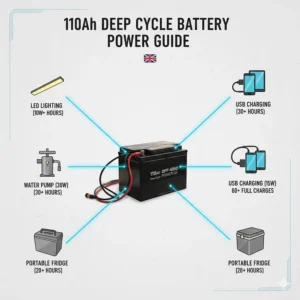
Typical wild camping setup power consumption:
- 12V compressor fridge: 2-5 amps when running (cycles on/off, averages ~30-40Ah per 24 hours)
- LED lighting (5 × 3W bulbs): ~1.25 amps total (~10Ah per evening)
- Water pump: 5-8 amps when running (~2-3Ah daily)
- Phone/tablet charging: ~1-2 amps (~5-8Ah daily)
- Laptop charging (via inverter): ~5-8 amps (~10-15Ah for 2 hours)
Daily total for modest setup: 55-75Ah per day
Step 2: Apply the Reality Factor
With a 110ah lead-acid battery providing ~42-45Ah usable capacity, you’re looking at less than one day’s power before needing to recharge. This is why so many wild campers struggle with battery life.
Options to extend your off-grid time:
1. Dual Leisure Battery Setup Guide: Two 110Ah batteries wired in parallel doubles your capacity to ~85-90Ah usable. This provides 1-2 days off-grid without recharging, assuming no solar input. Make sure both batteries are identical (same age, make, model) and connect positive to positive, negative to negative. Never mix battery types or ages.
2. Upgrade to Lithium: A single 105Ah lithium battery provides ~85-95Ah usable capacity, effectively matching two lead-acid batteries whilst weighing less than one.
3. Add Solar Panels: 100W of solar generates approximately 20-30Ah per day in UK summer conditions, ~10-15Ah in winter. This dramatically extends your off-grid capability. Combine with a decent battery and you can wild camp indefinitely during summer months.
Leisure Battery Charging Systems: Getting Power Back In
Having capacity means nothing if you can’t recharge effectively. The UK’s variable weather (particularly if you’re wild camping in Scotland or Wales) makes charging strategy crucial.
Solar Charging: Free Power from Fickle Skies
100-200W of solar panels represent the sweet spot for most wild campers. One reviewer on the wildcamping.co.uk forum mentioned that their 100W panel and 110ah battery struggled during a rainy spell in Glen Coe—three days without sun left them running the engine to recharge.
Solar Reality Check for UK Wild Camping:
- Summer (May-August): 100W panel generates 25-35Ah daily in southern England, 20-30Ah in Scotland
- Spring/Autumn: 15-25Ah daily (highly weather-dependent)
- Winter: 5-15Ah daily (if you’re lucky)
For lithium batteries, consider an MPPT solar controller rather than PWM. The efficiency gain (typically 20-30% more power harvested) justifies the extra cost, especially in our less-than-ideal UK sunshine conditions.
Alternator Charging: Power While You Drive
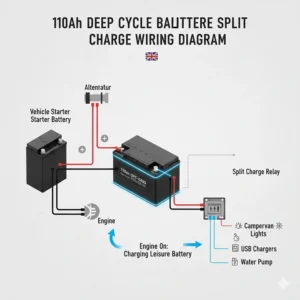
Standard split-charge relays are increasingly outdated. Modern vehicles with “smart alternators” don’t charge leisure batteries effectively using old-school relay systems. A Battery-to-Battery (B2B) charger solves this problem.
According to discussions on UK wild camping forums, a decent B2B charger (like the Victron Orion or Sterling Power systems) can recharge a depleted 110ah battery to 80% in 2-3 hours of driving, compared to 6-8 hours with a basic relay. For frequent movers, this transforms your charging strategy.
Mains Charging: The EHU Advantage
When you do find a campsite with hook-up, proper charging matters. For lead-acid batteries, a multi-stage charger that progresses through bulk, absorption, and float stages maximises battery lifespan. For lithium batteries, you’ll need a lithium-specific charger or one with a lithium profile—standard lead-acid chargers don’t provide the voltage profile lithium batteries require for full charging.
Deep Cycle Battery Maintenance: Making Your Investment Last
Proper maintenance dramatically affects leisure battery lifespan expectations. Here’s what actually matters.
For Lead-Acid/AGM Batteries:
Critical Rules:
- Never discharge below 50% (12.1V at rest). Every deep discharge dramatically shortens lifespan.
- Recharge promptly. Leaving a battery discharged accelerates sulphation, the primary killer of lead-acid batteries.
- Store fully charged. Batteries left discharged will sulphate and may freeze in cold weather.
- Check terminals regularly. Clean any corrosion with a wire brush and protect with petroleum jelly or anti-corrosion spray.
For flooded lead-acid batteries (less common now), check electrolyte levels monthly and top up with deionised water only—never tap water. The Health and Safety Executive provides detailed guidance on battery safety that’s worth reading.
Temperature Matters: A 110ah battery operating at 15°C effectively performs at ~100Ah capacity. At 5°C, that drops to ~90Ah. This explains why winter wild camping drains batteries faster—the cold affects both capacity and charging efficiency.
For Lithium LiFePO4 Batteries:
Maintenance is minimal, but these rules matter:
- Don’t charge below 0°C unless your battery has an integrated heater (like the Eco Tree). Charging a cold lithium battery causes permanent damage.
- Store at 40-60% charge for long periods. Unlike lead-acid, lithium batteries shouldn’t be stored fully charged.
- Use a BMS-compatible charger. The battery management system protects the cells, but it needs appropriate charging voltage and current.
- Monitor via Bluetooth. Check cell voltages occasionally to ensure balanced charging.
According to UK battery regulations covered by GOV.UK battery guidance, all batteries sold must meet safety standards, but proper use remains the owner’s responsibility.
Leisure Battery Lifespan Expectations: What Reality Looks Like
Let’s talk real-world longevity, not marketing claims.
Lead-Acid/AGM Batteries:
Budget batteries (£60-85): Expect 2-3 years or 200-300 cycles with good care, 12-18 months if regularly deep discharged.
Mid-range batteries (£85-110): Typically 3-5 years or 300-500 cycles. Several UK reviewers on Amazon.co.uk mention SuperBatt and Ultramax batteries lasting 4-6 years with solar charging and proper maintenance.
Premium lead-acid: Brands like Yuasa might reach 5-7 years, but you’re paying significantly more for marginally longer life.
What Kills Them:
- Deep discharges below 50% (most common cause)
- Extended storage whilst discharged
- Chronic undercharging
- High temperatures (particularly in enclosed battery compartments)
- Sulphation from standing discharged
Lithium LiFePO4 Batteries:
Expect 8-12 years of active use or 3,000-5,000 cycles. One Fogstar user on UK motorhome forums mentioned their battery showing zero capacity degradation after three years of heavy off-grid use.
The upfront cost stings, but spread over 10+ years of use, lithium often costs less than repeatedly replacing lead-acid batteries every 3-4 years. Plus you get double the usable capacity and half the weight throughout that entire period.
What Kills Them:
- Charging when frozen (without heater)
- Physical damage to cells
- Extreme overcharging (rare with decent BMS)
- Extended storage at 100% or 0% charge
Dual Leisure Battery Setup Guide: Doubling Your Power
Running two batteries in parallel effectively doubles your capacity. Here’s how to do it properly.
Essential Requirements:
- Identical batteries only. Same make, model, age, and capacity. Mixing batteries causes the stronger one to charge the weaker one, reducing lifespan of both.
- Equal cable lengths. Use identical length and thickness cables connecting both batteries to your distribution system. This ensures equal charge/discharge rates.
- Proper connections:
- Connect positive terminals together
- Connect negative terminals together
- Connect your positive load/charge cable to one positive terminal
- Connect your negative load/charge cable to the opposite negative terminal
- This cross-connection helps equalise the batteries
- Adequate charging. Two 110Ah batteries need a charger capable of handling 220Ah. A B2B charger rated 30A minimum is recommended; 50A is better.
Common Mistakes to Avoid:
❌ Connecting batteries of different ages or types
❌ Using undersized cables between batteries
❌ Adding a second battery to “boost” an old failing battery
❌ Inadequate charging system for doubled capacity
One wildcamping.co.uk forum member mentioned fitting two 110ah AGM batteries under their van’s driver seat, providing 3-4 days off-grid in Scottish Highlands with 100W solar panels. The key was upgrading to a 30A B2B charger and using 25mm² cables between batteries.
Choosing Between Battery Types: Making the Right Decision
The lithium vs AGM leisure battery comparison often focuses on price, but let’s consider total cost of ownership and practicality.
Choose Lead-Acid/AGM If You:
- Camp occasionally (weekends, holidays)
- Have budget constraints (~£85-110)
- Already have suitable charging equipment
- Don’t need maximum usable capacity
- Can tolerate 26-30kg weight
- Camp primarily in summer with hook-ups nearby
Best value: SuperBatt LM110 or Ultramax XV31MF offer proven reliability around £85-95.
Choose Lithium LiFePO4 If You:
- Wild camp regularly or full-time
- Need maximum off-grid duration
- Want to minimise weight (crucial for panel vans)
- Plan long-term use (8-12+ years)
- Have high power demands
- Will upgrade charging systems anyway
- Can afford £300-550 upfront investment
Best value: Fogstar Drift 105Ah offers excellent performance per pound spent. For winter camping, consider the Eco Tree with integrated heater.
The Weight Factor:
This genuinely matters for van conversions. Saving 15-18kg switching from lead-acid to lithium means you can carry more water, food, or adventure gear before hitting your van’s weight limits. One vanlife blogger calculated that lithium batteries saved enough weight to add a full week’s extra provisions—genuinely extending their off-grid capabilities.
Winter Wild Camping Considerations
British winters test batteries mercilessly. Here’s what you need to know.
Cold Weather Performance:
- Lead-acid capacity drops ~1% per degree below 25°C. At 0°C, your 110ah battery effectively becomes 85-90Ah.
- Lithium batteries maintain capacity better but cannot be charged below 0°C (without heater).
- Water pumps and fridges work harder in cold, increasing power consumption.
Solutions:
- Insulate your battery compartment (carefully—allow some ventilation for lead-acid)
- Keep batteries inside your heated living space if possible
- Choose lithium with integrated heater for winter use
- Increase capacity—consider 2× 110Ah instead of 1×
One Peak District winter camper mentioned wrapping their AGM battery in an insulated bag with heat-retaining material, significantly improving cold-weather performance. Just ensure adequate ventilation for lead-acid types.
✨ Don’t Miss These Exclusive Deals!
🔍 Take your wild camping adventures to the next level with these carefully selected products. Click on any highlighted item to check current pricing and availability on Amazon.co.uk. These batteries will help you create authentic off-grid experiences your family will love!
Common Wild Camping Battery Mistakes (And How to Avoid Them)
Mistake 1: Buying Based on Headline Capacity Alone A “110Ah” battery isn’t always 110Ah of usable power. Check the C-rating and understand discharge limits. That bargain £60 battery might actually provide less usable power than a £90 quality option.
Mistake 2: Inadequate Charging Systems Pairing a 110ah battery with a basic split-charge relay or tiny solar panel creates constant frustration. Match your charging to your capacity and usage.
Mistake 3: Regular Deep Discharges Running your lead-acid battery flat repeatedly kills it quickly. Monitor voltage and recharge at 50% (12.1V resting voltage). One wildcamping forum member mentioned destroying a new battery in six months through repeated deep discharges.
Mistake 4: Mixing Battery Types or Ages Adding a new battery alongside an old one in parallel creates imbalance. The new battery tries to charge the old one, reducing both their lifespans.
Mistake 5: Storing Discharged Lead-acid batteries left discharged will sulphate and may be permanently damaged. Always store fully charged, ideally on a maintenance charger.
FAQs: Your 110ah Leisure Battery Questions Answered
❓ How long will a 110ah leisure battery last wild camping?
❓ Can I replace my lead-acid leisure battery with lithium?
❓ How do I know when my leisure battery needs replacing?
❓ What size solar panel do I need for a 110ah leisure battery?
❓ Is a dual battery setup worth it for wild camping?
Conclusion: Your Perfect 110ah Leisure Battery Awaits
Choosing the right 110ah leisure battery for wild camping transforms your off-grid adventures from stressful power management to confident exploration. Whether you’re watching the sunrise over the Scottish Highlands, finding tranquillity beside a Welsh lake, or discovering hidden corners of the Lake District, reliable power keeps your adventures comfortable and safe.
For weekend warriors and budget-conscious campers, the SNAPPY Deep Cycle or SuperBatt LM110 deliver excellent value at £85-95. These proven workhorses provide dependable power for occasional wild camping without breaking the bank. Regular wild campers seeking better longevity should consider the Ultramax XV31MF or BulletBatt XV31, which offer 4-6 years of reliable service.
But if you’re serious about extended off-grid adventures, investing in lithium technology changes everything. The Fogstar Drift 105Ah at £300-350 delivers double the usable capacity at half the weight, lasting 10+ years. For year-round wild camping, the Eco Tree 110Ah with integrated heater justifies its £450-550 price tag through genuine four-season capability.
Remember: your leisure battery lifespan expectations depend heavily on how you treat it. Follow proper deep cycle battery maintenance, understand your leisure battery charging systems, and consider a dual leisure battery setup if you regularly spend extended periods off-grid. The difference between a battery lasting 18 months versus 6 years often comes down to proper care and appropriate charging.
Whatever you choose, make sure it matches your actual wild camping style. There’s no point buying a premium lithium battery if you camp twice yearly with hook-ups nearby, just as there’s no sense struggling with inadequate lead-acid capacity if you’re full-timing in a motorhome. Be honest about your needs, your budget, and your commitment level.
Now get out there and find your perfect wild camping spot. With the right 110ah leisure battery powering your adventures, you can focus on what really matters—those spectacular sunsets, that perfect cup of tea, and the freedom of the great British outdoors.
Recommended for You
- Best Elevating Pop Top Roof for SWB Transit Custom 2026
- Rock and Roll Bed vs Pull Out Bed: 7 Key Differences (2026)
- Compact Campervan Kitchen Unit with Sink and Hob: 7 Best Options for UK Van Lifers 2026
Disclaimer: This article contains affiliate links. If you purchase products through these links, we may earn a small commission at no additional cost to you. Prices shown are approximate and may vary.
✨ Found this helpful? Share it with your mates! 💬🤗
