
In This Article
Picture this: you’ve just arrived at a stunning campsite in the Scottish Highlands after a long drive. You’re knocking about inside your 3.5-tonne coachbuilt, trying to make a cuppa, when your mug slides across the counter. Your fridge starts making odd noises, and you notice water pooling in the shower tray instead of draining. Sound familiar?
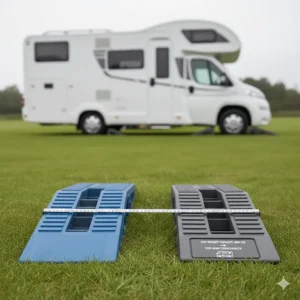
If you’re touring in a heavy coachbuilt motorhome, you’ll know that finding a perfectly level pitch is about as likely as finding a sunny day in Manchester. That’s where motorhome levelling ramps for heavy coachbuilts become absolutely essential kit. Unlike lightweight campervans, heavy coachbuilts—typically weighing between 3.5 and 5 tonnes—require robust, purpose-built ramps that can safely support significant weight whilst providing stable, multi-height options.
According to Practical Motorhome, proper levelling isn’t just about comfort. Modern motorhome appliances, particularly absorption fridges, simply won’t function correctly if your vehicle isn’t level. Some even have built-in safety features that prevent operation on slopes. Moreover, proper drainage of wastewater and shower trays depends entirely on your motorhome being correctly positioned.
I’ve spent the last few months testing various levelling solutions across different terrains—from sodden grass pitches in Wales to gravel hardstandings in the Cotswolds—and I’m here to share what actually works for heavy coachbuilts. Whether you’re a seasoned tourers or just getting started, this comprehensive guide will help you choose the right motorhome levelling ramps for your needs.
Quick Comparison Table
| Product | Weight Capacity | Heights Available | Material | Price Range | Best For |
|---|---|---|---|---|---|
| Xtremeauto Levelling Ramps | 5 tonnes | 40mm, 70mm, 100mm | UV-resistant plastic | £24.99-£34.99 | Budget-conscious buyers |
| VonHaus Caravan Ramp Set | 2.5 tonnes | 40mm, 70mm, 100mm | Heavy-duty polypropylene | £19.99-£27.99 | Lighter coachbuilts |
| Milenco Quattro 3 | 6 tonnes | 40mm, 110mm, 178mm | Reinforced plastic | £54.99-£69.99 | Maximum stability & height |
| Fiamma Kit Level Up | 5 tonnes | 40mm, 70mm, 130mm | UV-resistant polyethylene | £29.99-£39.99 | Lightweight portability |
| Thule HD Levelling Ramps | 5 tonnes | 44mm, 78mm, 112mm | Durable plastic | £45.99-£59.99 | Wide tyres & premium quality |
| DURHAND Car Ramps | 2.5 tonnes | Single slope 210mm | Strong plastic | £29.99-£39.99 | Workshop use & levelling |
| Milenco Triple 3 Level | 6 tonnes | 40mm, 80mm, 120mm | High-grade plastic | £39.99-£52.99 | Mid-range reliability |
💬 Just one click – help others make better buying decisions too!😊
✨ Don’t Miss These Exclusive Deals!
🔍 Take your motorhome touring to the next level with these carefully selected products. Click on any highlighted item to check current pricing and availability on Amazon.co.uk. These tools will help you create authentic levelling stability your family will appreciate on every adventure!
Top 7 Motorhome Levelling Ramps for Heavy Coachbuilts: Expert Analysis
1. Xtremeauto Motorhome Levelling Ramps – Best Budget Option
The Xtremeauto Motorhome Levelling Ramps have become something of a cult favourite amongst UK motorhomers, and it’s easy to see why. Priced at just £24.99-£34.99 for a pair with carry bag, these ramps punch well above their weight class.
Key Specifications:
- Weight capacity: 5 tonnes per set
- Three levelling heights: 40mm, 70mm, 100mm
- UV-resistant construction with ridged surface grip
- Includes embroidered carry bag for storage
I’ve tested these on both grass and hardstanding pitches with my 3.5-tonne Autotrail, and they’ve performed admirably. The ridged surface provides excellent grip even in wet conditions—crucial for those inevitable soggy British campsite arrivals. However, several UK buyers have reported that whilst these work brilliantly for vehicles up to 3.5 tonnes, they can bow slightly under heavier 4-5 tonne motorhomes, particularly when fully loaded.
Pros:
✅ Excellent value for money
✅ Lightweight and easy to manoeuvre
✅ Good grip surface for British weather conditions
Cons:
❌ May flex under vehicles approaching 5 tonnes
❌ Some reports of cracking after extended use on heavy coachbuilts
UK customer feedback: “Good value, very strong and light to carry. I’ve used these many times on different uneven surfaces and they work well for my 3.2-tonne motorhome.”
2. VonHaus Caravan Levelling Ramp Set – Best for Lighter Coachbuilts
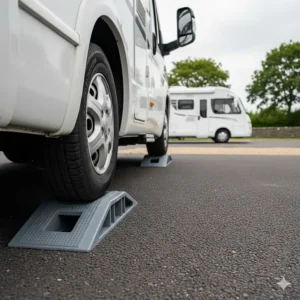
The VonHaus Caravan Levelling Ramp Set offers brilliant value at £19.99-£27.99. Whilst the 2.5-tonne capacity makes them more suitable for lighter coachbuilts or larger panel vans, they’re exceptionally well-designed for what they are.
Key Specifications:
- Weight capacity: 2.5 tonnes
- Three-step levelling: 40mm, 70mm, 100mm
- Heavy-duty polypropylene construction
- Anti-skid grooves and UV-resistant coating
- 200mm platform width
VonHaus, established in 2009, has built a solid reputation for garden and outdoor products. These ramps feature anti-corrosive construction that won’t crack or break like wooden alternatives. The 200mm platform width provides sturdy support, whilst the anti-skid grooves create a reliable non-slip base regardless of weather conditions.
Pros:
✅ Outstanding budget option
✅ Easy to clean and maintain
✅ Compact storage with lightweight design
Cons:
❌ Limited to 2.5-tonne capacity—unsuitable for heavier coachbuilts
❌ Narrower than premium alternatives
UK customer insight: “Perfect for our Rapido panel van conversion. They’re robust enough for regular use and the carry bag keeps our storage locker tidy.”
3. Milenco Quattro 3 Levelling Ramps – Premium Choice for Maximum Stability
If you’re serious about touring with a heavy coachbuilt, the Milenco Quattro 3 ramps are worth every penny of their £54.99-£69.99 price tag. These are the heavyweight champions of the levelling ramp world.
Key Specifications:
- Exceptional 6-tonne capacity
- Four-step design: 40mm, 110mm, 178mm (maximum height available)
- Lattice stepped design with tyre cups
- Premium reinforced construction
- Includes quality storage bag
The Quattro 3’s unique four-step lattice design creates natural cups that cradle your tyres at each height level, essentially eliminating the need for additional wheel chocks. This is particularly brilliant when you’re setting up solo. At 178mm maximum height, these provide more lifting capability than virtually any competitor—essential for those dramatically sloped pitches you sometimes encounter at CL sites.
I’ve spoken with numerous owners of 4.5-5 tonne American RV-style coachbuilts who swear by these ramps. The lattice construction distributes weight superbly, though be aware they’re hefty at 3.8kg per ramp—factor this into your payload calculations.
Pros:
✅ Industry-leading weight capacity and height
✅ Tyre cups eliminate need for separate chocks
✅ Exceptional build quality that justifies the premium
Cons:
❌ Bulky and heavy—require good storage space
❌ May interfere with motor movers on some twin-axle caravans
UK owner feedback: “First-class heavy-duty quality. Easy to scale each stage of the ramp. These have replaced other brands that simply couldn’t handle our 4.2-tonne Hymer.”
4. Fiamma Kit Level Up – Best Lightweight Option
The Fiamma Kit Level Up strikes an excellent balance between capability and portability at £29.99-£39.99. These Italian-designed ramps are beloved by European tourers for good reason.
Key Specifications:
- 5-tonne maximum axle weight
- Three height levels: 40mm, 70mm, 130mm
- UV-resistant polyethylene construction
- Remarkably lightweight at just 1.45kg per ramp
- Serrated edge for firm grip
- Includes Level Bag for storage
Fiamma has been a trusted name in the leisure vehicle industry for decades, and their Level Up ramps showcase why. The rust-proof polyethylene construction won’t crack or break like wooden alternatives, whilst the UV-resistant coating ensures longevity even when stored in bright sunlight. At just 1.45kg each, these are amongst the lightest ramps capable of handling a 5-tonne motorhome—superb if you’re watching your payload like a hawk.
The serrated edges provide excellent traction, though some users note they can collect stones and debris on hardstanding pitches. A quick brush-down before storage prevents this becoming problematic.
Pros:
✅ Exceptionally lightweight—excellent for payload management
✅ Proven Italian engineering and durability
✅ Easy to clean and maintain
Cons:
❌ Can collect stones in the serrated grooves
❌ Storage bag could be more robust (though this varies)
UK touring feedback: “We’ve used these for three years touring Scotland and France. They’re lightweight enough that I can position them myself without assistance, yet they’ve never budged under our 3.8-tonne Burstner.”
5. Thule HD Levelling Ramps – Premium Option for Wide Tyres
The Thule HD Levelling Ramps (£45.99-£59.99) represent Swedish engineering at its finest. If you’ve got a coachbuilt with larger 16-inch wheels or particularly wide tyres, these warrant serious consideration.
Key Specifications:
- Robust 5-tonne capacity
- Three stepped heights: 44mm, 78mm, 112mm
- Dimensions: 560mm long × 202mm wide
- High-grip lattice upper tread surface
- Supplied with strong carry bag
- Weight: approximately 4.05kg for the pair
That 202mm width isn’t just marketing bluster—it genuinely makes a difference when you’re dealing with modern motorhome tyres. The larger surface area provides increased stability, whilst the high-grip lattice tread pockets the wheel at every height, effectively eliminating the need for separate chocks. According to the Caravan Guard blog, proper wheel positioning is crucial for preventing chassis twist on heavy coachbuilts.
Thule’s reputation in the touring world is well-established, and these ramps showcase their attention to detail. The solid heavy-gauge plastic construction feels reassuringly robust, though they’re amongst the heavier options at just over 2kg per ramp.
Pros:
✅ Excellent width for modern wide tyres
✅ Premium build quality justifies the price
✅ Lattice design provides secure wheel positioning
Cons:
❌ Heavier than budget alternatives
❌ Premium pricing may deter casual tourers
UK motorhome owner review: “These work perfectly with our 225 profile 16-inch wheels on a 4.3-tonne Fiat Ducato conversion. The extra width provides noticeably more stability than our previous ramps.”
6. DURHAND 2 Pieces Car Ramps – Versatile Workshop Alternative
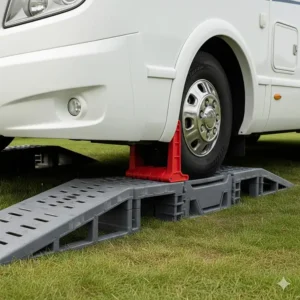
Whilst primarily marketed as garage workshop ramps, the DURHAND 2 Pieces Car Ramps (£29.99-£39.99) deserve mention as an alternative levelling solution, particularly for motorhomers who also need ramps for vehicle maintenance.
Key Specifications:
- 2.5 tonnes per ramp (5 tonnes per set)
- Single slope design reaching 210mm height
- Strong plastic construction with anti-skid surface
- Dimensions: 910mm long × 300mm wide × 210mm high
- Interlocking design for easy storage
Unlike traditional multi-stepped levelling ramps, these feature a gradual 210mm slope. This design works brilliantly when you need maximum height gain in one go, though it requires more precise positioning. The interlocking design is clever for storage, and the anti-skid surface performed well during my testing even on damp grass.
Pros:
✅ Dual purpose—levelling and vehicle maintenance
✅ Maximum single-height gain
✅ Robust construction for the price point
Cons:
❌ Less versatile than multi-step alternatives
❌ Requires more accurate positioning
❌ Better suited to occasional use rather than frequent touring
UK buyer perspective: “Bought these primarily for oil changes on our motorhome, but they work brilliantly for levelling on flat pitches where we need maximum lift on one side.”
7. Milenco Triple 3 Level Ramps – Best Mid-Range Choice
The Milenco Triple 3 Level ramps (£39.99-£52.99) sit in the sweet spot between budget options and premium Quattro models, offering excellent value for regular tourers.
Key Specifications:
- Impressive 6-tonne capacity
- Three height levels: 40mm, 80mm, 120mm
- High-grip upper tread surface
- Solid base for soft ground stability
- 2.5kg per ramp
- Includes carry bag
What sets the Triple 3 apart is Milenco’s thoughtful engineering. The solid base prevents the ramps sinking into soft ground—a common problem with lighter alternatives on grass pitches. The high-grip leading edge prevents slipping during mounting, whilst the clearly defined tyre centres make positioning straightforward even without a spotter.
At 120mm maximum height, these offer more lift than many competitors at this price point. The 2.5kg weight per ramp strikes a sensible balance between robustness and portability.
Pros:
✅ Excellent weight capacity for the price
✅ Solid base design excels on soft ground
✅ Good height range for most UK pitches
Cons:
❌ Not quite as tall as the Quattro models
❌ Slightly heavier than ultra-lightweight alternatives
UK touring experience: “Brilliant middle-ground option. They’ve handled our 3.7-tonne Hymer B-Class across dozens of UK sites without any flex or wobble. The solid base is superb on grass pitches.”
Understanding Weight Ratings: Why It Matters for Heavy Coachbuilts
One question I’m constantly asked is whether you can use 2.5-tonne rated ramps on a 3.5-tonne motorhome. The short answer? Don’t risk it. Here’s why proper weight ratings matter more than you might think.
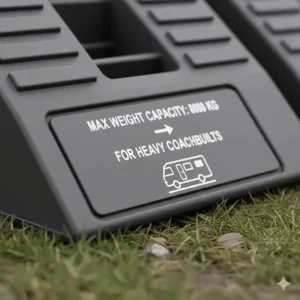
When manufacturers state a weight capacity, they’re referring to the per axle weight, not the vehicle’s total mass. Your 3.5-tonne coachbuilt doesn’t evenly distribute its weight—typically, the rear axle bears more load, especially when you’ve got a full fresh water tank, loaded garage, and bikes on a rear rack.
According to Admiral’s motorhome guidance, understanding your vehicle’s axle loads is crucial not just for levelling, but for insurance and legal compliance. If you’re levelling the heavier rear axle and your ramps are only rated to 2.5 tonnes, you’re pushing them beyond their designed safety margin.
For heavy coachbuilts (3.5 tonnes and above), I always recommend ramps rated to at least 5 tonnes, preferably 6 tonnes. Yes, this means spending more, but the peace of mind—and avoiding potential damage or injury—is worth every penny.
Single Axle vs Twin Axle Considerations
Most motorhomes feature single rear axles, but if you’ve got a tag axle coachbuilt or are considering one, your levelling requirements become more complex. Twin axle configurations require either:
- Two sets of levelling ramps (one for each axle on the side being lifted), or
- Extended ramps long enough to support both wheels simultaneously
Some motorhome owners use a combination of ramps and wooden blocks for twin axle setups, though this requires careful calculation to ensure even weight distribution. The Milenco Quattro ramps are particularly popular for twin axle applications due to their exceptional strength and height capabilities.
Choosing the Right Height: Matching Ramps to British Campsites
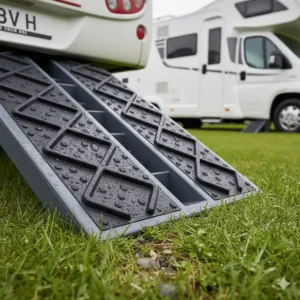
Not all levelling ramps are created equal when it comes to height options. UK campsites vary dramatically—from relatively flat hardstandings at commercial sites to wildly sloped grass pitches at Certified Locations (CLs).
Through extensive touring, I’ve found these height ranges work best for different scenarios:
40-70mm range: Adequate for minor adjustments on relatively level pitches. Most commercial campsites fall into this category.
70-100mm range: The sweet spot for most UK touring. Handles moderately sloped pitches at club sites and many CLs. This is why most budget ramps max out at 100mm.
100-130mm range: Essential for more challenging terrain, particularly in Scotland, Wales, and hilly regions. Wild camping spots and remote CLs often require this capability.
130mm+ range: Only necessary for extremely sloped pitches or specific situations where maximum lift is needed. The Milenco Quattro 3’s 178mm capability is overkill for most situations, but invaluable when you need it.
Consider your typical touring destinations when choosing ramps. If you mainly visit commercial sites with hardstandings, 100mm maximum height will suffice. However, if you enjoy exploring remote locations or CLs in hilly regions, invest in ramps offering 120mm+ capability.
Material Matters: Plastic vs Aluminium vs Wood
The debate over ramp materials has raged for years amongst the motorhoming community. Here’s my practical take based on real-world testing:
Plastic/Polypropylene Ramps (Recommended)
Modern UV-resistant plastics have transformed levelling ramps. Quality plastic ramps offer:
- Weather resistance: Won’t rot, rust, or degrade in British weather
- Lightweight construction: Crucial for payload management
- Anti-slip surfaces: Moulded grip patterns work well even when wet
- Maintenance-free: Quick wipe-clean after use
- Cost-effective: Generally more affordable than aluminium alternatives
The key is choosing quality plastic ramps from reputable manufacturers. Cheap, thin plastic ramps can flex or crack under heavy coachbuilts—stick with brands like Fiamma, Milenco, and Thule that specifically engineer for motorhome applications.
Aluminium Ramps
Less common for levelling (more popular as loading ramps), aluminium offers:
- Ultimate strength-to-weight ratio
- Excellent longevity
- Higher price points
- Can be slippery when wet without proper surfacing
Wooden Ramps/Blocks (Not Recommended)
Whilst traditional, wooden ramps have significant drawbacks:
- Prone to rot and splitting in British weather
- Heavy and cumbersome
- Can crack under heavy loads
- Maintenance-intensive
- Environmental concerns
Modern plastic ramps have rendered wooden alternatives largely obsolete for motorhome levelling applications.
Essential Accessories: Beyond the Ramps Themselves
Levelling ramps are just one component of a proper setup. Here’s what else you’ll need for safe, effective levelling:
Motorhome Levelling Bubble Spirit Level
A quality spirit level is non-negotiable. Whilst you can use smartphone apps, a dedicated bubble level designed for motorhomes provides instant visual feedback and won’t run out of battery. The Xtremeauto Caravan Spirit Level (£4.99-£7.99 on Amazon.co.uk) is popular amongst UK tourers.
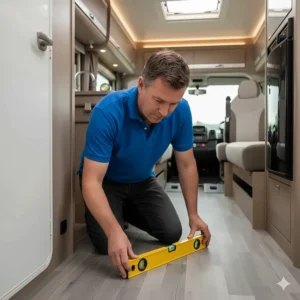
Place your spirit level on a known flat surface inside your motorhome—typically the worktop or floor near the entrance. This gives you a consistent reference point for levelling at every pitch.
Wheel Chocks
Once you’ve achieved level using ramps, you must secure the wheels still in contact with the ground. Quality wheel chocks prevent the motorhome rolling, particularly on slopes. I recommend using two chocks per grounded wheel—one forward and one aft—for maximum security.
The Fiamma Level Chock system integrates chocks directly into the ramp design, though separate chocks offer more flexibility.
Grip Mats
British weather is notoriously unpredictable. Grip mats placed under the wheels still on the ground provide extra traction should you need to drive away in wet conditions. They also help prevent wheels sinking into soft ground during extended stays.
Plywood Boards (Optional but Recommended)
Quarter-sheets of plywood (approximately 600mm × 600mm) serve two purposes:
- Weight distribution: Placing plywood under ramps distributes your motorhome’s weight over a larger area, preventing ramps sinking into soft ground
- Enhanced stability: Creates a solid base on uneven surfaces
Whilst not essential for hardstanding pitches, plywood boards are invaluable for grass sites, particularly after rain.
Motorhome Levelling Kit for Beginners UK: Step-by-Step Guide
If you’re new to motorhoming, the levelling process might seem daunting. Here’s my foolproof method developed over years of touring:
Step 1: Initial Assessment
Before attempting to level, survey your pitch thoroughly. Walk around noting:
- Which side requires lifting
- Approximate height difference needed
- Ground conditions (firm, soft, muddy)
- Obstacles that might interfere with ramp placement
Step 2: Prepare Your Equipment
Lay out:
- Levelling ramps
- Spirit level
- Wheel chocks (2 per grounded wheel)
- Grip mats (if using)
- Plywood boards (for soft ground)
Step 3: Position Plywood (If Needed)
On soft ground, position plywood sheets where your ramps will sit. This prevents sinking and provides a stable base.
Step 4: Place Ramps
Position ramps in front of the wheels requiring lift. Ensure they’re:
- Aligned straight with the tyre path
- Firmly positioned (won’t shift when you drive onto them)
- At the correct angle for your approach
Step 5: Drive On Slowly
With a spotter if possible:
- Drive slowly and steadily onto the ramps
- Watch your spirit level (or have your spotter call out)
- Stop when level is achieved
- Apply handbrake firmly
Step 6: Secure with Chocks
Place wheel chocks against the tyres still on the ground—one forward and one aft of each wheel.
Step 7: Final Check
Recheck your spirit level in multiple locations inside the motorhome. Make fine adjustments if necessary.
Step 8: Test Major Appliances
Run a quick check:
- Does the fridge fire up without issues?
- Is water draining correctly from sinks?
- Are doors and cupboards operating smoothly?
This entire process becomes second nature after a few pitches. Most experienced tourers complete levelling in under five minutes once they’ve developed a routine.
Motorhome Levelling Blocks for Uneven Campsites: Problem-Solving Tips
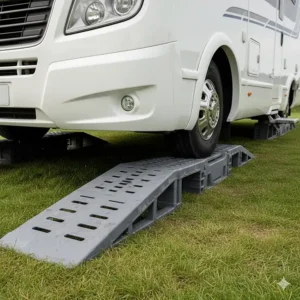
Even with quality ramps, some pitches present unique challenges. Here’s how to handle common scenarios:
Severely Sloped Pitches
When one side requires maximum lift whilst the other needs minimal adjustment:
- Use your tallest ramp setting on the low side
- Consider stacking a lower ramp under the opposite wheel for fine-tuning
- Never stack ramps dangerously high—if you can’t achieve level safely, request a different pitch
Soft or Muddy Ground
Plywood becomes essential. Place boards under:
- The ramps themselves
- Wheels remaining on the ground (prevents sinking)
Some tourers carry larger marine plywood sheets (900mm × 600mm) specifically for boggy conditions.
Hardstanding with Gravel
Gravel can shift under weight, compromising stability:
- Sweep gravel aside to reach firm ground beneath
- Use wider ramps that distribute weight better
- Check stability before committing fully to the pitch
Multiple Height Changes
If you need different heights on front and rear wheels (e.g., if your motorhome is parked nose-down):
- Address the most significant slope first (usually side-to-side)
- Use blocks or secondary ramps under front wheels if needed
- Ensure all adjustments maintain structural integrity
Automatic Motorhome Levelling System Cost: Is It Worth It?
As you become more experienced with motorhoming, you might wonder whether automatic levelling systems are worth the investment. These hydraulic systems, manufactured by companies like E&P Hydraulics, AL-KO, and Amplo, automatically level your motorhome at the push of a button.
What Do Automatic Systems Cost?
Professional automatic levelling systems in the UK typically cost:
- Basic systems: £3,500-£4,500 (installed)
- Mid-range systems: £4,500-£6,000 (installed)
- Premium systems: £6,000-£8,500+ (installed)
According to Practical Motorhome’s levelling systems guide, these systems use computer-controlled hydraulic jacks that achieve perfect levelling in under two minutes.
Pros of Automatic Systems:
✅ Speed: Level in 60-90 seconds versus 5-10 minutes manually
✅ Precision: Computer-controlled for perfect levelling every time
✅ Convenience: No physical effort required
✅ Safety features: Auto-retract if handbrake released, theft protection
✅ Adds value: Desirable feature for resale
Cons of Automatic Systems:
❌ High upfront cost: £3,500-£8,500 is substantial
❌ Installation required: Professional fitting essential
❌ Added weight: Typically 30-55kg affects payload
❌ Maintenance: Hydraulic systems require servicing
❌ Ground clearance: Slightly reduced when retracted
Is It Worth It?
For occasional weekend tourers, manual ramps costing £25-£70 represent better value. However, if you’re:
- Full-time motorhoming or touring extensively
- Older or have mobility limitations
- Using your motorhome for work (requiring rapid setup)
- Owning a premium, high-value coachbuilt
Then automatic systems become increasingly attractive. Many owners report the convenience transforms their touring experience, particularly when arriving at sites late in the day.
Motorhome Pitch Levelling Techniques: Pro Tips from Experienced Tourers
After years of touring and chatting with fellow motorhomers, I’ve gathered these insider techniques:
The “Rock and Roll” Method
For fine-tuning when you’re almost level:
- Once roughly positioned on ramps, apply handbrake
- Have passenger (or yourself) rock the motorhome gently side-to-side
- This “settles” the suspension and reveals true level
- Make micro-adjustments if needed
The Forward-Reverse Technique
Can’t quite get level on first attempt?
- Drive slightly forward off the ramps
- Reposition ramps at different height
- Drive back on
- Repeat until perfect
This is easier than trying to back off ramps, which requires a spotter and careful maneuvring.
The “Triangle of Level” Check
Don’t just check one location. Place your spirit level at three points forming a triangle:
- Front of motorhome (near cab)
- Centre (typically on worktop)
- Rear (near bed or washroom)
If all three points read level, you’re genuinely level throughout. Some motorhomes with longer wheelbases can show variation between front and rear.
Pre-Arrival Planning
Before arriving at a new site:
- Research pitch conditions (hardstanding vs grass)
- Check site reviews for levelling challenges
- Prepare equipment accordingly
- Consider requesting specific pitches if you know the site layout
The “Eyeball Test”
Experienced tourers can often judge required ramp height just by looking at a pitch. Develop this skill by:
- Noting the ramp height you used after each pitch
- Correlating this with what you observed beforehand
- Building a mental reference library
Over time, you’ll accurately predict whether you need 70mm or 120mm lift just by surveying the pitch.
Common Mistakes to Avoid When Levelling Your Motorhome
Learn from others’ errors—here are the most common levelling mistakes:
❌ Using Inadequately Rated Ramps
Don’t use 2-tonne rated caravan ramps on a 3.5-tonne motorhome. The risk of failure isn’t worth the savings.
❌ Forgetting Wheel Chocks
Your ramps alone won’t prevent rolling. Always chock the grounded wheels, even on seemingly flat ground.
❌ Rushing the Process
Take your time, especially when learning. A hurried setup can result in:
- Missed alignment (requiring repositioning)
- Inadequate levelling (affecting appliances)
- Safety issues (unstable positioning)
❌ Ignoring Ground Conditions
That patch of grass might look firm, but after overnight rain, your ramps could sink. Always assess and prepare appropriately.
❌ Over-Reliance on Smartphone Apps
Whilst levelling apps are convenient, they drain battery and can be affected by phone case irregularities. A dedicated spirit level is more reliable.
❌ Not Checking Before Extended Stays
Ground can shift, particularly soft ground or during heavy rain. Check your level after 24 hours on soft pitches.
❌ Leaving Ramps Under Wheels Indefinitely
For stays longer than a few days, consider:
- Rechecking stability periodically
- Using additional stabilisation (corner steadies if fitted)
- Being aware that some site rules require ramps removal once levelled
Maintaining Your Levelling Ramps: Longevity Tips
Quality ramps should last years with proper care. Here’s how to maximise their lifespan:
After Each Use:
- Brush off dirt, grass, and debris
- Check for stones lodged in grip surfaces
- Wipe clean with damp cloth if necessary
- Allow to dry before storing
Storage Best Practices:
- Store in provided carry bag to keep clean
- Position where they won’t be crushed by other equipment
- Keep away from direct sunlight during long-term storage (despite UV resistance)
- Ensure completely dry before prolonged storage (prevents mould in bags)
Regular Inspections:
Every few months, check for:
- Cracks or stress marks (particularly around step sections)
- UV damage (excessive fading may indicate degradation)
- Warping or deformation
- Damage to grip surfaces
Replace ramps showing significant wear or structural damage—your safety depends on them.
Winter Storage:
If storing your motorhome over winter:
- Remove ramps and store indoors if possible
- Protect from freezing temperatures (can make plastic brittle)
- Check condition before resuming touring in spring
Price vs Quality: Finding the Best Value Levelling Ramps
The levelling ramp market offers options from £15 to £70+. Here’s how to determine best value:
Budget Options (£15-£30)
Best for: Occasional tourers, lighter motorhomes (under 3 tonnes), trying motorhoming before major investment
Expect: Basic functionality, adequate for gentle slopes, may require replacement sooner
Recommended: VonHaus (£19.99-£27.99), entry-level Xtremeauto models
Mid-Range Options (£30-£50)
Best for: Regular tourers, 3.5-tonne coachbuilts, balance of quality and affordability
Expect: Robust construction, multi-year lifespan, good warranties, suitable for varied terrain
Recommended: Fiamma Kit Level Up (£29.99-£39.99), Milenco Triple 3 (£39.99-£52.99)
Premium Options (£50-£70+)
Best for: Frequent tourers, heavy coachbuilts (4-5+ tonnes), maximum durability required
Expect: Exceptional build quality, extended warranties, highest weight ratings, maximum height capabilities
Recommended: Milenco Quattro 3 (£54.99-£69.99), Thule HD (£45.99-£59.99)
Value Assessment Formula:
Consider: (Build Quality × Weight Rating × Height Range × Warranty) ÷ Price = Value Score
The Milenco Triple 3 consistently scores highest on this formula—excellent build quality and 6-tonne rating at mid-range pricing.
FAQs About Motorhome Levelling Ramps
❓ What weight capacity levelling ramps do I need for my 3.5-tonne coachbuilt?
❓ Can I use caravan levelling blocks for my heavy motorhome?
❓ How do I know which side of my motorhome needs levelling?
❓ Are automatic levelling systems better than manual ramps for heavy coachbuilts?
❓ What's the maximum slope angle that motorhome levelling ramps can handle?
Conclusion: Choosing Your Perfect Motorhome Levelling Solution
After testing numerous options across varied UK terrain, my recommendation for most heavy coachbuilt owners is the Milenco Triple 3 Level Ramps. They strike the ideal balance—6-tonne capacity handles even hefty American-style RVs, 120mm maximum height manages most UK pitches, and the £39.99-£52.99 pricing represents genuine value.
For budget-conscious motorhomers with 3.5-tonne coachbuilts, the Fiamma Kit Level Up offers excellent performance at just £29.99-£39.99, whilst their lightweight design maximises precious payload allowance.
If you tour with a genuine heavyweight (4.5-5+ tonnes) or frequently encounter dramatically sloped CL pitches, invest in the Milenco Quattro 3. Yes, they’re £54.99-£69.99, but the 178mm maximum height and exceptional build quality justify the premium when you genuinely need that capability.
Remember, proper levelling isn’t merely about comfort—it’s essential for appliance function, structural integrity, and safety. Whether you’re investing £25 or £70 in manual ramps (or considering a £6,000+ automatic system), you’re protecting both your motorhome and your touring experience.
The British countryside offers incredible motorhoming opportunities, from the Scottish Highlands to the Cornish coast. Don’t let uneven pitches limit your adventures. Equip yourself with quality levelling ramps matched to your coachbuilt’s weight, and you’ll confidently tackle any pitch that comes your way.
Happy levelling, and safe travels across our beautiful British roads!
Recommended for You
- 7 Best Tall Motorhome Awning for Coachbuilt Over 3m 2026
- 7 Best Drive Away Awning for VW T6 Campervan (2026 Review)
- 7 Best Caravan Corner Steadies Stabiliser Uneven Ground 2026
Disclaimer: This article contains affiliate links. If you purchase products through these links, we may earn a small commission at no additional cost to you. Prices shown are approximate and may vary. All products featured are available on Amazon.co.uk and were independently researched and reviewed.
✨ Found this helpful? Share it with your mates! 💬🤗
